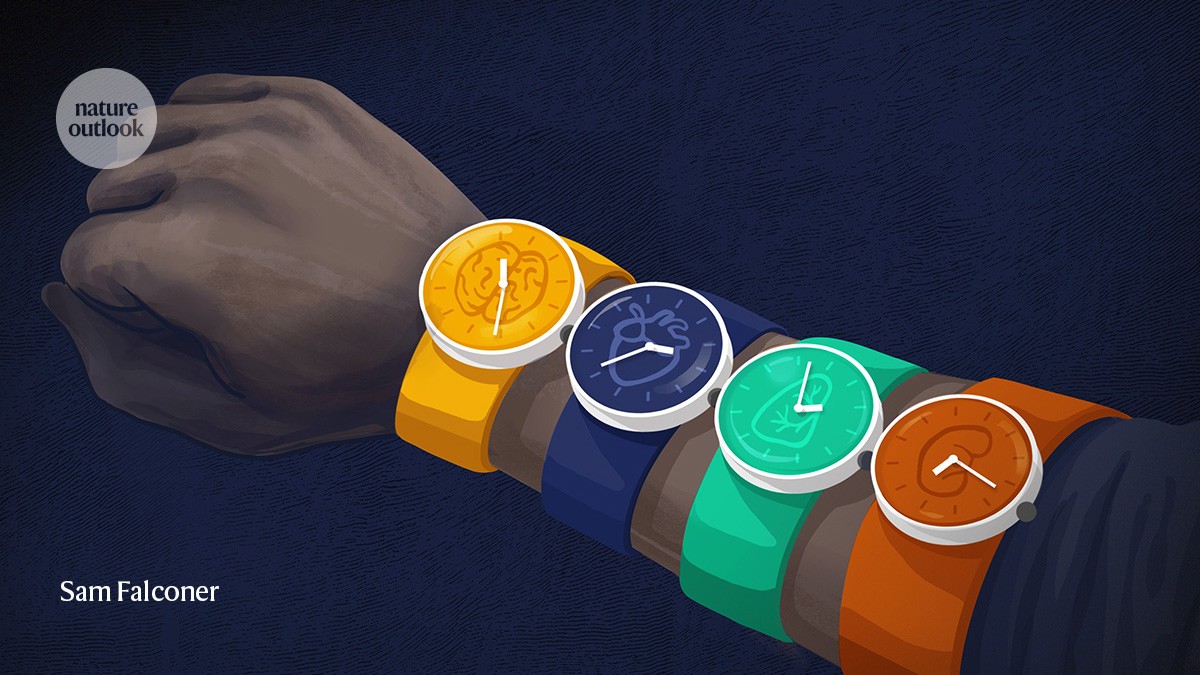
Turning back time with epigenetic clocks
If biological ageing can be slowed, halted or rewound, are the machine-learning algorithms the best way to measure it? Some experts are unconvinced.
nature.com
166 points · by Brajeshwar · 4y ago · 88 comments
Ageing is relative to a starting point and the variability between people in terms of phenotype is huge.
By way of analogy, would it be possible to come up with a universal measure of ageing for cars? Cars are a complex system made of thousands of components, each of which can age differently over time. Each car make and model will age in a different way. Some of the components even slightly improve in performance over time as they “break in”.
The best way to measure epigenetic ageing is relative to a starting point. There are few studies that follow the same people over time (longitudinal) because it’s difficult and expensive to pull off. We’ll eventually get there though.
- The accuracy of current epigenetic clocks suggests it might not be a dead-end with average error of 2-3 years, across multiple tissues (and even Chimpanzees).
- The variability of an aging phenotype is not that high. We all loose bone density, loose teeth, hair turns white, memory degrades, wrinkles appear, etc. In other words - aging follows a pattern.
- The car analogy assumes that aging is caused by damage over time. But there is an alternative explanation: aging provides and evolutionary advantage for a species and hence is predetermined.
People age at different rates depending on a wide variety of factors.
Progeria, over consumption of alcohol, too much stress, too much radiation from sunlight, etc.
The things you point to are measures of a biological age, not a wall clock age. While they do correlate, they're not 1:1. Some people age faster.
> But there is an alternative explanation: aging provides and evolutionary advantage for a species and hence is predetermined.
I don't buy this. We don't have a pre-programmed death. It's rather that we haven't had any genetic pressure to live beyond our current lifespan as it doesn't increase our offspring's chances of success.
There's little pressure from competing with children for resources. Look at how many people there are in the world today - the world supports billions of humans. There are far greater pressures being exerted in other ways.
Also, whatever we think about these epigenetic clocks, there are few things to come to terms with: 1) they work across pretty much all individuals (and people with progeria do exhibit older epigenetic age [1]) 2) they work across pretty much all tissues. I don't see how this could be explained through "damage over time". The way I see it damage should be random and not lead to something so predictable that we could use it to guess a persons chronological age with 2.5 year accuracy.
It might even be that death provides selective advantage(s), which would account for its being a nearly universal feature of known life. A "pre-programmed death" mechanism would be consistent with this.
Note: This is completely outside my expertise, so make of that what you will.
The source of all this is perhaps the suprachiasmatic nucleus which is important to perceiving the passing of time and emits growth hormone releasing hormone which signals the pituitary to make growth hormone.
It's a great example, but if anyone wanted to know more, it's spelled progeria.
[1] - https://www.sciencedirect.com/science/article/pii/S221112471...
Not universal or at least not easily or affordably. I can test each critical component and get a pretty good idea how much stress that component has been exposed to. Maybe the same could be done with mammals and we just test the critical components to get some numbers then apply a rough estimate of a score. Then perhaps a formula can be applied to the set of scores from all the critical components to assign a health score. I am considering the concept perfect is the enemy of good in this case.
I think these biological age scores are a really healthy way to debate and create broader awareness about a) how our bodies work and b) how we understand aging.
It's also worth nothing that another study shaved "3.2 years" off the "epigenetic clock" simply with lifestyle changes over 2 months. [1]
https://en.wikipedia.org/wiki/Disposable_soma_theory_of_agin...
The study itself says:
During the first week of the trial, rhGH alone (0.015 mg/kg) was administered to obtain an initial insulin response, and during the second week, rhGH was combined with 50 mg DHEA to evaluate insulin suppression by DHEA alone. During the third week, the same doses of rhGH and DHEA were combined with 500 mg metformin. Beginning at the fourth week, all doses were individualized based on each volunteer's particular responses.[1]
So the meds in question are:
- recombinant human growth hormone (rhGH) [2]
- dehydroepiandrosterone (DHEA) [3]
- metformin [4]
If you wanted to have this treatment for yourself, how could you proceed? I assume that it would be just about impossible to convince your family doctor to prescribe this drug regimen for you? If you were to do-it-yourself, what would be the best way? It seems that metformin is widely available but I don't know about the availability and cost of rhGH and DHEA.
[1] https://onlinelibrary.wiley.com/doi/full/10.1111/acel.13028
[2] https://en.wikipedia.org/wiki/Growth_hormone_therapy#Recombi...
Of course, doing research is hard. Because it isn't really research in the sense of running a legitimate study, it's research in the sense of studying the work of others as an outsider.
Personally, I like Dr Brad Stanfield. https://www.youtube.com/c/DrBradStanfield
He's not afraid to reverse positions, he's articulate, he calls out when research is or is not compelling and explains why.
Again, personally, I expect the number one thing you can do to improve your healthspan is probably focus on what you can stop putting in your body vs what things you can add. If you're 40+ though, might be worth looking at other options.
As for human growth hormone, this Huberman Labs podcast advises against taking it but also offers many natural ways you can boost it[0].
It is used to counteract the effects of HGH on insulin levels. HGH increases insulin levels, which is known to be deleterious to the organism, and metformin serves to reduce them back.
https://www.youtube.com/c/DrBradStanfield
There is evidence that Metformin doesn't extend the life of healthy people but does extend the life of Type II diabetics.
https://www.youtube.com/watch?v=iByaqfmWfHQ
I would also caution HGH for men since it can enlarge the prostate gland.
David Sinclair had mentioned in a podcast that we use to be cold and hungry and now we're warm and fat all the time. Need to be cold and hungry more often.
https://www.youtube.com/channel/UCwD5YYkbYmN2iFHON9FyDXg
Peter Attia has said that the number one thing he believes will extend healthspan/lifespan (if you did nothing else) is exercise. He wish he could prescribe as a medication.
[1] https://www.youtube.com/channel/UCT1UMLpZ_CrQ_8I431K0b-g
‘… life expectancy in the mid-Victorian period was not markedly different from what it is today. Once infant mortality is stripped out, life expectancy at 5 years was 75 for men and 73 for women.’[1]
[1]-https://www.ncbi.nlm.nih.gov/pmc/articles/PMC2625386/
[2]-https://www.bbc.com/future/article/20181002-how-long-did-anc...
[3]-https://www.sapiens.org/biology/human-lifespan-history/
Edit - sources ordered incorrectly.
What Sinclair hypothesizes that the reason behind the phenomena they see is that these adverse conditions trigger mechanisms in our body that are beneficial in the long term. And the very reason might be to try to make up for what causes the the lower life expectancy. Not knowing much about the topic and the mechanism, my other thought was that it tries to slow your ageing so that you can be fertile for longer in a bid to be able to reproduce when the rough times are over.
So the idea is to kick in the protective mechanisms but still cause no real damage. Similarly to how you're better off eating less than what the average person does in any obese society. Even though their life expectancy is still higher than what it was 500 years ago.
It sounds like to me the method is eat once a day and get in the best physical condition possible from working out. Beyond that, I am just not going to stress about it. Surely, not going to take any reverse risk with HGH or experimental drugs.
DHEA: available over-the-counter in the US
rhGH: go to your local gym and ask the biggest guy
Wow, no. Just... No. It doesn't.
That is so wrong that, from a researcher with a doctorate in biostatistics, it's very difficult not to infer deliberate misinformation on their part. To give some benefit of the doubt though, maybe it was just a very poor choice of words.
Statistical significance with 9 samples is suggestive at best. It just barely qualifies as a pilot study.
They even say that significance means there's a large effect, which again... No.
Significance in small sample indicates practically nothing by itself. What was the actual effect size? Though even at 0.8, with 9 samples I would be be very cautious in my optimistic.
He doesn't have to make an argument from logical implication, there are perfectly good measures of effect size he could use that would allow him to say something like "not only was this statistically significant but it demonstrated a large effect size as well."
My hope is he said something like "We not only saw a P value of < 0.04 but a Cohen's D of 0.7." and then the reporter was like, "yeah I'm gonna need you to dumb that down for our readers"
We don't really know the context for that statement. The journalist could have easily misunderstood something and used quoted him in a totally wrong context.
After a few weeks of taking it my T levels were below average and free-T levels were that of 100 year old men. This was a huge drop from the above average levels, for men in 20s, that I usually have.
Biomarkers of aging and epigenetic clocks[1]
Description: The biology of aging, rapamycin, and other interventions that target the aging process.
If they can get the price of the measurement low enough (which Sinclair claims to happen soon), then we can just wait and see: by doing a large number of measurements we'll have people who end up dying pretty quickly. (Yet another way to do it would be just to collect a large number of samples and measure those who die and compare it with some who do not, during the experiment.)
People start deteriorating in these parameters long before they develop actual life threatening diseases.
If it happens soon, the Putin situation could get weird.
This is not how it panned out in Cuba, China, North Korea, Venezuela, etc.
> He stresses the importance of reporting negative results, and determining whether all treatments that extend lifespan or improve late-life functionality decrease epigenetic age — as well as whether all interventions that decrease clock scores increase longevity.
This is it, test the theory properly in mice. Forget doing poorly designed human trials until then.
The way I see it, you’re burning something like (6/30)/2 = 10% of your quality-adjusted life years. Fasting had better increase lifespan by 7-8 years to be even close to worth it