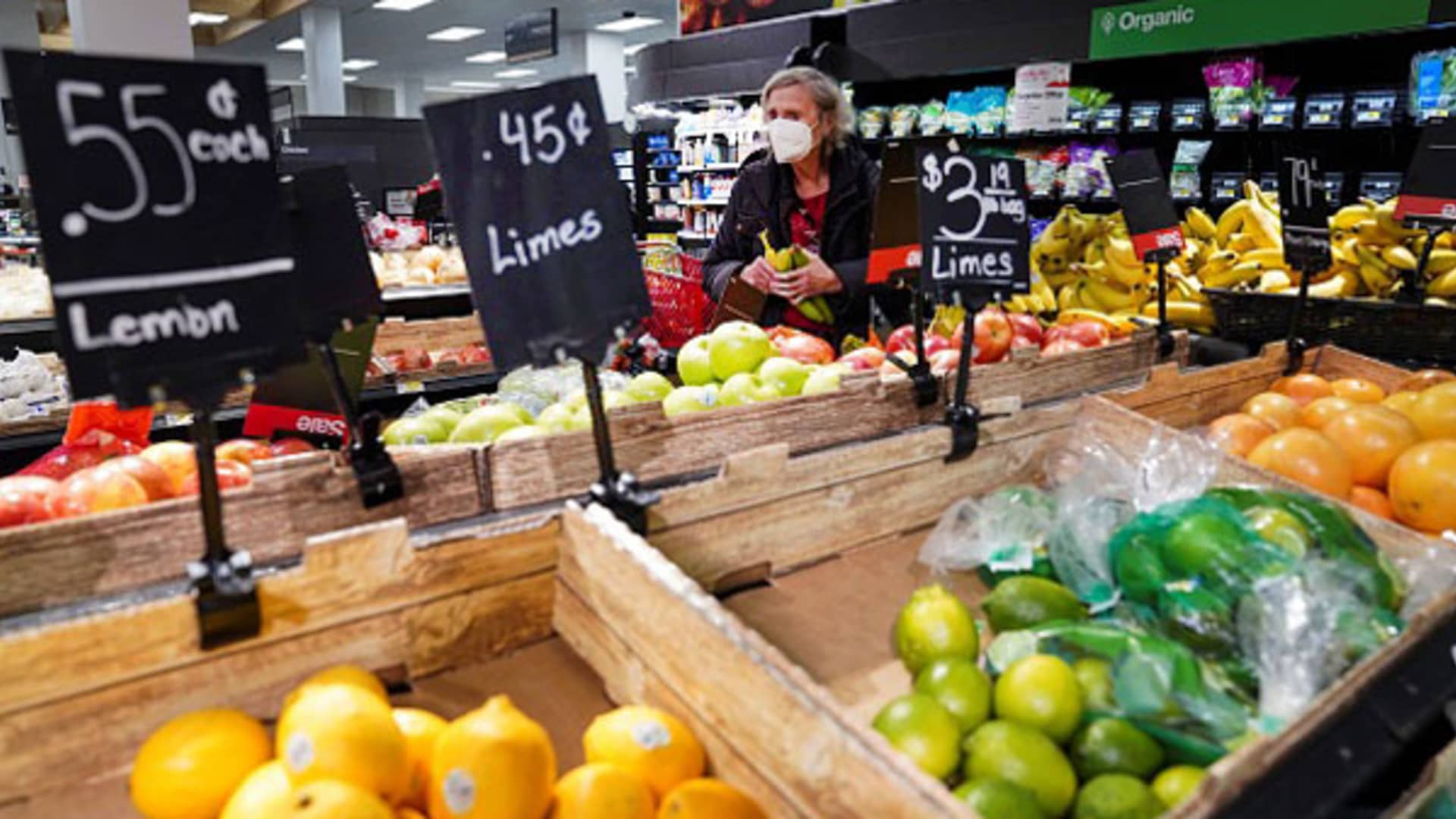
Inflation surges 7.5% on an annual basis, even more than expected and highest since 1982
The consumer price index was expected to increase 7.2% from a year ago, according to a Dow Jones economist survey.
CNBC
122 points · by koolba · 4y ago · 211 comments
And, I can understand that coming from the Whitehouse, after all it’s a political liability… but news organizations, economists, journals, Twitter, publications… as if they all just joined a narrative to wish something untrue.
There is no “fourth estate”. That looks to have been a myth to perpetrate unwarranted prestige.
https://www.bls.gov/news.release/pdf/cpi.pdf
It's more complicated than the headline number. There's a lot of big numbers that are clearly demand/supply issues. Like energy being up 27%, furniture up 17%, used cars up 40.5%, and so on. If I'm doing my math right, that 40.5% increase in used car prices is responsible for 1.6% of the head line number (40.5% * 4.1% weighting). Meaning, if we ignore the increase in used car prices the headline number would be 5.9% instead of 7.5%.
The economy is still reeling from covid and settling on what a "new normal" looks like.
In a functioning economy the supply of cars, houses, and furniture etc. would rise to meet the demand preventing a price increase. But they can't due to chip shortages, labor issues, and other assorted supply chain issues. It's a different problem than inflation and requires different solutions.
It also contradicts the "If you didn't get a 7.5% raise you got a paycut" narrative because it's very dependent on what you bought. If you're trying to buy a house, put furniture in it, and get a new to you used car then things got way more expensive. If you already had those things then it didn't.
That would be true if we were talking about new cars, but apparently the big rise is in used ones. That is likely due to a combination of factors, with liquidity being only one of them - the others are scarcity from the supply side due to covid, and the sector trying to push a new technology (electric) on masses of conservative consumers.
If you believe they'll be able to get back to normal numbers in the next 12 months, you believe inflation will largely go away, maybe even before the midterms
At least wrt cars, isn’t the knock-on pandemic effect by far driving the shortages? (Chips, disruptions in just-in-time, etc) rather than people have more money to spend on them?
> Person: My friend was shot!
> Expert: No, he had his heart stop beating. Stop being so uneducated™ and get your information from places that dont spread disinformation™.
> Person: But he is dead!
> Expert: Stop being so racist and anti-science. All the experts agree that his heart is just transitionally not beating. People dying would make us look bad and that is not the case here!
That is how I see the current conversation about inflation. You're supposed to ignore reality and parrot some dumb talking points. A lack of supply and increase in money IS THE LITERAL DEFINITION of inflation. I don't care about technicalities about gas prices and supply chain. If my money cant buy as much stuff as last year, that is inflation.
- housing
- health insurance
- childcare
Those have not gotten much more expensive (our health insurance got cheaper this year, housing is flat, childcare had a modest increase). Meanwhile gas for the vehicles costs much more, but comparatively fuel is a minor expense. When we weigh everything for our household, 7.5% seems high.
They aren't. Food, apparel, medical care commodities, and non-energy services are up less than the overall amount. The things that are up more just get mentioned more because big numbers are newsworthy, small numbers aren't.
[1] https://www.bls.gov/charts/consumer-price-index/consumer-pri...
[2] https://www.bls.gov/cpi/tables/relative-importance/2020.htm
> "The used cars and trucks index rose 1.5 percent in January, a deceleration from the 3.3-percent increase reported in December." (from your link)
It's good to see that this is slowing down. I was curious so I took it upon myself to gather a few links[0][1][2] with statistics on U.S. and global auto production. I wanted to know what the "old normal" looked like, what kind of drop in production is required to trigger this kind of inflation, and how close we are to getting back to normal. In short, my answers were our manufacturing numbers have been on a slow, steady decades long decline for some time now anyway[0] so I guess it depends on your level of pessimism, a 16-17% drop overall[1] (coincidentally about the same worldwide)[2], and about halfway back to normal but progress is slow and inconsistent[0]. Everything blew up in March 2020, somehow managed to snap back to normal temporarily in July 2020, and finally proceeded to spend the rest of 2020 and all of 2021 on an increasingly bleak rollercoaster that is just now beginning to rebound (hopefully).
[0]https://tradingeconomics.com/united-states/car-production [1]https://www.goodcarbadcar.net/usa-auto-industry-total-sales-... [2]https://www.oica.net/category/production-statistics/2020-sta...
If we had high persistent inflation, we would expect long term, consistent increases in prices. This is compared to "normal" persistent inflation, which we typically target around 3%. This target is set by the Fed.
If we wanted, we could target 10% inflation on a persistent basis by using monetary policy that was deliberately inflationary.
The argument being made by the government and by the media is that our current inflation (40% for cars, etc) that weighs out to 7.5% is the result of a supply/demand shock, and which must be resolved by working out these short term market inefficiencies/failures.
There are real arguments for monetary inflation (especially wrt asset inflation), but the fact that cars are up 40% and housing vacancy rates are so low and our supply chain is so backed up makes a very tangible case for us being in a transitory period of inflation which can not be dramatically improved by monetary or fiscal policy.
To use a ridiculous example, let's say the problem was a surge in the price of Christmas trees. One solution to the problem is to change central bank policy; a second solution is to do nothing and wait until December 26th. Clearly the price increase is caused by demand/supply issues, but it's possible to think more deeply about what's causing the demand and supply and come up with different prescriptions for how to deal with it.
Whether you want to apply that to our current situation or not, demand/supply applies to dollars as much as anything else.
A popular theory was that rental car companies will dump their inventory, there'd be a glut of used cars, and both used and new car prices would crash as a result.
They overlooked that eventually demand would return and those empty inventories would have to be refilled at a time that was just 12-24 months removed from massive decreases in production. And that it'd correlate with every other industry scrambling for supplies and transportation at the same time.
This too shall pass.
The prices of _all_ of my hobbies have gone up quite a bit over the past year or so. It seems to be consistent that discretionary/luxury goods are increasing in price significantly faster than the CPI.
Your best bet would be to pick 5-15 uncorrelated assets and spread you investment over those assets and just wait. This would simply be to reduce risk.
The next question is whether this is a one time bump or systemic? 10% inflation once is one thing, 10% inflation continuously is a completely different thing.
It's very important to get this right, because the only real antidote to inflation is recession. Raising interest rates and raising taxes will stop inflation, but kill the economy. Recession is preferable to stagflation, but nothing else.
And remember there are two sides to the political machinations at work here. A good recession will guarantee that the Republicans take the White House in 2024.
Why is this inevitable?
Investment in US tight oil is stagnating, OPEC+ lacks either the desire or capability to increase production, Venezuela's production capacity is still terrible, and rumors are getting quite loud that Ghawar has finally peaked.
EV sales are still far less than 50% of total sales, so net global fuel demand will continue to increase in the face of tight supply.
Barring another severe COVID variant outbreak, I don't see fuel prices declining anytime soon.
And the cool thing about energy prices is they feed forward into the cost of literally everything else in future PPI/CPI prints.
But the biggest factor is that the cost of renewable electricity is dropping fast. And to many industries, they are imperfect substites, so the price of electricity and gas are correlated.
> And the cool thing about energy prices is they feed forward into the cost of literally everything else in future PPI/CPI prints.
Exactly, which is why the forthcoming massive drop in electricity costs has me so excited.
That's not “the preferred term” for what you are responding to (whether it is transitory), but an orthogonal concern.
Yes, they would have preferred using a term that would make them look less foolish.
The political machinations you're touching on are a really disgusting reality of our system. People would love to sacrifice the middle and lower class for the sake of having their party in power.
https://thehill.com/blogs/in-the-know/in-the-know/456942-bil...
Edit since I'm getting downvoted, this did happen, and it's gross to see, regardless of what political side you support. I don't want a recession to happen even if my preferred party isn't in power. The people at the bottom are the biggest losers when recessions happen, even if most of the users on this board are largely insulated from the fallout.
Wealth comes from technological innovation improving productivity, not turning on the money printer
Obviously there’s some bias there in regards to ranking (as inflation is a highly charged topic so these articles were probably popular for months), but it seems clearly false that media has taken as fact that inflation will be transitory
Thing is, the recent volatility in inflation is a bigger concern than the actual average number (which is still within historical ranges), and also harder to address via policy responses. 7.5% is a bit scary but it's also just the latest residual. We'd like some more meaningful data before we can tell just how much of this is noise. (AIUI, market forecasts also reflect this outlook: sure, they're up, but not that far up.)
Please do understand that probably half the US and much of the world live paycheck to paycheck. They consume everything they earn and zero out at the end of the month. A 7.5% increase in costs isnt necessarily matched by an increase in pay...so that means a lot of pain.
I realize that as technologists, many of us barely consume everything we earn because many of us earn way above average, but that isnt the average reality for people.
Inflation is still mostly doe to energy prices. You get sustained inflation only after inflation expectations become self sustaining: prices up -> wages up -> prices up -> wages up
Where? The first couple months of high inflation numbers there was some of that, but while reactions against it as if it were common remain frequent, it doesn't seem anyone is saying it anymore.
> And, I can understand that coming from the Whitehouse
The White House isn't saying that, in fact it's leaning on present inflation as a reason to pass it's legislative priorities.
> but news organizations, economists, journals, Twitter, publications
Major ones of all of those also seem to not be saying it.
https://www.google.com/search?q=inflation+is+transitory&biw=...
the only way to fight inflation is to raise interest rates, but since the fed is only now in the next month or so ceasing buyback operations for bonds, its hard to imagine theyll have the momentum within the year to stop the quantitative easing binge thats left the US (and the world) with a corporate credit bubble.
tl;dr its here to stay. raising the prime interest rate is the only way to really combat stagflation, but the fed cant do it without triggering a corporate credit crisis.
We are however in February now, and people are still not back in offices, demand for consumer goods vs services is still much higher than pre pandemic, China is shutting down some of the biggest ports in the world for weeks on a moments notice, and supply chain issues abound.
The bigger issue now is how many of these factors simply represent a new normal.
Powell/GS has promised it is transitory and so has President Biden. The fact that you are paying more for everything now is just temporary. Soon things will be back to normal, especially after we embrace the new green deal and approve the 3 trillion $$$ stimulus. It's different this time, Powell has the ability to create trillions with the snap of a finger and buy all the US Government debt indefinitely.
Good job inventing a strawman and then knocking it down with sarcasm.
No one, Powel/GS/Biden et. al, is talking about deflation in the next 5 years
Not even once Rs take the house and the Green New Deal is doomed forever and ever. Not even that will bring deflation, sorry to burst your bubble
Revenue 20.95B +6.12% Net income 4.22B +9.57% Diluted EPS 1.66 +12.93% Net profit margin 20.15% +3.23%
During the last year they have paid ~3% dividend on top of buying back billions of stock (https://ycharts.com/companies/PG/stock_buyback), in Q4 they increased their buyback from ~3B->4.75B.
With all do respect supply chain/monetary policy concerns are a cover for what is really going on, lack of competition in the market. A rational market with multiple competitors and no price fixing, would prompt at least one of the competitors that is sitting on billions of extra money to drop prices. As a result they would increase sales and make up the profits in volume, this would prompt their competitors to follow suit or else lose customers and market share. You know Econ101.
The market is not rationale right now as we have allowed these mega mergers and pushed out all small competitors. That 7.5% inflation is them coordinating prices and sticking the profits back into their investors pockets, then using supply chain and monetary policy as cover in the media.
- Massive companies swallowing smaller, more agile, potentially more competitive companies like some uncaring amoeba allowing for massive silicon valley conglomerates like FAANG companies to influence public policy more and more in their favor, removing any sense of competition in a market, while politicians pad their wallets and purses on the side from "speaking fees" and cash handed under the counter.
- Being told that we're being told by every single media outlet that "inflation is transitory, it'll be over soon" - reminds me of the outright lie of "two weeks to stop the spread" while governments rushed to figure out what they were actually facing instead of being honest.
- Corporations moving to capture more industries that aren't even related to their original core business model to extract more value out of their users. Why does an e-commerce company like Amazon need to buy a fitness company like Peloton? Why does an advertising company like Google need to buy fitness companies like FitBit? Why did Jeff Bezos need to purchase Washington Post?
I'd say "why would society let this happen to us?" but really it's more "Yeah, we did this to ourselves". I'm really not sure what the answer is and I'm not sure if there is only one, or two, or any answer at all.
It's just depressing so I just ignore it until I hear about it again - maybe that's the problem?
In our market we have supply and demand. Currently, there is demand chasing a shrinking supply. We wrecked the status quo by freezing the economy and the jobs held in place. With the stimulus checks, wages were forced up to overcome the challenge of people sitting at home or coming into work. Costs thus increased. Most of the suppliers have held back on price increases because they a. Do not want to hurt the consumer, b. Do not want to have the government thinking they are price gouging (which if you want to be new to market and provide a product similar to everyone else but at a much higher price to cover your entry costs, good luck with the opportunistic folks in congress looking to pin this on the corporations).
The small businesses are not nimble enough to make paper towels because of capital investments not being there, the big players having a monopoly on store shelf space, and government agencies ready to swoop in and bury you in legal morass.
Now we see the companies realizing they are all in this together, similar to when all the airlines simultaneously declared bankruptcy. I am not saying they are collusion to increase prices, I am saying they are inadvertently appearing to collude based on how they feel out the other corporations going.
That doesn't look like monopoly abusing its power to me.
[1] https://www.macrotrends.net/stocks/charts/PG/procter-gamble/...
It is, though, an excuse used by pretty much every incompetent authoritarian politician from Russia to Venezuela.
Supply chain claims are fairly baseless. The assertion being that supply is low, demand stays the same. prices go up. The obvious argument is that when the supply chain issues are resolved, you would require deflation. Which is certainly not coming and not happening.
>With all do respect supply chain/monetary policy concerns are a cover for what is really going on, lack of competition in the market.
If this is true, the easiest way to become rich right now is to simply create competitors.
>The market is not rationale right now as we have allowed these mega mergers and pushed out all small competitors. That 7.5% inflation is them coordinating prices and sticking the profits back into their investors pockets, then using supply chain and monetary policy as cover in the media.
If this lack of competition is what is happening. They will actually come buy you out and shut you down. You likely wouldn't even have to do much to compete.
There are a million anticompetitive maneuvers short of a buyout. Off the top of my head:
* dumping to eat into your profit and bleed you out
* punishing retailers who stock your items, or payment providers who service your site
* buying up inputs for several cycles so that you cannot hope to even stock your goods
Am I the only one feeling entirely hopeless about the prospects for my financial future? How does everyone else deal with this?
The idea in the article is investors are trying to increase the liquidity of real estate assets down the line towards the higher liquidity of stocks. The results are more investors seeking returns from real estate, buying up buildings as if they were stocks. This can cause a fast step change in demand against the slower increase in supply, driving up prices quickly, which in turn drives up rents.
Energy costs hit this inflation as well, because most buildings need heating and/ or cooling during the year. With the supply of traditional energy being artificially restricted, this drives up the costs associated with real estate, increasing everyone's costs. Look at what's happening in NYC.
I still would have needed what I bought, but it would have cost more (or I would have had to buy a different - probably more expensive - item due to supply chain issues) if I waited.
I hate being incentivized to be 'irresponsible'. It feels like I'm living in upside-down world.
Also, my inner 1990s 12 year old boy mind thinks it is funny. So there's that.
Here’s something that bothers me most of all and I don’t hear much about: both my water and sewer, and electric utilities - increased prices by nearly 30%. I received notices and accompanying bills a few days ago. This was preceded by garbage pickup company raising rates similarly as well.
In my personal life experience - I’ve not seen utility prices go down, ever.
[1] - https://www.nvenergy.com/about-nvenergy/news/news-releases/p...
There were a lot of people complaining on my local Nextdoor about electricity rates being higher recently. I checked my bill and sure enough rates were higher.
But then I checked my old bills. I've been in this house for 15 years and have all my past electric bills. The rates have gone up and down, and have been higher a few times in the past. There was no obvious correlation between when they were high and what political party was running things at the time.
Similar with gasoline prices. I see lots of complaints of record high prices locally. I paid $3.60/gallon a couple weeks ago at ARCO which is indeed quite a bit higher than the ~$3/gallon it has hovered around for a while.
I checked my records. They only go back to the last quarter of 2017. I find that the highest I paid since then was $4.63/gallon on 2017-11-05. Second highest was $4.21/gallon on 2017-09-21. In between those on 2017-10-06 I paid $3.45/gallon and on 2017-10-20 I paid $1.90/gallon. All of those were at the same ARCO station. The next several times over the next several months were all in the ~$2.90/gallon range.
This puzzles me, because I cannot remember anything going on in late September or early November 2017 that would have caused short high spikes in gas prices. Anyone have have a better memory?
I think it depends on the utility. My town dropped electric rates a bit a year ago[0] and I think it's even more common for rates to fluctuate (both up and down) with utilities like natural gas or even oil heat, where it's more closely tied to the price of a single commodity.
[0] https://www.cambridgema.gov/news/detail.aspx?path=/sitecore/... with a caveat that this was for the "standard" rather than the 100% green plan, where prices went up
(Sorry, switching off Man-Shouts-At-Cloud Mode).
Inflationary expectations are definitely getting reanchored at a higher level, so it's hard to see an easy/painless exit. Helps deflate the debt/GDP ratio though (it's nominal GDP in the denominator, which includes inflation), so some folks will be happy.
I’m not trying to dismiss or minimize people who are not happy they effectively got a negative pay adjustment this year, just commenting that the perspective on how to measure pay relative to the economy and market doesn’t seem consistent, and I think that says a lot about psychology of rewards for work.
Obviously this also has different meaning in jobs where wages have been largely stagnant for many years, and weren’t keeping up with cost of living even before large inflation.
Anyway, if you are a software engineer or other highly paid professional, it might be an good thought exercise to examine your lifetime (or some other timeframe) increases vs inflation, or look at your spending that will be actually impacted by inflation (groceries etc) and calculate the tangible impact on your life in terms of cost. Again not to say that high inflation is positive or anything, just as a way of adding context and additional perspectives that are missing if you look at this year in isolation and it wasn’t a year you got a substantial increase in pay.
The effects of anti-inflation policy since the 1980s have been a major component of flat wages since then.
“ The burst in inflation has muted the sizeable earnings growth workers have seen. Real average hourly earnings rose just 0.1% for the month, as the 0.7% monthly gain in wages was almost completely wiped out by the 0.6% inflation gain.”
Both are driving inflation.
No no, the everything shortage, massive backups at the ports, the trucker blockade, and everything else are totally unrelated; clearly it's a problem of fiscal policy.
In order for that to take place, we need a prioritized list of what goods can be focused on economically. Then we need to get people organized and hop to it. That isn't happening. Either because investors are to squeamidh to take a risk, or Execs aren't popping up with ideas for execution to get invested. Execs aren't starting businesses, because that takes significant capital and stability from which to embark on the journey of fund raising from. Increasingly, that gets further and further out of reach as people don't get paid enough/the right experience to build up the springboard to jump off of, or even if they do the list for industrial sectors without value deserts is shrinking due to hyperoptimization fueled my mergers and acquisitions combined with an optimization to minimize worker pay, silo people, and an increased tendency to poach advice only from an entrenched "management" class.
I mean, none of these problems seem terribly obscure or hard to reach from my perspective. Capital is increasingly centralized, and if you've got international players not playing nice enough to keep JIT feasible, you have to go old school.
Supply chains disruptions are a core feature of monetary inflation, and they always have been.
When you adjust the price of money (interest) to where it is more affordable to pull future consumption into the present, one day the future becomes the present. And that is a future where there is a shortage: the hardworking ants eventually do get the better of the summer grasshopper.
That it need be said, but this current supply shock was predicted by everyone not enthralled to Keynesian policy prescriptions. The 1970s saw similar supply shocks and inflation, caused by (1) the Nixonian debasing of the monetary system in throwing off the last vestiges of the gold standard, and (2) various incompetences of spending and energy policy failure in the Carter administration.
This is what happens when you think there's a centrally planned "natural" rate of interest for the economy, and don't allow interest rates to be accurately priced on a per-instrument / sector / commodity basis.
To a first approximation, a libertarian would ignore all government statistics and instead look at markets. He sees the massive 10bp inversion in the eurodollar spot curve two years out, concludes that there is no (monetary) inflation, and positions himself for (monetary) deflation. He would agree with you that the CPI inflation has all the causes that you mention, perhaps throwing in lockdowns, vaccine mandates, and general government incompetence for good measure.
I have been looking for jobs. My area sucks. The company has used me for necessary tech that doesn't have a future, so my background sucks. Basically I suck and my area sucks. It will only get worse, no matter what I do. Even though one is a player, there are constraints, and the game can even be rigged.
I look forward to the technology behind payment systems getting to the point where "streaming" payments are a thing, paid every minute or hour or whatever over months or years. Your salary could be denominated in big macs or grams of gold or shares of BRK.A or whatever, and the streaming process that sends your payments in EUR or USD or whatever simply calculates the current conversion (which would approximate continuous adjustment for inflation).
It's such simple math and APIs. I wish payments (salary especially) weren't so tradition-based.
Why?
> It's such simple math and APIs. I wish payments (salary especially) weren't so tradition-based.
Yes, it's conceptually easy math (ignoring all the infrastructure needing to be updated to support this), but I'm not seeing the huge benefit here.
If people are having trouble making ends meet, do more to improve the balance of labor in society rather than just let people get access to their middle of the month check a few days sooner. That's a bandaid on a larger problem.
So you would like your salary denominated in things that are more volatile than currency. That is an interesting choice. I’m sure you would enjoy that when, e.g., gold drops and you can’t afford rent for the month because your salary dropped to match.
Where I work, they pick the highest inflation ( Canadian company). So we get the highest inflation from Canada or Belgium.
Once the cycle settles, someone eventually has to pull a Paul Volcker, no?
We are just waiting for election to be over. Fed doesn't wanna "meddle".
They/we just decided to delay the pain by printing lots of money and handouts which decouple the pain from the shutdown, instead 2-3 years later we can blame it on some vague 'inflation' and the massive loss of quality of life, suicide, drug addiction and other results of recession can be blamed on something other than the mismanagement of the nation in the pandemic.
/s
In reality even more because groceries are up way more than 7.5%
I just wonder how many more times we're going to fall for this nonsense.
Recession and inflation aren't the same thing, in fact, they are more opposed than aligned. The current inflation accompanied, and has in part been driven by, the rapid economic growth coming out of the COVID slowdown.
As salaries ratchet up, it will become progressively easier for you to pay your mortgage. Inflation is not all negative!
Thinking back to the mid-90s, for example, CS grads from prestigious schools were jockeying to earn $40k-$60k at prestigious tech firms. They were able to purchase houses on those salaries. If someone purchased a house in e.g. San Mateo after a couple of promotions to $75k, they might have spent in the neighborhood of $250k[1]. A few rounds of inflation later, the payments on that mortgage are inconsequential to that person (who may still, in 2022, hold a mortgage there).
TL;DR; compensation and inflation are linked.
1 - https://www.latimes.com/archives/la-xpm-1996-12-27-mn-12986-...
Unless you can afford to have one parent not work and that parent is good at teaching kids at many ages and in many subjects and that parent won't go insane doing that for years on end, which is at any rate opportunity-cost probably more expensive than just moving somewhere less cheap in the first place (especially if the other parent is that capable, surely their earning potential is significant).
So this works well for single people with remote jobs or couples who never want kids and for whom neither partner's work requires proximity to a decent city.