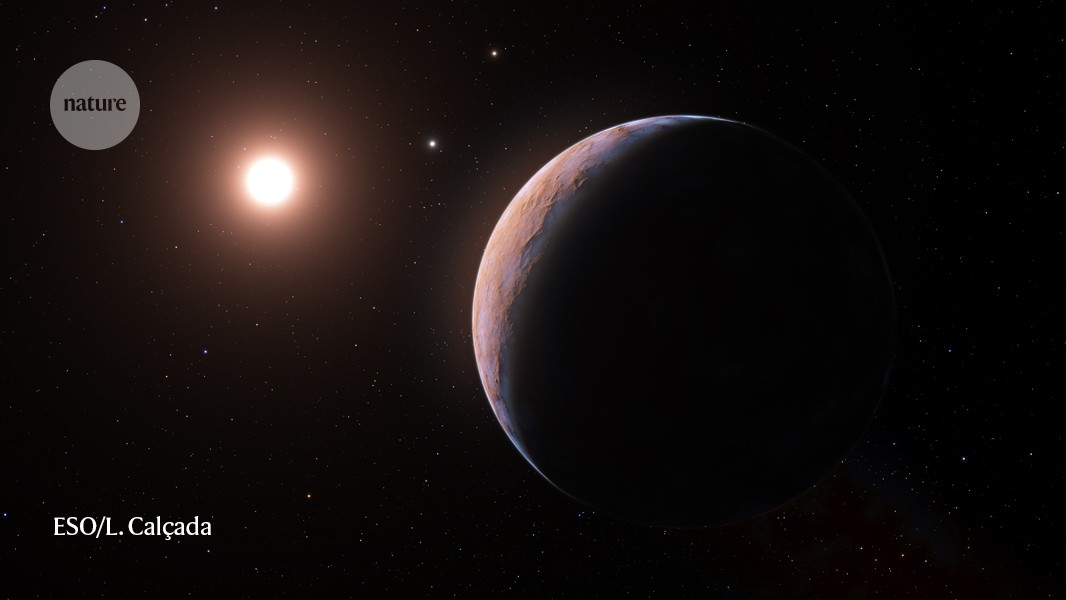
Earth-like planet spotted orbiting Sun’s closest star
Shifts in starlight from Proxima Centauri, observed over more than 2 years, reveal its third planet.
nature.com
231 points · by rntn · 4y ago · 339 comments
From the paper (Introduction and Conclusions, respectively) [1]:
The habitability conditions of Proxima b, which orbits within the HZ of the star, have been extensively studied (e.g. Barnes et al. 2017; Ribas et al. 2016; Turbet et al. 2016; Meadows & Barnes 2018). On the other hand, the candidate Proxima d orbits much closer to the star and outside the HZ range.
In particular, the discovery of an Earth-mass planet orbiting Proxima Centauri (Anglada-Escudé et al. 2016), our closest stellar neighbour, was one of the most significant results in the field, in part because the planet orbits inside the habitable zone (HZ) of the star (e.g. Kopparapu et al. 2013).
So, Proxima d is too close to the star to be inside the HZ; it's within the HZ in the sense that the HZ is further out from the star.
The author of the Nature commentary, which claims that "it could have oceans of liquid water that can potentially harbour life", apparently didn't read the paper.
[1] https://www.eso.org/public/archives/releases/sciencepapers/e...
https://www.star-facts.com/proxima-centauri/
Also fascinating, a relative distance vs time graph of close stars. It turns out we'll have closer distances for 6 in the next 10,000 - 50,000 years.
https://www.star-facts.com/wp-content/uploads/2020/08/Neares...
Somehow I feel like Elon Musk has a print out of that graph on his office wall.
They laughed at me when I bought investment property on Proxima Centauri b, but who'll be the one laughing in 10.000000001 billion years?
So we just need to tackle climate change and learn to live sustainably on Earth, then we’ll have a few billion years to figure out how to get to Proxima Centauri.
There are 6 if you count Proxima Centauri and Alpha Centauri separately; 7 if you count both stars in the Alpha Centauri pair separately, and 5 if you count Alpha and Proxima Centauri separately.
Alpha Centauri is the binary system of Alpha Centauri A and Alpha Centauri B, which are separated by about 10-30 AU. It's very, very close in terms of interstellar distances to Proxima Centauri, which is a red dwarf that orbits Alpha Centauri A and B at a distance of 13000 AU, or 0.2 LY - a remote enough orbit that it makes sense to keep track of whether it's on the near side or far side of the triple-star system.
"With the small stellar radius, Proxima d ... equilibrium temperature may reach 360K,"
NB: Earth's is 255K. Venus 260K, Mars 215K. So this doesn't tell the whole story, but is probably quite hot.
I dislike the term "Earth-like" in these publications because it conjures images of a strange alien world able to support (human) life. Even assuming there were life capable of withstanding the constant flares from the host star, I suspect it would have to look very different in color and likely composition to the plant life here due to needing to capture a different part of the spectrum.
Visible light being right in the middle is the trick which gives us photosynthesis, and sight, because in both cases a photon can be captured by a photosensitive bond. It's harder to come up with plausible photosensitive bonds for IR light, and most anything is photosensitive once you get far enough into UV.
A world evolved under lower energies and temperatures would select chemicals with weaker bonds. Other worlds evolved under higher energies and temperatures would select chemicals with stronger bonds.
Visible light is visible to us because it is important for molecules we use.
This is not to say that all points on the energy continuum are equally favorable to potential metabolic processes, but life adapts to conditions, even where they are not optimal. I don't know of any reason to assume the regime where Earth life has landed is optimal, but it has proven more than adequate.
Is this unique to IR?
Fun fact: Go outside on a clear night, and you can see 5-10,000 stars. There are 8 times that many red dwarfs in your field of view, and none of them are visible to the naked eye. But in 2016 Proxima was for a few minutes.
In March 2016 we saw a superflare: Proxima briefly became nearly a factor of 100 brighter, reaching a brightness just visible to the naked eye from dark sites.
The current fastest man-man object is the Helios 2 space-probe, reaching something like 25 000 kilometres per hour. Proxima Centauri is 1.3020 parsecs away from Earth.
So, just diving one by the other, we'd looking at something like 18 000 years as a rough order of magnitude for sending something from Earth to Proxima Centauri.
You'd be much better off waiting, well, even a thousand years for technology to improve rather than sending something now.
Note: this is a very dodgy line of reasoning. The Helios probe got a massive speed boost from a close encounter with the sun. But even if the speed is wrong by a factor of ten, we're still looking at somewhere between a thousand and a hundred-thousand years.
I mean we, as humanity, have to have an eccentric billionaire start a Martian fire (SpaceX Starship) under our lazy asses to even start to think about getting to Mars in a reasonable timeframe and in reasonable numbers (to start a colony). We are not funding making our species multiplanetary for the last few decades because we were too lazy, how can anyone expect us sending anything to the closest star (other than the sun)... You can't.
... has been said for the entirety of human history. And in all that time, they've only ever been right about Australia. (J/k Aussies!)
Only one technology matters: that which enables transportation.
Animal husbandry. Sailing. Railroads.
In the end, humans are plentiful. As long as it's done in full disclosure and as an uncoerced individual choice, who the hell are we to stand in the way of adventurers taking a chance on a better life?
However, it's likely that one task (going to Mars, even sending a couple rich bozos there) is small enough that you can probably do that and work on fixing things "at home".
In fact, one could argue that one set of big companies that exist this decade that didn't exist last decade is just a shopping list of "Crap I'll need for my martian condo"
https://blog.theclymb.com/out-there/because-its-there-the-qu...
Just don't stand in the way of those who chose to go.
Basically, the tech you need to make a Mars colony truly self sufficient is something like a compact fusion powerplant.
Before we have that, no point in worrying about using Mars as a "backup plan", because if Earth was screwed, Mars would have a couple of years to live at most.
And obviously it would be vastly better for humanity if Musk spent money on zero-emission large scale energy production, than on rockets.
- They don't need fusion. A StarShip can deposit hundreds of solar panels and put them on the ground. No, dust isn't an issue because they'll bring a roomba. No, this isn't a joke, NASA martian probes' solar panels were cleaned by a light Martian breeze.
- They will be able to become self-sufficient rapidly. They're not going to send 1M tons of cargo to Mars without a deployment plan. SpaceX and Tesla have already demonstrated effective vertically integrated supply chains and manufacturing. They have the institutional knowledge to mine raw materials and build factories that build complex parts.
- There are plenty of other Earth-bound governments and billionaires that could devote funds to zero-emission large scale energy production projects. Musk, his companies and assets amount to a very small fraction of the global economy. Your ire is misdirected: your anger about the situation is properly directed at the rule of corrupt imbeciles and their questionable resource allocation decisions (Netflix, coal, etc.) here on Earth rather than one team of folks who seem extraordinarily mission driven and effective.
Just build bunkers here and staff them in shifts. Much cheaper.
Your remaining threats for which Mars would be better than "ruined" Earth are something like a grey goo event, or an asteroid so large that it liquefies much of the crust (killing everyone in all your bunkers). So, a fair bit bigger than the one that killed the Dinosaurs.
I am very interested in watching people try to colonize Mars, but find the "backup for Earth" argument ridiculous, especially if presented as something urgent.
Classic zero sum thinking. Spacex doesn't cost money, it makes it. How much money do you think Musk put into it? The answer is ~100 million seed. It is now worth 35,000 million.
How far do you think that 100m would go to develop fusion. The ITER project alone costs 65,000 million.
Mars might not be sustainable in our lifetime but in a century or two? I think it's within the realm of possibility.
As for the urgency, the last two years has demonstrated the exact opposite to me. Modern civilization is a hop, skip, and a jump away from instability and disaster. When you say that we should instead spend resources on large zero-emissions energy production, well, we've had Nuclear Fission for half a century. The reason we didn't use it to prevent Climate Change is 90% political, not technical, another problem that having a self-sustaining colony, outside the sphere of Earth's influence, would solve.
Perhaps in the near future life extension technology will become common place, people may continue to have kids, but natural deaths may be rare; the human population will increase exponentially and need somewhere to live and something to do -- terraforming Mars in exchange for property may be reasonable.
From a standpoint of reducing emissions on Earth, it would be cool to see Elon Musk's best take on how to build a practical fusion generator though. I've heard of a few potential paths that could lead to net power much faster and cheaper than ITER. Supposedly superconducting magnets have gotten considerably better since ITER was proposed, and since power output in a tokamak reactor is something like the third or fourth power of the magnet strength IIRC, there's potential for a newer and smaller reactor design to outdo it in both timeline and cost.
The 1950s-2000s NASA model for space exploration was unusual in its centralized approach.
"A probe based on nuclear pulse propulsion could do it in around 50 years, with today's technology."
I was always under the impression that these vast distances were basically entire unreachable in several human lifetimes.
So we have the ability today to move 50K tons of parts into orbit, and come up with vast quantities of helium-3?
I'm pretty sure not even that.
The fastest crewed spaceship was Apollo 10 at 39,705km/h before reentry. After orbiting the moon they had lots of fuel left over so they just floored the engine on the way home. Not just falling back towards the planet but actively flying towards the ground for longer than any other Apollo mission.
This record can be broken with current technology, we just have to go back to the moon.
quoting from reddit:
> You may be thinking of the Sun as a big gravity well and how you can just drop things in a well. But orbits don't work anything like that at all. Sure if you are stationary relative to the Sun then you'll fall right into it. But anything that leaves Earth is very far from stationary. You're going at 30 km/s 90 degrees off your target. Possibly the first idea many people think of if they want to hit the Sun is to cancel that 30 km/s of speed, and sure it'll work. But you need 30 km/s of delta-v. On the other hand, to escape the solar system from Earth you only need a velocity of 42 km/s relative to the Sun, of which you already have 30 km/s. So you only need to increase your speed by about 12 km/s. (And for both cases add one or two km/s to counter Earth's gravity.)
https://www.reddit.com/r/askscience/comments/wjv87/comment/c...
https://www.forbes.com/sites/startswithabang/2019/09/20/this...
If we ever figure out light-weight fusion drives, we could build light hugger space ships that accelerate to a decent fraction of the speed of light. At 1g acceleration it takes about one year to get to 0.9c, which would make the Proxima system accessible with a travel time of about 6 years. Or 8 years at 0.5g. Or 9 years if we 'only' get to 0.5c.
The same goes for laser-driven light sails if we just wanted to send a probe, although deceleration would be an issue. (There is currently an aspirational research project for this called Breakthrough Starshot)
The exciting thing about these technologies is that they don't require new physics in principle, just a lot of engineering. Of course, uploaded minds would probably always be better suited for space travel, but it's neat to know that even biological people could in theory make these trips.
Maybe someone has a link to more information, that’s just what I remember from years ago.
No, we couldn't. The energy density of fusion isn't anywhere near close enough to make a lighthugger, you'd need insane mass ratios[1] and ramjets are probably unfeasible (as in, even-if-your-a-Kardeshev-II-civilization-unfeasible[2]).
[1]: http://www.projectrho.com/public_html/rocket/slowerlight3.ph...
[2]: https://www.sciencedirect.com/science/article/pii/S009457652...
For the cynical or pessimists: I'm not optimistic about humanity reaching year-4,000, I'm just possibilistic about it (as in the philosophical meaning [1]).
[1] https://en.wikipedia.org/wiki/Actualism#:~:text=possibilism,...
Propulsion maybe the easier part of engineering. Afaik we are nowhere near to life support and environment control that could be considered stable for a time period of maybe 10 years or more.
The biggest biological advantage, adaptation is meaningless for large organism on such a timescale and maybe dangerous on a microbial level.
In my mind, using the admittedly poor analogy of space-time as a membrane that is distorted by gravity, my thinking is we'll find some way to effectively bring two points in space-time adjacent to each other and 'step' between them. Wormholes, Warp, or whatever you want to call it.
Think of a flexible membrane 10 meters long and we are going to travel from one end to the other. We can either travel in a linear fashion over its surface for 10 meters or we can wrap the membrane so both ends are next to each other and travel 0.01m across the gap between them.
Yes, I know there are all sorts of obstacles and arguments against this simplistic visualisation but this is how I've always imagined the physics of any science fiction faster-than-light travel - worm-holes, warp drives, etc.
If you want an actual, real, possible-right-now analogy, think of our current situation where the fastest way to travel from London, UK to Sydney, Australia (1/2 way around the world) is through the atmosphere in an aeroplane travelling ~17000 kilometers and taking at best 19.5 hours.
SpaceX (Musk) Virgin Galactic (Branson), other companies [0], and space agencies [1] have talked about, and are actively working toward, stepping outside the atmosphere into space to reduce the time element to around an hour.
So just like with supposedly faster-than-light travel, by 'stepping outside' the linear/conventional thinking/physics we reduce the time of travel element dramatically. The start and end points don't move but the distance travelled by the transport vehicle itself changes in order to enable the reduction in time.
[0] https://www.telegraph.co.uk/travel/news/new-flights-space-lo...
[1] https://edition.cnn.com/travel/article/hypersonic-flight-air...
On top of it, let's handwave all of this away, poof. Any aliens anywhere in the Universe would also be using it once their technology got to that level. Just from the lack of visitors, we have three possibilities that are immediately evident:
1) Humans are among the first intelligent species to get to this technology in the entire Universe.
2) Other species have it, but all of them, every last far-flung one of them, even the renegade civilizations or the mad scientists at the individual level, abide by not using it around humans. Despite all of their numerous reasoning capacities and utterly inhuman motivations, every last sophont with access to the tech has agreed upon this, and has for thousands of years.
3) That tech can't exist.
The first and second are unlikely, statistically.
this is why we don't see any signs of life out there. there really isn't any point in trying to venture beyond your home. universe is just too big even at the speed of light when you start venturing beyond your local group.
We have barely scratched the surface of what is truly going on out there. It would be incredibly “human centric” to think our current understanding of the universe is “it”, in my opinion.
I guess that's why arthur c clarke said sufficiently advanced technology is indistinguishable from magic. I just think that kind of magic would be visible to us. Or maybe it is, but we just can't tell.
If you get really close to the speed of light (which is not really practical from a materials engineering standpoint) your time of transit is significantly shorter.
Once these (extremely hard) engineering problems are solved, a trip to the next star can be a week-long affair from your point of view, but your friends back on Earth won't see you for about a decade.
That just isn't practically doable with any technology within humanity's reach, probably for centuries. If it ever will be at all.
The amount of energy needed to propel anything at that speed is enormous.
You’d need to travel at around 233x the speed of light to make getting to the nearest star be a week trip, no?
And even if we could get the adversial networks to model all this garbage, etc it needs to line up with the plan of the rest of the Universe from the franchise and the managers can't even decide whether the photon is going to be a wave or a particle. Jeez. Vaporware like HL2.
We should and do send probes anywhere that's practical. The question is more like when it will be practical to build star probes.
The current fastest man-man object is the...
The current fastest man-made object wasn't intended to reach the stars.
On the other hand, there are many challenges that make more sense to undertake as previous steps to develop the needed technology.
252 792 km/h
https://news.ycombinator.com/item?id=29638529
Of course that doesn't necessarily preclude a nearby higher level Kardashev Civilization becoming interested in all the noise we're making and heading over.
As we put up systems beyond Webb, it may be possible to observe a hypothetical inbound craft / fleet some years off, which would have interesting effects on our current human society, once it became generally known..
My suspicion is that the social media generation would react a lot worse than the radio generation did to the 1938 broadcast of H. G. Wells' War of the Worlds:
https://www.space.com/40435-finding-aliens-humanity-reaction...
It orbits the star every 5 days; it's a quarter of the earth's mass. It's also a tenth the distance from its star that Mercury is from the Sun. It's earth-like only in that its temperature is consistent with there being liquid water.
So even if the thing's tidelocked, and has no atmosphere because stellar flare-ups, it still counts as earth-like. TIL.
And suddenly i am imagining lots of very smart people drinking lots of caffeine.
"To find the wobble.."
this is not helping :)
"ESPRESSO is kept in a special room at the observatory, inside a tank "
oh come on ..
It has a significant life span of about 4 trillion years and could easily outlive the present universe several times.
On a more serious note is this a good candidate for JWST, would it be able to infer chemical composition from the planet's spectrum or something?
Awesome though we went from (in my lifetime) learning at school that other planets have never been observed, to finding them sprinkled around basically every star just like our own. I feel like it won't be long before we detect the first potential chemical markers of alien life, if it's out there. Keep doing your thing space science folk!
Oh... and did I mention that Proxima is a known flare star?
Wake me up when they find a terrestrial world in the habitable zone of Alpha Centauri instead.
Anyway if Stellaris has taught me anything it's that the flares will add additional energy credits to the system... what's not to like?
Titanic. Moribund. Lethe. Purgatory I-X. etc.
The odds that there is life on our generational ship when we arrive are not that great either.
It’ll be Spacey McSpaceface if we put it to a vote.
After a week of reflection, I think it was a slight overreaction -- the book is still very very good but i dont think #1 for me.
But something about the way the story took shape and culminated in the final third of the book was so engaging, and so satisfying. I think I stayed up until 4 or 5AM the night I finished the last 200 pages.
- - - -
Tangent: Have you read Gene Wolfe's Book of the New Sun? It's less famous than the books above, but (IMO) it's in the same rarefied company as Dune and J.R.R. Tolkien's work.
I haven't even heard of Wolfe's book. Will check it out, thanks.
Full name is A Remembrance of Earth's Past.
Quite a nice concept - accelerate the probe with lasers- no plans for deceleration though
What's becoming clear though is the only thing stopping us from lots of Earth-mass planets is the abilities of our detectors to detect ever-smaller gravitational wobbles and ever-smaller transits. Bear in mind we only tend to find planets around stars where we're on their ecliptic planes.
So planets seem to be really common. If they weren't the odds of finding planetary systems on our nearest stellar neighbour would be quite low.
But the distances are still so vast that the energy expenditure and timelines are completely impractical (if you assume the speed of light of a hard cosmic limit, which I do).
So if planets are common and interstellar travel is impractical, the only way to expand really is around your own star. This is the Dyson Swarm. This would actually solve the energy issue of interstellar travel (ie"stellar highways") so it's almost a prerequisite. Thing is, Dyson Swarms are likely detectable from vast distances due to their IR emissions (ie the only way to get rid of heat is to radiate it into space and that has a specific frequency depending on the temperature of the radiating object).
But if planets are really common and we don't see any Dyson Swarms it seems that spacefaring life is extremely rare and the most likely number of such civilizations in the Milky Way is 1 including us.
Do we really know enough to be able to say if a planet is habitable? Or could there be other forms of life that we don't know of yet... We have only recently put a man on the moon, and now we're saying we would be able to detect dyson spheres...?
A moth doesn't even have electricity, but it can detect a lampshade. A Dyson sphere is basically a stellar lampshade; we can detect it if the laws of thermodynamics hold, and we're pretty sure they do. (A Dyson swarm is similar, though a bit harder to detect.)
1. The speed of light is a hard limit; and
2. Thermodynamics (particularly the Second Law) applies. Specifically, you can't get energy from nothing.
From this you can draw a few conclusions:
1. The likely sources of future energy are solar (most likely IMHO) and nuclear fusion. I hope fusion is viable. I'm not yet convinced it is. More exotic far-future options include antimatter and black holes. Antimatter is something you'd make. Think of it like a battery. So you still need the energy to make it. Black holes as propulsion are the same way. Generating power around a large black hole is theoretically possible but has a bunch of issues;
2. Reaction mass is a huge problem for traveling large distances, so much so that using photos to impart momentum seems the most practical. Fusion could be viable here. Antimatter and black hole propulsion are theoretically possible;
3. Because of energy demands, capturing the Sun's energy makes the most sense and doesn't require any "magical" or exotic science or technology;
4. Because of thermodynamics, eventually heat will radiate into space. It's really the only way of dissipating heat, ultimately.
5. Like I said, the IR signature is purely a function of temperature; and
6. A star with a Dyson Swarm will have a very strange (to us) spectrum. Very little visible light. High amounts of IR. There is really no hiding such a megastructure.
So this is essentially a natural conclusion based on physical laws we have no evidence for that they're false or meaningfully incomplete. Thing is, if the speed of light isn't a hard limit that actually makes it more likely we'd find spacefaring life not less because the reach of such a civilization would be so much farther.
I mean, I know the proof of life is us, but the human-centered view of the universe does reek of prior historical "knowledge" that the earth was the center of the universe. I understand searching for life like us, as that is what we can extrapolate from current data. But to use that to infer that we're it, it's just too much for me.
The key question is that if planets are so common and space is so big, why does it seem to be so empty of life? You bring up an argument that maybe life is so different as to be undetectable. It's a fair question to ask but the beauty of the Fermi Paradox is that you don't need to argue about what's most likely. You simply have to be concerned with what's possible.
Let me put it this way. let's say that there is 1 other spacefaring civilization in the Milky Way and they've evolved like you said in a way completely alien to us and as such don't follow a path we can easily detect or at least we don't think to look for it. I can buy that as entirely possible.
But now let's assume there are 1,000 spacefaring civilizations in the Milky Way. What are the odds that every one them falls in this category? What are the odds that none of them follow a similar evolutionary path to us and what we consider highly likely? It becomes increasingly incredulous as you scale up the number of civilizations.
So what's more likely? 1,000 civilizations followed a path alien to us independently? Or that there are few to no other civilizations out there to detect?
To say we're the only 1 of 1,000 to follow this path is really a different kind of human-centric hubris.
Extracting energy from a star is so low-tech it defies logic to think we're the only ones who will (likely) do it.
Space travel is only considered to be impractical for humans, or similarly large organic entities within their limited lifespan.
The time constraint and the mass constraint may not be particularly relevant to intelligence that no longer has organic form.
An artificial lifeform may not have a defined life span and thus taking 100,000 years to travel the stars may be acceptable.
Additionally, they may only need to make the trip once to establish the receiving antenna, in order to transmit their "progeny" around the galaxy.
Tldr; We are like ants thinking that we need to figure out how to make really long tunnels to cross the Atlantic, instead of focusing on the limitations of our physical bodies.
Rocks though space, but that doesn't help learn much. Rocks bring up the other issue is we don't know how many high velocity things might be between starts, numbers below the noise limits of our current sensors is enough to destroy anything we could send out.
If you haven't already, give Rendezvous with Rama a read.
2) speed of light is a hard limit, you cannot keep accelerating and you need more energy the closer you get to that limit
No that would be a waste of effort. A flyby mission definitely makes the most sense. The 3.5 years are with deceleration though.
> Humanity’s first chance to explore this nearby world may come from the recently announced Breakthrough Starshot initiative, which plans to build fleets of tiny laser-propelled interstellar probes in the coming decades. Travelling at 20% of the speed of light, they would take about 20 years to cover the 1.3 parsecs from Earth to Proxima Centauri.
4 trillion years. Wow. If there was life on one of the planets, it would have a long time to evolve.
"Earth-like planet spotted orbiting Sun's closest star" is a lot sexier than "We detect a signal at 5.12 ± 0.04 days with a semi-amplitude of 39 ± 7 cm s−1. The analysis of subsets of the ESPRESSO data, the activity indicators, and chromatic RVs suggest that this signal is not caused by stellar variability but instead by a planetary companion with a minimum mass of 0.26 ± 0.05 M⊕ (about twice the mass of Mars) orbiting at 0.029 au from the star. The orbital eccentricity is well constrained and compatible with a circular orbit."