191 points · by nikbackm · 4y ago · 142 comments
The goal of SiteTruth was to try to find the real-world business behind a web site, and look up information about the business, such as how long it has been in business and its annual revenue. That's become harder and harder over the last decade.
First, it's now acceptable to have an online business with no real-world address and no visible legal existence. This is illegal in the European Union and illegal in California if the business accepts payments, but enforcement is nonexistent.
Second, more sites have become inaccessible to scraping by servers. I have a system which looks for a human-readable business address on a site. It looks in the obvious places (front page, "about", "legal", "terms", "contact", etc.) and quits after trying the 20 most likely pages. It uses a honest agent ID ("Sitetruth.com site verification system", registered with the now meaningless "bots vs browsers" list) and obeys robots.txt. A sizeable fraction of the time, it can't read the site at all.
Third, the data sources for company information have been becoming less accessible. There used to be two reliable data sources: Hoovers, and Dun and Bradstreet. They merged. Dun and Bradstreet for a while became rather corrupt. They licensed a company in Santa Monica, CA to use their name, and sent the small-business part of the business to them. This unit's marketing approach was "Nice credit rating. Be a shame if it something happened to it". After much litigation, DnB HQ bought the Santa Monica company, but the reputational damage was done and DnB is no longer the gold standard of company information. There are lower tier data sources (look up "US Business List"), but the data quality is poor. Anything based on user recommendations, like Yelp, gets spammed, so that's out. Yahoo Directory, which was reasonably spam free, is gone.
Fourth, the SSL cert industry became corrupt. OV standards were never very high, and EV standards started slipping. Then there was the Cloudflare problem. Cloudflare is a certificate authority, and they issue certs to themself for domains which run through Cloudflare. So looking up a cert just gets Cloudflare's info.
Fifth, Google is making it harder and harder to have Chrome plug-ins that critique their ads. I dropped Chrome support recently, and only have a Firefox add-on at this point.
So, after fifteen years, Sitetruth is coming to an end.
Seems like this could just be a government run database (assuming these businesses are paying taxes and not completely shady) with some of it publicly accessible.
Have you tried also looking at US shipment logs? I know there is that guy who a few years ago made a site that scraped and indexed all of the public shipping logs (anything crossing US borders by land or sea goes into huge public databases - for some reason air is excluded). Could be a way to cross reference this data to fill in the blanks for some of the things you are talking about?
Tying SSL certs to identity (rather than just to verification that someone has the authority over a given domain) was a dumb idea in the first place, so I hardly see a problem with workarounds in that regard.
on edit: yes, they want to verify identity because their purpose is really to provide a form of security as well, so it is sort of removed by a step / nothing works all the way down, getting confusing at this point.
I've also never had a good experience with the validation process from any of the CAs. They often push anything that's not immediately discoverable back to the applicant and expect them to do the leg work. I've had both Comodo and DigiCert do this to me in the past. Here's an example from DigiCert. This happened this year (2022).
> First, As part of the verification process, we are required to confirm the registration of your organization with the local registering authority.
> We have attempted to locate the registration records using online resources, however we have not been able to locate such a document. If you are aware of any government based search tools for your jurisdiction that can be used to locate proof of the organization's registration, please reply to this email with a link and instructions for locating that record. Once received, our validation team will confirm the record and proceed with the validation process.
Really? To me that seems like someone who isn't familiar with my jurisdiction because they don't know the process. What's stopping me from sending them a link to a fake, official looking site? It seems like an invitation for social engineering. Code signing certificates are the same. It's infuriating.
In my experience, they look for your company on Google Local (or whatever it's called now) or similar and if they can't find it they punt it back to you. I think the whole process is worse than nothing because it's selling a false sense of security for anyone who believes the marketing.
From a customer value standpoint, I'd rather pay for a DV certificate where the value comes from helping me to set up proper CAA records to prevent mis-issuance as well as certificate monitoring for any potential lookalike domains. Of course, the margins on that probably wouldn't be as good.
Thankfully I only deal with one place that insists on buying expensive certificates because "they're better". Just for fun sometime go look at the TLS certificates used by all of your local government websites and try to figure out what they cost. Then factor in the labor for multiple people to coordinate annual renewals and manual installation. It's frustrating.
1. PDF Warning: https://cabforum.org/wp-content/uploads/CA-Browser-Forum-BR-...
I did. A high-value (to me) service used a cert with the green banner and I'd look to it to be reassured I was in the right place. Then one day, it disappeared.
Alarm bells started ringing and I tried to find out what was going on. I called their help desk and asked if they had changed their TLS certificate but the helper I spoke to had no idea what I was talking about and couldn't be persuaded to escalate my query.
Just in case my connection was being hacked by someone who managed to register a lesser TLS certificate, I left it a day until I could try again from my home broadband.
In the end, I did go ahead and use the site without the green banner, which makes me my own worse enemy.
It caused a great outcry from CAs, and I would’ve normally been against a single-sided, mostly Google-driven change like this, but the discussion[5] shows, at least as I read it, that CAs are unwilling to clearly communicate that the EV “green bar” does not imply “trustworthy”, it just upgrades “you have been securely connected to satan.com”, an authenticated DNS name, to “you have been securely connected to Satan LLC”, an authenticated legal-entity name.
And as Stripe, Inc., of Kentucky shows, it’s not clear this is an upgrade at all, because while the rules for domain uniqueness in the DNS are relatively (barring IDNA) straightforward and well-known, the rules for uniqueness for names of legal entities are complex and dependent on jurisdiction to such an extent that neither users nor even CAs can be reasonably expected to follow them all. (I think one discussion on the CA/Browser Forum list mentioned that—forget state-scoped legal names in the US Stripe case—Germany has township-scoped legal names, so jurisdictionOfIncorporation would literally have to record, and UAs to show, the address of a specific town hall in Germany. Sure you know which one it should be?) Even today you will find CA websites[6-8] proudly proclaiming “customers think the EV green bar means trustworthy” (and, presumably, if they don’t, you should teach them to). Except it doesn’t, and believing it does is harmful for users, so into the dustbin of history it goes.
(Of course, the conventional legal system is not completely clueless about this namespace issue and in most countries implements “field of endeavour”-scoped trademarks as a solution, but the issue of jurisdiction on a global Internet, as opposed to a billboard in your hometown, is only somewhat attenuated, and the discussion seems to show CAs were unwilling to move away from “green bar = secure” marketing, which is harmful however you spin it.)
There’s a more general line of research on the uselessness of positive security indicators, that first entered the public eye perhaps with Moxie Marlinspike’s green-padlock-favicon demonstration[9] at Black Hat 2009. The Google announcement page[1] links to some later developments in that respect. Chrome later phased out “secure” for HTTPS sites completely in favour of showing “not secure” for HTTP ones, highlighted in red once a password input or similar appears[10].
Fortunately for you if you want your EV TLS certs back, the corpse seems to be in the process of being raised[11,12] through the necromantic power of money and government coercion. (What is it about PKI that drives everywhere bureaucrats so wild?..)
[1] https://chromium.googlesource.com/chromium/src/+/HEAD/docs/s...
[2] https://bugzilla.mozilla.org/show_bug.cgi?id=1572936
[3] https://www.troyhunt.com/extended-validation-certificates-ar...
[4] https://arstechnica.com/information-technology/2017/12/nope-...
[5] https://groups.google.com/g/mozilla.dev.security.policy/c/iV...
[6] https://www.digicert.com/faq/when-to-use-ev-ssl.htm
[7] https://www.globalsign.com/en/blog/why-ev-ssl-is-here-to-sta...
[8] https://www.thesslstore.com/new-to-ssl/is-ev-worth-it.aspx
[9] https://vimeo.com/50018478, slides at https://www.blackhat.com/presentations/bh-dc-09/Marlinspike/...
[10] https://security.googleblog.com/2018/02/a-secure-web-is-here...
[11] https://scotthelme.co.uk/looks-like-a-duck-swims-like-a-duck...
[12] https://www.eff.org/deeplinks/2022/02/what-duck-why-eu-propo...
They spend considerably less time talking about why browsers do such a terrible job of surfacing cert information for website visitors. Yes, cert UI sucks; not sure we needed an enormous article to belabor that. The real question is, why does cert UI suck so bad? (UI design is a choice.)
The answer is that everyone who runs a major browser has a vested interest in making sure decentralized site verification sucks. Because they are supported by highly centralized private site verification schemes.
Decentralized verification is the norm offline. Do you carefully Google and research every store you walk into? No, because to open a store, the store owner has to establish a paper trail. And if you have a problem at that store, your advocate (a credit card company, insurance company, lawyer, law enforcement, etc) can follow that paper trail to find a party they can negotiate with, or investigate.
Over time, the effectiveness of this system—in which all parties have invested—creates a barrier to in-person scams. The result is a society where you can walk into a new store, a restaurant, a bar, etc. with confidence.
And note that name collisions don’t matter in this system. There are tons of restaurants called “McDonalds,” all owned by different people. But each one has an address and a unique paper trail that leads to a specific person or business. If you can remember which one you visited, your advocate can follow the paper trail for that one in particular.
The idea of EV and OV certs was to use the power of encryption to hook your browser to this same set of offline paper trails. You wouldn’t even need to remember anything; the browser would maintain a log of the sites you visited for you. If you got scammed, you just look back in your history and forward the business info to your advocate or law enforcement.
The decentralized nature was a feature; businesses had the choice of which cert to get, who to buy it from, and users had the choice of browser. Competition and mutual distrust would create incentives for parties to hold each other honest.
To be clear, an EV or OV cert would not magically prevent scams. But they would provide cryptographic guarantees that an advocate or law enforcement could trace back to an entity, to prosecute or make you whole. Just like in a real life store.
Instead, browsers became dominated by companies who run for-profit search engines, app stores, and identity platforms. So today what is the advice for verifying a website’s legitimacy? Google it. Or get their app from the curated App Store.
The result is a web dominated by a few huge gatekeepers. SEO is life or death because Google is the only way for a website to be “real” for people.
And most techies went along with it because they shared the vested interest, or did not appreciate the existing system that creates the real life shopping experience we see every day.
And so where are we today? A new generation of techies trying to use the power of encryption to create a decentralized web. Web3.
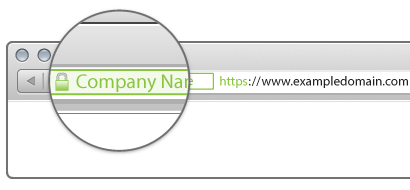
i don't see how it follows from this that the UI browsers provide for EV certs is bad. you claim that the value is not in inspecting the cert before a transaction, but in the logging of that data. the UI that browsers provide for EV certs allows you to inspect a cert if you really want to, but goes out of its way to avoid any implication that an EV cert is doing anything to prevent you from being scammed. that's a good thing. the browsers are honestly representing the effectiveness of EV certs.
Click on the lock in Chrome. It shows you the domain name. There’s no reason it could not read the cert fields and give you the parent org name and where it is registered. As opposed to clicking twice more and pulling those fields out of dozens of technical fields. It doesn’t pull the human info out, for a human to look at easily.
Or take a look through your browser history. Is site metadata logged with each entry? Can you look back at what the browser logged from the cert or network data when you visited a site last month? Is there a nice UI to help you find the problem site and package that info up so you can send it to someone else?
Browsers suck at safety UI in general. Let’s say I do find a phishing site. Where is the button to “report a problem with this site”?
Chrome has a screen to report browser bugs; in Firefox “deceptive site” is the last item in the help submenu. Compare to the prominent “report spam” button in email clients or the report features of social media.
Even if browser providers don’t want to take these complaints, the browser itself knows the domain registrar, DNS provider, and host for every website I visit. Each of those is a company that should have a process to handle abuse complaints. Registrars are required to supply abuse contact info in WHOIS. The browser could give me a nice UI to make use of that info.
If anything, it seems way easier? It also isn’t showing a potentially overly sure view of who the cert is really registered to for everyone.
Could it be made easier? Sure. But most folks aren’t going to be able to usefully process that information anyway. There are a ton of ways of making Whois information look plausibly like it’s owned by a bank when it’s not.
And I think you're right about EV? Ignoring gross CAs trying to juice the web, it makes sense to try to link the web's web of trust to our... non-web web of trust. The web is still pretty new, it's still pretty unfamiliar, and a lot of the signals we use to suss out a fraudulent physical shop don't really apply to the web.
I would counterargue, though, that you're really mythologizing physical stores. I think tons of fraud and abuse happen in physical stores, up and down the stack. The "paper trail" is like 45 minutes on LegalZoom. I think it's worth separating things like banks and bank websites from like, illegal casinos and gambling websites (crypto exchanges are what I mean here).
When you kind of pick away at the "physical stores have no fraud" pillar, then I think the web's security/trust model actually holds up. I don't simply rely on TLS to tell me that bankofamerica.com is legit, and I don't think anyone does, which is good because it doesn't! I also have totally different behavior when I'm doing online banking than when I'm [insert risky/shady thing here], because the threat model is different.
And there's where I think we hit a crossroads, because that "risky/shady" thing for everyone is "getting an email that looks like it's from your bank". This is an attack that doesn't really have an analogue in meatspace, but it's super effective because again, we don't have all the signals we normally do. If it were meatspace, I'd notice this wasn't my usual branch and then probably notice some other differences that might give me pause, but the web makes it possible to create a very convincing copy.
So, I think you're right in the large and I super agree. I just think that phishing is very bad and you shouldn't say you solved it when you in fact haven't solved anything. That's (almost certainly) browsers' fault, but that's a little irrelevant imo.
Here's a potential analogue - sometimes people stand in parking lots and collect fees, claiming to be representatives of the lot's owner, but in reality pocketing the money.
Some lots counter this by posting signs along the lines of "do not pay any attendant; pay only via kiosk/online". But since some lots do in fact collect payment via attendants, a potential way to secure this would be for the attendant to present proof that they are employed by a certain company. While the customer might not be able to verify that "ABC Parking, Inc." is in fact the owner of the lot, at least they would have a trail to follow if they were scammed.
This is an area where cyberspace has an advantage - the closest analogue to an EV certificate in the physical world would be a piece of paper with some official seal on it, which can still be forged in a way not easily detectable by the average person.
The underlying issue internet wise is unlike the scam you’re referring to, the people can be in another random jurisdiction and impossible to even arrest and still succeed at doing it online. In fact, in many cases it’s even economically preferable to do so (regardless of potential punishment) due to lower costs of living.
So you aren’t dealing with 5 lots in SF the owner is trying to avoid the problem on (and for which at least in theory someone could be caught and prosecuted by looking at a camera or walking there), you’re dealing with potentially every lot everywhere all at once, and that it is in theory scammable by people anywhere. And that there is no lot the owner can walk over to and see if it’s happening easily.
I don't agree. I think a lot of tech people (like me) felt like the whole system was a grift and that nothing of value was lost when LE offered an alternative. If you start a business in my jurisdiction your paperwork is going to get a lot more scrutiny than what the certificate authorities were (or are) providing.
Yes, yes I do... did. I'm in the US and get a vast array of bills coming from all kinds of different sources (utilities, doctors, etc.) that manage their payments via some random portal. Some of the "payment portals" they send me to are sketchy as hell and it brings me great anxiety to use them even though it's guarantees my payment arrives on time and I don't have to fuss with snail mail (and its associated thefts). I always make sure they are https and I used to look "beyond the lock" to make sure they a well-known CA was being used. Well as Troy mentions, it's effectively a worthless endeavor. I'm glad he's bringing this topic up to gain more visibility and awareness towards the issue.
If the companies aren't going to bother there's no hope for the users.
The conclusion was essentially that trust indicators offer no benefit at all and can even go as far as creating harm since it could encourage a user to trust an entity that they don’t know if the system is abused. The psychology of it boils down to this: people trust lots of sites, services and other people who haven’t paid extra for these trust indicators and because of that it’s not going to change their behavior at all.
On the flip side, inline and accurate warning indicators go a long way towards making users more cautious. Big red warnings from Google about users outside your domain for example.
There are a lot of flaws in EV. I think the biggest one I saw was that it is effectively no more useful than TLD's/subdomains. In fact, it's worse, because unlike domains, there can be multiple owners of the same corporate name!
To the people saying there is a paper trail... What good is that? There are "paper trails" for domain registration too. But that isn't very reliable and the same would happen with corporate registration. We know this all too well from how wealthy people use shell corporations to hide. And I'm sure there will be plenty of places around the world where it will be easy to incorporate for bad actors, even if some places do a good job of creating a paper trail.
Fundamentally, this is a hard problem to solve and I really don't see EV solving this any better than domains.
fwiw, I am not the biggest fan of Google's level of control either, but I think that the ideas in the video stand for themself. Forget the Chrome-specific stuff and just focus on the basic UX concepts.
Without providing some specifics, your comment comes across as pretty shallow and more about your dislike of Google than criticism of the actual ideas.
Here are some of the ideas that I think stand on their own regardless of who presented them:
- EV's cannot be trusted by users because different entities can have the same name, how is the user going to vet that?
- EV's have a problem of corporate name != domain name, how is the average user going to figure out if it's the right entity?
- Domains are difficult for users to verify because there are so many permutations possible with all the new TLD's, as well as subdomains
- URL's are difficult to read because paths are often non-human readable
- URL's are hard to share through non-digital means
and more... lots of generally applicable stuff that isn't all a giant Google conspiracy.
What is terrible about these ideas?
Web browsers told me they'd try better verification markers for years. They never did. So we don't know, except to say:
a. the 'green bar' verification marker isn't very effective.
b. the 'blue tick' logo as used for UIs like https://twitter.com/troyhunt hasn't been tried so browser makers have no data here.
It's a moot point: the realpolitik is browsers don't care about identity as it's not in their financial interest to do so.
Disclaimer: I spent 5 years of my life trying to verify the web.
Also why do I care about an EV cert as a user? does it tell me anything actually useful? Things I do care about as a user:
* Is my connection encrypted? (Browsers tell me this just fine)
* Is the site known to be malicious? (Browsers tell me this just fine)
* Have I been MiTM'd (Browsers protect against this just fine)
Things I don't care about as a user:
* Is this site actually owned by a specific Corporation?
Literally have never cared. Not once. Knowing this has never made me more secure or given me more confidence because fundamentally knowing who someone on the internet is does not tell me how trustworthy they are without way more context.
EV is literally the result of calling up the company directly and asking, signed by someone your browser trusts.
For online banks, I only got to them online by which automatically means I have their correct domain name.
The question of how I get the online bank's domain name to begin with does not really come in to this conversation, can be an ad, a friend etc.
EV is/was proof of identity. And proof of identity needs a scalable solution for the web. Certificate pinning won’t scale unless the browser knows all possible certificates in advance.
Knowing whether something is a scam is a separate topic from verification. Think of other verification systems - people may be known, but bad. Admittedly twitter muddied the water here terribly by removing verification badges from people that twitter considers to have broken their terms of service.
It's literally why banks were massive stone buildings - proving that they had the resources to build a solid thing that wasn't going to move or change was a part of establishing their identity as a something that can be trusted.
So the equivalent for EV would have been to make them cost ... say ... $185,000 to register and $25k a year - wait, that's a TLD and would be a much more powerful form of identity and ... it's not used at all. https://google.google redirects to ... google.com
So much truth expressed in this phrase. More than most of us would like to believe.
This is why I can’t avoid reading HN.
I feel this would prompt browsers to care about robust identity - both in terms of better verification and better display.
It doesn’t matter that it was a name collision with Stripe the payment processor. EVs were not designed to resolve name collisions. They were not even intended to attest that a business is legitimate.
What matters is that Ian had to register a company to get that EV. Which means that if he had actually tried to scam people with it, the police would have a nice paper trail back to him.
The paper trail is the deterrent. All the EV does is attest to the existence of a paper trail.
Name collisions are not a problem in general. There are other people in the U.S with the same first and last name as me. There are thousands of restaurants called “McDonalds” that all look the same even though they are owned by different companies.
It’s a solved problem. It is solved with legal documentation, like taxpayer ID numbers, articles of incorporation and payment records. The sole purpose of EV and OV certs is to cryptographically connect your browser to those.
Well, maybe. Maybe not:
> company formation agents signed up people who, for a fee, would declare themselves directors of newly created companies. Edwina Coales, a serial director of companies registered at 29 Harley Street, is or has been an officer at 1,560 of the companies listed on the Companies House website...
> In Britain, almost half of agents were happy to sell a company without checking the identity of the person buying it. If the agent does not record the beneficial owner of a company, then there is no way law enforcement officers can discover that information...
> From 2010 to 2013, cold callers harassed thousands of British households with claims that land near the Brazilian seaside town of Fortaleza would rocket in price thanks to the then-forthcoming World Cup. The cold callers seemed plausible, and 600 people put up a total of £19m. But, in 2013, the Insolvency Service stepped in, forcibly winding up a group of related companies involved in the scam, among them Pantheon Limited, and Pantheon Realty Consultancy Limited, both registered at 29 Harley Street.
> The only culprits the authorities could find were Ismael Rajabi and Ahmed Mohammadi, both from Afghanistan, whose names appeared on the companies’ registration documents. They are real people, but Companies House had, of course, not checked if they actually were the owners of the companies, which they were not. The real shareholders vanished, taking the investors’ money with them, and all the law could do was disqualify Rajabi and Mohammadi from being directors for 11 years.
https://www.theguardian.com/business/2016/apr/19/offshore-ce...
1. The paper trail is probably not as good as you think. I feel like you're thinking of a US system where there might be some pretty solid systems in place, but what about all the other countries around the world? I'm sure there will be at least a few places that will not be great paper trails.
2. The paper trail only helps you after you've been scammed as a way to maybe track down whoever did that. A costly and time consuming process which may be next to impossible if you think about the complications of shell companies and legal jurisdictions. Or are you suggesting that before you use a site you go through all this work proactively?
All the PKI requires of CAs (for DV certs) is to ensure that the entity requesting a certificate has control of the domain name they are requesting the certificate for. That entity may very well be a server, not a person; and it may very well be malware that has infiltrated on Google's servers, requesting a certificate for google.com. It's not up to the CA to verify which it is, for DV certs.
Sounds like EV is great in theory, nigh-worthless in practice.
Beyond that, it's all FUD, marketing, and hype. And at least 90% of any actual benefits to normal users of the web fall under "convenient side-effect of what the large corporations would have done anyway, for their own benefit".
[/cynic]
How do you determine whether this is actually Amazon or a scammer?
I'm not an expert, but at high level it seems to me that the only way to get trust is to tie every digital property to a real person, do some sort of KYC on them and allow for dispute resolution. The usual bureaucratic pains of doing anything in the real world would extend to the digital world, and the usual arguments about increase in regulation entrenching existing power structures and slowing innovation apply.
I think it only makes sense if you view the whole HTTPS everywhere initiative as a counter against MITM attacks - and only that. Everything related to identity has effectively been delegated to domain registrars. TLS certs as envisioned by browsers are really only about proving that you have genuine control of a particular domain - they give no indication at all who you are, whether your intentions are good or whether or not you're trying to imitate a different domain.
In that sense, the UI redesign from "neutral/secure" to "insecure/neutral" in Chrome makes some sense: HTTPS is necessary but not sufficient to make a site trustworthy: A https site might still be a scammer, but a http site can always be intercepted and manipulated by MITM, so http sites can can never be trustworthy at all.
Might as well just stick the certificate hash in a DNS record and forget about keeping a public consensus on universally trusted CAs.
You could mitigate this with some kind of (non-scary) trust-on-first-use UI. But even that doesn't help you if you're unlucky enough to encounter the attacker before the real site. (Which isn't even that unlikely if the attacker is e.g. an ISP proxying all connections by default)
What LE gives you is a signed statement saying in effect: "we've seen that the owner of this cert can make changes to the domain which are visible from multiple different network locations - so they are very likely the real owner of the domain and not a MITM".
That's valuable, even if it doesn't tell you anything about who that entity is.
What I absolutely would wish for is some mechanism to include a cert hash in the URL. Then you could e.g. distribute QR codes with the cert hash embedded and circumvent the trust problem that way. Then, I agree, there would be no reason not to use self-signed certificates with that technique.
I blame the browsers. They could have made it perform some kind of check, give some kind of warning. We've had to drag them kicking and screaming to adopt every ridiculous security extension to the web. They still use half-ass measures like HSTS that are trivial to work around. Nobody look at the big pink elephant.
The other issues with EVs are more damning to me.
Im not sketchy, my site isn't sketchy, and so there's nothing for the 0.001% to complain about.
So my site is DV, always has been, and no one has ever complained about that. So the money, and more importantly the hassle has no benefit to me.
Rinse and repeat for (some large % of web sites), users don't care about green bars or not, and EVs become useless.
The first time you connect to a website you get whatever identity it wants to show you. Whether it is a real site or not doesn't particularly matter, it only matters when the identity changes. If my first access was MITMed and then I connect to the "real" site, I should go and check to see what information changed, and if I sent any sensitive information I should probably do something to mitigate that (the exact action would depend on the exact type of info you sent). In the reverse case where you trust the original identity more than a changed identity you would ignore the event and might possibly want to inform the original entity that someone is trying to impersonate them.
Still fairly complicated for the original user, but certificate expiration would no longer be the insanity that it is now, and you can at least get transport security without the big scary self signed warnings that show up now.
Tor Hidden Services are closer to a well-designed petname system. The important insight is that, since domain names are too technical for ordinary people anyway, they might as well just be random numbers. If you trust someone to give you the real domain name for the server, you can also trust them to give you a signature for their real public key, and you don't even need a CA any more. The advantage of using a cryptographic signature for your address is that it implicitly forms a web of trust, using the links that people were already sharing.
The biggest problem with this — and SSH doesn't seem to do a better job of it than Tor does — is key rotation. Deprecating an old cryptographic algorithm is a total disaster in any system that doesn't support key rotation — it's fine on the server side (just host with both keys, and serve a 301 redirect from the old one to the new one), but the client side eventually needs to stop supporting the old algo, because those would be vulnerable to downgrade attacks, and at that point you cut off anyone who hasn't switched to the new one yet. CA's take care of this, because it's literally their job, but distributing the responsibility to everyone can easily mean it doesn't get taken care of properly.
This is how many people seem to use SSH, yes. It's also quite plainly the wrong way. I'm thankful the people behind HTTPS have higher standards than the typical Unix user seems to have.
I've mentioned before on HN that I once submitted a ServerFault question after finding myself unable to match the SSH fingerprint shown on the EC2 web interface against the one PuTTY was showing. [0][1] It turned out that PuTTY's fingerprint scheme was MD5/hex, whereas OpenSSH had switched to SHA256/Base64. I was surprised no one else had asked the question.
I dabbled with Azure recently, and iirc it was close to impossible to view the SSH fingerprint of a new instance using their web interface. Perhaps it was possible via a web-based command-line session. Either way it was disappointing.
I now suspect I'm part of a tiny minority of people who ever think to check SSH fingerprints.
> You can be MITM'ed for free the first time you connect (obviously, that's what TOFU means)
Judging by the old thread [0], at least one person uses it to mean Check manually on first use then trust it, rather than to mean Blindly trust on first use. Wikipedia seems to agree that the term can refer to either strategy. [2] I now make a point to say blindly trust on first use, or check manually on first use, to disambiguate.
Also, for what it's worth, SSH certificates do apparently exist, [0] but I know nothing about them.
[0] https://news.ycombinator.com/item?id=23958456
https://www.eff.org/deeplinks/2022/02/what-duck-why-eu-propo...
You still need them to properly sign binaries for Windows or get your logo showing in Gmail (BIMI), which are legit usecases where you want to verify the identity of the company.
The alternative to that is each business setup their own verification mechanism similar to what Apple does and you have to pay each one a good chunk of money. (Arguably the EV certs are not cheap either).
The idea behind EV was almost a good one - but you'd need a central authority that can say "This Nissan is the Nissan you're expecting" which is nearly an impossible problem at scale (see https://nissan.com vs https://www.nissanusa.com).
What has happened is Google is the central authority for 90% of the web - you search the company and click the link (which maybe is an ad to a scam site?).
LetsEncrypt is such a breath of fresh air. And the short 90 day validity period more or less forces you to set up an auto-renew script, so you can typically set it and forget it.
And if you mess something up, they even email you to warn that your cert is about to expire!
But encryption alone is insufficient for security in financial transactions. You also need to verify that the entity you’re exchanging encrypted traffic with is the one you intended to do business with.
How do you do that part today? Not via Let’s Encrypt.
Making the answer to the second question dependent on also answering the first -- so it was necessary to set up a whole chain of trust via a hierarchy of CAs just to encrypt your connections -- just delayed widespread adoption of HTTPS by decades.
The points that the article is making are the aftermath industry having muddled validation of identity and encryption of traffic up with each other in the first place.
Let's Encrypt finally solved that, but at the same time effectively made SSL certs mostly worthless for identity purposes (as it just means the domain you're talking to is the domain you're talking to).
Not even via TLS.
In all seriousness, PKI at web scale is a joke. Nobody knows which CAs are installed in their browser, who these entities are, how trustable they are, etc.
I have long accepted that TLS brought encryption, but certainly not trust.
I suppose Certificate Transparency is the tech working behind the scenes to flag mistaken or malicious certificates should they be issued.
The thing is, TLS certificates are a "weakest link" system. Even if chase.com is buying EV certificates, a bad actor can still get a DV certificate. You can mitigate that a bit by using a CAA record in DNS, but AFAIK there's no way to specify anything like a policy identifier (which indicates the type of certificate) in a CAA record. The best you get is the ability to limit issuance to a specific issuer.
There could be _some_ value to using a CA like DigiCert if you use a CAA record that limits certificate issuance to them only. Since they don't offer DV certificates you reduce the risk of a MITM using HTTP to get a DV certificate for your domain. You'd also want to reconcile every certificate issued to make sure they're legitimate requests.
For finance transactions there's basically a number of well known entities who should be vouching for the data I'm sending, who have large out of band systems for identity verification.
Sadly none of that has happened.
I understand it’s the larger security problem because there are far more return visits than first visits. But that doesn’t mean it is the only security problem online.
What is the web equivalent of walking into a store for the first time and feeling confident I won’t get assaulted or robbed?
In the cryptocurrency world, it's usually a feature to be unable to tell who you're sending money to, or even whether they exist, and this does not seem to have hindered adoption.