197 points · by ddubski · 4y ago · 337 comments
100 years ago the cost of construction was about $45/sqft when adjusted for inflation and today it is closer to $220/sqft, approximately 5x the cost. Blue collar wedges are pretty similar across time, but the cost of house construction (ignoring land) is dramatically higher.
The 1914 sears Model 147 house was 900sqft and cost $872 for materials, estimated at $1,530 with labor.[1] Adjusting for inflation from 1914 to 2020, that is about $22,000 for materials and 40K with labor.
Looking at 1913 US national labor statistics, the average baker in 1913 San Francisco worked 54 hrs/wk and made $0.46 per hour for an annual wage of $1,291[2] (or 33K in 2020 dollars)
The median baker in 2020 California makes 36.5K/yr [3]. The cost of new housing construction is $220/sqft[4], or 200K for the same size house.
http://www.searsarchives.com/homes/images/1908-1914/1913_014...
https://fraser.stlouisfed.org/title/union-scale-wages-hours-...
https://www.careeronestop.org/Toolkit/Careers/Occupations/oc...
https://ternercenter.berkeley.edu/wp-content/uploads/pdfs/Ha...
A more equal comparison would be to a prefab or mobile home, which you can get for that inflation adjusted price.
That stuff was, evidently, so cheap from the perspective of people in the 1910s, that they didn't think it worth any amount of effort to sub in worse wood for places where looks didn't matter. These days, some of that would be hard to find at any price, short of salvaging it from old buildings like that. And that's the "crap" they put under the nice wood they used for finishing!
OTOH we do have drywall, which has got to be cheaper in pretty much every way than lathe-and-plaster.
It makes me wonder .. if the US shutdown Canadian wood imports, would that significantly lower prices for Canadian consumers? How low would it go?
https://taskandpurpose.com/mandatory-fun/constitution-grove-...
Could that have been lumber from old growth forests that are now either extinct or protected from logging?
IIRC, lumber nowadays is basically farmed using relatively fast-growing trees.
Right after seeing that movie I visited an old house where everything is wood. Huge wood cabinets, wood floors, wood ceiling, etc...
I suddenly realised that I can't afford wood furniture any more! The IKEA stuff I buy these days is made of "manufactured" materials that are "wood-like", but have essentially cardboard honeycomb between two sheets of plywood or something.
I used to have IKEA furniture that was solid pine, but good luck finding anything like that in their store these days...
1. https://energynews.us/2019/12/02/estonia-is-beginning-to-see...
Lots of people want to build 900 sqft homes. It's just that with land costing 100s of ks and utility hookups etc at 100k, it make no sense to build a 900 sqft house.
Basically, areas with high house prices have created a situation building a little house on a bit of land is between very cost ineffective and simply impossible and then said "no one want to do this".
Also, it is pretty common for county codes to require each home to be a minimum 1000 sqft (at least in FL and MI). Even if we don't want to allow tiny homes of sub-500 sqft to gasp potentially lower the value of my home by giving someone else a place to live, the 700-900 sqft range is still very nice for a lot of people.
Like you said, part of this is differences in what you get, building codes, and amenities.
That said, Craftsmen homes are wonderful and in some respects have better build quality than modern homes.
They cost like 3x what a newbuild does, this "but building codes" stuff doesnt stand up to scruitiny.
You dont have to use wood, we have brick. We've had automation and 100 years of growth in productivity.
Maybe this is highly biased toward craftsman homes that have been well maintained due to how expensive CA housing is. But why wouldn't D.R. Horton homes also be maintained? They're theoretically equally expensive.
The 1910’s were a very different time. Comparing houses now to houses then is like comparing a horse to a Honda Accord. We’re not just talking luxury features here —- You can be pretty certain that a home built in 2022 has indoor plumbing, a refrigerator, and a furnace that doesn’t require shoveling fuel.
I dunno if you've dug deeply into most building codes but they're almost always overly specific in pointless ways and in ways totally unrelated to safety. Getting an engineer to sign off on a design should be enough, especially for a freestanding (tiny)house.
https://graphics.reuters.com/HEALTH-CORONAVIRUS/TOKYO-HOMES/...
They are going to last a fraction of the time that that $45 / sqft house from 100 years ago lasted
Also 250/sq ft is far from cheap/shoddy quality in much of the US. And with proper maintenance just about any house built to code in most places in the US will easily last longer than the average house built 100 years ago.
Lasting a long time does not mean a structure is better in every way. Old housing can be a challenge in terms of safety, cohesive design, lifestyle fit, land use, environmental concerns, etc.
In Japan, for instance, it is popular to frequently tear down housing rebuild it, and it works well for them.
I have lived in and fixed up many old houses with strong bones. They might stand for hundreds of years but everything attached to those bones is a patchwork of afterthoughts.
I live in a northeast city, and the average house in a ten block radius was built between 1920-1940. They seem to weather just fine and gradual retrofits to things like electric panels eventually take place. You can’t compare that meaningfully to a mobile home, which is more like a car with a 20 year lifespan. Frankly, I think the building codes are out of control in some respects and add needless cost.
The standard of construction of a middle class home built in 1925 is better the 2022 on the basis of materials alone.
I grew up in a small farm house built in the 1700’s - post and beam construction, that will far outlast “code compliant” building methods of today
Also - building larger typically reduces price/sqm.
If you built a house today without electricity, with only cold water service, and an outhouse, I think you’d save a fair bit on skilled trades (and be pretty damn unhappy when you visited a neighbor and saw their utilities).
Complexity and feature set are probably the biggest. New construction single-family homes today are more likely to be customized, not kits, have way more features and way better mechanicals. That 1914 house had no kitchen appliances, no laundry appliances, no driveway, no garage, no insulation, no central HVAC, etc.
Certainly I think most modern houses are too luxurious with marble and complicated accessories that aren't really needed.
What I see is that they have pretty poor build quality when you look closely, and are thrown together as cheaply as possible, and are not designed all that well. Where I am, "marble" would be engineered stone (which I don't have a problem with it's functional and looks okay), but many new kitchens (and bathrooms) aren't well designed for the space they take up and come with flimsy gimmicky fittings and appliances.
Where modern houses go overboard (in my opinion) is optimizing floor area per dollar and making them very large and lowering quality. Although that's also a response to buyer preferences, people like having very big houses and don't care too much about the design, the details, or efficiency.
Looking for kit-houses, I found: https://rethority.com/kit-homes/
Where it says "On average, expect to spend between $40 to $60 per square foot to complete your kit home build."
So that's right in the ballpark of the above inflation-adjusted cost of $45/sqft a century ago.
Blue collar wages as a whole may have, but construction workers' wages since 2006 have increased 47% when adjusted for inflation. This should come as no surprise, since that field historically has strong unions. You also have more rigorous safety codes for those workers.
On top of that, building codes have changed dramatically (thankfully) in those past 100 years. Whether it's structural, insulation, windows, electrical wiring and capacity, plumbing (older homes pipes were narrower, so couldn't handle things like a garbage disposal).
Did the 1914 house have more than one toilet? Cost per square foot doesn't cover what goes into the square foot, and fixtures cost a lot more than an empty room.
I love in a 'premium' newbuild block in a 1st world country, and the construction quality is so atrocious it would be condemned in some 2nd world countries!
The builders forgot to connect the extractor fan to any ducting, it just sits inside the ceiling and makes noise, the piping of the sprinkler system in not secured to any structure and is wobbling and threatwning a flood, the guy that made a hole in the ceiling for the sprinkler missed and we have a hole in the ceiling and a sprinkler somewhere inside. Last week a hot water mains has burst creating a flood of scalding water and 13 floors had to be evacuated. We had a nice steaming waterfall down the side of the building 40 meters down. The electric meters are installed in breach of code. It's a 23 story building and elevators never work, etc.
The building was completed 4 years ago, apartments sold at a premium to 'investors' based in tax heavens - not a single resident here owns the flat. Mine is based in Cayman islands.
Why do you think it's so much easier/better to upgrade an old house than fix constructions errors with a new one?
I live in an early-20th-century house with minimally-acceptable plumbing and electric (pipes not secured to the structure? welcome to the club!), no insulation, terribly cold windows, one tiny bathroom, sometimes-wobbly feeling floors, etc.
"Upgrading it" would basically be "rip it down to the studs and redo it all" which is basically "everything but one of the easiest parts of new construction" anyway.
People are willing to pay double or triple for artisanal bread compared with mass produced bread. But are they willing to pay 10-20x? If not, and the extreme cost efficiency of modern food factories inexorably lowers prices, the market clearing price of artisanal bread is limited and declining.
These days, bread is made very efficiently in massive plants (which is why it costs only $0.93 a loaf at my grocer)
Carrying workers' compensation insurance was not the norm at the turn of the 20th century; injured workers could instead sue their employer for negligence but usually lost. Legal challenges to state legislation that made participation in a workers' compensation program mandatory weren't resolved until the Supreme Court's 1917 ruling on N.Y. Central R.R. Co. v. White. In the modern day, Texas is the only state where workers' compensation insurance isn't mandatory.
In a similar vein, workplace safety standards have seen a lot of change. With the exception of a few states that passed legislation sooner, workplace safety was largely unregulated until the Occupational Safety and Health Act of 1970 established OSHA.
I know less of the specifics but consumer protection laws have also changed. Many states now impose statutory warranties on new construction that cover construction defects for a period of time. It seems plausible that builders had less liability for such defects in 1914.
Construction equipment and the cost of running and maintaining it is another thing that I would expect gets rolled into the cost of labor. I'd assume that equipment costs are usually offset by increased efficiency (paying wages for less time), so it wouldn't increase the cost of labor, but it would be interesting to see data on that.
As far as wage-related factors, while blue collar wages may not have changed in general there are some exceptions. Based on the sources you provided, plumbers in 1913 San Francisco worked 44 hrs/wk and made $0.75 per hour for an annual wage of $1716 (or $44.9K in 2020 dollars). The median plumber in 2020 San Francisco makes $110.9K/yr. (Since SF might be an outlier, in St Louis in 1913 plumbers made $1515 annually, equivalent to $39.6K in 2020, and had a median annual wage of $80.6K in 2020.)
It's also possible the number and types of workers required to build a home has changed. Constructing a new home might now require more "specialists" (like plumbers) who command higher wages to do work that was either not done at all or was previously done by general laborers paid lower wages. It would be interesting to see data on that as well.
But the real difference is that official inflation is a lie. Inflation since 1970 is closer to 38x (candy-jar guessing), not 7.25x. So the costs of construction are pretty similar.
[1] So once upon a time, to create a level line, and in Latin America to this day, you fill a clear hose held up in a U-shape with water up to a foot from the top on either end. Hold one waterline up to the mark that marks the height you want for the level line. Then extend the other end out to the wall you want the level line to extend to. The waterline will be at the same height on either end. Mark it. That's the endpoint of the level line. Costs like three dollars for the hose and that hose lasts indefinitely unless it is damaged, by getting stepped on pretty much not due to any other reason. Whereas apparently in USA there's laser levels that have all these buttons and a manual and a CPU and data and...yuck. And it starts at $29.99 for the basic model, of what I can tell--you can't look up prices online anymore much because they're tailor in many cases. That's what I think that crappy product costs--that's the "price point" they target. Plus there's price discrimination and rebates, points, programs, whereas with the clear hose you're clearly not getting hosed.
[2] Since about the seventies--a time when I daresay managers were underpaid--there has been opposition at multiple different levels against leaf-node employee wages. From opposing the minimum wage, to promoting immigrant arrivals who rarely manage anybody when they arrive, to busting unions and strikes, to right-to-work laws, plus noncompetes for the likes of sandwich makers, plus SCOTUS making paying union dues destined for political speech optional (but no such luck for the part of the price for a good that corporations destine for political speech), to women entering the workforce (more leaf-node competition, they don't start out as management), to college becoming impossible to pay for as a leaf-node worker, then endless distortions in the housing market to make rent a third of income (this is by design, it can just as easily be a tenth), plus the erosion of safety nets...it's a subject unto itself, but leaf-node wages are heavily opposed in America. After IIRC their peak in 1978, 44 years ago, they are coming back up from the trough. Tying it back to the subject of inflation, leaf-node wages are considered inflationary in a way that other wages are not. And according to the BLS, inflation and leaf-node wages are the sameself thing.
EDIT: I forgot the other main ingredients of inflation: commodities, cars and computers. Commodity prices are also strongly opposed politically, corporately, and "mediatically." Cars and computers are not politically opposed--on the contrary, they're good, that's why they're included, to make inflation look smaller, look it up on http://www.shadowstats.com.
The only levels where you might have more than a couple buttons and need a manual are specialty ones like for surveying, not something you would do with a hose anyways.
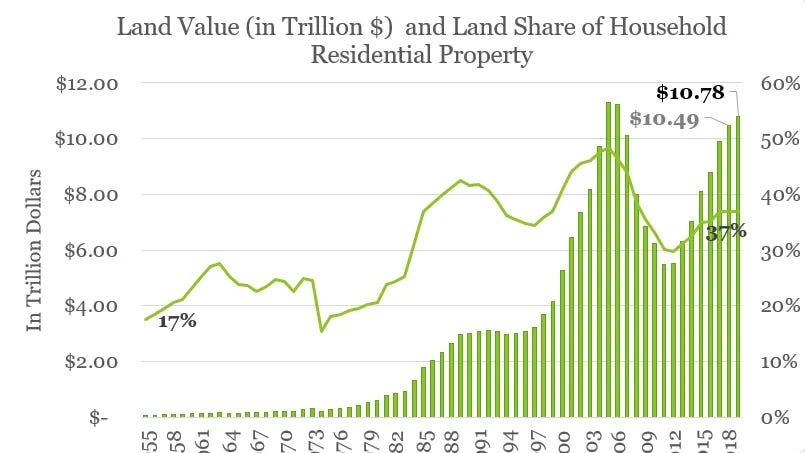
People want to live in specific locations, or have to in order to find work. This drives land values up as demand increases. Policies can make this worse, but the problem will still manifest itself to some degree. (Potentially as affluent people, especially in suburban areas, buying up more land to create setbacks, or simply buying because they can afford it now, or HOAs setting limits, none of which help density, demand, and cost).
"reduce the costs of construction, particularly residential construction (ie: housing)"
Changing preferences are the best way to address this, yet is likely the most difficult to sucessfully influence. Houses being built today are mostly larger homes, and definitely much larger than the majority homes built generations ago. This means more materials, more labor, more regulation, etc. Now we might be using cheaper materials, or less per sqft, or using tools that increase speed of laborers. But I think this is mostly canceled out by just increasing the size of the house (ie we're growing into our fish bowl).
For a personal example, my wife complains that an 1800 sqft house is too small.
This ignores the world's giant pool of floating capital ravenous for returns that jumps on trends and amplifies demand by buying up what it thinks will have good resale or rental value.
I saw this happen in the area I grew up in recently. Some people I know who were struggling to gather a deposit saw their dreams of homeownership go up in smoke as they got consistently outbid on a series of properties by investors.
This would be a pretty harmless outlet of an for a glut of capital if A) land werent finite or B) land had not been slowly untaxed for decades.
Of the two, B is a more prudent way of making property prices sane again.
"Of the two, B is a more prudent way of making property prices sane again."
Maybe if you taxed unused land. Otherwise that tax will end up increasing a resident's rent/mortgage substantially (as it's a perpetual annual expense). So really, you'd have to tax way above what a normal person can afford (average US household about $75k, so $7500 is 10% gross), and that still wouldn't be much of a disincentive to the wealthy (ignoring the fact the the market would collapse because normal people can't afford to buy it from them nor pay the rent).
Now if we did tax unused land, then we are reducing conservation and incentivize development. This is a major concern for some areas, especially around loss of agriculture land, riparian buffers for water quality, etc.
If we had work that was more distributed, like remote is for IT, then it's possible the effects of all the capital flooding a handful of markets would be diluted by spreading it across numerous others. A generation or two ago we had many small cities with industrial or manufacturing jobs. Now it seems many of those cities have shrunk while the national population has grown, mostly concentrating in specific metro areas.
It would do nothing to rents or mortgages intrinsically but it would cause property prices to fall and it could add to the tax burden of regular property owners depending on how it were implemented (i.e. if the tax free threshold were set too low).
>that still wouldn't be much of a disincentive to the wealthy
It would be a massive disincentive to the wealthy, since they own the most property and are used to it being an asset not a liability.
They would dispose of properties that were nonperforming because taxes > capital appreciation + rent and this would spiral as falling prices leads to more hoarded properties being given up.
They would also scramble to rent out previously unrented properties where capital appreciation wasnt covering taxes. More rentals on the market means even lower rents which makes their properties worth even less to them.
I think that is the point. The market doesn't make sense already for people who actually use the homes because of the investors. If there were property policies that targeted investors and forced their money elsewhere, prices would drop dramatically, making housing affordable again.
For example, would you just tax "new" purchases more heavily? Or scale it into existing homes? Give caveats for fixed-income (elderly and disabled)?
Politically, this seems like a tough road, even if it's the best choice. You have to essentially convince people to vote against their own economic self-interest. I think current tax policy around homes is curious because it's one of the few areas that there is a rather clear consensus around economists that it's bad policy that incentivizes the wrong actions, yet we can't seem to change them.
It could be made palatable to regular people by making a high tax free threshold. Most homeowners could be left unaffected.
That leaves 50% of land owned by the 1%. A fair chunk.
Additionally the money could be funneled initially into pensions for the impoverished elderly.
Capital/billionaires would fight back by arguing that it would hit the elderly the hardest just as the howard jarvis taxpayers foundation did with prop 13 but if it was very obvious how many elderly people were helped, crying about grandmothers having to sell multimillion dollar mansions would probably backfire.
They would throw immense resources at trying to discredit and kill this, though. They would use every character assassination trick in the book to stop those pushing it. Some would probably also resort to violence if that failed. It would be an uphill battle the whole way.
A modern blueprint 1800sqft house, yeah, for sure.
But somehow a 1960s split level at 1800sqft is spacious.
We are throwing square footage away on multiple large bathrooms, 2 living rooms, 2 dining rooms, and then wonder why the rooms we actually occupy are so small.
The recent trend towards 4 story narrow houses doesn't help. A literal 1/3rd of the house is taken up by stairs!
I'm in a 2300sqft house that has 4 bedrooms and 3 bathrooms and an office. There is still a bit of wasted space, but not much!
Meanwhile, I've seen new houses, 3000sqft, 3 bedrooms, 4 bathrooms, 1.5 million.
"Oh you want 4 bedrooms? Those start at 1.7 million" <-- Said by an actual house developer
Two living rooms (well, “living” and “family”) and two (“formal” and, well, not) dining rooms are pretty common in 1960s homes at the size being discussed.
Bedrooms, bedroom closets, and kitchens are probably smaller than newer homes, though.
> The recent trend towards 4 story narrow houses doesn't help.
Tall, narrow houses have been a feature of urban single-family homes for a while, I don't think they are a new trend.
When house buying in 2020/2021 I looked at over 100 homes.
Very few, if any, of the 1960s houses wasted space on two dining rooms, and a fair number had basements converted to family rooms but it obviously wasn't an original part of the floor plan.
The 1960s split level design is obscenely efficient in space usage. There are plenty of variations on it, but the well done ones, vaulted ceilings, visible interior wood trusses, are still nice to live in today. The only modern amenities they are missing are a walk in closet and a full master bath.
Clocking in at ~2000sqft they can do more than a modern 3000+ sqft home does.
> Tall, narrow houses have been a feature of urban single-family homes for a while, I don't think they are a new trend.
Agreed, but the new breed is much narrower than before. I've been in Chicago row houses, and sure they are narrow, but the new ones they are building around Seattle are insane. It is basically one room then a flight of stairs. 3 bedrooms, one in basement, one on 2nd floor, 3rd on top floor. It borders on unlivable for a family, not to mention anyone over the age of 35.
Honestly it'd be much better if they just made regular condos, instead of 4 across narrow homes of 4 stories, do 4 flats.
If you want vertical efficiency, we have apartments for that. You get a single staircase and 20 single-story homes instead of 20 staircases in 20 homes.
Its funny that US/UK/ anglosphere seems to have never figured out apartments, in Uk you can't even be a true owner - first you pay leasehold, then you pay ground rent, then you pay service charge (for which they are not obligated to provide any service), so you paid 3 times for the same thing!
And then when yoy find out that your block was built in breach of fire regulations, it's not the material supplier, not the developer and not the building landlord that get the bill, its the leaseholder that does not even own the house that has to pay for 'waking watch' (pateolls by firemen) and any repairs!
People who bought Shared Ownership apartments (you own 25%, other 75% is owned by investors) are responsible for 100% of the cost of fixing the building because between developer, supplier, fire inspector and landlord someone has commited fraud.
UK likes to think fo itself as free country, but I have never seen laws as tyranical and feudal as housing laws here. It's like they were writted for medieval lords to opress their peasanta and never changed.
If you want to know more about this, google 'cladding scandal, UK'
Living in London, I'd happily live in a generous sized apartment (I grew up in one in Scotland - it was fine), but the system here doesn't allow it. The apartments available are almost all very small (with a few very central and highly priced exceptions) and the leasehold system makes owning them and doing work a bureaucratic nightmare. So along with everyone else, I'm buying a house and bidding up the prices of those.
(And in the US it would be two staircases and 20 single story homes, specifically because building codes require two staircases to prevent a Grenfell-like disaster.
People really want to live in their own little hut - as we have done for centuries.
"in Uk you can't even be a true owner "
You can never be the 'true owner' of any land in England. All land is technically owned by the Crown. You can only ever hold an interest in land in England - a freehold being the best you can get, and even those are littered with covenants these days.
I've actually found the opposite. Modern builds seems to prefer open floor plans and higher ceilings that older homes do not. To me at least, this can make the equivalent square footage seem less cramped. To your point though, it's much more common for newer homes to have more bathrooms than older builds of similar size which obviously erodes living space.
Modern ones also do some really stupid stuff with square footage. One house we owned had a massive master suite the size of the entire 2-car garage (it was over it) plus some more carved out for the bathroom, but without any dividing walls or doors (even the [large] bathroom was just an open, wide doorway entry, no closing doors). It was huge, but also not quite big enough to divide into multiple spaces with furniture and rugs or whatever without it looking and feeling weird. A kind of awkward fake-luxury size. And it was a front-back split with a living room in the lower part alongside the entryway, with a fireplace and big window... the layout of which made it almost impossible to set up actual living room furniture in a decent way, so we basically didn't use that entire room and used the basement instead.
The house could have been a solid 500 sqft smaller and felt just as large, with some tweaks to the design. Nearly every other house we've owned, aside from one very old one (by American standards-1910s construction), had similar issues with large areas being wasted for one reason or another, due to how they were designed.
I think the "open floor plan" trend is mostly to look impressive in photos and to get that "wow" factor when you first walk in. In practice, as commonly realized at least, it's terribly wasteful of space and makes houses feel smaller, because it's harder to get a wall between you and someone else, than it is in older houses. Harder to furnish, and arrange furnishing properly, too (not enough wall space, more backs of things visible)
[EDIT] I'd actually liken the open-floorpan trend to the haphazard McMansion appearance of the outside of houses. One thing I've noticed looking at lots of houses over the years is that nice, big, older houses, or newer ones built with balanced and regular exterior layouts, tend to look smaller on the outside than they actually are—or, put differently, McMansion-style houses look much bigger than they actually are. They're loud, and deceptive. Open floor plans are like that for interior space.
Newer homes also seem to be kitchen heavy, and have larger closets (and also bedrooms), all of which reduces shared (and, but for the bedroom part, total) living space with the same square footage.
They often have vaulted ceilings and front bay windows.
While I do <3 a well done modern floor plan, sadly most new houses have garbage floor plans. Ironically, and IMHO, the smaller houses tend to make better use of space out of pure necessity. Take a 1200sqft 2 bedroom house, tell builders they have another 1000sqft, and they'll shove in a 2nd dining room, 3 closets, another bathroom, but no more useful space.
Related, 2 bedroom 3 bath houses make me want to scream.
This seems to mostly be a difference in preference. The house is 1.5 baths and not large ones. Some layout parts are less efficient, like a master bedroom bigger than it has to be (so opposite of the numerous small rooms issue you brought up). But overall there is plenty of room, even a room dedicated as a play room. But overall this is a great example of shifting preferences over time since an average size house was 1970 was about 200 sqft less that this, and I grew up in an 1100sqft house.
Prices vary by location. You can have a 4 bed house build for a quarter of that in many areas of the country.
For example, is it even remotely reasonable as a society to allow extremely wealthy people to own two or more condos in Toronto, when the minimum cost to get any condo is 3/4 of a million and salaries not remotely keeping pace? Is it unreasonable to settle on a definition of excess being that of the multiple residential property owner? Likewise for consideration towards residential property development companies. Maybe it's possible to own a lot of land specifically designated for development, but not for just holding more than one or a few properties.
If there was the political will to do it, it would be very easy.
Just pass a law that every residential property must be owned by real people with their names on the title.
In my neighbourhood, lots of wealthy homeowners have signs up decrying the construction of a sky-scraper that's sort of vaguely near the edge of their neighbourhood, which is currently occupied by a parking lot. The effect it would theoretically have, is adding to the available housing supply in the area for people currently renting at absurd rates because it's impossible to buy anything. It would take away rental income from people who already leveraged themselves too much, and marginally decrease demand for their scarce commodity known as a place to live.
Then, depending on where you are, you have fixed costs for building in an area like geological or ecological impact statements that can be $20k or more. Too much.
Surely people who are currently homeless would rather rent a small house than none at all? I haven't met one demanding '1800sqft or i'd rather live on the street!'
Fortunately the former has been mostly neutralized by the statutory minimum wage being reduced by inflation, but the latter is getting worse, with more such laws being implemented and reducing affordable housing.
One important factor to increasing house size is that localities in the US tend to have fairly large lot sizes. To recoup the cost of building on more expensive land, builders build more house, because the opposite (building 2 or more houses and subdividing the land) is just illegal.
In areas with high supply or low demand, the price of housing approaches the cost of construction.
In places with punitive zoning rules that forbid new construction, limiting supply, and have high demand (I'm looking at you, San Francisco) the price of housing dramatically exceeds the cost of construction.
Getting loans to build on these lots is nearly impossible, which contributes to their continued decline.
My natural inclination is to agree with this statement, but I'd like to hear your rationale. Can you elaborate on your preference? Is it location dependent?
It’s not location dependent. Phoenix and Vegas or wherever are doing themselves no favors by building out rather than up.
Area has a lot to do with prices and unless these outer areas become self sufficient so much that Central London or rich boroughs lose lustre, the inner areas will command a high price.
Single-use single family zoning is being eliminated in some areas of the U.S., allowing accessory dwelling units to be built, etc. Even California just passed a low changed R1 to R3 for all cities in the state (pending court cases, I assume).
Since 1990, Japan's population has risen by 2%, the UK has grown 17%, the US by 32%, Canada by 37%. That growth is bound to put a significant pressure on property prices.
(Not saying that allowing this is necessarily good or bad, but it's definitely something London has)
On a micro scale, where I live, it’s not. A $2M home in Toronto is maybe $400k where I live, an hour down the road. And I know a lot of local workers who commute to Toronto every day to work on sites. (They do 7-3 to avoid traffic and the neighbours hate their nail gun wake ups)
And yeah, commuting is nonsense. I’ll never ever do it.
There's a sci-fi novel I want to write some time...
You know how some countries have mandatory military service?
Well, what if all of the "Essential" jobs, all had mandatory service?
I want to do my own cherry-picking, selecting the "Essential" jobs, and especially those that are toilsome but that you can do with not a lot of training, and then do the math to see how many hours each able-bodied person in a country would need to do each job, in order to satisfy all of the needs of everyone in that society (able-bodied, or not.)
And then build up a story around some people who are finishing their Essential Jobs, and are deciding whether to Retire into living off the dole, or whether to transition into some Skilled labor to live in more luxury.
And then there's the fact that automation is making it so that less and less actual manual effort is required for the Essential jobs. So, does the society start categorizing new jobs as Essential, or do people end up with more discretionary time?
I feel like this would have made a pretty okay Star Trek culture to encounter...
I heard that Starship Troopers book had something like what you described but I haven't read it.
(Tweet from the author)
Under that scenario the relative fairness of paying for jobs to be done would be replaced with the relative unfairness of being friends with the right people in the "plumber corps" to fix your toliet.
While not exactly your setup, it explores what happens in a society like this.
>You know how some countries have mandatory military service?
>Well, what if all of the "Essential" jobs, all had mandatory service?
Corvee labor, aka a sci-fi novel about a concept in existence since Ancient Egypt.
My income here in Germany is alright, according to statistics I am in the top 20% with my monthly income. Unfortunately, I will not be able to buy a decent apartment in the city to start a family if my gf/wife is not also in the top 20%, we get some support from parents and agree to pay off the debt for the next 35 years.
This is the only reason why I am not starting a family.
Times were different, housing was more affordable, but today everyone wants to live in the urban areas, the human population is growing, building standards increased, people can own land forever. In the city where I am living apartments were relatively affordable 20 years ago, today they cost twice as much.
If you ask me then I have to rather populist solutions for the housing crisis: 1) nobody can own land; land is property of the people and can only be leased for 75 year or so; 2) one apartment per head. Not more. 3) all profits from selling real estate are taxed 100%. Those 3 measures would quickly lead to a huge price drop and speculation would not make much sense anymore.
There is no need for everyone to live in a big overpriced city.
The issues are in borderline countries that have a high population growth and are prone to migration.
+
[..] Builders say apprenticeship requirements drive up the already sky-high expense of affordable-housing construction in a state where it can cost as much as $700,000 a unit to build in dense, urban areas such as San Francisco. They also argue that the union-backed provisions could slow or halt construction of affordable homes in lower-income rural and inland areas where there isn’t enough available union labor.[..]
[..] California’s State Building and Construction Trades Council, which represents 450,000 ironworkers, pipe fitters and other skilled laborers, has blocked numerous bills it says don’t guarantee enough work for its members. It contributes tens of millions of dollars to political candidates and campaigns, engages in aggressive lobbying, and pays for advertisements that portray opponents as lackeys of greedy developers.
Legislative insiders say the success of the union known widely as “the Trades” is one of the main reasons Sacramento politicians have struggled to pass bills streamlining construction approval and easing zoning restrictions. Researchers say those steps are urgently needed to address skyrocketing real-estate prices and rents, as well as homelessness.
“They’re a gatekeeper for any significant legislation moving through Sacramento” on housing, said Ben Metcalf, managing director at the Terner Center for Housing Innovation at UC Berkeley and former head of the state’s Housing and Community Development agency.[..]
The upshot is roughly that the owner of farm (hedonic) land knows how much their land is worth both with and without planning permission and the minute housing is thought of the price of the land 10x.
And that's fair - no one wants to look like a chump. So any house building scheme to solve the housing crisis suddenly has this price built in, and thus any house building scheme immediately becomes too expensive to undertake.
There was a solution in UK in early 1950s. A 100% land value tax. If you bought land for 10k and sold it for 100k you owed the government 90k.
This quite simply took the heat out of the market, and allowed the government to invest in roads and schools and hospitals and so on. It mean that UK built two whole New Towns (widely seen as concrete monstrosities) but the point is they got built - enough new housing in a handful of years to create towns that still live breathe 80 years later.
If we want house building schemes we have the answer.
I think this is fair - the land itself is a natural resource that the owner has (presumably) done nothing to improve - they are just hogging it so that nokne else can use it
[0]: https://www.supermoney.com/inflation-adjusted-home-prices/
New construction requires higher quality electrical panels with fancier breakers, more GFCI outlets, and much, much, better insulation.
Builders have always used the cheapest materials they could get away with, and the cheapest labor they can hire. That has always been the case.
The old houses still around are the exception to the rule, not the norm.
So true. In fact, you could teach the concept of survivorship bias by looking at old homes, and the statement "they don't build them like they used to".
You need to get outside the beltway or at least go to some of the "bad" neighborhoods within it.
The only place your statement is close to true is very wealthy areas that are constantly being redeveloped. Other than the occasional prime lot or desirable commercial site new construction fills in around the old or adds on to it. Big lots get subdivided and a new structure goes on the empty chunk and buildings get additions. Basically nobody is demolishing any building that is sound because buildings are expensive and why would you waste a perfectly good one.
Generally speaking you only see good buildings get demolished when the land becomes worth so much relative to the structure that it makes economic sense to knock it all down and do a clean sheet because the little extra optimization you get from doing that is worth more than what you would have saved by keeping the sub-optimal structure.
My city has passed so many building code requirements on remodels that now days it is, from what contractors have told me, about the same price to remodel as to tear down and replace.
I was quoted over 150k to add a new bedroom to the 2nd floor, most of that is because the city would require me to completely replace my roof structure with a brand new one to bring it up to modern insulation standards.
I imagine, without doing the math, that the carbon footprint of tearing down a house and building a new one is much higher than whatever energy is going to be wasted by having amazing-but-not-the-best-insulation in my attic.
Being right outside the city core helps justify the price of redevelopment. However, I think the larger buildings are getting facelifts rather than rebuilds.
Did you read the article or just the title?
People are moving into them because they want to. Lower crime than the city, less lawn to maintain than the country, plenty of room indoors for the whole family during bad weather, looks posh (even if any craftsman would scoff at the crap construction).
I wouldn't ever buy one myself, but some people wouldn't have it any other way.
Land is bought and sold on an open market. Everyone can decide for themselves what is most important to them and what they can afford. One factor behind living in a major city is certainly easy access to in-person employment. But there are a ton of other factors (restaurants, culture, sporting events, community, etc.). If you are willing to pay a lot of money to be close to those things even if you don't use all of them, that's your choice and it's perfectly ethical.
1. I mean, unless you're talking about Boston in the 90's where the Charles was a pristine beautiful river that only an absolute madman would ever dare to fish on or some other similar pollution driven limitation of services... but that also shifts the original point since fisherman have no desire to live close to the Charles (and might actually be harmed by having to boat up and down the Charles every day when compared to living in Chelsea or Southie.
If such an obligation exists, it's the government's obligation, not an individual one.
The best thing an individual can do to provide housing to other people (aside from build it) is to support the loosening of regulations which make it difficult to build new housing. Those regulations tend to be worst in the major employment centers.
Morality is useful to avoid rationalizing things that we know are wrong. For example, killing is wrong -- we don't want individuals making complex rationalizations about how the end justifies the means.
But something as complex as the place a person chooses to live? No, that's a morally-neutral choice. It may not be optimal for the benefit of society, but that's not what morality is about.
Humanity justifies it in self-defense and war. A long time ago, civilizations justified human sacrifices. It doesn't take a complex rationalization. Only a convincing one.
While the platitude of "killing is wrong" is repeated by everyone, if you dig deep enough, people will still provide carveouts for themselves and their country or religion. Whether killing is good or bad is assessed by people objectively in terms of motives and consequences, and, on a subjective level, manner and "proportion". There wouldn't be a distinction between homicide and murder if humanity as a whole practiced what it preached.
>But something as complex as the place a person chooses to live? No, that's a morally-neutral choice. It may not be optimal for the benefit of society, but that's not what morality is about.
I agree entirely. However this seems like a massive departure from what I've had to argue against in this forum. Plenty have claimed the opposite, that morality is all about society and any correlated externality IS obliged to be solved by government or the people through a half-baked redistribution scheme.
I'd argue that choosing to live in any area for any reason does not in any way make you morally responsible for the externalities of that choice. What you do while living there you are morally responsible for, but merely the choice to move does not bear any responsibility.
So, yes, NIMBYs bear some moral responsibility for the housing situation, but simply relocating does not create responsibility or moral hazard.
For example, if I was permanently remote, I would like to move to a cheaper area. I can't because my wife doesn't want to leave the current county (because "It's the best county in the world"). Although I'm also not in a heavily populated area, more so on the edge of being rural.
For some reason that comment really piqued my curiosity. Obviously lots of us might choose different areas for various reasons (schools, weather, scenery, politics, recreational opportunities, cultural sites, etc). But to make a declaration of world's best must mean a lot of confidence in the greatness of one's county! It also reminds me how little I identify with the county I live in, perhaps because I've lived in a few, and perhaps because I currently live almost directly on a county border and can see the neighboring county from my back windows.
Still, I'm curious what about your home county makes your wife so enthusiastic about it compared to well, everywhere else?
I asked her that during the discussion. She wasn't able to give any explanation. My guess is that it's because she's never lived anywhere else. I've lived multiple places. They each have their good and bad characteristics.
Second, somebody living in a small super expensive apartment whilst fully working remotely is likely to have a miserable time (COVID situation). If they would have the type of job security guaranteeing they can continue working remotely for a long time, surely many of them might leave. Those that stay likely have non-work reasons to stay, like proximity to family or other attractions of the city.
As for home ownership, it's a market, and there's no such thing as morality in markets. If you think that sounds cruel and selfish, try this simple thought exercise: the people currently priced out of owning a home, imagine they somehow do acquire a home. Now add 10 years and their homes appreciating 50% in value. Now they sell, do you honestly believe that these people that were all about social fairness and morality now apply a 50% discount to the buyer, out of the goodness of their heart?
I don't think so.
Likewise, if something happens to your home (expensive repairs, mortgage issues) do "moral" people come to help and compensate you? No. Your problem, you're the owner.
Anyway, I do empathize with the point, and I think we need a systemic change. The spreading of work/cultural locations into more places/hubs. The idea that you can cram ever more people in a tiny area and somehow keep this stable and working is just a ridiculous illusion.
Extra supply doesn't really work in these areas, so indeed...reduce demand, by moving it.
Is it okay to sell people? Do you own your children? If you own land, do you also own anyone who lives on that land?
At various point in history answers to all of the above were yes.
Should we have a market for organs? There is a market for intellectual property, but what is intellectual property - maybe there should be a patent for everything that exists, say a pencil, and they should never ever expire. So noone except that owner should be allowed to make pencils.
Should we have laws against Dumping, self dealing, wash teading, antitrust, insider trading, tragedy of the commons, negative externalities, collusion, cartels, misselling?
All those behaviours arise naturally from markets.
Currently, a home is personal property and thus a market. The ownership of assets is a fundamental building block of a modern capitalist society.
The point of owning a home is to have a house to live in, which you like and can customize to your liking. Another point/benefit is to take control of your living expenses and to be independent from a landlord.
The fact that real estate prices are skyrocketing has nothing to do with the idea of home ownership, it's a side effect of an imbalance in supply and demand. Yes, some investors will abuse this imbalance to build wealth but the true root cause is the imbalance in itself that makes it possible.
It's not rocket science. You cannot keep cramming ever more people in the same area. Supply will never meet demand. No amount of policy or taxation will solve this. The only structural long term solution is to address the demand side. It should not be required for half the population to move into a handful of cities just to have a decent job.
The only one who the cost of materials matters to is the builder. If it costs them more to build than they can sell it for (within whatever % profit margin they want), then they simply won’t build it.
Which, as a catch-all condition, is next to useless to examing why the price of something is what it is.
The question then moves to the next turtle: why are people willing to pay X for a house in area Y.
>The cost of building is not relevant in any way to that.
Well, that's not true. In a place were land is plentiful and cheap, the price to get a house is dominated by the cost of building. Doesn't matter if there's an existing house that someone is willing to pay 100 for it. If people can trivially buy land and build for 20, that would be the cost to own a house in the area (note: a house, not THAT particular house).
Definitely true, just look at home prices in the south and midwest where there is plenty of land [0].
[0]: https://www.supermoney.com/inflation-adjusted-home-prices/
It's not about there being cheap land in the state in general, it's about being cheap land where people want to live.
Or, inversely, sure, home prices in the south and midwest might be high in expensive areas (e.g. major city), but they're much lower where land is cheap.
I may be happy to buy a house for anything less than 200k but if all houses are selling for 100k, then that (or something like it) will be the amount I am actually willing to pay.
If construction costs rise and now builders are only selling houses for 150k, I will now be willing to pay that price.
The actual costs of real labor and real materials is pretty cheap. Even with the elevated building costs today you could still build an average home for sub $40,000 dollars if you control all aspects of the process.
There's this company called Shepherd or something like that that does build insurance and it's a fantastic example of how to make something meaningful.
Why do we allow tax-heaven based shell companies to buy housing in areas where we officially declared a shortage, especially when we know much of that money is either stolen, or comes from dictators, or is doing tax evasion? It can't be helping the problem
> if you could reduce the costs of construction, housing costs would fall as well.
Why? What drives prices down is competition. Lower costs of construction might help with that, but only slightly, and I would guess that it will only help enough to shift the prices if construction costs are lowered by a magnitude or so.
This whole argument sounds like arguing that we must reduce wages across the board in order to lower prices of goods. This never works.