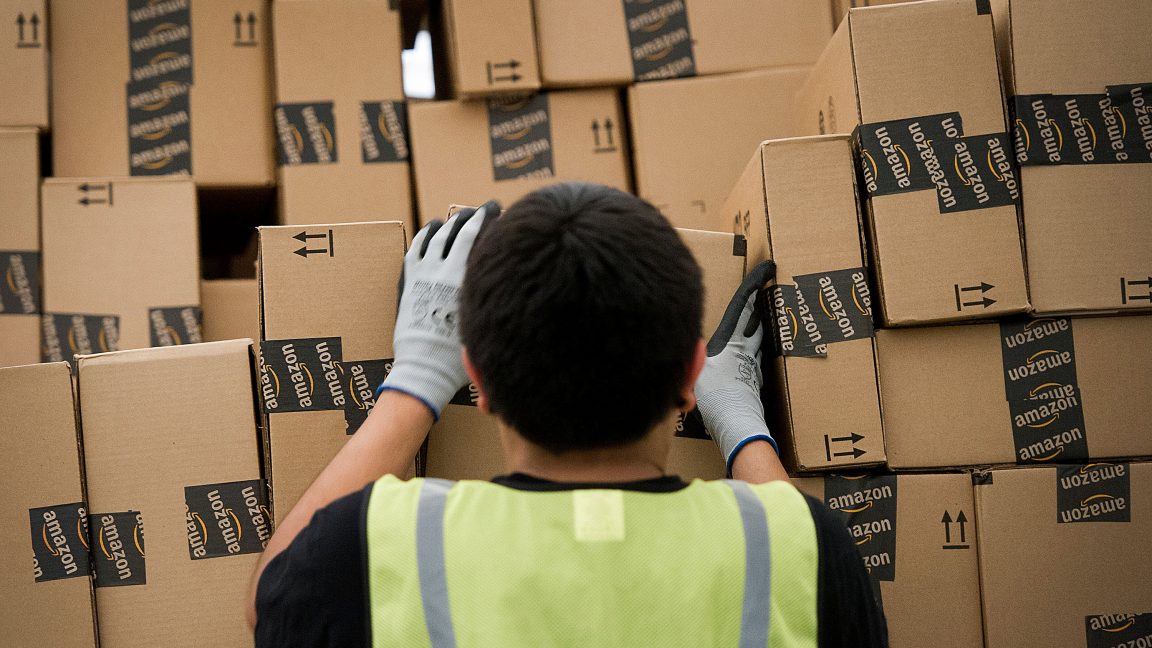
Amazon lied about using seller data, lawmakers say, urging DOJ investigation
Retailer had denied using third-party seller data to develop its own products.
Ars Technica
343 points · by ProAm · 4y ago · 100 comments
That's pretty incredible. I'm curious what kind of data this is; knowing the nature of the data would help us understand how platform operators can abuse their position.
There are policies in place saying that you definitely can't look at the data around which third party sellers are doing well, selling lots of stuff. But also there's no auditing in place to see if you check it or not. It's all a big data warehouse and you have access to it.
And hey, you've heard everyone else is looking at this data. You're just taking a quick look to get ideas do you don't get fired. What's the harm? You'll help the company do well and won't have to polish your resume.
[0] https://www.businessinsider.com/amazon-performance-review-6-...
Construct an algorithm that tells you what you want, based on the data that you're not supposed to be using, and then throw your hands up when anybody asks and say "Nobody really knows how ML models work."
Or before machine learning was an option: management consultants.
    import torch
design_parameters = torch.chinesewall(existing_product_url)PMs at Amazon, even people who need visa sponsorships, have options (and probably better options). Don't defend their poor choices. Engineers at Amazon have even more options.
You mean one of the companies Amazon is driving out of business? For some reason they aren't hiring.
Imagine you could get out of a robbery charge by claiming it was perpetrated by a rogue glove.
It’s a problem because the small sellers take the financial risk trying to sell a new product, then when Amazon sees it’s doing well they make the clone and get the profits.
To illsutrate my point, please take a look at the results: https://www.google.com/search?q=site%3Anews.ycombinator.com+...
I think it indicates a deeper problem, either on how we perceive these companies, or how Amazon succeeded in making itself look like a random traditional company. I don't know the solution outside a very prominent decade lasting lawsuit we could all point at, the same way we had the Microsoft antitrust lawsuit decades before.
They can't have it both ways.
You positively need to know what your users come to click on, where they bail, what features they never use, what browsers constantly drop out at this specific part of your website, what IP uses the bot that scrapes your most costly site wide search every millisecond etc.
Sure, any of these data could be derive from more focused, pinpoint check if you knew in advance what exactly you need to know. But let's be realistic, there's no way to anticipate every single use case and only collect the minimum data needed to fulfill it.
I don't see detailed usage data collection as a critical issue as long as it isn't sold/leaked/stored for decades/misused to harm. We can come up with so many cases where it has been effectively misused, but I'd argue it's like saying kitchen knives are misused again and again to kill people and we should stop their use. It's not realistic.
Personally I don't like having to show my ID when I walk into a store and then have a guy follow me around with a clipboard writing down everything I look at, touch.. I run out of such stores which is why I deleted my Amazon account.
How does this differ from say Walmart/Target/CVS etc., launching their own private branded labels?
Even they have access to all the data on the best selling products.
Amazon is a marketplace, and pays nothing to buy your products when they're offered for sale on its virtual shelves. It purports to provide an open and equal common area for companies (including itself) to sell products, yet only Amazon has access to the treasure trove of data about the behavior of consumers on its site.
This is not true for all products. Some are sold under a pay-per-scan model, where the product is owned by the supplier up until the barcode is scanned at checkout, whereupon it is immediately purchased by the store and sold to the consumer.
For other products, suppliers may also be required to accept unsold goods for a full refund of the store’s purchase price.
Stores are marketplaces too, and shelf space – particularly the valuable shelf space like end caps – is not free.
Walmart does this too. Newegg made the switch several years ago. Large retail outlets which do not have a "marketplace" online option are the exception rather than the rule.
Different companies do different levels of vetting, but the retail ecosystem is vastly more accessible to small-timers than it was in the 2000s.
If they instead told Congress that this is a long established retail practice, I would be more sympathetic to that argument.
If you put your products on Amazon marketplace, you are expected to join a marketplace. You don't necessarily expect for Amazon to also join the marketplace by using your data to compete against you.
Also you can use Amazon services and warehouses even for products that you do not wish to sell on Amazon website. Essentially using Amazon as a 3PL service. Again, you might not expect Amazon to use your data for their own products.
If you sell your products to Target, this isn't exactly a marketplace. This is a retail outlet. You know they can measure your sales, measure your competitor sales, etc. And you know they won't lie to you about doing it.
That's fine as-is -- nothing wrong with that in principle -- but what I seem to recall employees began doing (and I can totally imagine how this would become an underground "sneaky trick" that employees would begin to learn and share with each other) was to create so-called aggregate groups that only contained a very small number of merchant businesses.
That way they could claim (and perhaps keep a straight face when saying) that they were only looking at aggregate group-level figures, but the statistical reality of the situation would have been that they were looking at information about a few -- or perhaps even only one -- business.
When you apply to rent a house, you're required to provide pay stubs and salary information. The landlord can (does?) use this to know how much they can jack up your rent next lease term (my landlord raised our rent $800/month in January).
Same with insurance salespeople, car salespeople, etc. Everyone who gets access to your financial data can use it against you.
There should be a 3rd party involved -- they take your documentation and then report to the landlord/salesperson/etc. a simple "is the person qualified?" Yes or No. And then permanently destroy said documentation.
And it's a safe assumption that everybody who can also will. There's too much money involved to let the opportunity slide.
BTW: A $800/month increase is insane!
For example, the Amazon Basics guitar pedals are created by Nux pedals (the PCBs even have Nux on them).
So from what I can tell a lot of these are not ripoffs, just rebranded products. Amazon doesn't need to waste resources on manufacturing products that are already being sold on their site, but they can make deals with people that are already manufacturing those products.
With this reputational and data exposure hit revealed, exactly how much are you going to believe the same organization when they say, “we’d never violate your trust placed in our AWS services!” Keep in mind this is the same organization that gleefully says, “your margin is my opportunity”.
The way to deal with this is to arrest a whole group of Amazon execs, and offer the usual deal - the first one to make a full confession and implicate others gets off, the others get prosecuted. This is official DOJ policy.[1]
[1] https://www.jdsupra.com/legalnews/sometimes-confession-is-go...
Corporate fines seem ineffective and almost useless , especially because these sorts of actions will often benefit the individuals undertaking them (principal agent problem). I suspect the motivation behind corporate fines is that they can be large monetary amounts, and look good for the investigator/agent/attorney.
Personal fines and no prison time just tweak the risk/reward calculation a little bit. These executives make a lot of money, and I would guess if they are the type to do illegal behavior they wouldn't mind gambling if the reward is great enough. I could even see it making this behavior more likely to happen if it's clear that they won't go to jail for illegal behavior and all they have to worry about is a fine and losing their job.
Maybe even extend that to all government suppliers...
False.
> before then, cops and the prosecutor only need "probable cause" which is typically understood to allow that evidence may be gathered later.
No, it isn't; probable cause must be based in evidence. For cases requiring indictment, this evidence is presented to a grand jury before charges can formally be filed; for cases where the conditions allowing warrantless arrest do not apply, it occurs in the presentation of evidence to support an arrest warrant; for other cases the evaluation (by hearing or otherwise) happens generally within 48 hours of arrest, and delay to gather evidence has specifically been ruled unconstitutional.
Is Amazon Cosa Nostra nowadays? I find it hard to believe they'd be more scared of other execs than the government..
It mostly just lacks inspiration.
This is how you get false confessions and wrongful convictions. Especially for conspiracy where burden of proof is he-said/she-said
This isn't a dope dealer growing weed in his car and having his buddies sell it for him. These sorts of operations produce a lot of paperwork. As an employee who is actually tasked with building/working with all of these systems/processess, you don't get inducted into the secret conspiracy with a nod, wink, handshake, and a secret decoder ring.
* for poor people.
It's time to set an example. This sworn testimony was knowingly false. So charge this Senior executive with lying to Congress and lay down the likelihood of prison time. Watch them flip on their other execs.
Everyone suspected they were lying, but suspicion isn't proof. If proof has emerged, it's imperative to go hard enough to make up for the many times where conservative standards of proof let obvious lies slip through.