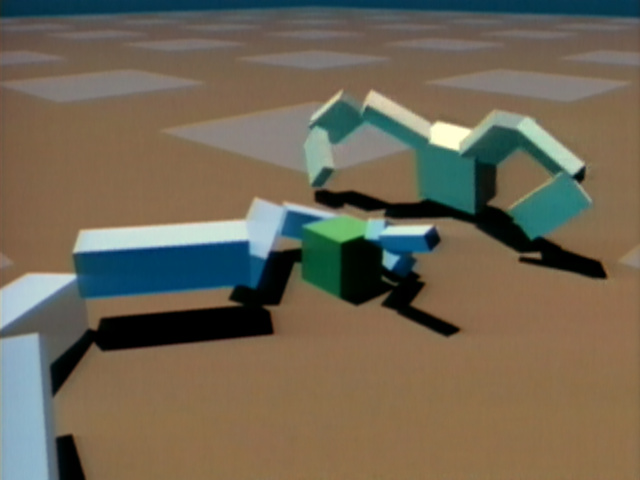
Evolved Virtual Creatures by Karl Sims, 1994
Demo of simulated block creatures performing various evolved behaviors.
karlsims.com
71 points · by sirnicolaz · 4y ago · 33 comments
He evolved a tone discriminator on real world hardware, and after a few thousand generations the resulting circuit was one no engineer would ever imagine - it made use of transistors operating outside their saturation region, and subtle secondary magnetic or PSU-line effects from nearby gates not even connected to the logic pathways. But it was effective and amazingly space-efficient.
Physics in the real world offers an incredibly rich and vast set of variables for evolution to play with, and I feel like our attempts to simulate it in software constructs may be too limiting to yield results approaching AGI.
[1] Article: http://www.damninteresting.com/on-the-origin-of-circuits/
[2] Paper: https://citeseerx.ist.psu.edu/viewdoc/download?doi=10.1.1.50...
Thank you for sharing this!
https://www.reddit.com/r/MachineLearning/comments/2t5ozk/com...
I remember running that as a screen saver back in the day.
It’s of a similar age and goals, but evolved physical creatures with a screensaver.
I ran that screensaver as a middle schooler and happened to work with Prof. Lipson at the Computational Synthesis Lab in college.
Like other posters here, I feel genetic algorithms got a bit overshadowed by neural networks. Circa 2010, GA’s were capable of some real feats that still seem cutting edge today: deriving the full set of differential equations of metabolism for a bacteria, self-modeling through exploration, finding fundamental laws of physics by watching a double pendulum video, and more.
A ton of good came out of that lab, including a big part of modern open-source 3d printing (which was originally pursued to print the multi-material GOLEM robots!)
It would be interesting to run this software today… probably would run on a phone, now.
> Typical production runs show sustained performance (including communication) in the range of 47--50 GFlops on a 1024 node CM-5 with vector units (VUs).
---
I did a comparison of a Raspberry Pi to a Cray-1. It was... very impressive for how far it has come.
I guess that's 32 nodes in the terms of your quote?
This is very interesting, and especially intriguing since this is a 1994 video and I haven't seen any modern examples of this, which would be equally interesting.
Thanks so much for this. I'm amazed it is still there.