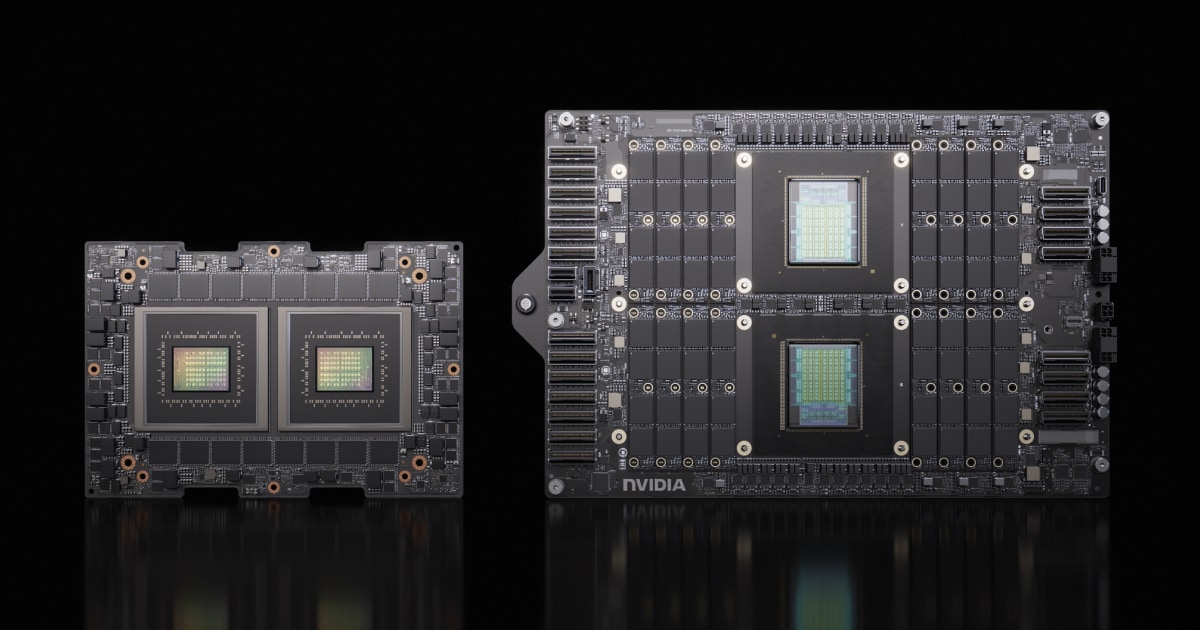
Introducing Grace
A CPU Purpose-Built for Servers Running Terabytes of Data
NVIDIA
418 points · by intull · 4y ago · 185 comments
https://www.anandtech.com/show/7621/nvidia-reveals-first-det...
So many computing devices such as Nvidia Jetson and Raspberry Pi are simply not available anywhere. I wonder what's he point of bringing out new products when existing products can't be purchased? Won't the new products also simply not be available?
Custom build Mac Studio, on the other hand, takes 10-12 weeks.
Apple bought out the entire capacity of TSMC's 3nm node [1]. I would not be surprised if the deal actually was for Apple to fund the construction of the fab in exchange for this level of priority.
[1] https://www.heise.de/news/Bericht-Apple-schnappt-sich-komple...
So GPUs are not high priority? Because they are out of stock pretty much everywhere too.
I know which SKUs I would be prioritising.
There are shortage in low end, high NM, mature node. This is on 4nm leading node.
All of a sudden there is real choice of ARM CPU on Server. ( What will happen to Ampere ? ) The LPDDR5X used here will also be the first to come with ECC. And they can cross sell those with Nvidia's ConnectX-7 SmartNICs.
Hopefully it will be price competitive.
Edit: Rather than downvoting may be explain why or what you disagree with ?
Apple isn't going to give up the substantial performance benefits of on-package unified memory in order to support DIMMs. Therefore I predict that we'll see a two-tier memory architecture with the OS making automated decisions based on memory pressure, as well as new APIs to allocate memory with a preference for capacity or performance.
The chassis design is new enough that it was designed with an eventual Apple Silicon Mac Pro in mind, so I expect to see minimal change to the exterior. It might shrink and have fewer slots (particularly since most users won't need a slotted GPU) though I think that's unlikely given that its height and width was defined by 5U rack dimensions.
People also seem often to forget that interconnects are a significant amount of modern power budgets - look at the Epic IO die often using more than the cores in many workloads. It may be the the M1 family looks less attractive when you actually have to add these requirements.
Perhaps there's some possibility of having both a tightly-coupled RAM package and also have an extensible memory system - though that has significant management complexity if you try to treat it like a cache, or likely needs app support if it's some NUMA system where they're mapped separately. But possible, at "just" the cost of the extra memory controller.
When Jensen talks about Transformers, I know what he’s talking about because I follow a lot of talented people.
https://www.kaggle.com/code/odins0n/jax-flax-tf-data-vision-...
Robots in disguise?
https://www.intel.com/content/www/us/en/architecture-and-tec...
edit: the market pretty much went from gaming as the primary pillar to gaming + HPC, which makes it far more attractive since you'd expect it to be much less cyclical and less price sensitive. Raja Koduri was hired in late 2017 to work on GPU related stuff, and it seems like the first major products from that effort will be coming out this year. That said, they've obviously had a lot of failures in the acelerator and graphics area (consider Altera) and Koduri has stated on Twitter that Gelsinger is the first CEO to actually treat graphics/HPC as a priority.
I find it strange that Intel has basically just left the entire market to nvidia, despite having 10-15 years warning and running their own GPU division the whole time.
[1] https://en.wikipedia.org/wiki/Deep_learning#Deep_learning_re... [2] https://en.wikipedia.org/wiki/Titan_(supercomputer)
I can't find a new dGPU at MSRP so I'm going to see if the Intel Arc cards are more readily available, and if not, I'm probably going to part out my desktop and move permanently to using Intel NUCs. Mostly for the GPU contained within. It seems like the days of getting your hands on a dGPU are over, and I'm not fighting over them.
[1] https://en.wikipedia.org/wiki/Larrabee_(microarchitecture)
NVidia tooling is the best among all GPU vendors.
CUDA has been polyglot since version 3.0, you get proper IDE and GPGPU debugging tools, and a plethora of libraries for most uses cases one could think of using a GPGPU for.
OpenCL did not fail only because of NVidia not caring, Intel and AMD have hardly done anything with it that could compete on the same tooling level.
This has been done as a commercial product with the Ampere ARM server chips. The base model is about $8k.
However, the price tag will be too high for a lot of desktop buyers.
(There are smaller Tegras around though)
It's theoretically possible, but there's no standard for it.
Once enough patents expire all ISAs are eventually equal, I'd think.
I’ve been using ARM since about 1992 though so I may be biased.
This will probably cost them some market share, but they have plenty of cash to weather there current manufacturing issues, they still have world-class CPU design talent which they've proven over and over and over again, and they have some very interesting products & technologies on the roadmap.
ARM offering a fight for the first time ever is not going to be a 1-hit KO against the goliath that is Intel.
Arm has a much more efficient and also much less profitable business model, and Intel will never catch up unless they adopt it. They'll never do that so they'll fade away like IBM.
are they going through TSMC like NVIDIA or are they using Samsung?
That is only the CPU though, they might deploy it as Grace + Hopper config.
An interesting angle here is these support partitioning even better than in the A100's. AFAICT, the cloud vendors are not yet providing partitioned access, so everyone just exhausts worldwide g4dn capacity for smaller jobs / devs / etc. But partitioning can solve that...
396MB of on-chip cache… (198MB per die)
That’s a significant part of it too.
The contention on that memory means that only segregated non-cooporative as in not "joint parallel on the same memory atomic" will scale on this hardware better than on a 4-core vanilla Xeon from 2018 per watt.
So you might aswell buy 20 Jetson Nanos and connect them over the network.
Let that sink in... NOTHING is improving at all... there is ZERO point to any hardware that CAN be released for eternity at this point.
Time to learn JavaSE and roll up those sleves... electricity prices are never coming down (in real terms) no matter how high the interest rate.
As for GPUs, I'm calling it now: nothing will dethrone the 1030 in Gflops/W in general and below 30W in particular; DDR4 or DDR5, doesn't matter.
Memory is the latency bottleneck since DDR3.
Please respect the comment on downvote principle. Otherwise you don't really exist; in a quantum physical way anyway.
Game Over!
What are the things that 1030 can do that G13 will struggle with?
https://www.realworldtech.com/forum/?threadid=197759&curpost...
I recognize what you are calling out/that performance will be the same on some workloads if you distribute or not. I would just point out less manufacturing causes less e-waste/I would rather live in a world where Nvidia sells 50 million 10*0 cards, than 500 million 1030 cards to create the same amount of compute in the world. It's not just the power costs to consider (but it could be there is a reality where running 500 million 1030s for their lifetime wastes so much less power, that the manufacturing costs to the planet are worth it).
Not only that. On-chip gives you high precision synchronous time (all cores observe the same time) so you can use synchronous distributed algorithms that are unsuitable for ethernet networks.
This type of hardware allows for much better solutions to some problems.
After 13 microarchitectures given the last names of historical figures, it's really weird to use someone's first name. Interesting that Anandtech and Wikipedia are both calling it Hopper. What on Earth are the marketing bros thinking?
So expect a future Einstein GPU to come with a matching Albert CPU.