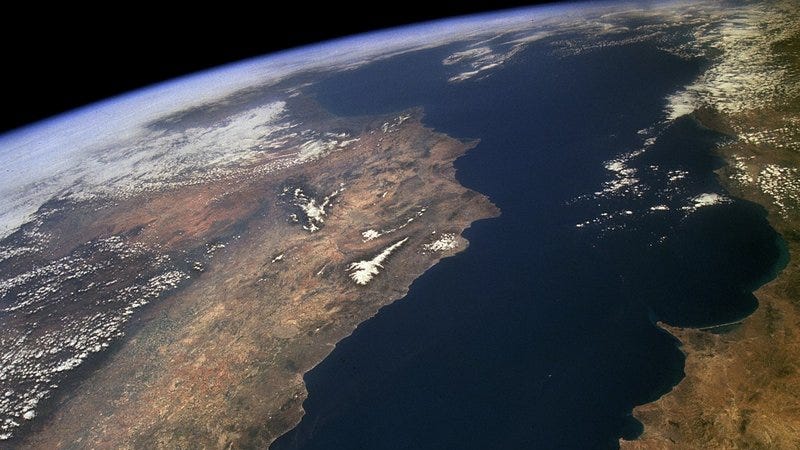
In Search Of A Flood Like No Other
"Zanclean Megaflood? What's that, a glam-rock band?"
everythingisamazing.substack.com
209 points · by bandibus · 4y ago · 59 comments
https://www.youtube.com/watch?v=H6Ma0SVjMHA
Starting at around 1:00 you can see the entire pacific ocean looming behind this thin and crumbling earth wall. And then the water comes.
Here is the cove it created: https://www.google.com/maps/@4.402039,100.5917748,1546m/data...
But I still agree that is near to impossible to imagine the scale of the peak inflow.
The video from Malaysia is water flowing into what was formerly a mine pit so (like a dam) the wall is going to be about as steep as the geology can support. Natural geology tends to create much more mild slopes.
My two guesses:
- The natural barrier was quite low (due to some combination of things). Then waves from either an exceptional storm, or an tsunami, swept over the top - eroding it enough to start the run-away erosion/flooding process.
- Setup similar to my first guess, but the soil/rock/bedrock of the natural barrier aren't able to withstand the groundwater pressure and flows. (Think of a slowly-failing dam, with water seeping through it faster & faster.)
Wikipedia's best guess:
> The most widely accepted hypothesis is that a stream flowing into the Mediterranean eroded through the Strait of Gibraltar until it captured the Atlantic Ocean...
(Which is more-specific version of your second idea.)
Starting very small and then growing exponentially.
When I was a child we also did something like in the video. The initial channel was very narrow and we could have easily stopped it by putting back some sand, but 15 minutes later through the game of erosion the stream was so intense that it became impossible to even cross it.
javascript:(function()%7B(function () %7Bvar i%2C elements %3D document.querySelectorAll('body *')%3Bfor (i %3D 0%3B i < elements.length%3B i%2B%2B) %7Bif (getComputedStyle(elements%5Bi%5D).position %3D%3D%3D 'fixed') %7Belements%5Bi%5D.parentNode.removeChild(elements%5Bi%5D)%3B%7D%7D%7D)()%7D)()
substack.com##.main-menu-content:style(position: relative !important)the author's regular readers might be interested in this though. to me, a reader sources from HN I wanted to get to the factual history of the event, than the author's background as well
Here's a site that lets you step through it one panel at a time: http://geekwagon.net/projects/xkcd1190/ . Well worth a read.
It also inspired the Saga of the Exiles book series by Julian May. (It's presented as an act of terrorism by time travellers, to repel alien invaders.)
I should watch it again. It was lovely.
There are quite a few videos of it on YouTube [0].
How long would it take to reach "homeostasis"?
there's already semi-stable thermohaline layers between the med and the atlantic. differential current flows depending on depth.
[https://www.sciencedirect.com/science/article/pii/S001282521...]
There is an enormous amount of intrinsic value and highly engaging content in science. Scientists need to have the courage of their convictions, and express what they find so interesting and beautiful about it.
I'm very interested, but when I anticipate such presentations I run: I expect they will displace the interesting stuff with the presentation, and/or it will distract from or obscure it, sometimes unbearably. I don't want to eat delicious food with spoons full of sugar.
All I know is my personal experience: I struggled through years of science journalism, popular scientific coverage, etc. It was almost all as I described: like bad-tasting medicine coated with sugar or cherry flavor or whatever. Ugh.
Then on a lark one day, I subscribed to Nature (for others, that's considered one of the world's two leading science journals, along with Science). The front of Nature is not research papers but coverage of research and other issues - no sugar or cherry flavor or strained analogies - just coverage of what is valuable. I loved it! It was, and is, incredible. And I learned in an hour far more than I learned from reading 10x the 'science journalism'.
I'm an audience of one, so maybe it doesn't apply, but I don't see science journalism having great success in the general public. Most people roll their eyes if I try to talk about anything, and are deeply unaware. As a recent example, someone I know - with a graduate degree, who is generally well-informed - thought the International Space Station was somewhere beyond Mars. Think of all the knowledge you need to be missing in order to believe that (in what orbit? why? how do we get crew there and back?, etc.), and it's a belief about something relatively commonly in the news.
You know, I've read some history that was written to read well, and I've read some that was unbelievably dry but that I slogged through anyway because I was interested in the topic.
There's plenty of room for writing that isn't unpleasant to read.
I remember well-written history much better than the dryly written.
Some find this kind of articles highly engaging. What you're calling for is rigorous, and I do not believe that pop-sci needs to be rigorous and matter-of-fact to have value. Quite the opposite, in fact.
Any asteroid big enough to move a continent would effectively destroy the world's biosphere.
We know what asteroid impacts look like. None would do what you say.
Only about a quarter of the Sahara is covered in sand. Why weren't the other parts covered in sand?
What does "killed ancient Egypt civilization" mean? The Assyrian conquest ca. 663 BCE? And which South America civilizations? The Chavín? Wikipedia says the Jarabarriu period ended until ca. 250 BCE. That's a 400 year difference.
I refer to the flooding theories dating from 4000+ BCE from all over the world
Including https://en.wikipedia.org/wiki/Outburst_flood#Glacial_floods_...
I should note that it's just fantasized thoughts, i'm just dreaming
4000+ BCE predates the Early Dynastic Period, so for that postulated event to have occurred you must be referring to something earlier, during the prehistory of Egypt.
The better reference is https://en.wikipedia.org/wiki/Flood_myth#Historicity .
When expressing a dream you understand to be non-realistic, please don't start "i always thought ...". Perhaps "I always fantasized ..."