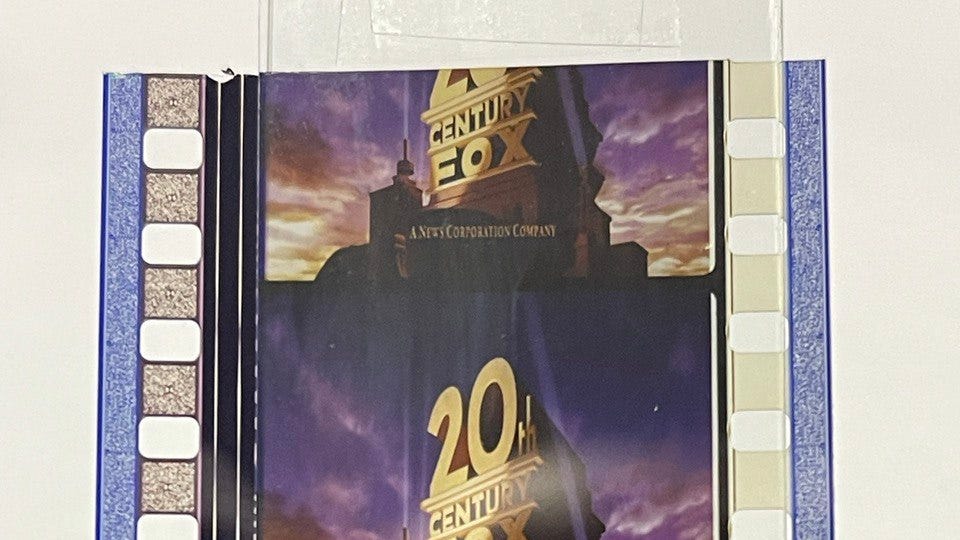
35mm cinema film and digital audio
A while ago I decided to pick up some 35mm cinema film to help me experiment with projection optics.
everydaything.substack.com
110 points · by zdw · 4y ago · 73 comments
> The blocks also carried software, so that the decoding equipment (such as the DA-10 and DA-20) could have their firmware automatically upgraded in the field, just by playing a newly-released film! Pretty advanced for early 1990 electronics.
I found another oblique reference to this in the manual for the Dolby DA20 sound processor, page 8-6 here, where it refers to "dynamic loading":
http://www.film-tech.com/warehouse/manuals/DOLBYDA20.pdf
however, I can't find anything else online about this. This raises the possibility of putting a film-bourne virus in a movie or trailer, though I'm not totally sure what you could really do by pwning a sound processor.
There are 3 blocks every 128 on the film that contain the software update (and/or other data channels, or are unused). They're also used for something called the "Splice cache" which I can discuss if you want. The rest are the audio blocks.
As far as I'm aware, Dolby only used this once - to update from what they called version EC9 to EC11. I've also heard that it didn't work well with the DA10 - their first processor - and this may be part of the reason.
The Dolby Digital signal is AC3, a lossy codec for 5.1 audio. I believe it's the same AC3 that DVDs use. Bitrates (and audio quality) is roughly similar to MP3. Both were developed around the same time.
> I suspect audio data is stored uncompressed.
A little bit of math: 96 squares a second, at (assumed) a 48000 / second sample rate correlates to 500 samples / block. If it's 5778 bits a block, (and that's a strong if,) that's ~1000 bits / block / channel, or ~ 2 bits a sample. There's definitely a LOT of compression going on.
> I couldn’t find any public references to the dolby matrix encoding format
The author is confusing terms here. "The Dolby Matrix Encoding Format" is what's going on in the analog audio tracks. In audio, "matrix encoding" is how multi-channel audio is derived from two-channel audio. The analog audio is "Dolby Stereo," where a 5.1 mix is "matrixed" into a 2-channel recording, and then "de-matrixed" on playback. (In theatrical audio, "stereo" means what home audio calls "surround" or "multichannel.")
From https://en.wikipedia.org/wiki/Dolby_Digital#Cinema A constant bit rate of 320 kbit/s is used.
edit: This explains the differences pretty well - Dolby Digital (original version) can go higher than 320kbs
https://ottverse.com/mp3-aac-ac3-wav-wma-opus-audio-codecs-d...
In contrast, AC3 encoding was performed by professionals who understood what they were doing.
AC3 has higher fidelity at the same bit rate, and can be used at higher bit rates, but the difference between AC3 and MP3 is not exactly night and day. AC3 is roughly similar to MP3 in terms of quality and bitrate, but that's not a bad thing.
As mentioned elsewhere in the thread, the audio format in cinema wasn't technically AC3 but something quite similar.
There is a reason we don't use it anymore. AAC/Opus don't have these problems.
The prints would generally come with SR (analog 4.0) and SR-D (Bitmaps between the sprockets). Most of the time you'd also get DTS CDs and about 40-50% of the prints we got (in Stockholm) had SDDS, though I think there were maybe like 5 SDDS theatres in Sweden.
70mm film was far superior with 6 discrete magnetic soundtracks. But it was also far more expensive and required entirely new equipment.
Digital soundtracks were a solution to retrofit discrete multi-channel audio to existing 35mm technology. I love how they found space next to and between the perforations. It reminds me of how colour TV works. DTS is one that used the timecodes and came on an external CD which would also be far cheaper and something cinemas could easily upgrade to without replacing existing equipment.
The LFE channel appeared with these formats and is another example of supporting retrofitting. The idea with LFE is cinemas could simply buy and install some subwoofers and feed the LFE channel directly to them. No expensive bass processing required. No need to touch the existing main channels. Easy upgrade. Now every cinema has bass management so it's not really necessary but it's still there.
Even by the late 70s, decent prints were getting hard to find though.
I would have thought Wikipedia would have a list but it's not obvious if they do.
The SDDS soundtrack (blue strips on the outer edge of the film) had severe issues with reliability the older the print got. This is because that part of the film is the bit that touches the rollers while the film is being transported from the platter to the projector and back so unless everything is squeaky clean and perfectly aligned it’ll get scratched and SDDS would begin to drop out (and fallback to other formats, usually analogue depending on your config) resulting in a bad experience.
If you got a second-hand print from somewhere you’d just never bother to run SDDS.
It would eliminate the problem with it wearing out.
Maybe it was different elsewhere, but SDDS was pretty much a non-starter for us for any kind of effort.
GitHub did this with its Archive Program https://archiveprogram.github.com/, and Piql https://www.piql.com/ is a company that specialise in doing this. They're the company that created the Cinevator, a high speed data to film transfer machine that was originally used for creating film prints, but since film is kinda dead these days, they've pivoted to archival storage.
> Dolby Digital cinema soundtracks are optically recorded on a 35 mm release print using sequential data blocks placed between every perforation hole on the sound track side of the film. A constant bit rate of 320 kbit/s is used. A charge-coupled device (CCD) scanner in the image projector picks up a scanned video image of this area, and a processor correlates the image area and extracts the digital data as an AC-3 bitstream. The data is then decoded into a 5.1 channel audio source. All film prints with Dolby Digital data also have Dolby Stereo analogue soundtracks using Dolby SR noise reduction and such prints are known as Dolby SR-D prints.
I suppose he could get away with nobody adding the [citation needed], but that'd be against the rules.
----
Oh, a topic I know a bit about!
To add a few things onto the stuff mentioned in the article: - A lot of places mention Dolby Digital on film being AC3 encoded. This is sadly not true - ish. Dolby were developing AC3 for film and other applications, but the version that ended up going on film isn't quite AC3 - although I suspect it's very close. To quote someone at Dolby:
> The audio coding used is actually a pre-cursor of what became AC3, and in fact, two different versions of the codec were used during the lifetime of Dolby Digital on film. We referred internally to these as EC9 and EC11. I don’t remember the exact characteristics of these codecs but unfortunately they are not compatible with AC3
- The article mentions Reed-Solomon encoding being used - this is indeed the case, but more specifically a concatenated code meaning that two Reed-Soloman instances are applied one after the other. However because nothing is nice and simple here, some of the bits are only protected by one of the R-S layers and not both, but I'm not sure which at the moment.
- The article questions how the bytes are stored - this is actually mentioned in the patent. The bytes are arranged in 2x4 groups, ie 2 horizontal, 4 vertical, and therefore each block is 38 bytes wide, and 19 bytes high. Interestingly the picture in the article is rotated - you can tell by the Dolby logo being the wrong way round.
- Something not mentioned in the article or the patent - before the Reed-Solomon decoding is applied, all the bits are XORed against a constant in order to break up large black or white areas which would be hard to detect. Because the same value is used during encoding as decoding, the original data is recovered. Sadly, I don't know what this constant value is.
I would love there to be a open source decoder for the Dolby Digital on film, but at the moment I'm at the limit of my knowledge on AC3 and audio signal processing. If anyone knows more, or wants to help, I'd be delighted! You can reach me on email `fergusondavid6@gmail.com` or discord `davidferguson#2018`
When I was still working as a projectionist, for big releases (like Twilight) the film courier would often bring three reels on Monday and three reels on Tuesday, so you could make it up Tuesday night and test before the film opened on Thursday (or Wednesday night for midnight releases). I suspect that is why you have what you have...
One neat thing I remember: we applied these little foil bits on the edge of the film to control the house lights. They were applied at either end to dim the lights when the movie started and bring them back up at the end.
I think I still have a Star Wars Ep. III trailer on 35mm kicking around.