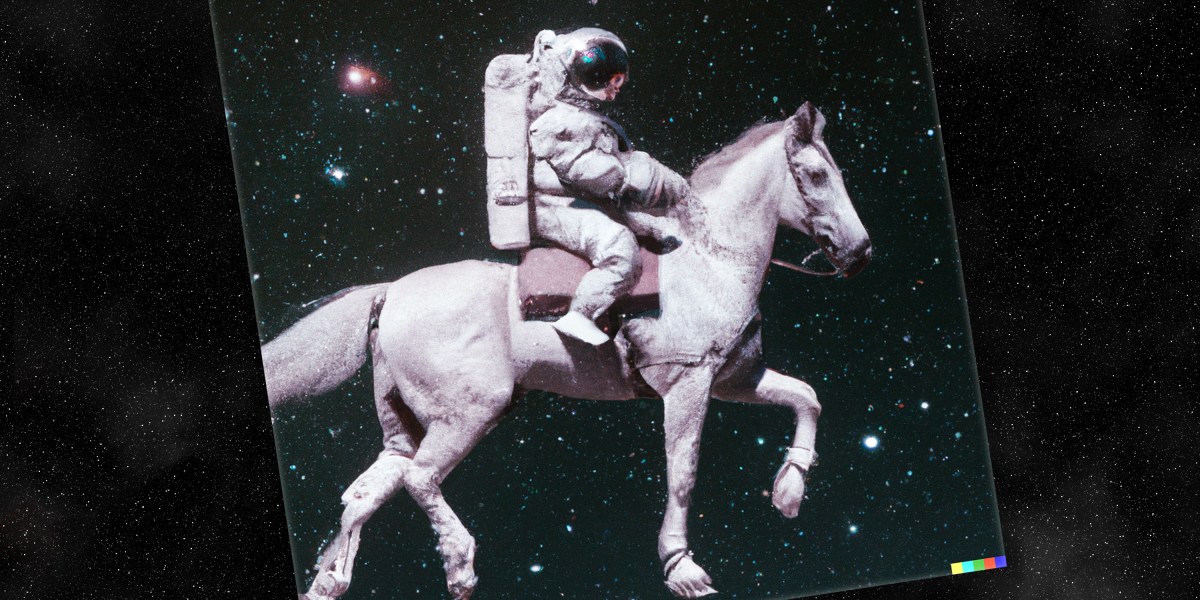
This horse-riding astronaut is a milestone on AI’s long road towards understanding
OpenAI’s latest picture-making AI is amazing—but raises questions about what we mean by intelligence.
MIT Technology Review
123 points · by nkurz · 4y ago · 79 comments
And if they end up getting close to what they're really after, it's really undesirable to get an arms race where solely OpenAI's contributions are known to everyone.
It wasn't just the name, it was the whole rationale they presented for creating OpenAI.
Nick Bostrom was having his 15 minutes of fame with "Superintelligence" [1] and scenarios like a an "AI arms race" and the sudden emergence of a super-intelligent singleton [2] were legion. OpenAI was founded on the premise that making leading edge AI research public was the best way to mitigate that risk [3].
It was presented to the world as a "research institution which can prioritize a good outcome for all over its own self-interest" where "Researchers will be strongly encouraged to publish their work, whether as papers, blog posts, or code, and our patents (if any) will be shared with the world" [4].
That lasted all of three years.
[1] https://en.wikipedia.org/wiki/Superintelligence:_Paths,_Dang...
[2] https://www.nickbostrom.com/fut/singleton.html
Not sure if this is the main reason OpenAI went less open though, as I’m not an insider.
https://arxiv.org/abs/2102.12092
Their code/models are indeed closed, but there is no realistic alternative.
If they let the public have unrestricted access, deepfakes + child images would appear on Day 1, and OpenAI would get cancelled.
For OpenAI to survive, it has to be closed source.
The harms themselves are probably overblown. There are plenty of deepfakes of various celebrities. Mostly people can tell the difference or they just don't care.
I think the reality is that training these models and paying ML engineers is incredibly expensive. Not a good fit for the open source model, thus OpenAI had to convert to SaaS.
In a way, censorship seeks to make the Human AI "safe".
(Emphasis mine.) Philosophical nit: this by definition would not be AGI. AGI would be the ability of the entity to figure out its own subjective qualia-inducing way of interpreting the world. Thomas Nagel already explained this in the 70s (in his famous essay What Is It Like to Be a Bat?). By enforcing our own worldview (technically speaking, model), we're just making some artificial (and in all likelihood inferior) version of a human.
I fully understand the discourse; my point is that it's not (Nagel, Chalmers, Searle†, and other substance dualists would agree). We need a breakthrough akin to what analysis was to algebra in neuroscience before we even understand what our brain is doing. Whatever it's doing, it's definitely not what OpenAI implemented.
† Yes, I know he says he isn't, but he kind of is[1].
[1] http://www.edwardfeser.com/unpublishedpapers/searle.html
Defining intelligence as "the thing brains do" is a mistake. Planes fly, but not like birds. Biology is a great tool to understand some relationships between form and function, but mimicking biology isn't the end-goal.
Cauchy's work certainly fundamentally changed our understanding of calculus (in that Newton and Liebnitz's earlier hand-wavy proofs were validated with a rigorous definition of a limit), but I'm not aware of any large impact it had on Galois, who was a contemporary of Cauchy.
Edit: Never mind. It does eventually show that it will generate different people when repeatedly prompted for the same thing. Given that fact, though, it seems to do a pretty shitty job. It generated 10 apparently female Korean flight attendants. At least in the US, the actual distribution is more like 3/4 male 1/4 female. It's not 100% female, let alone 100% Korean. It does seem to oversample from the most likely examplars, which illustrates a pretty serious failure mode compared to human artists. No human writing a novel is going to make every single character in every novel they write the most likely possible example of its reference class.
A couple of these lawyer images have issues (one is holding a book hilariously called "LAWER"):
https://github.com/openai/dalle-2-preview/raw/main/assets/Mo...
GPT-3 does shockingly well at classification tasks with basically 0 training/prompting (outside of the base model). And it works for an incredibly broad set of use cases.
But using QA and generation are much harder to judge because we can't say (in general) whether generated text is "correct"
That's a heck of a lot of training. It might seem to work if you ask it to repeat stuff that it has seen in the base model, but there's nothing reliable about that. Most attempts to find some practical use for AI language models have basically been failures.
> our expectations are wrong. For the vast majority of computing history, computers have been used to do things deterministically and accurately.
Actually, accuracy matters even when dealing with non-deterministic, statistical/random/sampled data. A lot of supposed 'AI' is little more than a glorified toy or party trick, founded on ad-hoc data mining rather than rigorous inference from a well-defined model.
Part of the ideology is the ends justify the means.
Hence, "AI training specialist" means "works for Amazon Mechanical Turk."
Open AI isn't paying people $250k a year to classify images.
And $500k a year to check that work.
The AI ideology is God will know his own.
A racist, misogynist, hillbilly singularity meets success criteria.
One could say (and some have said) that the tendency of some facial recognition software not to recognize black faces is not racist - but simply a matter of physics. What's racist is the culture of software engineering which only tests that software on white faces, and doesn't consider it a problem.
Likewise the 'most likely image' of a nurse being a non-white female and a CEO or lawyer being a white male is still a problem even if it accurately reflects racial and gender class role biases in society. Eventually these systems will enforce and maintain power structures and media narratives which themselves are already built upon racial and gender prejudice.
There is no God but you and me here.
This took me into the following line of thought. If we wanted AGI we probably should give this neural networks an overarching goal, the same way our intelligence evolved in the presence of overarching goals (survival, reproduction...). It's these less narrow goals that allowed us to evolve our "general intelligence". It's possible that if we are trying to construct AGI through the accumulation of narrow goals we are taking the harder route.
At the same time I think we should not pursue AGI the way I'm suggesting is best, too many unknown risks (paperclip problem...)
Of course all this begs the question of what is AGI, how we define a good overarching goal to prompt AGI and many more...
“The essence of intelligence is the ability to predict.” -Yann LeCun
https://twitter.com/BecomingCritter/status/15118082774908969...
https://www.reddit.com/r/MediaSynthesis/comments/tyaz70/link...
https://twitter.com/jmhessel/status/1511783083967586306
And a non-cherry picked depiction of cherry-picking scientists:
https://twitter.com/jmhessel/status/1512143226022481932
I think tbh people have been burned by cherry picked results in AI for so long that they're overly suspicious of DALL-E 2...
I'm now imagining a mashup of Scribblenauts and this AI image generator.
I'm amazed to see how easily Intel/AMD are able to cram so many monkey/typewriter combinations onto such tiny chips.
So, some stages seems to be artificially introduced...