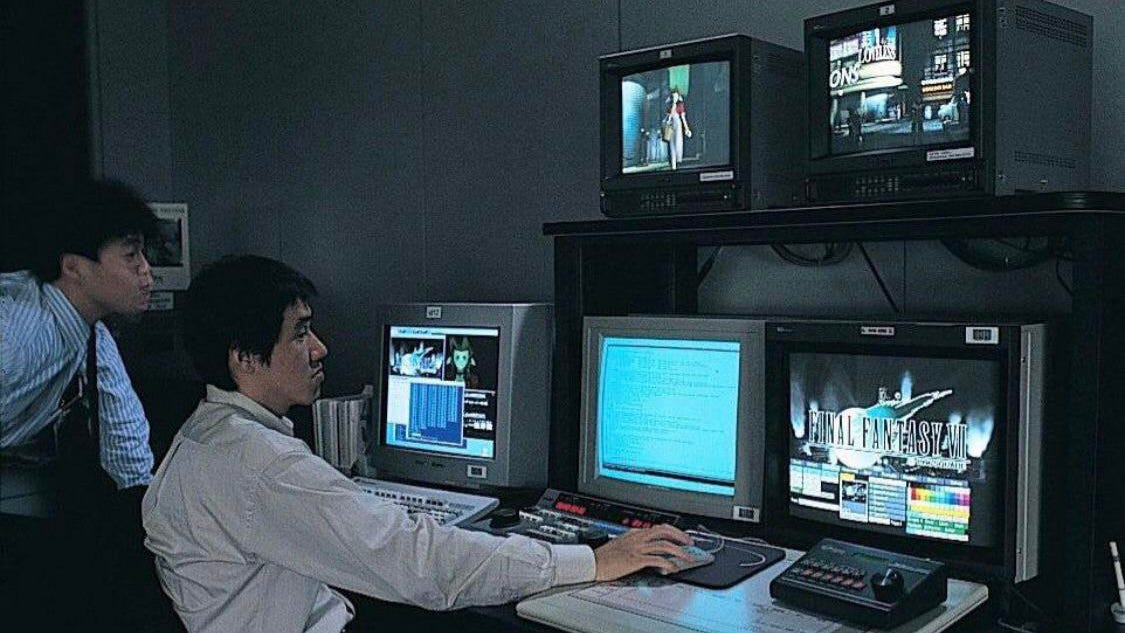
The computers used to do 3D animation for Final Fantasy VII... in 1996.
It's time for a little dive into mid-1990s computer history!
lunduke.substack.com
768 points · by marcobambini · 4y ago · 364 comments
250 MHz in 1993 is insanity, considering that was the 33 MHz 486 era.
> The RAM on these machines were not industry standard [...] and could handle up to 8 GB of RAM. 16 GB in the rackmount version (yeah, there was a massive rackmount version).
8 gig of RAM at a time when home users didn't even have 1 GB hard drives. 16 GB of RAM at a time when a home user's desktop could read memory at < 100 MB/s.
Having those specs then would be like running a 37 Ghz CPU with 16 TB of RAM now.
It was a massive auction, ranging from pallets full of backup tapes to stuff like this fridge size Onyx (looking at the Onyx wikipedia page, maybe it was actually two Onyx's in a rack, like the image for Onyx 2? Or maybe it actually was an Onyx 2? I didn't know anything about theses things, just that they looked cool, and they were legendary among us first wave Linux adopters, which most 'real Unix' folk at the time still looked down on).
Anyway there was so much stuff to be sold, that the normal auction house didn't have enough storage, so they had to move to an actual (disused) pig sty in the same village. Complete with smell from the remaining functioning animal stables on the rest of the farm (which was still an actual functioning farm).
Most of the stuff sold quite quickly, then when the Onyx went up, nobody wanted to bid. Everybody was sort of looking at each other with shifty eyes, waiting for someone else to make a move. As mentioned I didn't know anything about IRIX or any non-free Unix basically, nor did I have money or a place to put such a machine, but I just shouted out '250 euros!' and the auctioneer looked relieved that at least someone was going to take this thing off his hands. Then some other people started bidding, I got over excited and bid along up to a thousand euros or so and then I came to my senses and gave up. IIRC it eventually went for a few thousand.
That auction hall looked like a 'revenge of the nerds' casting call. Good times.
edit: Wow these were actually $100-250k! Back in 1993 that was an immense amount of money. I bet you could have bought a nice San Francisco row house in the mission or other hot area for $100k back then.
32mb Ram, 1GB hard drive, 19”monitor. Monitor and system weight 80lbs if I remember correctly.
Alias was an additional 16k.
It sounded like a jet engine.
I loved it.
That's $20K in today's money, so depends on how you define "nice". A nice late model used Honda Civic.
$20K then is $40K now, so that's a bit of an underestimate for home prices, I think. [As it happens, my home was built about then, and the value has stayed in line with inflation figures]
P.S. that Honda Civic had one airbag, crank windows, didn't necessarily have a passenger side mirror, a tachometer, or a wiper on the rear hatch. And A/C was a dealer installed option. Don't ask about side impact protection.
To be honest, the idea of even getting a down payment of 100K for a house like that in SF is insanity. Crazy how prices skyrocketed in 30 years (I'm guessing 2008 didn't help much).
Doubling your money in 30 years isn't great at all. And this is within about 50 miles of tech jobs, although the drive will take 90 minutes in the morning and 60 minutes at night.
Given the cost of those, did the companies actually own them, or was it more like a lease? And given the cost, would they work on them in shifts to get the most out of them? I can't imagine they would be treated the same as we treat laptops and other work items these days. For one, they'd probably be in a high security section. And I can imagine it'd only be used for the final work that actually needed that power, where most "grunt work" would be done on cheaper machines.
It seems weird to me you could've bought a house for the price of two cars. Either cars were too expensive, or houses were too cheap.
Just think you had to ask the most opinionated people in your town every time you want to get a new computer and potentially ask people in your neighborhood when you want to make minor changes to you existing computer...
But that too has limits; megacities like Singapore have built upwards for decades and is still one of the most expensive places to live.
And another factor is that landlords and investors will resist oversupply. This is where China went wrong, billions have been invested in brand new cities that are effectively ghost towns; preparing for an influx of people that never came.
More, much more. We've long hit a point of diminishing returns for a lot of standard consumer workflows. More CPU and RAM helps mainly for "specialist" workflows (including software engineering) and can be really nice, but computers have overall been "fast" for a while now.
Back then you could notice an increase in CPU frequency or cache in almost everything you do, even if it was just writing a letter. And more RAM allowed you to do things that were virtually[1] impossible before. Especially because there were no SSDs: You paid dearly for anything that could not be kept ready in your puny RAM.
[1] Pun sort of intended: Virtual memory might technically allow you to do those things anyway, but often the performance cost was so high that it was no fun, if not pointless. But we're also talking of the DOS/Win 3.x/DOS extender days, where virtual memory was technically possible, but definitely not ubiquitous.
I tested Linux on that 486/33 in early 1992, and when my office X terminal broke down I replaced it with that Linux box the same year (I can't remember what the experimental X11 was called - this was before XFree86. Something YFX86 I think.. but no search finds it). As soon as it was possible I replaced the CPU with a 486 DX2-66. Probably early 1993. Still only got 16MB though. Enough for me. Now this 16GB laptop runs out of memory all the time.. oh well.
Upgrading one's PC was also a big thing even into the mid 200X. A lot of magazines devoted entire columns for upgrade and installation guide. Hardware manufacturers lured users by sending extra copy of AAA games bundled with purchasing their hardware.
I must say the 90s was really the golden era for players and developers. Lots of opportunities, developers usually had to learn asm or C or Pascal to do real work. While it is still possible to push AAA titles for a small team. Both ID and Epic were examples.
Nowadays it's just red sea everywhere.
I remember discovering Quarterdeck QEMM and found it worked so much better than EMM386 for making programs load into Upper, High, or Conventional memory segments.
Oh yeah, and the whole clusterfuck of "extended memory" versus "expanded memory".
More precisely, it was the start of the Pentium era. The First Pentiums with 60/66 MHz were released in March 1993. But interesting enough, it seems the R4400 were already 64-bit.
The EV5 reached around 500MHz in '96 though! The high end RISCs really did blow the doors off everything back then. The Pentium Pro was the beginning of the end for them though.
Before that I had only used 286, 486 and 586.
I remember some senior managers from IBM at the time, who had 128MB powered Workstations using Windows NT. They did not brag about the machines, they simply stated the fact, that this was some engineering master piece.
That much RAM itself posed some problems, because Windows NT was still new, hardly any software ran on it and also that "much" RAM was new, so what to do about it? Virtual Hard Disc? For example, Windows 95 could only address 64 mb without slowing down.
To be fair I don't think the 200MHz chips came out until 1995, when you could also get a Pentium Pro in similar speeds.
Something common in the hypervisor admin space is expressing the compute capacity by multiplying the core count with the clock speed.
So for example a 64 core EPYC at 2.5GHz is written down in documentation as a 160 GHz processor.
So these Onyx desktops are directly comparable to artists using a high-end Mac Pro or Threadripper workstation.
4x 250MHz R4400s + 12x 40MHz Intel i860s = 1480 MHz when maxed out.
But clock speed is a very poor metric for comparing older CPUs. The size of these CPUs were much smaller, the number of instructions they could cram into each clock cycle and complexity of those instructions was no doubt far lower, and the variety of instructions and ability to specialise far lower (i'm not even considering the whole RISC and MIPS thing, just the fact that they are working with much smaller dies and far fewer, larger gates)... instructions per second might be a better comparison, but then you still lack that qualitative difference in the variety of instruction as i said.
I'm always flabbergasted when I hear of something like this. Such as NASA losing many videos of the moon landing. How does that happen?!
Could the existing copies of the game out there be reverse engineered?
March 1994 was both 486 DX4 100MHz and Pentium 100
R4400 wiki: "In mid-1995, a 250 MHz part began sampling."
Pentium 200 came out in June 1996. So ~one year clock wise, probably two-three years for performance (1998 >400MHz Pentium 2).
I think the 250 MHz ones appeared later on, in subsequent revisions. Still, one of the promises of RISC was that, since the logic was much simpler, you could jack up clock rates further than it was possible with CISC designs.
There were at least 2 rack mounted SGI machines used for large-scale rendering jobs (ie promotional images, magazine covers etc). May have been SGI Challenges (I know one certainly was) and were kept off-limits to most staff, at the time they were rumored to cost $250k each.
I've always been fascinated with Rareware. For such a tiny studio, the level of quality in the games they put out during that era is completely unparalleled, and many can justifiably still be held up as the greatest ever made.
What was the secret sauce? What was it like working there? How was the culture?
Each game team (of which there were 4 who I was there) was isolated from the other teams, only senior management and IT had access to the other team's floors/buildings. If someone from another team needed to visit for some reason we were usually instructed to turn off monitors. There was very little sharing of code and core graphics/gameplay features were fiercely protected by each team. The competition was not other games companies (with the exception of Nintendo) but the team in the next building.
There was almost no recruiting from other games studios, almost everyone was hired out of college (or recently so).
The management (Tim and Chris) generally let the teams do what they thought best and didn't push hard on things like deadlines. Release dates existed but were argued/negotiated with Nintendo when things slipped.
Employees were expected to be in the building at 9am (there was a bonus for punctuality, which I dint think I ever received and was reprimanded about several times). Lunch and dinner were provided, the studio was literally on a farm so there were no lunchtime distractions, and long hours were expected, although not mandated. 70+ hour weeks were not unusual.
Teams got a small bonus for shipping a game but then got a split of game sales (after some 'production cost' was subtracted). The split increased as Rareware negotiated higher payments from Nintendo, for later N64 games the team received something insane like $1 per cartridge, which on a 10-16 person team with millions of sales was crazy money. People were paying cash for houses and Porsches.
Unfortunately while the generous bonuses drove the work culture, it also caused a large amount of resentment. People on shelved projects, projects on low royalty rates (eg Goldeneye), or poor selling products put in the same or more work but did not anywhere near the same fiscal rewards. It was a side effect of Tim and Chris being extremely generous and wanting to do the right thing by the staff but it did cause a number of departures (albeit mostly from the Goldeneye team), I think this has been discussed publicly by many of those folks.
Rareware's talents were big advantages in the early 3D game console era. But by the PS2 / Xbox era, their special skills didn't help as much.
Today I'd say that Epic's Fortnite is the spiritual successor of the old Rareware.
I would disagree that this was good management, though. Burning out your talent is how and why game studios fall apart over time. Had they retained talent and kept crunch time low they probably would have continued churning out hits on the GameCube and Wii instead of stinkers on the Xbox. In fact, Nintendo probably understands this[1] - for example, when Retro Studios imploded they bought them out and immediately banned overtime work at the studio.
[0] Microsoft didn't understand this, and this is why they wound up overpaying for Rare.
[1] Or at least did in the Iwata era. No clue if Kimishima or Fukukawa have the same convictions, but given that Nintendo hired them both internally I imagine they do.
StarFox Adventures on the Gamecube was probably their last "holy crap" game from a technical perspective. There wasn't anything else at the time, on any console, that did realistic-looking fur as good as that game:
https://i.pinimg.com/originals/69/d1/9b/69d19b00eb25ffde0f1d...
> Hollis remarked that he worked non-stop on the game, "[averaging] an 80 hour week over the 2 and a half years of the project", and that the team he recruited was very talented and dedicated even though most of it was composed of people who had never worked on video games.
I guess the answer is insane levels of talent + dedication, and don't worry too much about domain expertise. Probably my favorite factoid out of there is that Goldeneye multiplayer was an afterthought, and basically one dude hacked it together in a couple of weeks at the end of the development cycle.
Rare: The Inside Story - The Retro Hour EP180 https://www.youtube.com/watch?v=ED7rX3ZIBoE
The History of Rare - The Retro Hour @ Retrospillmessen Norway 2019 https://www.youtube.com/watch?v=6iuCg_rqVL8
Years later when we were collapsing ILM into the new Presidio Campus, the amount of SGI full-rack sized machines being thrown into the trash was insane.
I believe they turned at least one into a keg-erator...
I could have had an opportunity to get one of the cabinets, but I didnt have a place to put it. Wish I had figured out a place to keep one.
The SGI cases were a thing of beauty.
---
I was focused on Softimage, as I liked the UI better. (Should have picked Alias though)
The interviewer stated they’d laughed and said ‘no, we’re just making video games’. It gave me a giggle, and demonstrates just how advanced these systems were.
Here is a video, only released decades later, of the SNES game midnightclubbed refers to, which fell by the wayside as the N64 came about: https://www.youtube.com/watch?v=w72kj20YNA0
I was surprised to find my jaw dropping at an SNES game after all this time.
Imagine, this and Super Mario World are the same platform!
So can we expect a release next week?
I wish we could get some insight on the development of the first successful 3D game on PC, Quake by I'd software as there's a famous picture of John Carmack sitting in front of some SGI workstation with a monitor with a resolution ox 1920*1080( in 1995!)
Also, SGI powered most VFX Studios of that era, so many great movies went through those machines before ending up on the big screen.
It's insane how quickly 3dfx, Nvidia and Intel X86 consumer hardware made SGI workstations overpriced and completely obsolete within the span of just a few years. The '90's were a blast.
But still, I'm sad to see SGI go, as their funky shaped and brightly colored workstations and monitors had the best industrial design[1] in an era of depressing beige, grey or black square boxes.
[1] https://preview.redd.it/tt3ziuwt98o31.jpg?auto=webp&s=e5cc61...
Let's at least give some credit to 3dfx Interactive for PCs dethroning the 3D giants. There was a time practically everyone playing Quake had a Voodoo card.
With the advent of semi fabs like TSMC, STM, etc. making their processes more accessible to smaller fabless companies, 3dfx, PowerVR, ATI, Nvidia and other startups in the 3D space back then, realized they can replace all those expensive discrete RISC chips SGI was using for their massive 'reality engine' PCBs, and instead design a cheaper and more efficient custom ASIC from the ground up that does nearly the same things SGI's reality engine was doing (triangle rendering and texture mapping was enough for a PC 3D accelerator back then), but at 1/100th of the price, and sell it to consumers.
Fast forward, and we all know how the story played out and where the industry is today.
>There was a time practically everyone playing Quake had a Voodoo card.
Yeah they were the most desirable piece of tech back then, plus, the marketing and advertising 3dfx had at the time was wild as hell.[1]
Even the box-art on their GPU boxes was the most memorable of any HW of that era. Anyone remember those eye glaring down on you from the store shelves?[2] I feel like this is now a lost art.
As a teenager/young adult in the late 90s/early 00s, I was so glad to see 3dfx fail. I hated how popular the Glide API was since you could only run it on a 3dfx card. I had asked for a 3dfx Voodoo for Christmas one year, and my dad got me a Rendition Verite 2200. It supposedly had better performance than a Voodoo while having a lower price, but it couldn't run Glide, so couldn't play half the games I wanted a Voodoo for.
I didn't want to feel ungrateful to my dad, so my frustration got targeted to 3dfx for making a proprietary API when OpenGL and Direct3D existed.
I eventually got a Voodoo Banshee, but by that time Glide was falling out of favor.
This one. It is amazing seeing how some monstruosity of a full-length, full-heigth cards were replaced by, essentially, a single chip solutions. I would recommend something akin to a computer museum to see exactly how it came to be.
On mobile ATM, if someone is interested - leave a reply, I would provide some links on the most interesting ones.
Haha. Amazing commercials. I don’t remember those at all, but they’re 100% on brand for the times.
those who had a voodoo + those who wanted to have one = 100%
Which had enough power to dethrone the Indy or O2 at a fraction of the price :)
In 1995 I think there were 16:9 aspect ratio japanese model TVs but I am not sure about monitors, might have been more like a 4:3 1600x1200 display.
Nope, it was definitely 16:9, but I was mistaken, it was an Intergraph[1], not SGI like I originally thought, but still connected to an SGI workstation.
Just look at this beast[1]. Also, the monitor is in the photo as well :)
[1] https://www.reddit.com/r/crtgaming/comments/gxvm99/legendary...
Notice how the left and right sides of the glass are straight vertical lines, and only the top and bottom edges are curved: https://spectrum.ieee.org/the-consumer-electronics-hall-of-f...
Versus a standard CRT, where all four sides are curved: https://fineartamerica.com/featured/vintage-tv-scott-chimber...
Of course, the final-gen Trinitons (circa 2000 onward) had truly flat glass, so there was no tell-tale curvature to look for.
And once Sony's patents started expiring, there were competitors like Mitsubishi's Diamondtron displays with glass shaped like Trinitrons. I'm not sure if they had the two horizontal lines like Trinitrons.
Apple mounted the Trinitron tube upside down compared to other vendors, so that the faint horizontal line would be in the bottom third of the screen rather than the top third.
Over time their timings would drift and you could never get the entire screen completely sharp.
That thing was a tank! I bought it at a CG house bankruptcy sale in the 90s for $2k, which was less than half the going price at the time.
But you're right, it weighed a ton. It did need periodic degaussing. And when a communication company half a mile away put in some satellite uplinks, I could see when there was heavy communication traffic by a slight color shift on one side.
This is what I miss most about the 90's and proprietary computer vendors: the exotic fun looking cases they had vs boring beige Mac and PC cases.
I have an SGI 230 which was a last ditch effort to stay relevant via offering a regular x86 machine in an ATX SGI case. Unfortunately SGI ditched the snazzy cube logo sy then so it only has the lame fisher price sgi logo stenciled on it. It now houses a 12 core threadripper running Void Musl.
Before that workstation, the 320 and 540 used Intel P3/Xeon chips on proprietary motherboards, 3D GPU/chip-set and even proprietary ram modules. Only ran nt4 and was a miserable failure of a machine.
The refresh rate compromise at higher resolutions was due to the limitations of the graphics card, NOT the monitor.
LCDs took a little while to catch up for a few reasons:
1) expense! It was hard and expensive to manufacture a display containing millions of transistors with an acceptable (read: profitable) failure rate.
2) colors! LCDs had a reputation for extremely poor color quality in the beginning. Blacks were medium gray at best and primary colors all looked washed out. Today's LCDs still have a hard time getting to "true black."
3) ghosting! Early LCDs had poor response times. Move your mouse cursor and watch it leave a trail across your screen. Fine for word processing and spreadsheets. Terrible for games.
Another physical limit was the weight of the glass. The larger the display, the glass got thicker and thicker to "lens" the beam correctly so the edges/corners were straight. We had a Sony reference CRT for our film transfer/color correction suite that was a 32" HD monitor. MSRP was >$30k for it. (Sony's reference monitors were roughly $1k per inch in pricing.) The thing was stupid heavy requiring a minimum of 2 people if their names were Arnie; otherwise it'd take at least 3 maybe 4 typical post house employees. All of the weight was in the front.
The Sony 21" CRTs (and 24" in widscreen) had a very good run -- spanning several decades. They were certainly capable of higher resolutions, but the 1600x1200 was pretty much a standard (or 1920x1200 on the 24" widescreen) for that entire run. I can't think of any other desktop workstation performance 'metric' that was stationary for so long.
It's not surprising they fell out of favor though. Once the ghosting stopped being absolutely horrendous the LCD is just superior for office work. Uses less power, saves tons of desk space (and due to less weight, doesn't need a strong desk) and no flickering means a cheapo LCD is probably easier on the eyes than a cheapo CRT.
I bet the CRT wwould still be used more often if the supply chain to make them didn't fall apart when the demand disappeared.
When Sony first brought out their OLED reference monitors to the market, they had a demo at NAB to demonstrate the various screen types. All of the monitors were the equivalent reference version of that series: CRT, LCD, OLED.
It was an interesting demo as they had the same feed going to each monitor. When showing how each monitor could display black, the OLED looked like it was off, the LCD was just a faint shade of gray, while the CRT was much much more noticeably not black from its glowing screen. I started to think to myself how they might be pushing the brightness on the CRT to make it look bad against the others. Right as I was thinking that to myself, the narrator said something to address this thought and then displayed bars. All 3 monitors were correctly adjusted. A gamed CRT with brightness adjusted would have been obvious at this point to those knowing how the test pattern is meant to look.
The only thing I'd suggest that a CRT looks better is on true interlaced content.
Jensen Huang did. When people think of tech visionaries they think of Jobs or Musk, but Huang is just as great. He's been bang on the money on the future of this industry since he founded Nvidia, which is how they managed to not just consistently stay ahead of their competition (ATI) or put them out of business (3dfx), but leapfrog them (AMD) by branching in several fields (AI/ML, PhysX, computer vision, self driving, compute etc.) He saw early on that GPUs should push into general-compute and not just be for video games, and he executed well on that.
There are interviews on Youtube with Huang at Standford IIRC, where he discusses his vision of the GPU industry from the early days of Nvidia. Check them out, the guy's not your typical CEO suit focused on the share price, but he's basically a tech genius.
So, to answer your other question about why only Nvidia manage to win compute and not the other GPU companies, it's simple. Huang had the vision for the entire ecosystem from GPU chips, to drivers, to APIs and SW libraries, to partnerships and cooperation with the people and the companies who will use them. Building great GPUs for compute is not enough if you're just gonna throw them on the market without the ecosystem and support behind them, and expect it to be a success. That's what Nvidia gets and the rest (AMD/Intel) don't. So while ATI/AMD had tunnel vision and was focused only on building gaming chips, Huang was busy building a complete GPU-compute ecosystem for their gaming chips with the rest of the industry.
And it's easy to see that Huang and Nvidia put their money where their mouth was. The first GTC was 2009. That's 3 years before the famous AlexNet paper that's often credited with kicking off the current AI on GPUs trend.
No wonder they are always a shadow of what proprietary ones bring in the box.
by wasting two years on Quad rendering? Wonder how much VC money got burned in NV1 and cancelled NV2 debacle.
Rendering 3D graphics for games and the supercomputing used by AI/ML/research both need the same thing: Embarrassingly parallel math calculations with little or no branching in the code.
For example, a feed-forward neural network is just a whole lot of multiplication and addition. Transforming a 3D vertex in space to a 2D screen coordinate is matrix multiplication, which is just a whole lot of multiplication and addition. If you've already designed silicon to perform those operations in a single clock cycle, making it do HPC/SC rather than gaming isn't that big of a switch.
Unix was born to play a video game on a different platform. The Curses library for terminals (Windows users: "widgets" for the console") where born for Rogue.
Today, a damn serious OS like OpenBSD gives the BSD games set by default on the base install.
Text adventures for the Z-Machine had top tier grammar recognition parsers.
Then, a lot of simulation games overlapped the serious simulation software features, such as Sim City.
Not Quake. Not 1995. The picture
https://preview.redd.it/x3kqn3bjvb351.jpg?width=557&format=p...
is from Doom3 development, as seen in this video https://www.youtube.com/watch?v=PjbEdWF1e-I There is Blue G3 on the picture after all, released in 1999.
The only blocking plates on the rear cover of an O2 usually cover the spot where the Flat Panel Adapter or Dual Monitor board goes, and it's not installed by default, or the spot where a PCI card would go, which, well, it's a PCI card.
Chapter 64 onwards of https://www.jagregory.com/abrash-black-book/ is Mike Abrash's detailing of Quake's development.
(tl;dr - Quake was developed on NeXTSTEP + an MS-DOS port of GCC (DJGPP), Quake2 was on Visual Studio + Windows NT (this was the era of that Carmack giant-monitor photo), there was an in-between period of free updates to the original Quake, like WinQuake, QuakeWorld and glQuake).
The graphics editor seen is just the S-Paint part of S-Graphics - it could use a FrameThrower, but also other graphics cards. There was also S-Paint on the MacIvory running in a Macintosh. S-Graphics also ran on earlier Lisp Machines from Symbolics, like a 3670 from 1984.
A bunch of TV studios, video production companies, animation studios and game developers were customers.
https://www.youtube.com/watch?v=Cwer_xKrmI4 from 6:09 shows the using such a Paint system on a Symbolics.
The software it runs is S-Graphics, which was later ported to SGIs and Windows machines as N-World, by Nichimen (then using Allegro CL from Franz Inc.).
    (camera 0 0 -20)

    ; red sphere
    (sphere 0 1 50 5 (material (color 255 127 127) 0.8 0.8))

    ; green sphere
    (sphere -20 1 200 9 (material (color 127 255 127) 0.8 0.8))

    (plane 0 1 0 20 (material (color 127 127 255) 0.8 0.8))
To me, there's something very natural about using S-expressions to create graphics. I wish there was a video (with a high enough resolution) that shows the Lisp interactions—especially in the subdivision modeler.
From time to time I threaten to rewrite Terraform in Lisp for that same reason.
Ok so I'm pretty biased here, but I think the answer lies in VR computing. There's no doubt VR computers are more expensive than their PC/laptop counterparts, but they allow you to adopt a bleeding edge technology which is essentially 5+ years ahead of its time in terms of where it is on the "commodity computing" frontier.
A good quote from Alan Kay I find pretty inspirational on this front: https://youtu.be/id1WShzzMCQ?t=3345 Here he basically advocates for spending hundreds of thousands of dollars on a computing machine, in order to compute on what will be a commodity product 10-15 years into the future. VR computers aren't this extreme on the cost curve, but I think there is something to this point of view which I find really inspirational.[1]
[1] Caveat: I'm one of the founders of SimulaVR (https://simulavr.com), so admittedly am very biased here. But I do think VR provides a way to convert money into "better compute" in a way that hasn't been available since the 70s-90s super workstation era.
I don't think there is an equivalent, because as I explained here, the very noticeable, very significant gains in almost every aspect that even simple hardware upgrades brought haven't been a thing for a long time: https://news.ycombinator.com/item?id=30951533
It's not just that back then an "extremely expensive supercomputer" workstation effectively enabled you to do a lot of things that we take for absolutely granted nowadays in the first place. When not having such a beast meant essentially not being able to do any serious CAD (whether mechanical or electrical engineering), large scale software engineering, number crunching, anything related to graphics/visuals...
It's also that super mundane tasks like writing a letter, editing an image, or even just booting your computer received a significant, immediately noticeable boost for comparably plain seeming hardware upgrades like a 33MHz higher clock or a bit more L1 cache.
I could see VR computing as the mobile version of that. Laptops can be pretty powerful, but their screens are limiting. VR gives you the screen real estate without requiring you to set up monitors where you are.
Typing this I realise that does not explain why the follow-ups were not as good.
They got the music part down though. That stuck around.
Oh, no. But I can say that the game is still objectively incredible. I recently did a full play through of the Steam version with the 7th Heaven upgrades, and enjoyed every minute of it. And I don't think it's all nostalgia either.
And yes, the music is incredible, as evidence by the fact that the Shin-Ra Orchestra still tours.
Then suddenly a game comes along on the popular console, and everyone's playing it and talking about it, and it puts you in this 3D living world, and a real story is happening with real characters, with real conversations - there's even swear words in it! It's treating me like an adult! - and yes the music is beautiful too, and the whole thing seems impossibly huge, the world seems to go on forever and now I can fly? And now I can go under the ocean? There was nothing else like it, not on a mainstream console anyway.
Bear in mind from 1998 to ~2003 most people had launched ZSNES with Chrono Trigger/FFVI for sure.
> huge, the world seems to go on forever and now I can fly?
That was on SNES RPG's too.
On the mid-late PSX/N64 era, people played SNES roms even when FFVII-VIII-IX rocked.
Things changed a lot since then but I think that so much of the Playstation's success comes from having these games that are quite high fidelity. You no longer need your brain to fill in too many of the blanks, making it way more mainstream and interesting for a broader spectrum of people.
This sounds like a pretty simplistic reasoning to me. Do you really believe this?
The fact that your follow up game (or movie/book/album/painting) wasn't as successful as the previous one, doesn't mean you don't understand why the latter was a success. Understanding success and replicating it are two different things.
Btw, I like FFVIII more than FFVII.
Doing more of the same isn’t enough - you need to find the right path to go from where they are now and just getting a bigger boat won’t do it.
https://finalfantasy.fandom.com/wiki/Final_Fantasy:_The_Spir...
> The movie was created using a 3D CG tool called MAYA as well as original tools created in Honolulu.
> By the time the final shots were rendered some of the earlier ones had to be redone because they did not match anymore. Also, the software used to create them had become more advanced (and hence more detail was possible).
Also it was just dreadfully boring, which is basically the worst thing a piece of entertainment can be, even worse than the visuals.
I thought actually the film was alright, if you're into such spiritual things. But I can see, that it didn't appeal to the video gaming crowd.
>Think about that for just a moment. This was the mid-1990s.
Let's pose the more theoretical question of what is the most powerful computer that could be built if enough recourses were summoned to make it. We're talking a single rackmount. What about a rackmount the size of a city.
The biggest issue you’ll hit as your computer gets bigger is latency, because even light has a speed limit. You can, however, cheat, by distributing your inputs and outputs in space so that, by the time information flows to the right places, that’s where it should be. That and adding more pipes for increased bandwidth.
https://en.wikipedia.org/wiki/Altix#/media/File%3AUs-nasa-co...
If you can make your problem fit the architecture you can work on enormous tasks. It wasn’t bad stuff at all but probably impossible to make money on. Commodity hardware improved so fast they couldn’t keep up.
and finally, if you make something with a bunch custom chips with a bunch of pins with high bandwidth, then you don't have another metric to compare to something else.
I'm open to the thought exercise but I can predict which directions the conversation would go, I'm just content with the variety of metrics on CPUmark these days.
No one there knew (or cared to learn) IRIX. When they converted the biggest lab to Windows NT4 everyone abandoned the SGI machines. Which worked out great for me, because it was much more peaceful in the SGI labs compared to the NT4 lab. Some of those StarCraft matches could get kinda rowdy!
Good for a few surprises: "wow, python is older than win 3.1!"
I was just a teen getting into 3D animation & game design in 1998, and since I couldn't ask my parents to mortgage the house to buy one, I wound up picking up a workstation card instead - a footlong Dynamic Pictures Oxygen 402 with 32mb ram and four 3dlabs chips - for a much more reasonable $750 used. I think about a year and a half before these went for $4k new, that was the pace of 3d innovation at the time. It suited me really well to learn Softimage 3D on until I got a job at Pandemic Studios as an artist/designer. Even this beast of a workstation card couldn't run Quake without errors though, there was still a separation of functionality between consumer 3D accelerators like 3dfx and the $1k+ workstation ones.
Of course it's arguable how RISCy ARM really is, but x86 is the only CISC left for non-embedded computing anymore, and really A) it's a hybrid with SIMD and a lot of recent instructions, and B) I the ISA is essentially internally virtualized atop a microarchitecture which operates vastly differently than the ISA - all the wacky stuff done for performance is tucked away there until it rears its head with Spectre-like issues and such.
Further, couldn't it be said that RISC changed Intel? - one wonders what Intel would have done had RISC not been making gains in the 90's against Intel.
The one x86 that actually had a RISC core inside was AMD K5, which essentially used 29050 core with an x86 frontend slapped on it (in great simplification). Am29k architecture is still used and produced by Honeywell for their avionics systems.
If we would have had the funds, it would have been nice to put Alias on the SGI boxes. We were later able to purchase Lightwave for Irix which was pretty nice, but StrataVision wasn't that bad in retrospect.
That said, it looks like somewhat typical case of discussing a bit of design, with main artist sitting at the workstation, while the other person came from elsewhere.
> … a fork of the LISP Operating System developed at MIT. Virtual memory, a full GUI and window manager, neworking, Emacs… this thing had it all.
I’d never heard of Genera until today. I read about it earlier this morning in an article on non-C operating systems¹.
> Symbolics, the company which owned the first ever dotcom domain, built an entire OS in Lisp, called Genera. The last version, OpenGenera, ran on an emulator on DEC Alpha workstations, and today you can run it on Linux, but sadly the inheritors of the defunct company won't open-source it.
¹ https://www.theregister.com/2022/03/29/non_c_operating_syste...
It ran on an 8 CPU SGI Onyx that was about the size of a refrigerator. The view was from the position of the LSO, at the aft end of the carrier deck. In the actual installation, the images were projected onto curved screens giving a 270 degree FOV. I do wish I could have seen the final product!
The flight review theatre was AMAZING, it had a huge screen, and the graphics were 3D wireframe - but they had the entire valley modeled and had a huge trackball and they could review the flight scenes in 3D -- this was ~1988/89
It was amazing... but I am not sure if it was backed by SGI, but based on your comment, I believe it would have been.
---
I bought one of the early OpenGL capable graphics cards frm Evans and Sutherland in ~1997 to run Softimage on Windows NT with a Dual PII 266 based machine...
The card had 32MB of graphic ram. it cost me $1,699 -- and it was a full length AT board.
I was trying to get an O2 -- but it was way out of my price range.
Sometimes you can get yourself into really interesting places :)
I think it's been said elsewhere, but those entry level SGI boxes were around $25,000 in the mid 90s (and oh boy did I ever drool over those things back then).
I made out alright, with some friends on IRC having mailed me warez CDs, from their tiny middle-American town in Iowa to my depressed backwoods in WV... precious gold discs arrived loaded with wintel based 3D modeling and DAW software.
And Linux. https://www.linuxjournal.com/article/6011
Much faster than SGI machines, zillions times cheaper, ridiculously cheaper.
If you set the KDE theme to Motif or the SGI Indigo theme (QT allowed it) you had a pretty Irix copycat with a Slackware 8 CD pack.
With DRI and 2.4.5 from the extra/ directory it was a beast.
https://slackware.uk/slackware/slackware-8.0/ANNOUNCE.TXT
They used Red Hat, ok, but that Slackware release from 2001 was pretty close to their setup.
Computers at Industrial Light Magic:
https://www.linuxjournal.com/files/linuxjournal.com/linuxjou...
We used them at the VFX software shop I was interning at during those times.
Bad management made the wrong bet, thought Itanium and Windows would take over the world.
But what really broke all UNIX workstation manufacturers' backs was the unwillingness to cannibalize their products with affordable machines. SGI workstations were not affordable to students, so they got x86 machines instead and installed Linux. Google was built with x86-based Linux boxes because that's what the founders were using and could afford. UNIX workstation manufacturers lost an entire generation of young engineers that way. Apple eventually offered what they should have: Sleek, affordable machines with a rock-solid UNIX underneath a polished UI.
Source: I was the designer of the datacenter and network cabling infra for the Presidio.
I believe HPE essentially continued only the UltraViolet series (The Xeon-based continuation of Altix series)