Vancouver 3D Zoning Map | rbrtwhite
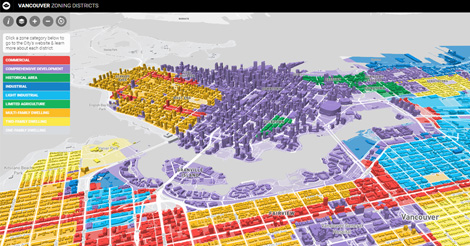
How is land zoned in Vancouver, and what/where are each of the different zoning districts? Explore my latest interactive 3D map and find out!
maps.nicholsonroad.com
213 points · by lbrito · 4y ago · 231 comments
Zoning decides so much of the vibe of a city/neighbourhood. Changing zoning is pretty short sited if you have the goal of having an area that people love to love in.
Having lived in 6 other cities, other things Vancouver does well that aren't obvious on this map:
- Narrow streets (avoids traffic in side streets)
- No highways in the city (loud, dangerous, take up lots of space)
- Grass on both sides of sidewalk and trees on every street.
- Extremely high park density.
- Protected bike lanes everywhere.
- Side streets with random dead ends.
- Commercial streets every ~4-6 blocks that allow more traffic + bus routes.
- Rectangle structured blocks with numbers 1 direction and names the other.
NIMBYism. I would rather have 6x more houses that people can AFFORD to live than 1/6th the homes owned by the richest people in the city who _really love it._
You can design beautiful neighbourhoods that are much much denser than they are now.
Single family zoning should be abolished in this city if we have any intention of solving the housing crisis.
Not to mention the huge positive impacts this would have on walkability, transit, climate change, etc.
NIMBYism.
Name calling as an argument technique.
You can design beautiful neighbourhoods that are much much denser than they are now.
In theory. Sometimes it actually happens in reality, too.
Most of the time though, when developers and their paid servants (aka your elected representatives) get together, something rather different from this glossy vision you seem to have ends up happening. In most cases the end reuslt is not at all beautiful, and (when you actually crunch the numbers) not all that affordable, either.
Not too infrequently it devolves into outright shenanigans, with profound betrayals of trust, and huge swaths of development opportunity more or less handed out to connected donors and/or other political kingpins (in exchange for who knows what votes or other favors they have to offer).
That's how it goes, and like the Leonard Cohen song -- everybody knows.
I agree that zoning has its pros and cons. And just because we did things a certain way 50 year ago, doesn't mean we have to keep doing it that way.
But the attitude you're presented sounds (to these jaded ears) well - saccharine. There are plenty of legitimate reasons to be fundamentally circumspect about the promised benefits of many (if not most) proposed zoning changes. There's no need to assume that anyone who doesn't share your own enthusiasm for such changes is (as you imply) just fundamentally self-centered - or filthy rich.
What about people that want to have a party on a Friday, but NIMBYs in an apartment complex throw the book at anybody that has fun past 10PM?
A lot of construction and transportation seems like it’s needlessly bad due to underinvestment and old equipment. I think we can make almost noiseless EV cars like Teslas today, no-compromises high density housing, quieter construction equipment and so much more.
As an avid biker in Vancouver, I can unfortunately not confirm that. There's a few strategic ones, but it's far from everywhere. https://vancouver.ca/files/cov/map-cycling-vancouver.pdf has the overview. It unfortunately doesn't cover the extended area, but already shows that outside of downtown only a small amount of fully protected lanes exists - like Arbutus Greenway.
Also it gets a bit worse in suburbs like North/West Van, New Westminster, etc.
Vancouver is consistently ranked among the most bike friendly cities in the world: - https://www.archdaily.com/920413/the-20-most-bike-friendly-c... - https://dailyhive.com/vancouver/vancouver-cycling-ranking-20... - https://www.momentum-biking.com/us/9-of-the-world%E2%80%99s-...
This is such an odd statement; it's "not even wrong."
Vancouver zones most of its land for low-density suburban houses that accommodate very few people. It also has many examples of zoning districts that accommodate a lot of people in urban neighbourhoods that people love to live in. You can just change one zoning district to another proven one!
Well, avoiding changing zoning has created areas that nobody can afford to live in, so they don't really have a choice at this point. Vancouver's affordability crisis is generally considered by economists to be the worst in North America.
Not really. If you don't build more homes, you have to limit how many people can live there. The latter is currently accomplished by money, but could be shifted to lotteries and waitlists if there was strict rent control or all housing was public. Both of those are significantly worse than just building more.
Interestingly the 1st image result of view cones is how they could be a bad thing for Vancouver: https://dailyhive.com/vancouver/vancouver-view-cones-economi...
Personally I can't understand the hate for the viewcones that I sometimes see. Talk with any newcomer to the city and they absolutely love the mountains. The mountain views are one of the selling points of this city. It would be utterly mad to block them.
I live near one in East Van that is utterly useless; it's defined as starting in the middle of a road, and the view is blocked by tree foliage most of the year anyway. And yet because of it, multiple proposed apartment buildings have been cut short.
This implies that the current zoning was implemented for good reason. That's basically never the case. Most existing zoning was done either to increase property values or to keep out people that the elites don't want to be around.
In a nutshell, it was intentionally designed to keep apartment buildings and stores out of most of the city.
Is there a compromise that you’d be okay with? Maybe sprinkle in some high-density apartments around to supplement the single-family housing? Maybe wipe away rental properties so that you don’t have effectively vacant units for portions of the year?
I don’t think it’s as clear-cut as that.
https://cityobservatory.org/the-myth-of-revealed-preference-...
Not even a little bit. Go read about exclusionary zoning in general or see your sibling comment's link for some reading on Vancouver specifically.
> Is it fair to say that the suburb layout is generally considered ideal to live in?
Is it considered ideal? Maybe. Is it actually ideal? No.
Aside from the huge negative impacts on pricing and equality that we've already discussed there's the environmental impact, isolation, car dependence, etc, etc.
> I would argue that most people would move to a suburb rather than a dense city all other things equal.
This is unfortunately true for Americans and I'd guess Canadians as well. I think this is due to some combination of:
- The absurd "American dream" vision that's been pushed by car manufacturers and other companies for many decades.
- Most American cities aren't actually very good, so most Americans have never experienced the alternative.
- Fox News and other conservative media pushing the narrative that cities are infested with criminals, terrorists, etc.
> Maybe sprinkle in some high-density apartments around to supplement the single-family housing?
Great. This is what would happen if there wasn't zoning.
Not really, no. It's the choice a lot of people make in north american metros from what they are offered, but that's not what ideal means.
Who is saying that? The zoning bureau that is forcing this lifestyle upon you against your will?
From my experience, many of its neighborhoods/dining districts feel really cold/loud/unwalkable due to the high speed 4 lane roads everywhere. Traffic noise still seems like a huge issue, trying to parallel park when cars are buzzing by at 50 mph isn’t fun, and the unprotected left turns are pretty gnarly.
Yeah, this is an unfortunate aspect of Vancouver's city planning; our zoning forces nearly all shops and restaurants onto busy, loud, polluted arterial roads. Changing this isn't really on the political landscape right now, and I don't think it's going to change anytime soon.
Great. Driving should not be convenient in cities.
Ask yourself if you would like to spend 45 minutes aboard the bus system as opposed to 15 min. in a car
That's an interesting one to me, because I'm generally bothered by how wide Vancouver streets are. IIRC most Vancouver residential streets are 33 feet wide, waaaaaaaay wider than in many European and Asian cities.
Like the fact that there's a term, "transit oriented development" used in North America. Here it's just common sense, nobody calls it anything.
I moved to Vancouver from the UK last year and it is significantly nicer/more liveable than most UK cities I've seen.
And i didn't say those are better than Vancouver, just that OP's list about why Vancouver is better than most NA cities is common sense which can be said about most cities in Europe.
- Quite a few stroads[0]: Granville around 70th, Granville around Broadway, Cambie around Broadway, 4th West of Burrard, most of Broadway, many sections of Kingsway, the section of W 41st Ave under the Kerrisdale label, and others.
- In general, getting East-West by vehicle is notably worse than North-South. While I 90% agree with your highway comment, this does make the situation frustrating at times.
- Vancouver is less bad than most of the cities that surround it, but it still has job areas a little too clustered in a few spots.
- Most land is low density in a city that has a huge housing shortage.
- Skytrain doesn't cover the majority of this map.
- Residential neighbourhoods have so much street parking that kids can't play street hockey these days. In general, there are too many cars in residential areas that kids can't play outside with the minimal supervision I had as a child.
I will add one more good:
- Grid designs tend to have a problem where local roads don't remain local roads and instead become side streets for cars. Vancouver has done a good job of using tools to keep these local roads serving just local traffic: narrow streets, tight visibility, forced turns, etc. Besides the benefit this provides to locals, it also helps with https://en.wikipedia.org/wiki/Braess%27s_paradox
[0] - Stroad is a portmanteau of street and road. By trying to be both, if fails to do either. Stroads suck no matter what type of user you are:
Car perspective:
- For thru traffic they suck since they are "too busy", traffic usual goes slower than the speed limit.
- For traffic stoping at a local destination they suck because getting to your destination is difficult: the road is busy so you need to focus 110% on driving, but you also gotta find parking, places to turn around, etc. A lot of people put pressure on themselves if they block traffic while parking and that is a necessary aspect of driving to a business that is on a stroad.
- Unprotected left turns usually only allow 1 vehicle per cycle of the lights. There will be a lot of unprotected lefts happening in these areas.
- For locals they suck because your community has congested traffic all the time.
For pedestrians:
- The area is loud due to all the cars. God forbid if people start honking. And this is Vancouver. I've seen people honk at parked cars a few dozen times in the last 5 years.
- If you have to cross the street, it can be a real bother as you will have to wait for a crossing signal that may take a few minutes. When you finally get your turn, you have to deal with drivers who are desperate to make their left turn.
- Walking distances are higher than they'd otherwise be on a proper street.
For cyclists:
- Commuting: Prepare to Die Edition
For business owners:
- While the traffic does get you some amount of visibility, a lot of that traffic will simply never stop at your business. There is also a portion who won't go due to the difficulty in driving in the area.
- You probably get way more business from random people walking by than from random people driving by. The artificially high walking distances mean fewer walkers.
- You have to soundproof your facade to deal with the noise.
- Prior to the lockdown, Vancouver city council was quite against patios and balconies at businesses. These days, they are allowing more of them. These will necessarily be loud and there is nothing you can do. Customers will complain.
Why doesn't this result in cars simply traveling on regular streets and creating noise and danger in the exact same space as pedestrians, cyclists, and residents?
The Grandview Highway cuts through half of Vancouver.
If you're thinking of the Georgia Viaduct (https://en.wikipedia.org/wiki/Georgia_Viaduct), it is slated for removal and is only about <1km
Vancouver's not a particularly well-designed city; its lack of a fully through highway is more a circumstance of indecision than design. It's still a city hampered by office districts and bedroom communities, linked with stroads, like many North American cities.
Glad I left.
The 400 series highways don't go anywhere near Toronto's downtown either. The 401 skirts around Toronto's suburbs, far to the north of what anyone would consider the city.
The urban Toronto road you're probably thinking of is the Gardiner Expressway, which is owned and managed by the city itself, not the provincial government.
For decades, there have been calls to remove the elevated downtown section which cuts Toronto off from its waterfront. Something that would not only remove a source of blight and open up the development potential of some significant tracts of prime land, it would also save the city a fortune in maintenance costs!
But I always wonder why don't you have more smaller supermarkets closer to where people lives, instead of larger ones that require so long trips. I guess it wouldn't make it walkable, because cities are not designed like that, but it would be a 5 minute trip maybe.
In my mind that is probably more efficient. People may come more often, so more opportunities for cross selling, real state is probably cheaper and the only downside I see is that would probably require more labor.
If I had to hop in the car for doing anything I think I'll die of laziness.
Of course, all problems in NA urbanism seem to stem from land zoning. Building a small grocery store in a residential neighborhood is illegal in a distressingly huge percentage of urban land here, and it's been this way since the 50s. So that's probably part of why the megamart has succeeded. The concept of 'mixed use' is a new idea to many cities, and it's not well distributed on the zoning maps.
Hence Costco/Target/Walmart/Home Depot/Lowes/Best Buy/Staples/etc succeed over a small business that might be a walkable distance. You are already in the car going to and from work, what difference does a detour make.
The rest of your comment, however, I fully agree with.
...and all of it is from three different companies?
As a result, the different people have very diverse diets, and it is unlikely that a small store would satisfy most of them.
For example, each week I shop from 2-3 different supermarkets that are 60k ft^2 each (6k m^2).
This is one of the reasons I enjoy shopping at ALDI. When I want honey, I pickup the one and only container of honey and move on.
Shopping takes 1/4 of the time and requires no decision making other than reading a list I made earlier, so it's literally like a relaxing stroll.
You don't have at least forest honey and meadow honey? That seems rough.
Note that <100 years ago basically every US city had somewhat similar density to New York or Boston. It’s not that they were built for the car so much as they were rebuilt for it. So I don’t think the reason can be as simple as ‘because they’re older’.
Most American cities were designed to do everything by car.
It's a reasonable question but I don't really know the answer.
In the US you tend to have sort of a bifurcation between (a few) supermarket chains (possibly somewhat downscaled in an urban environment) and convenience stores/bodegas/small food departments in places like urban Targets that tend to have minimal produce etc. Whereas in someplace like London, you're have Tesco's and smaller Sainsbury's which are somewhat in-between. Certainly there are exceptions with various local markets/specialists but that's the general pattern one sees.
For example, I live in Seattle, in a single family house in a single family house neighborhood. I have 3 large supermarkets within 5 minute drives, and at least 6 within 10 minutes.
Given that, why would I want to go to a store that has smaller selection and higher prices, if I can get to a proper one in 5 minutes?
I've lived most of my life in places that are 5-10 minutes by car from a store, and it makes for a very isolated social experience, but also it means that if I don't have a car, getting groceries is a planned 1.5 hour experience.
Now that I'm living within walking distance, I buy a majority of my food multiple times per week, only for a few days at a time, which means I can also go to the coffee shop and see people doing the same thing, have a talk with them, socialize etc..
>Given that, why would I want to go to a store that has smaller selection and higher prices, if I can get to a proper one in 5 minutes?
Because you might not have a car.
The Lively & Liveable Neighbourhoods that are Illegal in Most of North America (Not Just Bikes channel) https://www.youtube.com/watch?v=bnKIVX968PQ
I have a local grocery store that I can walk to in 5 min but I’m not paying double for food when the alternative is to drive 10 min.
It's generally a bit more expensive than the larger one that was already in the area but damn is it nice. I've noticed this in a bunch of other neighborhoods, too. They have stuff like European import candies and stuff. They didn't exist about a decade ago when I was living here last.
You will find smaller supermarkets (publix, trader joes, etc.) within 5-10 mins of driving time in a lot of cities.
and what about within 5-10 minutes of walking time? I think that's what was meant in the GP comment.
In a tight grid (like where I grew in Chile), a small store can survive off the foot traffic of a few square kilometer of houses, because they're more connected and just more fit in the space.
Back when these places existed, they were terrible leaches on poor people. High prices, almost rotten meat and produce and etc. Desperate oasises in the "food desert". Many cities had a social program to clear land to build full service groceries and box stores in transit dependent areas.
The modern versions are pricey stories for wealthy urban professionals.
However, this is less-common in the more central areas of Vancouver, at least where I live, and I could never go back. If you drop into street view and go up and down Commercial Drive, there's 5-10 grocery stores that are easy to walk to. This absolutely isn't the case in most of the suburbs though.
We do have "convenience stores" some of which are effectively very small grocery stores (produce, fresh meats, etc). But usually significantly more expensive.
Or you can get the 1.5 lbs of chicken breasts (boneless) for $7.
Of course I’m actually only a block from a normal grocery store so I don’t need to worry.
My wife & I walk or bike to them quite regularly in the spring/summer/fall.
Maybe we’ll leapfrog that step straight to Amazon Fresh delivery to the door.
In my country such central neighborhoods in such a young fast-growing city would have been re-zoned to 4-story buildings a long time ago, and then rezoned again to 12-story buildings more recently. No wonder they have a "housing crisis".
Edit: And when you compare it to a transit map it becomes even more outlandish, they have "single family zones" completely surrounding major transit stations.
1. https://vancouversun.com/opinion/columnists/dan-fumano-the-e...
The Vancouver Plan needs to be approved, then an Official Development Plan, then neighbourhood plans, then actual rezonings. Expect 10+ years, if it happens at all; Vancouver has a very poor record with these sorts of city-wide plans. From a 1992 article I found in the archives a while back:
"no city council has ever accepted any of the half-dozen attempts at developing a city plan"
https://twitter.com/GRIDSVancouver/status/106689301711663104...
Also, Richmond Delta are 50% or more farmland, Surrey maybe 30%.
But upon clicking, the pop-up legend says that gray means "One-Family Dwelling", and "Zoning District" is RS-1, RS-3, RS-5, RS-6, etc.
For starters: it's gone quickly downhill in the last 5 years or thereabouts because the street-level outreach services were placed within the downtown and high-density mixed use areas of the city; and so city promenades and parks have become unsafe for children and other vulnerable persons. I got tired of having to sweep the grass and sand for broken glass and needles before my kids could play; or having to explain why their favourite playground was closed/spray painted/burned down. My wife and neighbours didn't feel safe walking at night; probably because of the _numerous_ murders in the immediate neighbourhood.
But more to zoning: the Queen's Park Heritage Community is an affront to affordability and heritage both! It secures and defends the white-favored, post-war housing that was constructed in the Queen's Park area that replaced the high-density housing that existed in the area pre-war. The tenements that were there prior would never pass the heritage committee now. Good luck trying to convince Queen's Park to build anything remotely affordable.
The whole of Brow of the Hill is a low-income residential area that council, even the current self-declared progressive council, seems determined to completely ignore. It has some of the highest density of children, but parts of Brow are a half hour, or longer, walk from a public playground. There was a playground, 10y ago, but the School Board paved it over to put in parking for teachers.
Last spring, I knew it was time to leave when I was walking my kids to day care at 9am on a sunny day and I had to divert their attention _yet again_ because a man was running down the street with knife wounds. It's funny, because when I first moved to town I did so because it was cheap; and one day leaving the Columbia Sky Train station a man lunged from a bush, covered in dried blood, and asked to use my phone. I let him, thinking he'd call 911, but instead he called his friends and ordered a hit on those who tortured him.
Since then things got better, the neighbourhood cleaned up, but then they rapidly declined again because council thought it was better to embrace than resist.
And so I packed up my family and left.
To me as a foreigner living here its glaringly obvious that the affordability problem is at least in great part due to SFH zoning. I think basically anyone not native to the US or Canada immediately understands this.
I'm glad to see this topic being increasingly discussed among locals instead of just the usual boogeymen (foreign investors is #1).
Years before governments come around.
Years more before they finish their endless studies and legislation and actually legalize housing.
Once housing starts getting built, it will be a knock-down battle to keep the changes. At the same time, we won't have the capacity built up yet to build it, so years more for new industrial capacity to come online - more companies, more trained personnel, more equipment.
And then even more years for the supply to finally catch up with the demand.
My oldest kid is 14 and he's either he's living in my basement until he's 40 or he's going to have to move to Texas.
Or replace it with 2-6 story mixed-use, with commercial space on the ground floor, and density goes way up and suddenly you can survive without a car.
Here is another example with calorie labels (Do calorie labels actually reduce calorie intake?): https://www.ncbi.nlm.nih.gov/pmc/articles/PMC4209007/
Contrasting calorie consumption with the housing market is just disingenuous. One is clearly not a market and the other one clearly is. People like you are just going to have to understand that as population in North America grows cities are going to have to get denser and your lifestyle is no longer a viable one because it comes at the cost of millions of peoples' lives.
Not arguing your point that this rezoning should take place, but just pointing out that housing development is a physical process and that even if Vancouver and British Columbia politicians do get their act together around land use policy, we're in a painful housing shortage hole that is going to take years to build our way out of.
All the more reason to act sooner than later!
But I’m not sure China is a good model for North America, they have a lot of density but an even worse property bubble, many bought apartments aren’t even renovated to be rented out (so actual density is much less than the capacity of these buildings). Such speculation was exported to Vancouver as well.
One minor bug I noticed was the popup title bar color usually matches the map zoning coloring, except for zoning district DD where the title bar color matches CD-1 instead. At first I thought I was misclicking but it is just a display issue.
But if you do want to read them, here you go: https://vancouver.ca/home-property-development/zoning-and-la...
The "CD-1" zoning is notable in that it's actually 800+ unique zoning districts: https://cd1-bylaws.vancouver.ca/ByCD-1Number.htm
For a variety of depressing reasons, the Vancouver planning department is quite reluctant to use broadly-applicable zoning districts; a lot of new development happens with new unique zoning districts that apply to one lot only.
I'd love to see similar maps for other cities.
The history of Shaughnessy land use is kinda interesting; it was designed to be an ultra-exclusive enclave from the start, and the province and the city have both used their powers to keep it that way.
In the first half of the 1900s, the province enacted laws mandating single-family homes only in Shaughnessy; they were particularly weird in that the Shaughnessy Heights Property Owners' Association was empowered to enforce them. In (more) recent years the City has done largely the same thing with zoning restrictions.
Some links if you're curious:
https://twitter.com/GRIDSVancouver/status/960183009017135104...
https://web.archive.org/web/20190722191318/vancouver.ca/home...
Kudos to author https://twitter.com/rbrtwhite!
And considerably more responsive than the Google Earth mobile app.
By many metrics, FDS is one of the best places in the world to have a house in, due to following reasons:
1. Big lot size: Average size Half acre (21k+ sqft). No other world class city has such sized lots in walking distance to the downtown (< 30mins walk, <10min drive).
2. Incredibly safe.
3. Right next to the Granville shop area which is even closer than the downtown (< 10 mins walk). Major develpment happening in nearby Broadway area.
4. 15mins drive to Vancouver International airport.
5. Incredibly safe.
6. 10mins drive to beach
7. 30-40mins drive to skiing. While Vanvouer itself gets snowed in maybe 10 days an year.
8. Other benefits which apply to Vancouver due to being centrally located in Vancouver.
It's such a great area because of the proximity to the city, so we should let more people live here.
Raze the mansions to the ground and build apartments that regular people can afford.
Vancouver downtown is amazing too. Used to live there. But living in a high rise with young kids and constant false fire alarms where a big pain.
Most of the map is white.
In addition, you can't build anything that's so tall it would block people's view of the mountain backdrop ( https://vancouver.ca/home-property-development/protecting-va... ). Vancouver has it's priorities straight, and it's more important to have scenic views from existing housing, than building new housing