A first for Canada: New type of nuclear plant opening by 2028 - The Weather Network
Small, transportable modules could emerge as future nuclear plants are distributed across Canada.
The Weather Network
425 points · by nick__m · 4y ago · 404 comments
1. Vast swathes of uninhabited land can absorb some of the risks/fears associated with a nuclear accident. With technology like this, the risks are even lower. 2. It's lot cleaner than coal and natural gas, which are still the primary sources of our electricity. 3. There will be a huge demand for electric cars in the near future drawing massive amount power from the grid. Nuclear power would be a lot cheaper and enable us to truely go green.
Of course the coal companies won't like that. I can't see any reason why don't have nuclear energy. Please correct me if I'm wrong.
(I'm a candidate for the Fusion Party; we'd like to remove the ban on nuclear power in Australia because it would enable research)
The main reason? NIMBYs. Loads of people go out to the countryside to retire. imagine what these retires would do if their picturesque landscape is now comprised of windfarms? and they dont have anything else to do to fill up their day?
they imagine themselves wanting to go out to the country side to retire, but would find that living in remote places that doesn't have facilities to be poor quality life.
you want to travel to the countryside for leisure - may be even for extended vacation. But you will almost always want a "home base" in a big metropolitan area for when services are needed - such as medical or home helper etc.
Likewise, nukes: a dollar plowed into nukes generates, many years later, much less power than a dollar of renewables that start producing immediately. You spend on coal the whole time while the nuke is being built, and the amount you have spent just on coal, by then, would have bought as much renewable generating capacity as your nuke.
1. Nuclear is a more expensive sources of energy than our alternatives (uranium ore is a small proportion of the cost stack, and Australia would still need to import nuclear fuel)
2. Nuclear isn't commercially viable in energy markets with very high levels of variable renewable energy where they have to be economically curtailed on an almost daily basis (our coal plants are all closing for this reason)
Nuclear doesn't have a big support base. It's basically only supported by educated technocrats.
And those educated technocrats are already holding their nose, because they know big government projects are often late and over budget. And the designs that are intrinsically safe haven't been built before. And if there was a meltdown, the taxpayer would have to foot the bill. And nobody's going to want the plants built in their area. And a permanent waste repository has been a political football for longer than most of us have been alive.
At the same time, if you squint hard enough when you look at the figures, solar+wind+batteries look cheaper.
Squinting that way is pretty tempting if you were on the fence anyway.
The additional pumped storage needs of solar and wind are more than offset by their vastly lower cost.
If nuclear power could compete on a level playing field it'd be great but it sucks up subsidies like nothing else and puts the taxpayer is fully on the hook for dealing with all and any 800 billion dollar fukishima events.
True for cost per Watt, but there are other factors. A good replacement for burning fossil fuels is solar + batteries, which is more expensive right now. Even if batteries get cheap, you still have to protect yourself from black swan events e.g. volcano eruption which hides the sun. Also, it seems Australia would need nuclear weapons to protect its independence in the future. It's critical to have nuclear experts at home.
No they wouldn't. To quote https://globalroadtechnology.com/uranium-mining-australia-hi...
> Australia is home to 31% of the world’s recoverable uranium. Australian uranium is exported and consists about one-quarter of its energy exports. Australia uses no nuclear power and depends on coal. The uranium mining industry is a billion dollar industry in Australian dollar ... In 2019, Australia produced 7790 tonnes of uranium and was ranked the world’s third best producer behind Kazakhstan and Canada.
If that is true, Australia would have to export natural uranium and import back uranium enriched in 235U, unless they would choose to build a reactor with heavy-water, which can use natural uranium as a fuel.
About 60% of Australia’s electricity came from coal over the last 12-months, but this proportion is rapidly declining and all the large coal plants are losing money and slated for closure.
Not in the very long term. Upfront it's really expensive yeah.
>(uranium ore is a small proportion of the cost stack, and Australia would still need to import nuclear fuel)
A very small portion and isn't Australia a big exporter? Might as well set up refinement capabilities.
>with very high levels of variable renewable energy where they have to be economically curtailed on an almost daily basis (our coal plants are all closing for this reason)
I went to check gov sources and it still seems to be mainly fossil fuels tho renewables are growing. What will be kept as backup for days with little production btw? Here our greens are pushing for gas.
Australia is different to Germany. We get high solar output every day, even in winter, and while we do get some wind droughts, they are less long and widespread than in Europe. We don't need to 'back up' anything close to 100% of our renewable capacity, and we don't need 'back up' for very long durations.
And to make matters even worse, you generally want to run nuclear at 100% all the time because of the high initial costs but summer peaks can be twice winter lows which means you would need to have a ton capacity that hardly ever gets used whereas gas is by far the cheapest option for handling variable demand.
[0]: https://en.wikipedia.org/wiki/Power-to-gas
[1]: https://en.wikipedia.org/wiki/Cost_of_electricity_by_source#...
I've asked time and again for costed *TWh-scale* storage, the proposals are never forthcoming. Because, on first principles, they're far too high and unlikely to ever decrease. Ask actual investors - which I have - in private, and they'll admit it.
Almost nowhere are renewables outcompeting nuclear. What is outcompeting is greenwashed gas.
Our state with the highest share of renewable energy, South Australia, has not seen gas use increase as renewables have replaced coal.
The idea that 100% of all renewable capacity has to be ‘backed up’ with firm capacity is not true in general, and certainly not true in the specific case of Australia given the solar and wind resources we have.
Like renewables, much of the cost of nuclear is in construction - unlike renewables, this has gone up not down over the years.
> Of course the coal companies won't like that.
This is a fairly important reason why it's not going to happen in Australia.
Does it? Article says this new reactor is helium cooled and vents heat. No mention of water cooling.
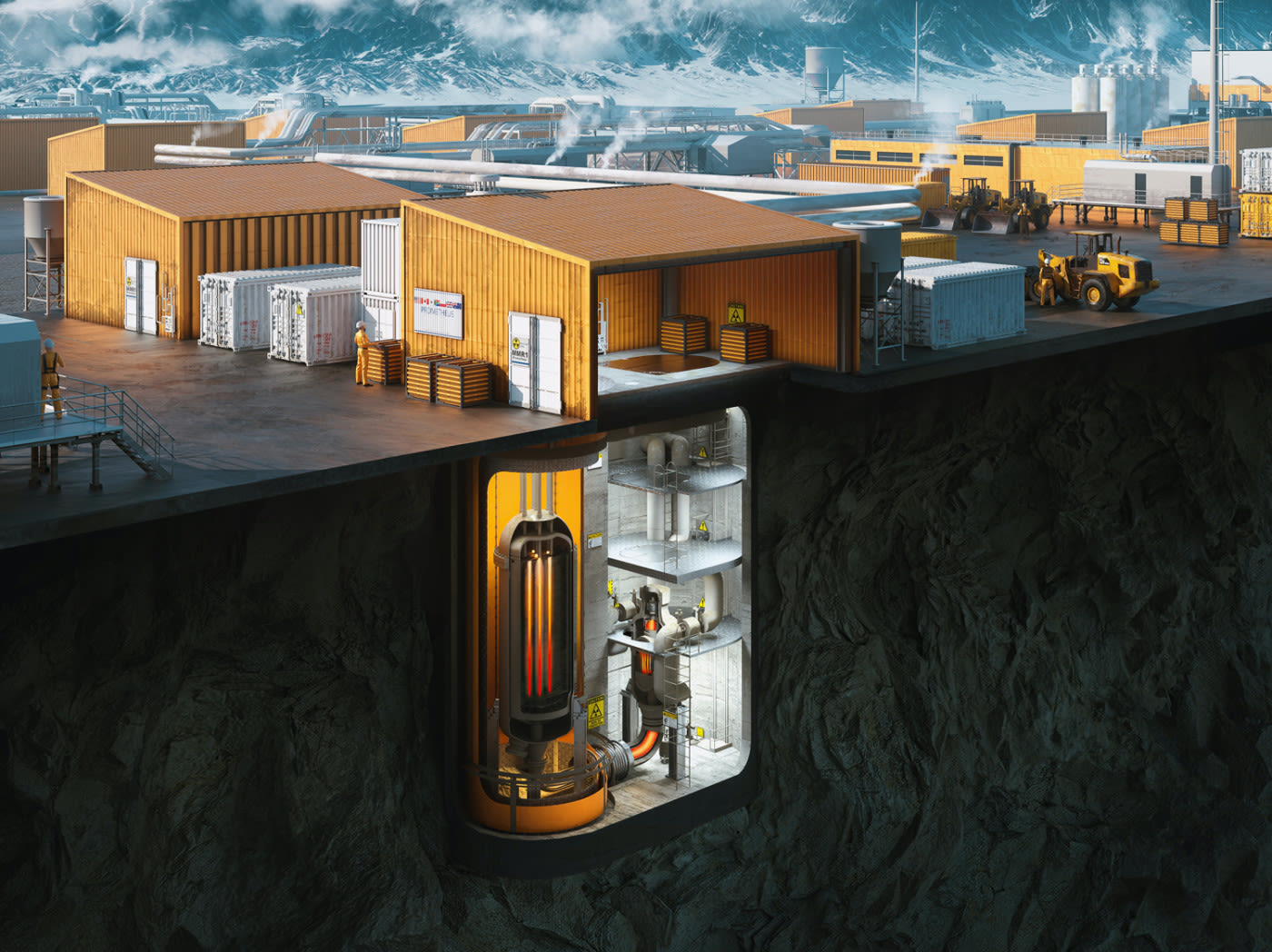
The system described in the article punts the "how do we use the heat this system outputs" to some other facility/plant. It could use the heat directly in a variety of industrial processes, or it could be used to boil water for a steam turbine.
So it's non-functional without a methane industry tuen. Got it.
Water or salt or sodium sounds more sustainable.
Not always. The Palo Verde nuclear plant in my state is in the middle of the desert far from any body of water, and also the largest in the country in terms of net generation.
> The nuclear plants need to be built near water, which means they're likely to end up near habitation.
Would seawater work? Does Australia have any "vast swathes of uninhabited land" near the sea?
> Like renewables, much of the cost of nuclear is in construction - unlike renewables, this has gone up not down over the years.
IIRC, a big reason why nuclear plants cost so much to construct nowadays is that most reactors designs aren't produced in quantity, like they used to be.
Local (to me) example: Diablo Canyon Nuclear Power Plant killed all the abalone in its discharge cove during its first hot run due to the increased water temperature. There were so many that before the plant the spot was known to locals as "abalone cove". You could rock pick to your heart's content and not even need a wetsuit. On the other hand, they do have rather fascinating sea life in that cove due to the higher temps there vs. the cold Pacific just a few feet away (they used to have a show-and-tell marine biology lab onsite for visitors to check out). Anyway, to relicense DCPP, the plant would likely need to switch to cooling using the signature big towers people associate with nuclear plants, which is obviously a titanic effort.
The thing is that nuclear is expensive by itself, anything you increase makes it less desirable.
Anyway, AFAIK, nearly all of the uninhabited land on Australia is inside the continent. It's much easier to deploy solar and wind there than anything else.
personally I feel this is untrue. its done out of convenience; but from an engineering/infrastructure standpoint there isn't a reason we can't condense the steam that gets pumped out of the towers.
That's what the water is for!
Turbine systems follow the Rankine cycle, https://en.wikipedia.org/wiki/Rankine_cycle , which includes a condenser. The water circulating is a closed loop. The steam you see coming off cooling towers is the external water which has been used to condense the circulating steam.
The water is a source of "coolth".
https://www.theguardian.com/news/2018/sep/07/weatherwatch-nu...
So geographically, that likely means that nuclear power stations would still be close to Australian coastal cities.
In the place I live (Brittany/west part of France), a hot day is more like 25°C.
Also Australia doesn't have anything like the number of size of major rivers that France, and continental Europe has.
But this is a conventional issue, a gas or coal generator has similar cooling requirements.
There are still unending miles of coastline in Australia that aren't peppered with big cities ;-)
Water is a essential resource, and in a higher level than electricity.
TL;DW: Coal, gas lobbies.
And it's hardly "vast amounts", it's a small portion of the flow of a small river.
A coal plant also works better with a water source - there's no real difference here, you just need something to cool the steam at the end.
If coal can work in Australia so can nuclear.
There is no mainstream party that supports nuclear outside of the libertarian party (which gets single digit percentages at the ballots).
You realise you're commenting on a post about Canada using Nuclear power, and all of the things you said about Australia also hold true for Canada?
Canada is somewhere I'd begrudgingly admit that nuclear may have a role to play in the future energy market, but it would be downright silly for Australia.
I'm happy with whatever actually delivers carbon-free watt hours, which yes, in Australia should be solar.
Clearly you want something else as well.
But I'm not, so I have to be realistic and admit that there are niche areas where nuclear is helpful in real politics even if most of the noise around nuclear is clearly climate change denial.
We have a lot of "unused" and stable land well away from population centres.
I imagine transport from afar is an issue though.
Wherever it is put the high level waste (not much in quantity but...) is deadly and a silent killer for over a hundred thousand years. This is geologically significant time period, and we can make bets, but have no guarantee of any place on Earth being stable on those time scales.
So it must be monitored.
For a hundred thousand years
That would be us making future generations pay for the cost of our current consumptions. I do not think they will think kindly of us.
- Extinction - We don't need to care about it, because there are no descendants.
- Advancement - We will be able to handle the problem better as our technology improves.
- Stagnation/regression - We don't need to care about it. Our descendants will have to worry about dysentery, crop failures and regional warfare. Some magic rocks that kill people will end up as curios in warded laden boxes after first adventurous monk opens sarcophagus and succumbs to curse.
The geological pixel - smallest possible measurable period - is 50,000 years. Nuclear waste is 2 pixels.
Everest is a 50 million years old. The chalk that makes up white cliffs of dover is 130 million years old. There are layers of bedrock over a billion years old.
So yes, we are making a bet in the sence that when I go putside I make a bet that an asteroid won't fall on my head.
What's left is just fission products. Encase them in glass and bury them, and they'll be back to the radioactivity of the original ore in 300 years. Most of the radioactivity will be gone in the first few decades, since the decline is exponential.
Russia has a couple fast reactors in operation right now, and various startups are attempting new designs.
It does not really matter how big the caverns are where you store the waste so any additional nuclear material stored is basically free.
Yes nuclear is cleaner than coal. But also way more expensive than everything else even before you consider that. Note how the article carefully dodges the cost topic. That's because it probably is quite a bit of money per mwh. Nobody installs nuclear because its cheap. There's always a secondary objective; usually military. Countries like being labeled "a nuclear power". It's not about the electricity. It's a label that comes at an extreme premium. The price of the energy they sell simply does not cover the cost of the plant over the lifetime.
The cheapest options in the market are solar and wind. Not by a little bit but by a wide and growing margin. That's just at current prices; they are widely predicted to continue dropping for a long time and there is very little consensus on where it will bottom out except perhaps nowhere close to current price levels. Cheap energy storage solutions are also becoming available and also dropping in price. Solar in Canada is not good enough to rely on exclusively. But wind is fine. Lots of coastal areas; lots of empty planes. Lots of wind.
Electrical cars won't be that big of an impact. They will actually have a balancing impact on the grid because they can be both sources and sinks of energy. They can absorb oversupply and supply back to the grid during peak hours. A single EV can keep a house hold going for several days. With millions of EVs on the road, a large percentage of them will be plugged in and either charging or ready to discharge at any time. Even using just a small percentage of that capacity means you can pretty much permanently turn off a bunch of gas peaker plants. 1 million cars supplying 1 kw of power for 1 hour would amount to about 1GW of capacity and 1GWH of power delivered. The same as running 3 of these fancy new nuclear plants for 1 hour. Charge them with a few solar panels and they pretty much become net producers rather than consumers of energy too.
The us drives about 3.2 trillion miles per year apparently. A good EV might get 4-5 miles per kwh. Lets call it 3.2 miles for the sake of easy numbers. So, that's 3.2 trillion kwh. Or 3.2 billion mwh. Or 3.2 million gwh, a common metric of the output of energy producers. The US generates about 4 trillion kwh per year. So switching overnight would cause some issues but also be a completely impossible scenario because the battery production volume wto make that happen simply does not exist to make that happen. Not even close. It will take decades to construct that. But gradually phasing in storage and renewable energy sources over say decades, would be plenty of time for the less than 2x increase in energy production. It's not an energy crisis but a healthy growth scenario for any energy company worthy of the name.
That's why the investment space around renewables is so hot right now. Nuclear, not so much. Risky investments, poor ROI (if not outright negative), long lead times to plants actually coming online, politics very uncertain, high chance of budget overruns, etc.
Incorporating solar into housing, like roof tiles seems like a no brainer. Energy stores like reservoirs, or flywheel tech or something else could help plug gaps.
Then there is the whole question of energy needs. Zero energy housing. And micro generation could help.
In the UK our housing and agriculture sector, uses a huge amount of energy for not a lot of gain. Given a modern country and opportunity learn from others' mistakes.
Such a cynical take. We have a lot of land, its fine if we turn some of it into a nuclear wasteland.
Every reactor ever built has been guaranteed to be safe. Yet 2 of them have experienced meltdowns. This technology is safe in a sense but not in the sense that accidents will not happen. They have happened and they will happen again.
ugh ffs : mabo was 30 yrs ago last month
If you ask the people who inhabit "uninhabited" areas they may have a different opinion. That's why we tell them and not ask them.
Maybe the nuclear subs will provide impetus
The problem space we're in now is multi-dimensional. Purely on economic and rational engineering grounds you are right. Bring politics to the table and no, there is no clear time now or in the future where it will "work" to propose nuclear for powergen, where if we had installed the worse, 2/3 gen stuff in the 60s we'd be arguing about replacement, but with a good investment in nuclear physics engineering, and baseload supply demands which had displaced brown coal already.
The problem really is that time is of the essence now and it simply takes way too long to build a new plant. Cost isn't great at all, they will never be profitable and insurance is neck breaking, but it can be managed. If any of these issues currently do exist with renewables, they are continuously waning.
Two recent nuclear projects:
- Olkiluoto Unit 3 (EPR) in Finland. Projected cost: €3 billion / Real cost: ~€11 billion (4x) / Delay: 13 years (https://en.wikipedia.org/wiki/Olkiluoto_Nuclear_Power_Plant)
- Flamanville Unit 3 (EPR) in France. Projected cost: €3.3 billion / Real cost: €19.1 billion (6x) / Delay: currently 10 years, no start in sight (https://en.wikipedia.org/wiki/Flamanville_Nuclear_Power_Plan...)
It doesn't look much better in other countries most of the time [2], China is possibly an exception due to, let's say, different handling of safety and other topics... In any case, nuclear is quite an expensive energy source [3] on top of critical time issues in construction and commission [4].
In the time it takes to build new nuclear power (10-15 years) technology and cost of renewable energy are projected to become much more favorable and then we gain several things:
- inherent safety
- decentralization
- stable cost (less dependence on imported resources such as uranium)
[1] https://www.reuters.com/article/us-energy-nuclearpower-idUSK...
[2] https://en.wikipedia.org/wiki/List_of_commercial_nuclear_rea...
[3] https://www.iea.org/reports/projected-costs-of-generating-el...
[4] https://en.wikipedia.org/wiki/Economics_of_nuclear_power_pla...
I suppose anyone who has some knowledge re electricity knows what they're trying to say here, and for anyone who doesn't it won't make much difference, but reading a sentence like this still hurts me a little.
MW (megawatts) are a measure of power, not energy. This means the "per year" part is meaningless. Also for what it's worth, 300MW for 300k homes is 1kW/home, which is a pretty old rule of thumb for average household power use. I believe the current average in Canada (and the US) is considerably higher But that's also just the average; the peak is much higher. 300MW is the peak output for the plant, so the true number of homes it could power is lower regardless, absent storage.
None of that to say the prospect isn't exciting! And I suppose the source here is the weather network, so perhaps they're a bit outside their area of expertise.
All in all, the greatest feature of SMRs in my opinion, is the scalability they offer. I'd have also added decentralization, but I'm far from familiar what is most optimal in terms of electricity networks.
https://www.world-nuclear-news.org/Articles/Canadian-provinc...
Supposedly this is promoting clean energy and fighting climate change, but the details don't always match this rhetoric. In particular they're thinking they can use nuclear power to replace piped-in natural gas to mine the Alberta tar sands and make (very dirty) syncrude for export to refineries in the USA, maybe China too. Yes, that does reduce natural gas use... but you're still burning dirty tarsand oil. The better option is to just leave the tar in the ground.
Otherwise, SMRs sound kind of interesting, but there's been a lot of failed innovation in nuclear reactors in the past. Some of us might remember when safe and reliable and innovative pebble bed reactors were going to be the thing that made nuclear acceptable everywhere, and that ended up going nowhere:
https://thebulletin.org/2009/06/the-demise-of-the-pebble-bed...
> "For some, helium-cooled, graphite-moderated reactors such as the PBMR have always been the ultimate evolution of fission reactor design. The use of helium and graphite allows the reactor to burn the fuel efficiently and to operate at much higher temperatures than conventional light water reactors. It is hoped the temperatures would be high enough to allow for the reactor’s heat to be used directly for industrial processes such as hydrogen production and tar sands processing. High temperature reactors can also be designed to use thorium-based fuel as well as uranium and can be developed as fast neutron reactors that don’t need moderators."
I was enthusiastic about nuclear 20 years ago... now, not so much, since solar/wind/storage really gives more watts per dollar invested, with less side issues (security, uranium supply, waste storage). Nuclear has a niche, but it's going to remain small.
The pebble bed reactors seemed to have stability issues created by graphite rubbing off of the spheres as the pebbles we loaded in the top and removed from the bottom. This newer design works around that by having the fuel in a cylinder and the fuel in the core not being changeable for its 20 year life. It seems to be one of the simplest designs yet and is likely cheaper as a result.
If it turns out to be cheap power this would have a big impact on northern communities where there is little sunlight for several months, and low-angle sunlight during the summer months. It doesn't have to beat typical solar, it just has to beat diesel that is shipped or flown in.
I'm from Alberta and I also wish they would leave the tarsands tar in the ground. I have little expectation they will, so nuclear seems like an improvement at least.
It is fortunate that extracting tar sands produces very expensive oil. As demand for oil drops, cost for oil from tar sands will be unable to match prices offered.
I am fairly enthusiastic about both renewables and nuclear, but I am a bit pessimistic about storage. The holy grail would be green hydrogen as storage, and that has been the political aiming for in the last 10 years. However in the mean time, everyone just got to rely on that Russian gas and oil. Solar/wind/fossil fuel is the current model and I just can't get enthusiastic about that.
It is strange that people proposing storage methods frequently seem unable to reason about cost, so propose absurdly expensive realizations of their ideas. What will end up deployed will be the most sensible alternatives.
We don't need to have storage built out until after we have enough renewable generating capacity for both peak load and to charge up the storage, at the same time. Until then, money is overwhelmingly better spent on the generating capacity. Given equipment to synthesize ammonia or hydrogen, we can then continue building out generating capacity, because all the hydrogen or ammonia produced after local storage is topped up can be sold for direct revenue.
There are some alternative use cases. If you can convert the energy directly to a substance that an industry consume, like hydrogen in steel production, then the economics start to shift a bit. Hydrogen is produce today through natural gas, and if we include the carbon tax and introduce some subsidies to those who want to use renewables, then green hydrogen can be made to price match grey hydrogen in steel manufacturing. It not perfect, and its not storage, but it does reduce the use of fossil fuels. Burning the hydrogen for power however is still several times more expensive than nuclear, and I don't think people are willing to pay that kind of money in order to avoid nuclear power.
The current way most governments seem to operate is to build out renewable generating capacity while also build out equal or greater amount of fossil fuel generating capacity. Looking at the Ukraine war, looking at the climate, and just looking at air pollution or graphs over fossil fuel usage, I am not optimistic that the current strategy are working at all. If anything it look exactly what the fossil fuel lobbying are pushing which is a future where they still hold a significant position and where the high peak price results in about as much profits as in the past but for a significant less amount of actually product.
A town not too far from where I grew up had most of it's economy based around a single factory (Hershey Chocolate in Smith's Falls, Ontario). There were lots of other stores and whatnot, but money flowed into the town via the factory paying workers' salaries, then bounced between hands from in shops, services, whatever else.
When I was in high school, that factory closed down. The inflow of money stopped. And so did the rest of the economy of the town. Hard to run a flower shop when nobody in town can afford to buy flowers, you know?
Stopping mining of tarsands entirely would be a bit like doing that to the entire province of Alberta. The money enters the province via the dirty oil they sell. We should never have gotten into this situation, no doubt, but now that we're here it's politically impossible to stop.
And being major exporters, they're also a big reason for the value of the Canadian dollar. Stop exporting all the dirty oil and the exchange rate goes to crap- now all the things we buy from the USA and China are more expensive. What political party wants to be elected on that promise?
Nuclear could be the thing that provides a route forward. Given BC's seismic issues, it's probably not a great place for nuclear power plants and there's really no more rivers to dam. Alberta should be pivoting away from oil and toward becoming a nuclear power provider to BC, the Prairies and the United States.
So what would happen if a disaster somehow hit one of these mini plants?
These new miniplants don't require power or water, loss of either causes shutdown.
However, I find it elegant that heat is directly used to heat homes, rather than turning it into low-entropy electricity just to turn it to heat again (which is inelegant, even with heat pumps).
I know that fossil fuel plants have a lot of waste heat that enables cogeneration, but I've never heard of that with solar or wind.
There was talk of heating cities with the waste water, but "nucleophobia" killed that idea, as usual.
Also, you'd need enough heat to boil water, but the waste heat, by definition, is lower than the boiling point of water (otherwise the turbine doesn't work).
The waste heat from a steam turbine is higher than boiling. Otherwise the turbine wouldn't work. The boiler turns water into steam, which produces pressure to drive a turbine. The condenser takes the low pressure steam and condenses it back to water.
Though for industrial purposes (rather than just heating buildings) you'd probably have to be closer.
You can make hot water though.
This statement reflects the quality of the article.
There is nothing very interesting about SMRs. They are much more expensive than equivalent renewables, so they will only be built by coercion of ratepayers who would be better served by the alternative.
This statement reflects the quality of the comment.
Renewables need significant storage to be directly comparable, cost-wise, to nuclear. There are no currently existing grid level storage solutions, same as SMRs, and both are invested in.
And you're missing a huge part of the equation - we're talking about Canada, the northern cold parts. Which renewables would run there ( maybe wind?) and which storage solution could be viable to withstand the cold and storms and what not?
I can understand that it might be fine to bury small amounts in specific stores but if countries slowly adopt nuclear energy at scale then over time won’t we be burying a lot of waste that, correct me if I’m wrong, has to be stored for thousands of years? I don’t understand how this can be sustainable long term. I also think it’s maybe arrogant of us to assume that it will always be safe to just store it and that something won’t happen that could disrupt that.
I’m no expert on this though so if someone has a great explanation I’d love to understand it.
Is a good starting point. There has been a lot of thought put into this.
All of the uranium used as fuel came from the ground. Now, we will be putting smaller quantity of other, also radioactive, materials into ground. Lot of places have high natural levels of radiation[0], sometimes they even make it as a spa location[1].
People were living around radiation since before they were people. And they managed. We still do.
In the end the question is if we want some radioactive pollution that is easy to contain in the near term, or a lot more carbon pollution that is impossible to contain in the near term.
One is destroying the planet as we speak. The other might be a problem few centuries in the future, if there is one.
[0]https://en.wikipedia.org/wiki/Background_radiation#Areas_wit...
However. I still think humanity can do better.
If we put all the energy, resources and research that we are putting into nuclear into truly sustainable energy like wind, solar, wave and geothermal, which to my knowledge produce less or no byproducts, then that would be best.
It's unfortunate that the world can't take an aligned approach and build solar farms in deserts, wind farms at sea, wave energy on coastlines and then just export it all fairly to countries. I think I'm almost campaigning for energy as a global right and not for sale as a commodity.
Most of newer reactor design produce very little waste -- the newest type of reactor produce only a few pounds of spent fuel a year per 1GW.
Just came here to point out what appears to be a significant error in the linked text.
"...when an earthquake-triggered tsunami crashed into the nuclear plant and caused three nuclear meltdowns that leaked radioactive materials for several days."
It is my understanding that radioactive materials were leaking and being released into the oceans far longer than, "several days."
According to Wikipedia (https://en.wikipedia.org/wiki/Fukushima_nuclear_disaster), "As of October 2012, radioactivity was still leaking into the ocean."
This article from World Nuclear (https://world-nuclear.org/information-library/safety-and-sec...) describes unintentional leaks and planned discharges continuing for years.
- Power company executives live in on-site "VIP housing", and work from offices within the outer containment structure. In case of a major spill, they're issued mops, buckets, and lead underwear, and deployed as front-line clean-up workers.
- NIMBY's shiver in the dark.
300MW is a lot of energy to passively release into the environment. Does this design really fail safe? And if so, how?
The Fukushima issues were caused (IIRC) by failure of the backup generators to run the cooling system after the reactors were shut down. Do these small reactors really not need any external power when in that state? And do they get into this state by default? I.e. do they shut themselves down without external power and if the control systems fail? That would seem to be a massive safety advantage if it's true.
I remember reading about UK magnox reactors where the graphite control rods were held above the core by electrically powered actuators and which were designed to fall into the core (and stop the reaction) if there was a power failure. Perhaps these reactors are similar.
Most modern designs claim that if you just switch everything off, the reactor is safe. This is either because having no machinery around the reactor working still makes it safe, or the few critical components have tons of redundancy, and everything is designed to be “broken”.
300MW is what the reactor produces with the moderators retracted. You put them in place and the reaction stops immediately. So you don’t need to cool 300MW passively. What you do have is the residual heat, and fission products decaying away and giving more heat. I’m not sure what power output that equates to, but far, far less than 300MW, and decreasing over time too as shorter-lived fission products go away.
Some major advantages of small reactors in this context:
- the ratio of volume (r^3) to surface area (r^2) is better so it’s easier to cool
- there is simply less bad stuff in any one reactor so the tail risks are smaller
If the reactor is air cooled, that can be translated as “the heat can just burn off” as there isn’t a liquid cooling system, reducing this failure mode.
As mentioned in the video, reactions are about balance. If a ‘safe’ SMR gets shut off or has its systems fail, you would want the accelerators / enablers of the reaction to disappear, and roll out the reaction.
This is unlike most fission reactors in use today which are a ‘balanced dance’ where lots of the design is focused on reducing the speed of the burn (like a constant stream of water on a fire) rather than say controlling the oxygen of a fire with limited fuel. SMRs aim be more of the “control the oxygen” type of reaction rather than “keep the fire cool” kind of reaction. (Forgive my vast oversimplification, but this is my intuition on it).
If those balls are removed from the reactor, it won't have the critical mass to maintain the reaction.
See https://en.wikipedia.org/wiki/THTR-300 or if you can read german: https://de.wikipedia.org/wiki/Kernkraftwerk_THTR-300 with a lot of details.
> spherical fuel compacts each 6 centimetres (2.4 in) in diameter with particles of uranium-235 and thorium-232 fuel embedded in a graphite matrix
And from the article on Canada's reactor:
> The fuel inside of this vessel are solid kernels made from a mix of uranium, carbon, and oxygen, with each being roughly the size of a poppy seed. These kernels, which are covered in several ceramic coatings, are then encased in a diamond-like substance
That substance is silicon carbide: https://www.ans.org/news/article-2830/a-first-triso-fuel-mad...
Also, the wiki says "a fuel pebble became lodged in a fuel feed pipe to the reactor core." In the new design, there's "no on-site fuel storage, handling, or processing." If the fuel elements are just sitting there instead of getting moved around in pipes, there's little reason for them to break.
I do wish it was a thorium based project though. Gordon McDowell was active in Calgary trying to spread awareness of the technology. Sadly it always feels "a decade away" ...
A generous interpretation might be that the "year" is a statement about an average taken over seasons, during which power consumption might vary. But I fear that the article instead betrays simple ignorance, as is the case in many non-technical discussions of power.
I wonder what is it about power that seems so difficult for soft-science writers to comprehend. After all, their readers are paying power bills that are expressed in kilowatt-hours.
https://en.wikipedia.org/wiki/CAREM
https://world-nuclear-news.org/Articles/Nucleoelectrica-cont...
It seems like Canada has only been talking about nuclear power for, what, a decade or two?
I mean, how long did the U.S. wait before getting on board with nuclear energy? We were ahead of Canada on that one by at least half a century!
Just because nuclear power is more expensive and less safe than the alternatives doesn't mean I think Canada should reconsider its ambitious plan to open a new nuclear plant by 2028.
https://www.ans.org/news/article-2830/a-first-triso-fuel-mad... https://www.energy.gov/ne/articles/triso-particles-most-robu...