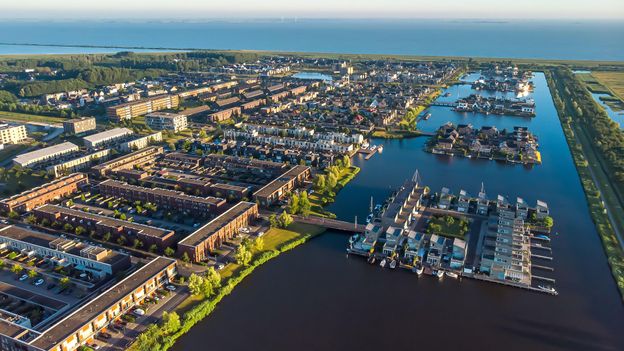
The Dutch city testing the future of urban life
With a hotchpotch of neighbourhoods focused on innovative architecture, sustainability and social enrichment, is Almere a glimpse of what living in cities could be like?
bbc.com
175 points · by lelf · 4y ago · 153 comments
I don't see how this helps. An urban farm is not nearly as efficient as a true industrial farm. They don't have the economies of scale. They are limited as to chemical use (both pesticides and fertilizer) and have to deal with noise complaints. Urban farms are also, nearly universally, fed by potable water sources which can never scale to appreciable food production (acre-feet rather than liters). If we actually want to produce food near consumers, urban farms are not the way. It only works using enclosed buildings, ugly industrial greenhouses, not pretty little fields between condos.
Sounds great to the uncritical hearer, but it's a recipe for a rodent and/or bird plague and lots of disease outbreaks. Unless someone is employed to deal with all of the rejected part of the crop. And that's not easy with tree and bush crops.
Wait what?
"Urban agriculture includes the cultivation, processing and distribution of agricultural products in urban and suburban areas. Community gardens, rooftop farms, hydroponic, aeroponic, and aquaponic facilities, and vertical production are all examples of urban agriculture."
The trick is to not have suburbia. Go straight from urban to rural.
If we want to address global climate change, then we need to look into minimizing total energy put into things like food. Often that will mean growing things where they can grow most easily, with the least amount of energy. A banana brought thousands of miles by very efficient transport is more sustainable than grown in an ill-suited climate through the application of energy-expensive heat/light etc. Distance is not everything.
Minimizing total energy is indeed the name of the game. To do that, we have to recognize that we may have over-extended a little bit as a civilization, and to pull back on some of the more hubristic enterprises like bananas in Maine or avocados in Sweden during winter in the Northern hemisphere. We can still have those things, but at a minimum the costs for the consumer should reflect the costs of transportation, including costs normally externalized (excluded) from supply chain analyses.
The big issue with agriculture and environmental disasters like climate change and biodiversity loss is land use patterns. That implies a need to drastically replace consumption of very land-inefficient uses like beef with mostly plant based foods.
But yes, I completely agree with you that 'food miles' is largely a distraction.
We can't easily pack humans more densely into trucks, so reducing their miles traveled has a much bigger effect (and if the distances are shorter they can also walk/bike/bus instead of single occupancy vehicle).
We basically can, with decent urban transit and rail services.
The thing people don't realize is that industrial farming is actually extremely carbon-emission efficient. Even your food coming from a container ship from halfway around the world, transported via freight, and driven last mile in a semi is less carbon intensive than getting a delivery from a local (XX miles away) farm.
This seems to be trivially true as well for an entire city of inefficient farms with any expectation of modern amenities.
It may have other benefits, such as greater degree of self-sufficiency but it does approximately nothing for the climate.
For farming, surely we need space, poultry and rabbits are the least needing animals but still demand space to produce their own food, however again there is NOTHING more efficient than a classic country home with some animals around: it do not need third party fertilizers, the balance between animals manure and cultivated ground means manure suffice, the resulting pollution is very low, water usage sparse enough to be a non-issue in most cases. Surely it can nourish a limited number of humans PER FARM, but it's absolutely sustainable and effective.
Urbs are not, we never ever have a sustainable city, we have just some needs who justify them. But the rest you mention is needed only for mass distribution, not for nourishing humans but for nourishing business, in money, not in food, and we have enough proof that that's totally unsustainable. Surely we are too much for such classic approach, but we can handle that with a SLOW de-growth pushing toward de-urbanization as much as we can leaving just enough for certain kind of manufacturing and other specific needs.
The sparse small-scale industry is actually ECONOMICALLY inefficient but far more sustainable, self-sufficient on scale, at the human size. It's like a small countryside restaurant, it's economically far less efficient than a modern fast food, but suffice for their owner and satisfy their customers, only managers and the companies behind them are unhappy.
The Netherlands soil is of very low quality in terms of nutrients (soil depletion). There is an ecological debt because of intensive farming: if we would take that into account in the final price, it would lose it's appeal.
Some of my ignorance may be because the knowledge has been abstracted away, deprived of its nuance, and physically kept at a distance from where I have lived and worked.
My view is that most people are not fully opposed to industrialized farming. But rather I don't want there to be farms (or companies for that matter) that exploit workers, pollute the environment, bribe politicians (in essence, rigging the once free market) [1]. That's my main gripe. We live in a society, and profits should not justify treating others like they were less than equal to ourselves.
In my opinion, some of those companies are too large to properly behave like well-run businesses (not too large to fail), and they have accrued a critical size and mass that they bully away competition, and no longer have the interests of the customer in mind.
To paraphrase Douglas Adams:
If it maintains high prices like a cartel, and restricts competition like a cartel, we have at least to consider the possibility that we have a large association of nefarious manufacturers or suppliers on our hands.
A popular view in NL is that the Dutch farmers mostly work for export and that we shouldn't do that anymore.
There's also a counter-movement of farmers and their supporters stating they're proud of the farmers, for providing our food, and reducing resource usage per unit food significantly over the years. The suggestion by a politician to half the amount of livestock caused riots with tractors.
I'm kinda torn: importing more food is bad for the environment as a (global) whole as our farms are very efficient. But should we sacrifice our local environment for it?
The real question is: should it really be used to for that purpose. Does it make sense that the Netherlands is the second biggest exporter of tomatoes in the world? The easy answer to that is: no. The more complicated one is: also no.
To actually produces these vegetables in -let's be generous- less than ideal climate, they have huge gas-heated greenhouses, with 24/7 lighting. That is anything but sustainable.
Of course they are highly-efficient greenhouses, combining heating with electricity production, allowing to minimize the use of chemical inputs etc, etc, etc. But in the end, the gas prices they got were so cheap, that they would simply burn gas to produce and resell electricity, and vent the heat in the atmosphere.. Oh well..
What about them pigs? Does it make sense to have about as many pigs as inhabitants in such a densely populated country?
etc.
The lakes are shallow, but they are pretty big.
They're also not as efficient at destroying the environment.
I would expect a key part of future urban life would include one of the most important parts of current urban life; walkability and a harmonious melding of commercial, residential, and public spaces.
I think you forget that everyone owns a bicycle, everyone rides their bicycle everywhere, and almost every single street has a separated bicycle lane. There are more bicycle lanes than in any other country on earth (22,000 miles in a country ten times smaller than California) [1], there's even bicycle highways and intersections.
Public transport is exceptionally good as well. Everything is highly walkable and accessible, everything you want to do is doable and everywhere you want to go is reachable. You should check it out sometime, these pictures don't really show it.
(jacquesm in this thread is spot on too though. There's not that much life going on in Almere itself.)
[1] https://www.opencyclemap.org/?zoom=7&lat=51.48412&lon=8.0871...
Bicycles are more suburban than urban. Because they allow people to move flexibly at a relatively high speed, they encourage suburban structure, where things are spread out over a larger area. They are functionally similar to cars, but on a smaller scale.
Now, of course, you could argue that that makes the Netherlands a relatively suburban place in general - the fact that it is one of the most densely populated countries on earth would disagree.
Seems like it would probably be better to just ride your bike to Amsterdam if what you want. On the other hand, that's just my observation. What did you get out of living there? Was it the quiet, or the parks? Did you meet people easily?
Almere itself is rather boring and devoid of life. It’s simply artificial land reclaimed from the sea with no history or story to it.
So in terms of meeting someone for a coffee/meal/beer/event it looks like you'll have to hop on a bicycle unless you want to go on a 20-30 minute walk past monotonous homes. Which is not that different than suburbs anywhere else.
Public transport intervals are measured in minutes, and unlike in the US, it not only connects the suburbs to the city center, but the suburbs to other suburbs as well.
Really, everything you want to do is doable and everywhere you want to go is reachable. I miss it.
Regarding coffee/meal/beer, there's little shops or cafes or restaurants mixed into the residential areas as well.
This video details the fantastic engineering very well: https://www.youtube.com/watch?v=lP-G-inkkDg
This is specifically about differences between US and Europe but also a great watch: https://www.youtube.com/watch?v=6K8KEoZwMRY
But that's exactly what you're missing. Hopping on a Dutch bicycle in a dutch city is like walking, but better. No helmet required. No hassle of dealing with cars trying to kill you. No pain from hunched over road bike posture. Just unlock your bike and go.
You can't create and buy a thousand years of history.
Not sure why, it could be that rudimentary, half of the people is upper middle class that is doing everything by car, the other half was born in another country and could more easily find a house in Almere compared to Amsterdam but they don't share the cycling culture much.
Edit: And every neighbourhood has supermarkets and small fastfood and bar locations. It is not that different from other dutch cities.
I'm sure it's a nice place to live, but this is not the future of urban life.
(I put a 1km marker on the map for reference)
Almere obviously doesn't have a whole lot of history compared to other Dutch towns, it is quite literally built on 'new land', areas that were turned from water into land in living memory (1950's and 1960's). Almere 'haven' is the oldest part, subsequently Almere has grown in jumps to become the fastest growing and now the 7th largest municipality of the Netherlands.
So this why Almere is the place in NL where there is room for such experimentation. In other Dutch cities it is usually super crowded already and the only places where you can still expand is at the edges, and municipalities tend to be very conservative to help the new areas blend in with the older ones.
I have some family living in Almere, they work on the other side of the bridge so over the years (they have lived there now for 35 years) that took up a lot of commute time, but where they live is child friendly and it is a much nicer house than they would have ever had anywhere else in NL on a much larger lot. But there isn't - even today - a whole lot of life in Almere compared to other Dutch cities and likely this will remain until it is so old that it no longer stands out as the 'newest city'. Second generation citizens of Almere already are much more at home there than those that moved out from Amsterdam (and especially from Bijlmermeer), and with every passing generation that will improve.
But it will be a long time before people will go to Almere to see the city center.
What would really help Almere is a second bridge into Amsterdam but there are many reasons why that likely will not happen in the next 20 years or so. (see: https://nl.wikipedia.org/wiki/IJmeerverbinding (Dutch)).
From that to a few hundred thousand inhabitants is quite unusual here.
Google Street View:
https://www.google.com/maps/@52.3921571,5.2180409,3a,90y,176...
(look up and down De Realiteit to see many freaky houses)
Polderblik:
Campus (1987) -- Vertical Red Shipping Containers:
https://www.architectuurgidsalmere.nl/almere/campus
Cargo (1987) -- Yellow Porta Potties:
https://www.architectuurgidsalmere.nl/almere/cargo
De Naam van het Huis (1987) -- Half House with Watchtower:
https://www.architectuurgidsalmere.nl/almere/de-naam-van-het...
Circle (1987) -- Circular Hobbit House:
https://www.architectuurgidsalmere.nl/almere/cirkel
Many other weird ones:
https://www.architectuurgidsalmere.nl/almere/meerzicht
https://www.architectuurgidsalmere.nl/almere/macabine
You can see them all and more on the map of this Almere Architecture Guide:
https://www.architectuurgidsalmere.nl/
And there's another road called Aresstraat that contains rows of totally unique houses, reportedly so up-and-coming architects can try out their weird ideas. Here's a funky looking tilted level "House in House" designed by Marc Koehler in 2011, which was just up for sale for around 700,000 EUR.
https://www.google.com/maps/place/Aresstraat+21,+1363+VJ+Alm...
(Look up and down Aresstraat at all the different architectural styles! Down the street a bit it flashes back in time to street views from 2009, before most of the neighborhood was even built, showing the wide open sand peppered by a few houses and construction sites.)
https://www.architectuurgidsalmere.nl/almere/house-house?fbc...
>PROJECT ARCHITECT(S): Marc Koehler; CLIENT: Privately; BUILDER: Ubink and Co BV; REALIZATION: 2011
>According to the architect, “House in house” is based on a reinterpretation of a traditional Dutch canal house with an attic. An arrangement of three 'boxes', which accommodate the necessary functions of sleeping, office and entrance, structures the interior space.
>The slanted attic window ensures a striking presence of the house in the streetscape. Here is the sleeping area with skylights to see stars and moon. The floor is placed horizontally, which is visible from the outside. The office is retracted on the first floor, with its own entrance via a spiral staircase. Living takes place in the residual space between the boxes. That space is a route with stairs that spiral upwards. What are usually the landings is here transformed into a series of spacious places, for hobbies, music, watching TV or eating. This design keeps living flexible and dynamic. The house is also equipped for new interpretations that people want to give to the concept of living.
Tour:
I think the architecture has more to do that every individual plot allowed owners their own design & development.
Almere still does quite a bit of that, for instance, it was the first municipality where they allowed 'tiny houses', though, truth be told what they are selling those for you might as well buy a normal house.
https://www.funda.nl/koop/almere/huis-88999896-alseidenstraa...
It's not something worth to visit. It's still too sterile. Nobody visits Almere for the city.
Even just doing something like the blue floating houses is so much better. They have variation. I think it probably also works better due to the smaller size (red sports car vs solid red semi truck - one can look nice and the other looks obnoxious)
There are plenty of buildings that look amazing when they are first built (or even worse when they are simply drawn) but give it 5 years, some water staining, a few unruly residents etc....
I don't want to be negative because I often wonder about much better living environments/thinking but I think that the social side of things is often overlooked (at least in the UK) so that affordable housing in my friends new estate meant drug dealers and large white vans parked up and down her small road next to her nice house. You don't want to be a snob but when you work hard to afford a nice place to live, you also don't want to be imposed upon by those who aren't so bothered about their community.
We still have to see what will happen to Almere, Almere Haven is just 30 years old. Not all parts there are good :) It is often 30 or 40 years, that a neighbourhood can go from good to bad, at least that is usual in the Netherlands.
It's unfortunate because there's still a few historic buildings from before that era suggesting what might have been.
Croydon also has a similar reputation.
https://archive.curbed.com/2019/6/7/18657121/brasilia-brazil...
Still is, but massively improved compared to the 80's.
The lack of history makes everything so sterile. Everything is hypermodern, clean and new. You won't have that cute old bar, infrastructural imperfection, clash of cultures, hybrid of old and new, it's entirely without soul.
It feels like a VR game. Maybe I just hate modern architecture.
The criticisms are valid, but people haven't exactly given Almere a chance to be anything other than hypermodern, either.
Every new project around say, Utrecht, has the same "hypermodern" feel to it. Little contrast, straight lines, visible patterns, flat and rectangular. They try to add a little more chaos to it (probably to avoid being compared to Almere) and some more greenery, but it's a far cry from the old European city look.
In particular, in Japan here are lots of older buildings or collections of buildings with tiny businesses. At some point developers come in, bulldoze the place, put up a high-rise building. The bottom 1-3 floors of the building have shops, but they are all 4x larger than the shops they displaced. The result is those shops end up being 90% chain stores such that there's now nothing drawing anyone to the new building (well, there are tenants).
My wish is that some architect would break with convention, build the bottom 1-3 floors with tiny spaces and then be hailed as the new fashion in architecture and see it spread.
Sure it's not the old imperfection, but I'd hope given smaller spaces you'd get the variety that was there before.
As an example here's a spot in Shibuya in 2009
https://www.google.com/maps/@35.6628366,139.7024402,3a,75y,1...
You should be able to move the timeline to 2022 and see it now.
Before there were 10 tiny indie businesses. Now there is 2 chain restaurants, 1 chain supermarket, one chain clothing store. (though at least they have 3 varying food trucks for lunch)
OTOH, I personally love much modern architecture.
There have recently been plans to raise prices but since Florida is such an important state to Federal elections there's a massive political hurdle
At least Florida can be abandoned in a worst case scenario and the US would continue to function.
But even though we occasionally have a dike that fails something at the level of 1953 isn't going to happen 'just like that', though you can never entirely rule out the possibility.
Much more money has gone into water management since then, it is our 'Los Alamos', special water management taxes have been used for massive investments into infrastructure including pumps, dikes, flood barriers and all kinds of less visible work. It isn't perfect, but it is really quite good and I would much rather live here than a few hundred kilometers upstream during a heavy rain season. At least we are no longer in denial that water management is something that you postpone until after the flood.
jacquesm seems to believe that we have a solution. That's not the sentiment being brought forward by the newspapers. Even reputable newspapers are like "this time we're really screwed, we can't win this one". I'm not a water management expert so I don't know any better than what I hear, but I've yet to hear from someone authoritative that it's going to be okay — the authorities just seem to be quiet on this issue. That really doesn't help me with my long-term plans.
I would not buy anything in Venice though, they will likely be done for and we'll remember it like we remember Atlantis. Money + engineering are a pretty good combination, similar to how Japan manages to do quite well in spite of very bad and regular earthquakes.
I think the way the Dutch deal with water is probably best described as symbiotic, we don't force it but we guide it and when we really can't do it any other way we'll bring out the pumps.
Oh, that's another one for your list of stuff to visit: the pump cassettes next to IJmuiden's Northern most locks, those things are straight from a SF movie, 260 cubic meters per second.
There are some voices that NL will have to abandon terrain, I think we'll see the exact opposite: more terrain will be created with the express goal of being used as basins for increased control over water. The important bit when you construct dikes is the delta between the water table on one side of the dike and on the other and we already have areas where there are three such dikes in a row to be able to deal with fairly extreme differences in water levels.
If you drive or cycle in the North of the country every now and then you'll find yourself crossing through a dike with a concrete lintel built into the dike body, this is where in the case of high water the dike can very rapidly be closed again and turned into a functioning part of the water defenses.
Those dikes are called 'sleeping' dikes they are still there and ready to be activated but normally they are transparent to traffic.
https://en.wikipedia.org/wiki/Sleeper_dike
https://www.climatechangepost.com/netherlands/coastal-floods...
Other evidence that this can be done is that there are some massive artificial lakes constructed all over the world with dams that have a 'head' that is much higher than anything that NL will ever have to deal with.
A bigger problem than keeping the sea out will be to deal with the rain water coming into the Netherlands by way of the very large rivers. These carry massive flow (from a total area much, much larger than that of the country itself) during some times of the year and to accommodate that flow and ensure that the land behind the river dikes doesn't flood is - in my opinion - a much bigger problem when the sea level rises. During some storms you see a reversal in the flow of the rivers in the delta. Several interesting constructs are located near Rotterdam and Zeeland, transparent to shipping but it can be closed quickly if such reverse flow threatens the land:
https://www.rijkswaterstaat.nl/water/waterbeheer/bescherming...
(Dutch)
Those 'pie slices' are as large as the Eiffel tower but mobile, and are some of the most impressive engineering works that I've seen in my life.
You could see this during the flooding that destroyed those houses in Germany, it didn't go much better in NL, but fortunately on a smaller scale.
https://www.youtube.com/embed/96IGKw2NKQY?feature=oembed
Still, you are right that 'upstream' this problem can get much worse due to terrain geometry and lack of preparation, as well as building into areas that really belong to the river.
Sparse tall buildings and hallway spaces are not likely at all and have no purpose at all. Floating constructions is a tempted and failed way, too much humidity, cracks and fissures, problems of sewage and networks in general (water intakes, TLCs etc) so again might sound nice on paper but a failure otherwise so very unlikely as well.
To architects: when you design something imaging it's usage BEFORE start drawing. We built for some reasons, beauty is one of them, but secondary, an added thing to something with more practical reasons; anything designed first than adapted to some purpose end up in expensive failures.
To my fellow Citizens: please when you dream your future dream it really: where and how do you really want to live? In a Goshiwong/capsule-hotel room in a dense area with some hallway and common areas in general to loitering aimlessly, maybe with a stupid smile drawn on face for the "happy-o-meter" part of the new social score? Or you dream a low density area where you can work and live in homes, with a bit of nature ALL AROUND, leaving tall buildings to specific purposes like hospitals, schools etc? Perhaps considering that single family homes can evolve, being recycled and rebuilt perhaps at generational change, while no tall building can evolve so even if it's well designed now will be a disaster in 40+ years and no one know what to do then?
(NB: I have a good friend in Almere and I live in Irvine.)
https://en.wikipedia.org/wiki/Amstelpark
It's a gorgeous park and one of the lesser trafficked ones in Amsterdam, well worth a visit.
"They suggested some kind of pattern. Their peculiar ugliness consisted in the very fact that they kept on suggesting it and then frustrating the expectation thus aroused."