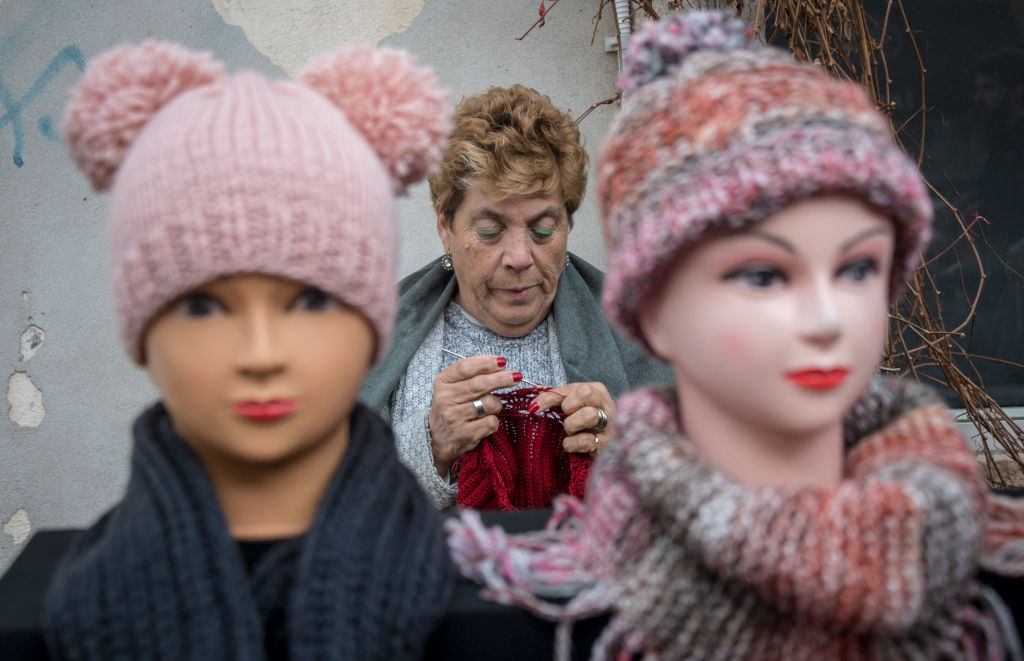
How knitters got knotted in a purity spiral
A process of moral outbidding is corroding small communities from within
UnHerd
209 points · by Tomte · 4y ago · 174 comments
Personally I have become much less agreeable, and as a result, people in my own networks who might have participated in the ratcheting don't do it when I am around, because the purity ratcheting was essentially a way to abuse and exploit peoples agreeableness. Given it was such a tiny minority to begin with, if only a small fraction of the majority become disagreeable, it can halt the spiral of hysteria it requires.
What I/many can articulate more simply now that we didn't have the words for then is that this is a very old redemption hustle, and they're offering a kind of redemption I don't need. Just because someone is uncharitable doesn't mean I have to mollify them, and demanding a denial or denunciation from me is just their way of making a conversation about themselves. It's a disease of politeness, and the reason we got here is because we forgot sometimes in this world it is appropriate and necessary to say, please, fuck off, because we are being taken advantage of by people betting very heavily that we won't.
The bully wasn't reformed after that, he remained a bully until we parted ways years later, however the group was wiser for it, and that type of behavior had a very short half life as a result. As I get older, this phenomenon is emblematic or representative of society. Sometimes culture dictates that there are certain things we just won't accept anymore, like spousal assault, smoking in the public indoors, and poor legislation. Resistance is cumulative.
In the past on some corners of the internet I'd get "down voted" (whatever system the locals use, not just reddit) for anything that smelled of X, Y, or Z.
That's still the case at times BUT I've seen a lot more folks express distaste for that kind of crusade and gotten a lot more support from people when inevitably I end up sayng "No that's not what i'm saying, I'm tired of having to say that ... we can say X and not be Y".
Meanwhile the most egregious examples of the kind of calling folks out for their perceived impurity such as "you know you don't have to defend X" type comments seem to get a great deal less support now, if not outright ridicule.
People are starting - albeit unevenly and at different stages and with considerable pushback – to realise that they don't owe an account of their morality to any old person on the internet, that they can be non-racist and not have to agree with (and genuflect to) every other self-styled non-racist trying to sell some wacky opinion to them, etc.
And - what makes me most happy of all - they are doing it, at least many of them, without falling prey to the "I disagree with someone from Not Racist FC so I guess all that's left to me is to sign up to Racist FC" non sequitur.
What is the situation now compared to 10 years ago for example?
But I am interested in the varying responses / votes over time, specifically when it comes to the topics I mentioned.
Community voting patterns are interesting.
There are some few exceptions but people tend not to care. Result is that there is an even larger trust problem between people, politics and press. In my opinion people trying to improve language expose themselves and what you see is mainly shallow and ugly, especially if they shine the focus on prejudice where they usually don't really form good role models compared to the average bloke.
I still remember some companies that jumped on this train though and I am looking for signs if I want to work for any of them. Because that will inevitably be a toxic relationship and with probably management with a weird focus.
I think the reason why lots of such endeavors peaked and subsided is removal of a major irritant - the former president. Trump was fairly unusual in his ability to boil the blood of his opponents into outright madness, in a way that, say, GWB couldn't. If he spent 4 more years in the WH, I am not sure what would be the end result.
The original blog post behind this case (where the woman wrote about how foreign India seemed but how excited she was to visit) is a perfect example.
The people calling out her “colonialist” references to Mars claim to be speaking on behalf of their friends. Then you have actual Indian people coming along later, wondering what the fuss was about and welcoming the author to India.
My theory probably doesn’t stand up to any scrutiny but it useful to ask “is anywhere here actually saying that they’re personally offended?”.
Eh. Actual Indian person here. I think it's pretty stupid to comparing a flight to India to "going to Mars". You have Pizza Hut, Subway, and KFC in India, for crying out loud.
In normal times, the person saying things like this would have been chided by a few of their friends. Now they are viciously attacked by the whole of the Internet – which is the real problem.
The first 50+ comments on the blog are supportive, as they would be "in normal times" as well.
https://fringeassociation.com/2019/01/07/2019-my-year-of-col...
In case anyone is curious, here is the paragraph including the "pretty stupid" comparison:
> I’ve wanted to go to India for as long as I can remember. I’ve a lifelong obsession with the literature and history of the continent. Photos of India fill me with longing like no other place. One of my closest friends from that pink-striped tube skirt era (we originally met at JC Penney) is Indian, and her family had offered back then that if I ever wanted to go with them on one of their trips, I could. To a suburban midwestern teenager with a severe anxiety disorder, that was like being offered a seat on a flight to Mars. It was fun to think about, but are you kidding me? I was so young and dumb then that I didn’t even partake of her mother’s Indian cooking. (Talk about regrets!)
She could have said the same expression about New York.
Also, the woman in question was coming from the UK, as I recall, so alleged food quality in America wouldn't be terribly important to her.
And the answer is always "It's never an easy answer. You have to do your homework. And it might change, and it might get uncomfortable. Too bad."
The easy answer is “I really don’t care.”
So far, universally, the people "on the ground", doing the work, are very nice to talk to. Informative, understanding, firm, kind.
(AKA isn't Twitter itself a huge part of the problem?)
I can't help thinking the whole woke thing has been some kind of manufactured media project, maybe with overtones of state propaganda, which had the overall goal of drawing attention away from the fundamental failings of many once-respected American institutions - media, government, academics, etc. I wouldn't be surprised if it was all purposely designed as some kind of divide-and-conquer tactic, something to distract the American public and draw attention away from ever-more-obvious gross failures of our incompetent leaders, which are across-the-board in nature and not exclusively linked to any political party.
If this is a correct assessment, then you'd expect the typical 'accepted topics' of mass American political conflict - i.e. guns & abortion - to start taking center stage now, because they don't want people howling for 'better wages and less inflation' or screaming 'fix the damn infrastructure, you incompetent clowns' outside their windows.
Also, I think your point about it being a distraction tactic is exactly right. I remember back around the 2012-ish era, when Tumblr started getting really weird with blogs promoting some pretty insane things in the name of “social justice.” Turns out, some Russian troll farm was posing as Black activist bloggers to sow chaos. I was very active on Tumblr at the time and remember thinking how weird all those blogs felt, and when the news of the Russian campaign broke, it all made sense instantly.
I get that same feeling from today’s woke/anti-woke discourse. It doesn’t feel honest. It feels like someone is playing us again.
Until it does. I didn’t care about any of it myself until I got an email saying my mild mannered Midwestern law school professor declared himself a “a racist” in front of the whole school: https://www.washingtonexaminer.com/news/northwestern-univers.... Then my high school declared standardized tests to be racist: https://www.newsweek.com/states-ask-high-court-halt-race-bas.... Then I got an email saying my third grader was learning how to “develop her identity” around her “skin tone.”
A lot of the people who are in charge of telling you what to do and pulling the levels of state power to coerce you into doing stuff, and people in charge of reporting the news and socializing your kids and in many cases making public health decisions, buy into this woke stuff. And if you think the things they believe won’t affect you, just wait.
If one wanted to come up with a propaganda project to hide decline they picked a really bad one!
We clearly run in different circles. I basically eliminated my own social media usage, and pretty much what people around me are concerned about is who will get deported, how to protect people seeking abortions once they’re banned, and what new fresh hell will be visited on some person of color or marginalized faith, trans or queer person, or just someone holding a camera. Y’all worried about your finances are totally justified in that worry. But these concerns aren’t drama or trivia, they’re literally life or death for people whether you care or not.
Don't underestimate it. For example, hardcore German nationalism was once very popular in academic circles of Germany and Austria-Hungary (the German speaking part, of course). A normal Hans from the street, just like you, couldn't care less about what the students say and shout, and Vienna, Terst, Prague and Krakow were nice multicultural cities. At least on their surface.
Until 1914. It is possible that without this toxic undercurrent that attacked the Austrian state for decades and moved it closer to imperial Germany against its own interest, the Great War wouldn't have happened.
It's one of the big problems with social media. Outside of social media, we act differently in professional or public contexts from private ones. Context collapse merges them to great detriment.
I cannot emphasize enough the harm that can come from this and how easily it is exploited.
It lists:
- BY THE SAME AUTHOR "How knitters got knotted in a purity spiral" BY GAVIN HAYNES
- SUGGESTED READING "How knitters got knotted in a purity spiral" BY GARETH ROBERTS
- SUGGESTED READING "How knitters got knotted in a purity spiral" BY DOUGLAS MURRAY
- SUGGESTED READING "How knitters got knotted in a purity spiral" BY ANTONIA SENIOR
- SUGGESTED READING "How knitters got knotted in a purity spiral" BY TITANIA MCGRATH
- SUGGESTED READING "How knitters got knotted in a purity spiral" BY GILES FRASER
I can't even begin to guess how stuff like that happens, must be some epic bug in their CMS, or some weird A/B attempt to ... fool people into reading the same article many times? And where does it get the author names, one wonders. AI-backed publishing system gone crayzay?
How knitters got knotted in a purity spiral - https://news.ycombinator.com/item?id=22240041 - Feb 2020 (235 comments)
Some of the comments at the time seemed to think the only way to save the community would be to reject the values being force onto the community, it looks like that did not happen.
I don't think that rejection is necessity for a community to survive but there needs to be a way that they can recenter. If the community is supposed to be about knitting, than discussions about race, sex, etc should not occur.
Perhaps is is enough to identify as a knitter, as opposed to a bisexual knitter from SE Asia. All the other stuff is noise in the SNR.
What a packed and insightful statement. I'll be turning that over in my mind for some time.
On the right, there's a coherent, objective moral value statement that voters want upheld, namely "babies are people too, beginning at conception, and must be treated as such by the law." It's pretty straightforward whether this value is being upheld, and there's no risk of a "purity spiral" where people propose increasingly crazy ideas to signal their loyalty to the cause. Just don't kill babies... that is all.
On the left, unless I'm mistaken, there aren't coherent, objective moral value statements at the heart of CRT, identity politics, or pro-choice arguments ("my body, my choice" isn't a well-defined philosophical statement) which does lead to a purity spiral. For example, there have been serious proposals to allow "after birth abortion" -- i.e. it's OK to kill babies after they're born - for a recent example see [0], but there are many other examples as well. TA mentions other purity spirals that occur on the left.
But regardless, yes, there are absolutely politicians on both sides of the aisle who use people's moral values as a means to power (I'm especially thinking of a recent US president, but there are many others). "You want to get rid of abortion? Vote for me!" -- but disingenuously. They don't appear to care personally about whatever it is, they posture to get power while not understanding the nuances of how to wisely implement laws that reflect the peoples' values, or even what those values are exactly in the first place.
---
[0] CA AB-2223, in its original text (now amended), read "Notwithstanding any other law, a person shall not be subject to civil or criminal liability or penalty, or otherwise deprived of their rights, based on their actions or omissions with respect to their pregnancy or actual, potential, or alleged pregnancy outcome, including miscarriage, stillbirth, or abortion, or perinatal death" (emphasis mine). Note "perinatal death" means death within the first 7 days after birth (thus legalizing infanticide). This has thankfully been edited to perinatal death due to a pregnancy-related cause -- but that could still encompass scenarios like "intentional injury to the child moments before or during birth".
On the other side, many of the politicians currently running for office as Republicans in my state have been dragged so deep into the anti-abortion purity spiral that they’re publicly insisting women should die rather than terminate a non-viable and life-threatening pregnancy.
I don't know where you live, but clearly what the article was discussing went beyond North America.
American culture really caught on only during world war II, when people around the world experienced first hand the sheer wealth of American soliders.
It works in the context of being a wealthy superpower with access to almost limitless energy sources(mainly oil), but attempts at emulating it outside of this context look silly.
Case in point: new housing in my corner of the world is in large part sprawl. People flock to it, because they crave the same amazing amount of living space Americans usually enjoy.
Problem is, as a percentage of wages, fuel is easily at least four times as expensive around here. Also cities aren't nearly as car-oriented as in the US.
It's a humanity thing ... not a region.
History is full of "oh those people over there do that thing, how silly" and then it happens in their own backyard. We're all human.
It does seem, however, that US-based social media companies set up systems that foster and fuel them, like warm a Gulf of Mexico (am I a racist for using that name?) makes hurricanes (not an intentionally racist suggestion).
Here is a question I don't know the answer to: are purity spirals common/problematic on WeChat?
> "As long as our hypothetical Blub programmer is looking down the power continuum, he knows he's looking down. Languages less powerful than Blub are obviously less powerful, because they're missing some feature he's used to. But when our hypothetical Blub programmer looks in the other direction, up the power continuum, he doesn't realize he's looking up. What he sees are merely weird languages. He probably considers them about equivalent in power to Blub, but with all this other hairy stuff thrown in as well. Blub is good enough for him, because he thinks in Blub."
http://www.paulgraham.com/avg.html
I have a theory that this applies to progressivism or moral frameworks or whatever you want to call it. Let's suppose we were to re-write the above quote to apply to morality.
> "As long as our hypothetical practitioner of the Blub moral framework is looking down the moral continuum, he knows he's looking down. Moral frameworks less advanced than Blub are obviously less just, because they're missing some assumptions about people's rights and obligations that he's used to. (Don't they know that slavery is wrong? And obviously lying and stealing are right out under most circumstances.) But when our hypothetical Blub practitioner looks in the other direction, up the moral continuum, he doesn't realize he's looking up. What he sees are merely weird rules. He probably considers them about morally equivalent to Blub, but with all this other hairy stuff thrown in as well. (Intersectionality? Critical race theory? And people keep adding extra letters at the end of LGBT? Is this all a bunch of made-up nonsense, posturing, and virtue signalling?) Blub is good enough for him, because he thinks in Blub and lives in a world where Blub applies to situations that correspond to his real-life personal experience."
This isn't to say that critics of complicated moral frameworks are always wrong. Sometimes people really do get caught up in virtue signalling and posturing. But I think these complicated moral frameworks are usually a reaction to real injustices, and sometimes it's worth standing up to oppose an injustice. Knowing when or how to do that can be complicated though. Moral crusades can themselves cause tribalistic behavior, exclusion, and intolerance of honestly held opinions, which can also be another kind of injustice.
> Most movement atheists weren’t in it for the religion. They were in it for the hamartiology. Once they got the message that the culture-at-large had settled on a different, better hamartiology, there was no psychological impediment to switching over. We woke up one morning and the atheist bloggers had all quietly became social justice bloggers. Nothing else had changed because nothing else had to; the underlying itch being scratched was the same. They just had to CTRL+F and replace a couple of keywords.
There it is. It’s an advertisement for a documentary masquerading as a news article.
It plays out so predictably, too. First, they -- we -- came for the fundamentalist conservatives, but I was not ... Then it was the fiscal conservatives, then the moderates, the liberal guys who didn't manage to seem vaguely embarrassed to be heterosexual, and so on. They all get together and "discuss" things until someone (or more than just one) leaves the site. Throw in a unhealthy dose of "dogwhistle" paranoia and "everyone who disagrees with me is a goosestepping fascist buying Nazi memorabilia on the darkweb" disdain and, well, it's amazing to watch.
> I have to wonder how many of these morality spirals aren't instigated by actual trolls.
> An example of this was the explosion of transgender issues into the mainstream soon after gay marriage was legalized. I recall reading a fringe right-wing blogger about the "lesbian vs transgender conflict", a few years before the "T" in LGBT became more prominent. This prominence may well have been engineered by trolls in an attempt to alienate a group of people who were rapidly being accepted into mainstream society.
Funny how this "troll" managed to somehow also coincide with the opinions of countless lesbians and radical feminists, who have been speaking and writing about this topic for many years.
That is, in the above instance, in terms of homosexuality being defined as a same-sex sexual orientation, and the inherent conflict in attempting to replace it with the concept of "same gender identity" attraction. With so-called "genital preferences" being an act of bigotry. It's incredibly homophobic ideology, in that particular purity spiral.
The evil woke people are coming to ruin your knitting and Young Adult novels communities.
By... asking you not to say ignorant things on a global medium about how going to India is like going to mars?
And people apologizing for stuff. The horror.
Like, even if what was claimed is true, who cares? There's nothing there and people seem to have adopted fighting against this non-thing as part of their identity.
Does this really deserve the multiple mentions of war, the red terror, and communist China purges? Aren't we overreacting just a tad?
The degree of political polarization now evident in the U.S. is despicable and horrifying in equal measure. Purity spirals are evident on both sides of the divide, and the worst thing you can call someone is a member of the opposing party. The extremes on both sides are anti-science, although the left has embraced some behaviours that are less contradictory to the common good purely by coincidence. e.g. Wearing masks became a political statement. While it was good that roughly half the population were wearing them willingly, turning it into political virtue signalling made it less likely for the other half of the population to wear them. The right behaviour for the wrong reasons had unintended consequences.
In Canada, our political parties have long detested each other beyond reason. e.g. Read "Right Here, Right Now" by Stephen Harper (former conservative PM) and, even if you don't agree with him, you'll find he makes intelligent arguments except when it comes to the Liberals. When he speaks of his opponents it's a bit like like reading Marcus Aurelius' "Meditations" when he transitions from stoic philosophy to ranting about catamites. Logical one moment, insane the next.
In a real sense, politicians are at the very centre of purity spirals even if they aren't always responsible for creating them. Consider Republicans who have caught flack from the far-right for being vaccinated or wearing masks. If you're a highly visible member of a demographic entirely consumed by a massive purity spiral, what option do you have but to conform?
While it's to be expected that politicians will bend in whichever way the wind of these spirals blow, it's especially distressing to see how many people have a rigid political identity that is completely unhinged from personal values, needs, or philosophy.
For example, in my province "Conservatism" used to include a healthy dose of "conservation". Four decades ago, a conservative government decided to ban strip mining in the Eastern slopes of the rocky mountains to "conserve" natural beauty. Scientific studies conducted since then have only confirmed the wisdom of this decision. Strip mining in these areas, even with today's best practices, would have had massive risks for watersheds covering huge swaths of populated areas. Today, "Conservatism" means overturning that ban without telling anyone, quietly inviting shady penny stock companies in to start strip mining explorations, getting caught, "pausing" and opposing the efforts of the non-Conservative opposition to reinstate the ban.
My father is a staunch political conservative who voted for the conservatives four decades ago and now supports them just as unequivocally, despite the fact that conservatism's meaning is, in many cases, the polar opposite of what it used to be.
Politics as personal identity is the root of purity spirals at the same time as it is a cause for people to support policies that are contrary to their ideals and needs. We need to encourage people to stop being loyal to "their side", and start supporting things they value. How do we do this?
non-Influencer knitters aren't affected at all.
I don't think getting more middle-managers will ever get this issues any better because it's in their interests to increase their power as much as possible, not solve anything.
At best, it's racists projecting their discomfort onto other people, making others responsible for their own guilt. But more likely, it's sadistic bullies. A sadistic bully cannot say "Destroying a life gets me excited!" but they can say "I fight for social justice!"
Given that, what's the alternative to a messy communal brawl that hopefully doesn't destroy the community? The author of the essay speaks about the ratchet dynamics as if it's obviously to be avoided; an alternative read is that his take is descriptive of what's actually the way that these things get worked out, sometimes for the better, sometimes not.
I fail to feel outraged by this process. Is "White Fragility" without criticism? Probably not, I think it is a fantastic book, but it scares the bejeebers out of some people and we get instagram drama and articles like this which I interpret as another attempt at purity (trying to outsmart "wokeness").
It is going to take a while for society* to come to grips with this new shift, because we're clearly not going back, but it definitely is rough around the edges, IMHO, because we haven't found the right vocabulary and framing. Unfortunately it is going to require people to sit with feeling uneasy, and that is something most people cannot tolerate.
You have to ignore quite a lot of history to come to the conclusion that these problems were historically ignored.
> I fail to feel outraged by this process.
Maybe if you end up on the receiving end you'll feel differently?
> Is "White Fragility" without criticism? Probably not, I think it is a fantastic book, but it scares the bejeebers out of some people and we get instagram drama and articles like this which I interpret as another attempt at purity (trying to outsmart "wokeness").
Robin D'Angelo has made some deranged, outlandish assertions, and instead of defending them she simply follows up with more outlandish assertions. I had the pleasure of having a non-white person explain things about "white people" that she'd learned from that book that were patently false.
People throw around this phrase, but it always strikes me as nonsensical.
There's a lot of stupid opinions that can make people feel uneasy, so unease is not some magic barometer of truth.
People are going to feel really uneasy if they are listening to you defend your appreciation of child pornography, but that doesn't mean you have struck upon some deep uncomfortable truth.
That says a lot about your ideology’s consistency when it comes to how we should behave individually, and treat others, now, in our present.
Questioning the moral standing of those who would criticize the dynamic itself isn't useful or worthwhile. It conflates interpersonal confrontation (useful, good, corrective, it's how we build each other up) with a zillion passersby hurling invective at a guy who, in this case, found it so troubling to have a mass of people condemn him on a moral spectrum that is very dear to him that he ended up suicidal.
That being said, you've hit on the actual shortcoming of "woke culture" these handwringing articles miss. It's admirable, not outrageous, that white people becoming conscious of racism feel compelled to do whatever they can about it. But most people (in the US at least) are so depoliticized that their ability to effect systemic change is virtually nil. The project of rebuilding the necessary political capacity is hard, boring work and we probably won't live long enough to see its fruits. If you want gratification, making some rando on the internet bend the knee is much easier.
One definitely gets the impression from critics like the author that they're less interested in seeing that energy redirected than in it dissipating entirely.
It's kind of an Overton Window thing for me. I'm just very used to the 90's, where you couldn't even come close to saying anything like this out loud in, e.g. an academic setting because you know what you would set off.
I'm glad it's out there to at least be reckoned with as a theory.
(Relatedly, this is why I have zero respect for the suggestion that a new form of "censorship" is taking place when people talk about e.g. "cancel culture" and whatnot. This has always been around, the only thing that's new is that it can now come from e.g. both the left and the right)
Put differently, "White Fragility" is intellectual exchange, so was "The Bell Curve", so was "Phrenology" and a lot of other things?
I very much agree that many people have limited knowledge of the history of the last six hundred years, but I believe that sharing the cold hard facts from history (that aren't taught in schools) has a better chance at opening up a person's viewpoint rather than criticizing their behavior.
You can only make an omelet by breaking a few million eggs. If you chair is uncomfortable I would suggest a cushion. There isn't much more to discuss here I guess. There are people without too much self-reflection but you are not making a good case. Get some distance if you need it.