287 points · by the88doctor · 4y ago · 291 comments
Further, there are restrictions on what kind of business it can be. It can't be, for example, a golf course or a liquor store.
Qualified Opportunity Zone Business QOF 50-percent of gross income test Q56. What is the 50-percent-of-gross-income test?
A56. Each taxable year, a QOZ business must earn at least 50 percent of its gross income from business activities within a QOZ. The regulations provide three safe harbors that a business may use to meet this test. These safe harbors take into account any of the following—
- Whether at least half of the aggregate hours of services received by the business were performed in a QOZ;
- Whether at least half of the aggregate amounts that the business paid for services were for services performed in a QOZ; or
- Whether necessary tangible property and necessary business functions were located in a QOZ.
Q57. Must a QOZ business meet all three safe harbors to satisfy the 50-percent-of-gross income test?
A57. No. A QOZ business satisfies the 50-percent-of-gross income test if it satisfies any one of these safe harbors. For example, if 50 percent or more of all the hours of services that a business receives and uses were performed in one or more QOZs, then the business satisfies the hours of services received test and, therefore, satisfies the 50-percent-of-gross-income test.
[1] https://www.irs.gov/credits-deductions/opportunity-zones-fre...
I'm not going to go read the IRS regulations because I'm not actually planning to implement this scheme but it seems plausible that it might work. As long as there isn't another COVID forcing everyone to work from home...
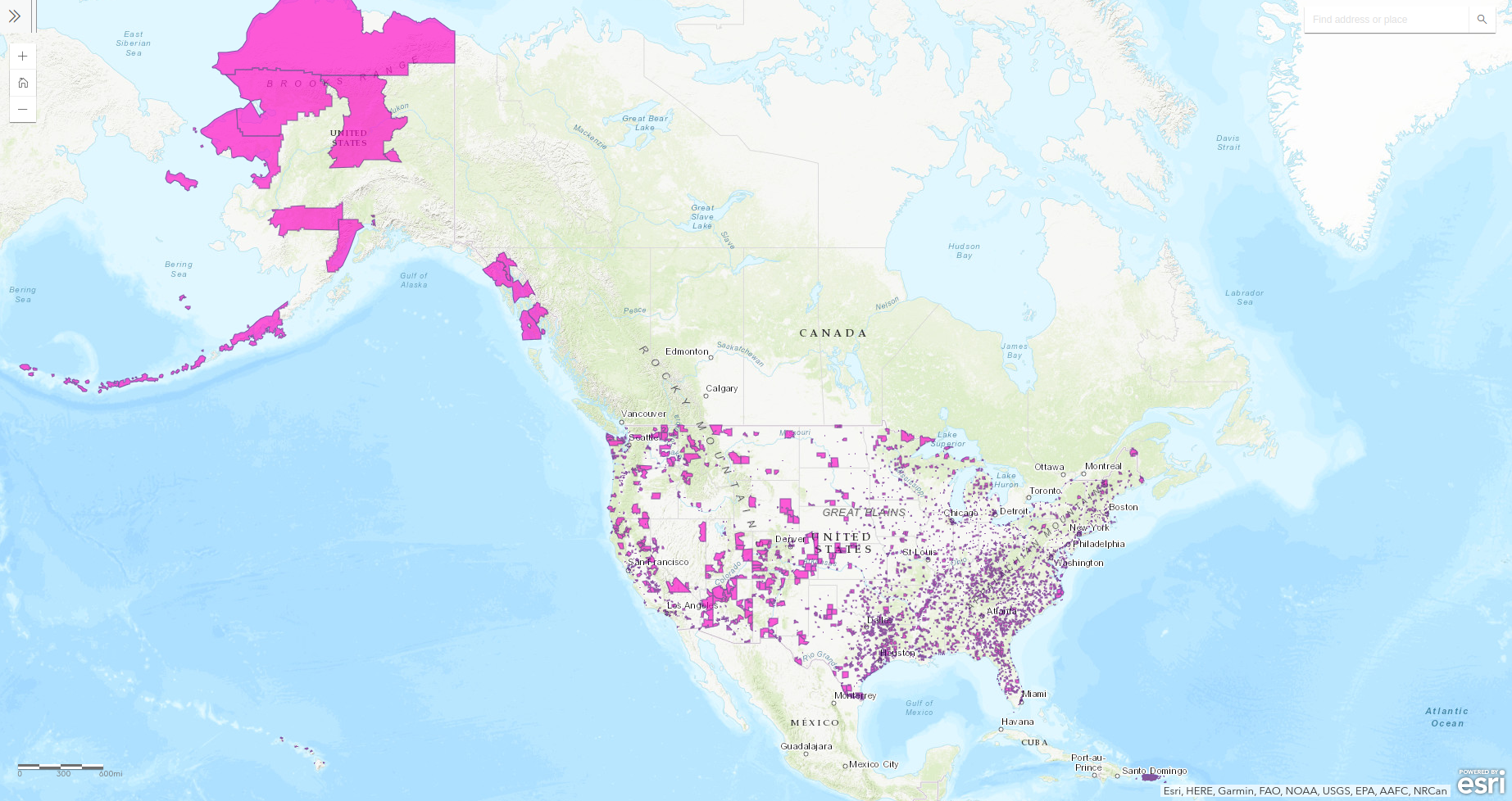
https://cimsprodprep.cdfifund.gov/CIMS4/apps/pn-nmtc/index.a...
The purpose of the QOZ is to encourage investment in those areas, and it does this by favorable tax conditions.
Some of these areas are surprising, at least around me I see areas designated that aren't much different from the surrounding areas. And there are rural ones, too.
Looking at some of the ones above in street view, I can see why they're classified as they are, and I could certainly see a start-up choosing to place an office in one of those locations. Some are transit-close, even.
The reason that HUGE tracts of OZs make no sense is that the “for development of blighted areas” thing is very thinly veiled bullshit.
The Opportunity Zone Selection Process
As prescribed by law, governors nominated which census tracts should be designated as Opportunity Zones by the U.S. Department of the Treasury. To be eligible for designation, a census tract must:
- Have a poverty rate of at least 20 percent; or
- Have a median income below 80 percent of that in the State or metropolitan area, or for rural census tracts, 80 percent of that in the entire State; or
- Be contiguous with a census tract meeting one of the above conditions and have a median income less than 125 percent of the qualifying contiguous census tract.
[0][0] https://www.rd.usda.gov/sites/default/files/ImpactofOpportun...
It is literally a tax break for gentrifying. "Build in this poor area and you don't pay taxes".
I'm not sure who draws census tract lines.
The wealthy
Option B: Move to Puerto Rico, run your company from here, do Act 60, zero capital gains tax.
It's challenging to build a successful billion-dollar-exit company in PR, though.
It makes sense for completely vertically integrated businesses which are highly profitable (some software, crypto, pharma production), but it's not a place you'd put most businesses. compared to Florida/Texas (low tax low cost), a lot of other parts of the US (low cost moderate tax), or CA/NY/etc. (high talent pool, high tax).
It can be done, it's just harder, and it's probably not worth saving 20% long-term capital gains (if successful) this way vs. a higher change of a successful outcome at all otherwise. But for some specific kinds of businesses it works great.
If at some point we no longer want to incentivize that behavior, the government can simply remove the tax break. Moralizing about how people shouldn't engage in the behavior that the government is encouraging them to by offering tax incentives is beyond useless.
Yes, as we’ve seen, it is very easy to get the government to repeal a loophole that enables a billion-dollar company to dodge a tax. Why, it is virtually child’s play! The poors just need to hire a lobbyist, outspend the tax-dodging lobbyists, and Bob’s yer uncle! The government, as you say, will simply remove the tax break.
There are even plenty of things people might want to donate too that only governments do, the Red Cross etc are hardly building space telescopes or US highways.
Except the wealthy play games like extending Harlem through central park to midtown so that they can fund building their own luxury apartments as economic development in a "depressed" area.
But then these corrupt, America-hating billionaires will spend millions digging up dirt on you, funding your opponents, and claiming you’re sending jobs to China.
Not unless you're extremely rich or extremely poor, that is.
This is where your argument breaks down. Gerrymandering has completely eliminated this as a reasonable belief in most places.
Most voters don't even care about issues, they care about parties, their team. As such, they don't care or want to incentive anything except their own team winning.
> the government can simply remove the tax break.
If most people want abortion to be legal, the government can simply legalize it.
Oh wait!
Seems like the problem is the voters then.
> If most people want abortion to be legal, the government can simply legalize it.
Per your earlier statement, that is not what most voters want. They want their team to win.
You're right that moralizing is beyond useless. Instead let's define the bounds of our morality by our tax code. What can go wrong?
This is effectively a tax incentive to open new businesses in these somewhat remote and low-income areas. I dont think it's a bad thing if it does indeed encourage job creation and economic activity in those areas that otherwise would've stagnated.
Why don't people want to contribute back to an environment that enabled their success?
I have too many family members that will avoid acknowledging anything the government does for them.
"The social contract."
You are working from a flawed model. Government spending is not tied at all to revenue. Over the past three years the federal government has dropped over 5 trillion dollars on the economy from a helicopter.
Why not take advantage of a loophole when money can and is being created out of thin air?
The fairest solution is to scrap CGT and associated capital loss write-offs.
This allows the middle class to thrive by investing in productive enterprises and not getting taxed yet again to do so.
It's the worst kind of tax that punishes success by stealing your after-tax money.
As for your appeal to nation, the US will waste your money on slaughtering Afghanistani children with bombs and handing out cash to serial fraudsters (look up how many people on Social Security are actually real). Most tax money is wasted by government.
Calling out other parasites, don't forget you also are one.
Any example of a cooperative usually descends into chaos, an example being worker's unions which descend into criminality, corruption and pure evil (teacher's unions regularly defend sexual predator teachers, for example) more often than not.
It's also a pure fallacy and just plain wrong to suggest I claim profit from Cloudflare. Cloudflare has not and does not issue dividends, meaning all of the profit is reinvested in business operations or goes to the workers.
As an investor, I don't see a single cent of profit in this case.
The same money isn't taxed again. Only the gains on top of that.
Some sort of tax on wealth or the proceeds of that wealth is necessary, otherwise you end up with a society where only the middle class pays tax while the people who benefit the most from society, the rich, live tax-free. It's either this or a simple wealth tax.
The very fact that some of these places exist for a long time; means that it's not worth it to invest in them even with the tax breaks.
Not sure that’s correct. https://thehill.com/policy/finance/599753-study-57-percent-o...
If I had billions of dollars I would always strive to legally pay as least taxes as possible and use the funds to contribute back the country in much more efficient ways, including investing in people who are provably getting shit done.
Here's the latest of a constant firehose of misuse of funds I've seen. The gist is that a Stanford professor is basically leeching $40K of tax money at a $5000/hr rate for "consulting" about social justice and equity in schools. I'd rather give that $40K directly toward educational supplies for underprivileged students, or to a hundred tutors and therapists at $50/hr, or something else.
https://nypost.com/2022/04/08/stanford-prof-calls-cops-on-be...
How does that make your case?
I'm on the point of panic about taxes right now and still trying to sort out my expenses over the last 2 years which do include about $500k in investment in one of the poorest areas in the country. My location just happens to be gerrymandered out of the local opportunity zone though.
Meanwhile, I am surrounded by vacant lots, a large mall that is entirely dead and vacant, low income housing, one tiny strip mall with a convenience store, and another with a church, dollar store, and liquor store (a mile away).
I can see though that the OZ tract is tiny, whereas the tract I'm in is about 7 x larger and includes some more supermarkets and malls further away that are very active though not upscale.
Looks like a fairly straightforward case of economic gerrymandering.
> No more than 5% of a QOZB’s assets can be “nonqualified financial property”. Nonqualified financial property includes most types of financial assets such as stocks and bonds but excludes cash, loans with a term of 18 months or less, and accounts receivable acquired in the ordinary course of business.
Cash on hand is ignored.
However, I speculate that if you put said cash in an interest gathering bank account, the IRS might have a firmer view.
So you're likely capitalizing the business with cash on hand that cannot attract meaningful interest.
In terms of gross, you need at least 50% gross income in the qualified opportunity zone.
> - Whether at least half of the aggregate hours of services received by the business were performed in a QOZ;
> - Whether at least half of the aggregate amounts that the business paid for services were for services performed in a QOZ; or
> - Whether necessary tangible property and necessary business functions to earn the income were located in a QOZ.
So "in" is flexible.
But in the meantime, it still makes sense for me to play the game with the rules as they are.
If you happen to have a billion dollar exit on your reinvested capital gains that can be tax free, but you're still paying tax on the original gain.
The main intent is that they be things like machine shops and the like that supply jobs and a bit of spin of economic activity (workers go get lunch etc).
Having people work in a coworking space may not be what they had in mind, but if those people go out to lunch in the zone, mission accomplished.
You can argue if that works well or not but the tax advantage does not exist in a vacuum.
I assume you're talking about the SALT deduction? The one that mostly benefits the highest income earners?
Interesting how when people personally benefit from a tax break it's "entirely justified", but when someone else does it's a "massive special interest handout".
When an investor gets a billion dollar return, remember that is the value from a company that likely provides billions more to local economies.
I have no idea why that would be true, especially if it's an online business where highly paid people go to a campus and don't leave until it's time to drive home.
Want a bigger list? Here's several thousand billion dollar companies: https://companiesmarketcap.com/
How many don't pay local property, income, unemployment, and other taxes?
Not every new company is an online mythical virtual company. When someone presents reasonable evidence, if your first reaction is to latch onto outliers and pretend they're common, you should check your biases versus reality.
Stop paying your taxes for a moment, even a small amount say $2000 and witness how much expense the system is willing to spend to try and claw back that tiny amount from the individual.
The people enacting these systems don’t even “pay their share”, yet they’ll be the first to try and make you angry at others while taking profit from hours of your labor daily.
The system is rigged.
So like then instead of paying the orphanage tax you pay the Ferrari tax and the...the handbag tax of the brand, but like always dodging actual luxury taxes, just paying for the brand. Like paying for the advertising, the...the events, like the Rolex sailing thing? Dude I rather hang out with one of my evicted buddies than go to that shit. As long as I'm squandering money, rather buy Jonnie the beer he's asking for so he can sleep, without judging him. And at obviously placing the burden on myself to help him, like making sure I have coins in my pockets for the beggars before I leave my house. Or a couple times when he asked, I'd tell him to let me get some change I knew I had at home to bring him. It's this whole Christianity thing.
Though normally not talk about that, supposedly charity you're not meant to talk about. Well I guess it's not glamorous charity. And the whole thing about charity being private sort of works sort of doesn't, the Gates Foundation has a huge amount of publicity centered around, I think, the size of William Gate's fortune, reputed to be the world's greatest. But on the other hand, you have Laurene Powell Jobs, I knew someone she was indirectly paying wages to that had literally no idea where the money was coming from, like she used a corporation instead of a 510c3 for privacy and liberty in giving. So then Laurene Jobs came out in public, saying (paraphrase) this sucks, why rag on the Jobs's so much like they're niggardly, and then she opened up about the giving and then that someone I knew found out wages were coming from her. Basic reason it doesn't work is you can't know for sure, as a society, if the rich individual is giving anything at all or just hoarding. That's what's up in Chile, the rich just hoard. Acaparan in Spanish, but that's like a Communist-word. Well myself included, compared to Jonnie I'm rich, no two ways about it.
And that's why I love paying taxes, so taxes are the escape hatch for this moral dilemma, you can by all means tell everyone what you're paying in taxes. Taxes are not charity. If you pay...I think I paid $80 extra split half-and-half State of California and Federal taxes, which I could do by asking about a form at the temp job agency at which I worked this...this menial but mostly dignified labor role...so I payed an absolute tax rate of 45%. I have the W-2 still, looks like I earned $300, obviously outside income but that's not what's in question. So that's why I'm quoting numbers, as well as I can remember, because it's not charity, it's not like being a sugar daddy, it's like being a husband. The money is demanded and if I choose, due to what is considered a masochistic loophole which nobody ever uses or talks about, but which appeared on-screen as a pre-filled 0 so I could ask about it...so because the state demands money and it's obligatory in general, that has more dignity. Because if you can pay a bit, you ought to. Not like they have to throw a party for you to sign a little check, no, DEMAND it. Just like education for children, it's GOOD that's it be OBLIGATORY. OBLIGATORY. And if you want to teach your child more after school, by all means. And like no capital gains on a billion dollars? OBVIOUSLY TAXES ARE A STUPID POINT SYSTEM BECAUSE EVERYTHING IS A STUPID POINTS SYSTEM, THERE'S NO ALTERNATIVE, YOU'RE NOT AS CLEVER AS YOU THINK YOU ARE. Just submit.
Plus being a billionaire makes you a high-value target, in addition to a qualified investor, and there's more price discrimination. The only people that price-discriminate transparently are the Government. I would say they are the least predatory. If you really do pay up without avarice, they won't chisel you. And keep in mind the perk of having the FBI available for eg abductions or blackmail, extortion, what you might term "first world problems." But not if you're dirty from cheating the system. Totally different vibe.
Speaking as to USA, there's different situations. The worst thing, the absolute worst thing, is dropping your US citizenship, because everyone knows the only real reason for that is avoiding taxes, or for avoiding going to war. Or both. Then it's open season. When the US Government says, and tax lawyers repeat this, fat pigs get slaughtered, it means you have to show respect for the point system and only hack a little here and there in additive, not multiplicative ways. And in a manner that conforms to American values and norms. Like middle-class gets to carve out the primary residence from capital gains I think, that's a super American value.[1] Or like making your career about intellectual property, especially inventions. What would a house be without them? Or what would we be without them? Still apes, no clothes, no fire, no tools. Hands are for inventions, and hands make us special to the exclusion of everything else. Otherwise we'd be knuckle-dragging. Plus America had so many great inventors, endless, still does they're just...it's different like everyone's delegating now. Trying to find the innovation in another field, rather than banging them out on their own. Or AI.[2]
Like you can get very very rich in America, just accept the friction it comes with.
[1] And it's American in tandem with being favored by the tax system, the two are inseparable.
[2] Despite this being my line of business, soon to be hosted in www.fgemm.com, I have a negative view of matrix multiplication for this purpose. I think as a tool in a toolbox, to be used sparingly and not relied upon completely. Never a substitute for creativity, and thinking. And using your hands instead of just the brain, real inventors did that.
Loopholes are one thing and IMO should be closed but morality is another. The whole idea that you can make a billion dollar business without being hugely dependent on the infrastructure, education, history, societal background etc that has largely been paid for by...taxes...is utter fallacy.
Maybe if massively profitable businesses spent a bit more time doing the right thing then everyone would be happier.
Just a thought.
~ braces for inevitable downvotes ~
Of course, I understand that if you're in that wealth bracket, the actual tax/accounting acrobatics is abstracted from you. You probably hire some consultant to do all the work, and in the day only pay a fee to get your tax cut by x.xx%. That's zero work for you, minus whatever time you spent on a meeting with the consultant.
But still, there are people that will be heavily involved in these things themselves.
Yes, it is a polarizing topic. Some people refuse to pay taxes because of how the money is spent - or they have some idea of how the money is spent. But from a pragmatic point of view...what's the difference between sitting on say $500MM in cash, and $800MM? It's either way going to be more money than you'll ever be able to spend. Hell, even the safest investments at that scale will yield more money than what most CEOs make in a year.
(With that said, I do have sympathy for the people living in countries where you have to pay wealth tax or tax on unrealized gains, which for founders means
1) taking out loans to pay taxes
2) increasing their yearly compensation, just to meet their tax burden or
3) to sell their equity
But these aren't really in the "exit" bracket)
At least $15M a year over most 3 year horizons, or the insane compounding effect of $300M invested over the long haul. Your question makes sense from a "normal" perspective, but doesn't once you're UHNW [0].
> It's either way going to be more money than you'll ever be able to spend.
Not even close. At UHNW levels there are whole classes of things to "spend" on that ramp pretty quickly into 8, 9, 10+ figure values. Influence, power, status, prestige, legacy, ideology, politics, rinse, repeat. And the UHNW "brackets" are a real thing (you're either in the tres commas club or you're not, etc).
Sure, pay your taxes. But once you crack these numbers there are entire industries dedicated to helping you work the system, and it's unfortunately pretty workable (because there are substantial interests lobbying to make/keep it so).
[0] - https://en.wikipedia.org/wiki/Ultra_high-net-worth_individua...
"UHNW" people are crazy, evil and dangerous. There is no amount of stuff that will ever satisfy them. They will consume, and cheat on taxes, obsessively - until our natural world is destroyed.
It has come down to us vs. them. We didn't start this fight, but we are going to have to finish it.
How about the insane compounding effect of a better funded society, through less multi-mill/billionaire tax avoidance?
>Your question makes sense from a "normal" perspective, but doesn't once you're UHNW
Or rather, it makes sense from a normal (non quotes) perspective, but not from the point of a power hungry sociopath.
Your basic premise is flawed.
Note that I'm not even talking about taxes. But tax avoidance also becomes a lot easier the more money you have.
My wife's life was saved twice by tax-funded health care. Won't share details here.
I happen to enjoy quite a few government services. Like "roads".
I'm happy to pay taxes.
I don't always like the way they are spent. I also don't like everything about my job, and if I had a dog I could probably find things about it that I didn't like.
Life is compromise.
When I left home at 15, I got into crime, as no-one would hire a smelly homeless kid.
Then when I turned 16, I was able to get a social security payment for "independent youths". I wasn't living in the lap of luxury, but I could actually pay rent in a flat and buy food, without committing crime.
So now that I'm earning a very decent wage as a dev, paying my taxes is the very least I can do to contribute to a country that supported me when I needed it.
It would rise to the level of cheating if you abuse the rules. Investing in an opportunity zone, starting a business there, improving property, employing people, re-investing there. These are all the intended effects of opportunity zones.
It seems like an awesome loophole, but it’s not. The hole was put there deliberately. It’s meant to be used.
If you’re curious, take a tour of your nearest opportunity zone. Imagine starting a business there. Imagine your employees shopping at the bodega on the corner, grabbing lunch on the street, using the run-down auto repair shop because it’s convenient. If you’re willing to locate your business in an area we’ve decided we want revitalized you can realize tax benefits. But there’s some risk, so do it with open eyes.
Which I also refuse to take, myself, but for different reasons than refusing to steal.
I'm a high tax kinda guy. If we all had Norway taxes, we'd have Norway sovereign fund and EV and lifestyle (but maybe without SAD, because we're not all that far north)
You seem to be quite the expert on Norway. Can you elaborate how they prop up social services with oil money?
It’s worse for capital gains and they have a wealth taxes so a lot worse for some.
The top CA or NY bracket is dependent on the top US federal bracket which kicks in at $537,000.
Not to mention the <cough> 25% VAT in Norway.
If the law says some entity must pay X tax it is uncertain what it would mean, in practice, to claim "their taxes" were really Y, some other amount they aren't legally obliged to pay.
> The whole idea that you can make a billion dollar business without being hugely dependent on the infrastructure, education, history, societal background etc that has largely been paid for by...taxes...is utter fallacy.
A business is a hypothetical entity, a term for a system of organising people to do things. Things that are measurably in high demand. It is profoundly uncertain that diverting money out of those systems is a good idea. Observing that businesses rely on their context does not start or end the argument about how much tax they should pay.
I pay federal income taxes, payroll taxes, medicare and medicaid taxes, social security taxes, corporate taxes, state income taxes, city income taxes, property taxes, and more.
Why should I then pay a huge capital gains bill? Why should I feel morally obligated to do such a thing?
I think you’re missing all the taxes paid along the way to achieving a billion dollar business. For me it’s 47% per year. Far more than I would consider my fair share considering most people pay an effective rate of 0%.
Adding more rules is generally favorable to the rich. The real solution is removing special-interest tax benefits like this in the first place.
I think it is sad they exist, but clearly they are there to be used.
>~ braces for inevitable downvotes ~
If you get downvoted it will be because you stated an opinion that is in no way controversial among these demographics and then pretended like you were making some noble stand based on principals when in reality you were just the first person to come along and say what half of everyone was thinking and you weren't really risking much blowback.
I won't downvote and I agree with you in principle and wish I was lucky enough to live in a country where I can actually feel like I'm getting value out of my tax money, but as of right now that's not the case so I can totally understand tax evader's positions.
That's a different deal than some body squeaking around tax law; this was all about trying to change parts of the nature of capitalism's tendency to rerun money to capital more than to labor.
If you think it's misguided, I do too. Though I think it's good to invest in under invested areas, I also think we need to counteract the effects of the Henry George Theorem and also redistribute money from the land rents to people that do not own land.
Both are necessary to try to make our economic system more fair and more efficient. The fewer people that are allocating capital in capitalism, the worse it works. And pretty much all positive defenses of capitalism start with assumptions that most people are starting from somewhat similar places of wealth, or at least enough wealth that they are not destitute. Until we have that base level of security for all, we need things like massive redistribution, which includes carrots like opportunity zones, as well as sticks like taxes on land and monopolies.
I strongly doubt that the outcome here is the intent of the tax break, which seems to be "pump money into poor areas and we'll let you off the CGT on the amount you invested in the area".
She "re-invests" a thousand dollars by starting a company that is just a few people in some co-working spaces, and walks away a few years later with hundreds of millions extra.
If she'd started a major factory employing large numbers of people in the local area then sure, that seems like the intent.
This is much better a tax break than a city bidding for an amazon HQ with a custom tax break deal that they have to compete with other cities!
No, this was a small group successfully lobbying to reduce their share of the costs of running society. AKA special interests.
> Until we have that base level of security for all, we need things like massive redistribution, which includes carrots like opportunity zones, as well as sticks like taxes on land and monopolies.
If you're going to redistribute wealth, do it in a broad, simple way (UBI/negative income tax). Not through millions of tiny special interest gifts like 'opportunity zones'.
Corporations have been doing it for decades, and anyone that doesn't do the same will continue to be taken advantage of.
I guess the worlds has some space for people who can be rewarded enormously through the work of the long tail and everything collapses when the number of people who act in that way passes the acceptable threshold.
Like, it's O.K. to have a royal family and bunch of elites around them who engage only in high life stuff like poetry, paintings and politics but you can't have half of the population be painters, poets and the other half work the land and have no life so to feed the elite half.
I think there was article on HN some time ago about the tolerable percentage of knights in the society.
The rich must be forced to do the right thing, otherwise they will not do it. Expecting otherwise is lunacy. Maybe one or two foolish and good ones will try to do the right thing, but they'll be swiftly out-competed in our hyper-efficient economy by those willing to break rules and cut corners.
Why? (and I have mentioned this before, many times, even here)
Poor people already pay almost zero taxes.
Rich people avoid paying taxes at all.
And me, someone with an above average but below "rich" (engineers) paycheck get fucked by the taxes.
I don't want higher taxes for the rich, I just want the rich to pay the same tax rate as I do in the first place.
It may not sound a lot, but remember - when you're making that little money, every dollar counts. You could be living on the edge of poverty, where you just make enough money to cover your basic needs, but never make enough to save up anything.
Compare that to someone making, let's say $60k in Texas. You're not anywhere near a six-figure salary, but you'd still make 4 times more than minimum wage.
Same calculator shows that at $60k in Texas, you'll have to pay $10778 in taxes, or %17.96. Higher percentage, but you'll probably have a lot more to save than the minimum wage person in the previous example.
The "rich" engineers making $250k will have to pay 28.23% in taxes, even more than you.
Now the wealthy, they will probably never pay more than capital gains taxes at most - which is a capped figure, most places. And as others have mentioned, there's a whole industry dedicated to bringing down the taxes for wealthy people.
So while the middle and upper-middle class is bankrolling the nation in terms of tax %, I think it's important to remember that these things have to be seen in context. I have a 3-4 times higher tax rate than "poor people", but I make more than enough money to everything I need, post-taxes.
A basic factory worker (a bit above minumum wage), earns 1200eur monthly gross, which (due to weird laws) costs the employer 1393eur (gross-gross), and the worker gets 831eur net out of that, meaning that the government takes around 40%. (the tax rate also includes pension and health insurance)
If you earn 5x times average pay (let's say you're becoming "rich"), that would make it 10k gross, costing your employer 11610eur, and you earning 5167eur net, meaning that the government takes around 55%.
Ok, similar enough,... but(!), with the same cost to your employer (11610eur), you can earn a lot more if you avoid taxes.
Lets say you start an independing contractor business in slovenia (a paper thing, you get the status) - this would make you pay a minimum of ~450eur monthly for health insurance and pension insurance (yes, this would also make you get minimal pension later, but wait for the rest of the math). Then you open a company in bosnia, where you pay ~100eur per month for bookkeeping, a mailbox, and other related costs, and then pay only 10% when you take out the profits. So your fixed monthly cost is around 600eur + 10% of the 11k of your gross gross left over, totalling to 1700eur, and earning 9900eur net, meaning that you effectively pay 15% in taxes. But that's not the worst part... if the company is registed in your girlfriends/brothers/mothers/... name, you (as a couple) still earn the same, but you're now (on paper) poor, so if you have a kid, with some paper turning, the kid will get free kindergarden and food (compared to almost 500eur monthly for two a bit above average paychecks). You might also get a government sponsored apartment to avoid high rents.
So yeah... at some point, dealing with bureaucrats in two countries goes from "not worth it" to "definitely worth it".
In my country, foreign (or rather, multinational) corporations that invariably make huge profits, pay zero taxes, by doing the following:
- they transfer 'ownership' of critical company resources,
e.g. the software WE develop, to a remote entity that is also them, typically on e.g. cayman islands.
Then our local subsidiaries rent/lease OUR OWN SOFTWARE back from the cayman part, in order to serve it to our clients.
Our local subsidiaries pay a silly huge leasing fee for using "its own software" - as much or more than what our clients pay for using the software services.
The net result is, that our local subsidiaries always operate with a loss, no profits, which both results in no taxes having to be paid, and the "losses" being tax deductible (depending on details, both can be useful).
The real net result is, that a huge profit is funnelled out of our countries, with no taxes paid for local services, wear and tear.When your size allows you to hold the pen when writing the tax laws, tax does not apply to you.
Tax is something the wealthy and society extracts from the taxable classes. They don't extract it from the rich, it is in direct opposition to the nature of being rich - rich is something you become, by being exempt from the rules that apply to 'lesser' creatures.
And if the low-income classes do not provide taxable income, I wonder why the republicans are so hellbent from prohibiting poor people from getting abortions. It suggests to me, they DO believe poor people serve some purpose, given that they insist on creation of new poor people.
We had a really shitty government for two years now, who did only one good thing, and that was to raise the general tax deduction, making our workers get a bit more net out of their gross income, and even the unions protested, because they "cared" about te governments budgets.
Now with the government change, we expect them to scrape that (because that would mean more money for the government, and the poor (their voters) would be least affected), and the paroles they'll use go along "taxing the rich". On the other hand, as you said, if you're rich, the "progressive" tax rates make it worth it to avoid taxes by funneling money around, and we (engineers, developers, etc.) get fucked, because we earn above average (and get hit with taxes hard), but still not enough to make it worthwile to do the whole tax-avoidance (legal) thing.
So while I understand the arguments for fairness, it cannot meaningfully affect my situation, and therefore it's a bit like an "there shouldn't be any homeless" type situation. Ideally, yes, I'd want the rich to pay. Practically, it's rather low on the priority list.
But they don't, because of tax loopholes like these. If you want the rich to pay their fair tax, we definitely should "tax the rich". A couple of years ago, Warren Buffett pointed out that his secretary paid a higher tax rate than he did. Also because capital gains are taxed at a far lower rate than income.
I haven't benefit very much from government infrastructure. Woo, we have roads now. Where multiple of my family members have died, and most of my family members have been traumatized by those deaths. The person who raised me nearly died in one, and it left us even further in the poverty trap than we otherwise would have been, because of millions of dollars in hospital bills, even with insurance, thirty years ago, that we spent decades paying off. Oh, internet? I had dial-up growing up in the 2000s because my local government sucked and the wider governments sucked.
Honestly, my education sucked. It was actively harmful to my development. Government incentives historically kept my family in poverty, leaving my societal background awful, and filled with terrible people. And, on top of all of that, every two years, there's a 50% chance that a government I despise becomes in charge. Even when a government I find tolerable is in charge, more goes to funding wars than anything I genuinely care about. "Billionaires aren't paying fair taxes!" becomes a campaign point, rather than anything that could genuinely help people, because no politician is interested in fixing things.
The one thing that is unambiguously good about the US government, the Postal Service, has been getting slowly dismantled and made inefficient over the last decades.
Evading taxes is the only morally correct thing to do in America. I'm not going to evade them, because I'm not a moral person and prefer the convenience of not being randomly investigated by the IRS.
We should tax billionaires and companies because billionaires and companies suck. That's the valid reason. Cloaking it in false-utilitarianism is nonsense. Taxation should be punitive.
That’s what voting is for surely?
I want 2x better government services for the same amount of taxes. The fact that no one questions government efficiency, but everyone is eager to pay taxes is delusional.
If I lived in Zurich or Tokyo, yes, I am happy to pay taxes.
I really don't want to give a dime to Oakland local government and California in general; I will do everything in my power and exercise all legal avenues to pay as little tax as I can.
I give my local and state government a solid 2/10 score.
I am a socialist where governments are efficient, liberatarian where governments are dysfunctional.
You position is irrational and seems to be from a place of envy over other's wealth than actual societal benefit.
Honestly, the level of bother is too much to keep track of for 20%, which is already really low.
I'm referring to the "I'll do X when others do Y" type of reasoning.
Sounds a bit like whataboutism.
2) please don’t build straw men
3) please don’t be so combative
What exactly are you trying to say here?
If every working American contributed $8,000 in taxes we would have the same revenue as the insanely progressive system we have now. I don't think anyone here would advocate for zero taxes. I think they would simply advocate for less taxes.
You're not arguing for lower taxes; you're arguing for higher taxes on the poorest.
Maybe instead the federal government could do inventive things like substantially cut the military budget.
Taxation is not a transaction you enter voluntarily; it's enforced by violence, and all these rationalizations don't matter as you don't have any choice anyway. So, taxation is either extortion, robbery or theft (I'm not sure which definition matches it better), and tax evasion is simply a moral obligation for everyone who believes that people should not be subject to violence.
If ultimate enforcement through violence is the only determinant of whether or not something is a crime, then the very laws that dissuade other crime, say the robbery or theft that you refer to, are themselves blackmail, extortion or some other variation of violent crime.
This circular reasoning does not hold up to scrutiny, which is why it is almost only used in respect of taxation in libertarian circles and nowhere else.
No, because in these cases it's violence enacted in self-defense (often by proxy), and therefore not an aggression.
Defending yourself is not aggression. Going after somebody or their property is.
>tax evasion is simply a moral obligation for everyone who believes that people should not be subject to violence.
Some people should definitely be subjected to violence. It's not hard to find examples where violence is justified. Even a Buddhist monk will forcefully stop a child from touching a venomous snake and make the child cry.
You don't enter life voluntarily, you don't go to school voluntarily, you don't go to the hospital voluntarily when you fell on your head, become unconscious and slowly bleed out...
I know the US defense complex gets a lot of sh!t for its massive expenditure, but the hard reality is that no state on earth is going to invade the US, and thus threaten its citizens within the boarder, which is a result of tax money being spent on building the most powerful military in the world.
Perhaps, but less so than money. People wouldn't recognise other people as having millions or billions of wealth unless that was enforced through the violence of state capitalism, and a legal system protecting banks, creating cops and prisons.
Why would they? Millionaires aren't a natural concept; it's something our society allows.
So what? Does it mean that it's something not valuable or desirable? I don't think so.