Oxygen Candles: Providing Emergency Air
Oxygen candles are used as a backup source of breathable air inside refuge chambers, making them ideal for emergency situations underground.
MineARC Systems
323 points · by thunderbong · 4y ago · 138 comments
You need co2 scrubbers for any oxygen producing solution, since co2 kills faster than o2 scarcity.
Having a candle, and just a candle alone in a hermetically sealed room will result in suffocation as fast as without it.
I reported the post as it contains false and dangerous info.
"Oxygen cylinders are used in the event compressed air fails and generally require the support of a scrubbing system to remove carbon dioxide [...]"
Oxygen cylinders are also used as an emergency non-consumer product. The comparison is a misleading one.
Just because something in a consumer product does not mean that thing, by itself, is a consumer product. Or at least us using the term "consumer product" is stretched near the breaking point if you look at things that way.
They point out that piped air is one option (which is basically continuous open circuit in these settings; exhausting to outside.). The alternative is oxygen cylinders mounted on the chamber (or inside the chamber), which (generally) require scrubbers.
Oxygen candles are then mentioned; they are essentially a nearly direct replacement for oxygen cylinders, but with somewhat better storability. It is silent on whether co2 scrubbing is needed, but obviously would in the same settings oxygen cylinders would.
Compressed Air: The feed can often be compromised during an emergency due to damage to the circuit or carbon monoxide contamination requiring the chamber to be isolated."
The candle is not isolated from the common fault of carbon monoxide contamination. Both Oxygen candles and oxygen cylinders will generally require scrubbers.
They mean that with oxygen candles you don't risk having your very oxygen reserve introduce carbon monoxide in the air you breathe, as it could happen of you have a contamination at the source of compressed air.
In this case, an Oxygen candle _MAY_ be enough to keep people alive. However, why O2 tanks would need scrubbers and candles wouldn't doesn't make any sense.
Seems that algae are up to 400x more efficient at CO2 scrubbing than terrestrial plants. See: https://newatlas.com/environment/algae-fueled-bioreactor-car...
No idea though if such bio-tanks are a viable solution in a rather devoid of solar light shelters.
The net effect is generally, plants release similar amounts of CO2 at night as they consume during the day. The exception here would be plants that use Crassulacean acid metabolism for photosynthesis, which would be a lot of your arid native plants.
The company sells an air scrubber: https://minearc.com/products/air-quality-management/life-sup...
I love this place.
I thought these chambers have pressure-triggered relief valves and rely on elevated pressure in the chamber to force air out? Basically dumping some of the existing air/gas in the chamber which carries away some CO2 with it.
Don't see how this is relevant for civil use though, but hey, maybe some paranoia can sell some candles.
Anyone in a position to be using oxygen candles or bottled oxygen in a survival shelter setting is likely to have had safety training in how to use them, and if it is a situation where CO2 concentration is likely, that should have been accommodated in the construction of the refuge or shelter.
Given their uses are the space station, planes and submarines, cant you just vent some of the atmosphere out since you're in a pressurized tube of some kind to lower the CO2?
With hydrolysis you just have waste Hydrogen to toss which could in the future be combined with CO2 from the scrubbers to create methane fuel (probably not in significant quantities but it closes the cycle on O2 as the Sabatier reaction also creates H2O which could feed back into electrolysis or drinking.
They use these candles to help replenish the oxygen in them: https://www.youtube.com/watch?v=g3Ud6mHdhlQ
Burning candles is a hassle and creates a big mess, to the consternation of junior enlisted who have to haul clinkers around and clean up the constant dust storm they leave behind. That said, huffing that good O2 straight out the spout will keep you awake, especially if your boat has been below 18% for awhile.
3k-lbs of pure O2 combined with a reputation for fires, rapid depressurizations, and hydraulic leaks. More than one auxiliaryman got blasted to bits by those things back in the '60s. Every submariner thinks theirs is a unique and special hell, but I don't envy those who went underway with the old O2 plants.
In Kursk it is suspected that it got dropped into water that had a lot of oil floating on top.
Also... even these show how difficult life on a submarine is (and the ultra-wide angle used most of the time shows how extremely claustrophobic everything is). Not exactly appealing. It takes some very special people to do this kind of job, and I doubt a lot of people are cut out for it...
So, if you're sitting in a nuclear shelter, remember to get the CO2 scrubbers working first, then worry about the low oxygen.
I think the myth is older than Hollywood and it is ingrained in our languages - when people begin to suffocate they say „I meed more air”, not „The air is to stuffy”. And this leads to a mental model of bringing more oxygen in as helpful instead of letting co2 helpful.
A few years ago, maybe 2015 or so, I was walking through base on my way home and saw a moored tugboat was on fire. The two guys on board were in OBAs trying to put it out while waiting for the base FD to show up, so I suppose they’re still used in some places.
[1] https://en.m.wikipedia.org/wiki/Oxygen_breathing_apparatus
Tasks become harder and you make worse decisions, but at no point will you think "I need more oxygen, better light the candle".
On the other hand, high CO2 is pretty detectable. You'll start to find the air 'stuffy' and it will be immediately obvious there is something wrong with the air.
Humans will clamber down into a space that's been flooded with CO2 (to fight fires or by mistake), go, huh, that's not... er... bonk, and lose consciousness. Then others up top are likely to climb down to "save" the people who just fell over for no reason and suffer the same fate.
The unprocessed logs in the holds are slowly rotting, so the air in the holds can be depleted of oxygen.
A crewman went into the hold to check on something, and collapsed. Another crewman went in to rescue the first, also collapsed. I don't recall how many went in, but eventually someone grabbed an oxygen tank and managed to save the last one. The rest died.
CO2 in high concentrations causes issues through various mechanisms with a major one being that it impairs your ability to absorb O2 and other cellular disruption through increasing the pH of your blood [1]. This can cause unconsciousness in seconds at high concentrations and other potentially fatal impairments even at lower levels.
So CO poisoning is worse as there's no (easy) therapy for it but it is still very possible to have fatal exposure to CO2 if you are not able to receive fresh air in a immediate time frame (minutes).
There is also the general issue that confined spaces might be low on O2 as well, as described in this video on confined spaces in ships [2].
[0] https://www.ncbi.nlm.nih.gov/books/NBK532988/
With Carbon Dioxide that gradual risk doesn't exist, you would realise there's a problem. You will probably even be woken if CO2 gradually rises, you'll become conscious, discover the air seems "stuffy" and go somewhere with fresh air.
The problem in the drastic CO2 scenarios is it's too sudden. It's understandable (more so than with Carbon Monoxide) that we didn't evolve to cope with that. Prehistoric man did not use CO2 fire extinguishers.
Consequently, that's why hyperventilating is absolutely a no-go when freediving. It tricks your body, by not triggering the CO2 feeling. So then you can suddenly pass out without feeling you were close to running out of air.
At high altitude it's easy to mistake this for hypoxia (due to loss of pressure), because the feeling and visible symptoms can be very similar.
The distinguishing symptom is seeing blue lips/fingers, that doesn't happen with hyperventilation. But if you've taken hypoxia that far you're in a lot of trouble.
Recommended approach for flight crews is to not bother figuring out whether it's hypoxia or hyperventilation but instead for everyone to put on oxygen masks, verify each other's masks and focus on breathing normally. It will fix both issues and ensures that the rest of the crew is fine in case it was hypoxia.
Hyperventilation is also at the core of Holotropic Breathwork, which people deliberately do to get psychedelic effects:
https://www.holotropicbreathworkla.com/how-to-do-holotropic-...
The candles can enter a state of elevated oxygen (maximum 32%), classified as oxygen-enriched. However, the same fire ignition risks remain at these percentages, and no additional ignition risk is present.
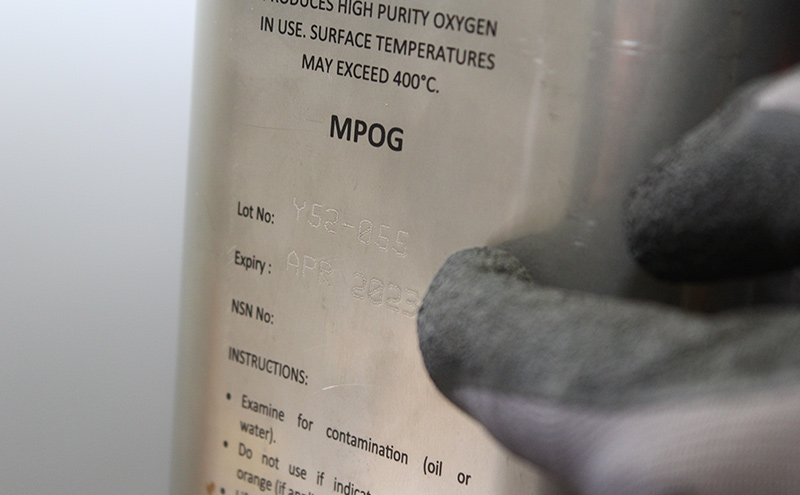
> The candle supplied by MineARC Systems burns for approximately 60-90 minutes, producing 2600L of oxygen. This amount can provide approximately 20 hours of breathable air for four people. An oxygen candle cannot have its oxygen production regulated or halted and once ignited; it produces oxygen at a rate of approximately 28 Litres per minute until it is exhausted.
Oh I see now, it's that big metal cylinder on the floor, they are going to pour the powder into it and ignite?
https://minearc.com/wp-content/uploads/2021/01/cristel-train...
The molar mass of NaClO3 is 106.44g.
So some quick math, to fill 2600L we need 116 moles of oxygen, which we can produce with 77 moles of sodium chlorate. Multiply by the molar mass and we get ~8kg.
Sodium chlorate has a density of 2.49 g/cm^3, so an 8kg slug will fit in a 3.2L bucket.
3L of powder gets you 2600L of oxygen, not bad!
Another page details a 'rugged oxygen generator' - https://minearc.com/products/emergency-response-products/rug... that produces 90L of oxygen over 15 minutes, and that is 115mm x 284mm, weighing 2.3kg. Confusingly, the PDF of the product specs shows that it comes with a mask - so 90L of oxygen is for one person, for just 15 minutes here? And if used with a mask, is it actually pure oxygen being produced, or breathable air (where does the nitrogen come from?) I'd love to know more, but the website doesn't tell us.
At 100% oxygen that’s 105L of O2? So guesstimating almost 100% O2?
Source: am paramedic, not doctor or respiratory therapist.
I'm guessing the best place to find them would be a military surplus dealer.
https://en.m.wikipedia.org/wiki/Vika_oxygen_generator
https://www.nasa.gov/pdf/602090main_44s_international_life_s...
Would be cool if something else could be done with the heat to get rid of the CO2, like a Sabatier reaction (sorry, a bit handwavy).
This provides accurate info on specifications and the details about these candles/devices from a different manufacturer. Including % of particulates.
The global average atmospheric carbon dioxide in 2020 was 412.5ppm. We're so screwed, aren't we?
Stupid question: How is it the sodium chlorate and not the barium peroxide that produces the oxygen?
Nice summary of the process.