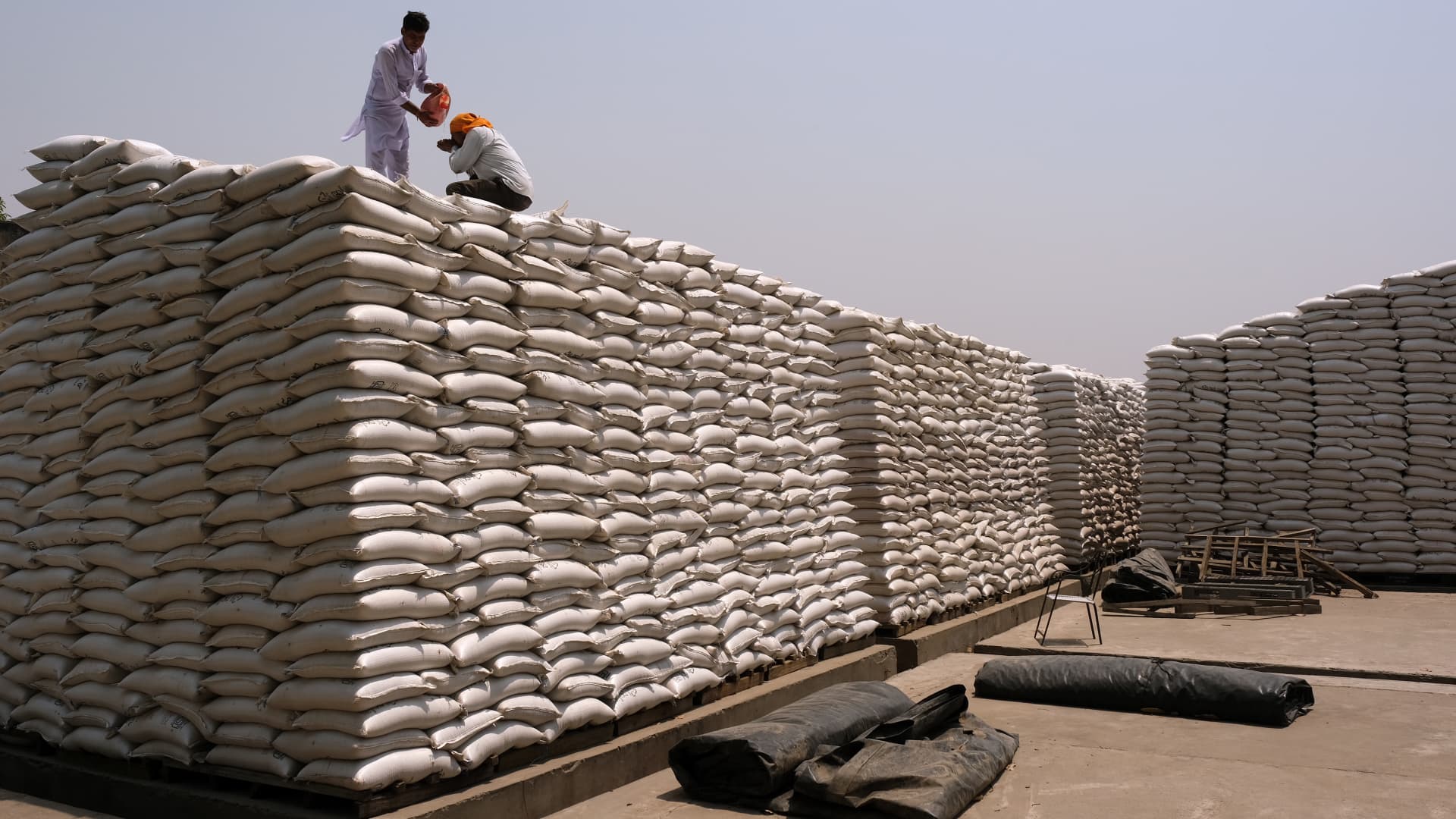
India bans wheat exports to try and tame prices as a scorching heatwave curtailed output
The world's second-biggest wheat producer is trying to bring down local prices.
CNBC
54 points · by camillomiller · 4y ago · 33 comments
Before, it was cool to talk about efficiency and how backward it was for countries to try to protect domestic industries instead of just allow “free trade”.
However, the last few years have illustrated that if you don’t have domestic production of essentials, then you are going to be hurting. Look at the early Covid pandemic and the shortage of face masks and other protective equipment. Look at vaccine production and how countries that could manufacture the vaccine prioritized domestic distribution first. Look now at global food supply and how countries as limiting exports of their grains.
The last decade or so is a story about countries and companies pursuing “efficiency” at the expense of increased fragility. Going forward, I think you will see more companies taking a larger role to make sure critical production capabilities stay domestic.
What if there's a volcanic eruption and we spend half a decade in semi-darkness? Our civilization probably could survive that if we prepared. And we know something of that scale happens every few thousand years. We have more potential for reserve capacity than ever and yet we run on razor-thin margins even for the basics of life.
I don't think those are very good examples. A large part of the PPE shortage problem was from not restocking the national stockpile after the 2009 swine flu pandemic, in part from a bi-partisan, multiple administrations by both parties capture of that program by Emergent BioSolutions.
Which then abjectly failed when it had to deliver cell culture grown vaccines in its Baltimore plant that was in reserve for pandemics (fortunately that didn't hurt so much because the Janssen and Oxford vaccines are ... subpar, and Protein Sciences approach which works for flu generally failed or were extremity late (Novovax and Sanofi Pasteur)). We had part of a system and failed to use it properly. On the other hand if we as in the US were sharp we'd have bought the equipment Honeywell ended up scrapping when they shut down mask making in France.
3M for example does make masks in countries like the US and even keeps an extra set of equipment to double production in case of emergencies like this. But of course just doubling normal production isn't enough, and they and other companies like some that got crushed after 2009-10 found it hard to compete against very cheap PPE from the PRC, and refused to risk their companies again after COVID started hitting.
For vaccine manufacturing it's a tall order to expect political systems to be ready for once in a century events. This wasn't so bad for us with COVID since we could tool up during the development and testing of vaccines although the Indian national government abjectly failed to do that, but there was always going to be issues here, especially in learning curve issues.
Also how do you prepare for the best vaccines being mostly completely new technology for mass manufacturing? Even for fill and finish BoNTech's vaccine has at least at some point temperature requirements way beyond normal medical freezing, the latter any of us could achieve with a frost free consumer freezer.
In general, though, you're right, but solutions free of their own corruption problems are very hard. Plus tariffs are regressive taxes.
5 When he opened the third seal, I heard the third living creature saying, “Come and see!” And behold, a black horse, and he who sat on it had a balance in his hand. 6 I heard a voice in the midst of the four living creatures saying, “A choenix of wheat for a denarius, and three choenix of barley for a denarius! Don’t damage the oil and the wine!”The text is presumably describing a famine produced by drought, which were regular occurrences in the ancient world, rather than by siege. In the latter, the price of all food rises because the supply is dwindling. But a famine in the highly-connected ancient Mediterranean world would not necessarily affect other areas. Egypt supplied a lot of grain to the empire, so a drought in Egypt would affect grain prices empire-wide. But a drought in Egypt would not necessarily affect olive oil production in, say, Italy.
Regarding Revelation, though, each generation thinks the end times is their generation. One (potential) wheat shortage is hardly enough to qualify as meeting the prophecies... Besides, if we're just going to quote Bible passages, "there will be wars and rumors of wars, but the end is yet to come" (Matthew 24:6) [4] Besides, the only one of the 4 major interpretations of Revelation that actually makes sense of the entire text is that most of the end-time prophecies are about the destruction of Jerusalem in AD 70, which is called preterism (and also partial-preterism). While this does not preclude multiple fulfillments of a prophecy, OP presented no evidence for why the prophecy this out-of-context verse applies to the present situation.
[1] https://en.wiktionary.org/wiki/choenix
[2] https://www.biblegateway.com/passage/?search=Matthew%2020%3A...
[3] Google: "how many cups in 5 lbs of flour"
[4] https://www.biblegateway.com/passage/?search=Matthew%2024%3A...
Let them eat cake.
Infosys can own 5000 acres of land for a golf course but they cannot own 5000 acres of agricultural land.
"Last week, Indian PM Narendra Modi told US President Joe Biden that India was ready to ship food to the rest of the world following supply shocks and rising prices due to the war in Ukraine." [1] (Article published on 19th April)
[1] https://twitter.com/PlatformAdam/status/1519980107217129472?...
Actions like these are not new or surprising because India’s economy is quite price sensitive and the government in response likes to micro-manage in the face of rising prices, but it does mean you’ve to take these sound bites to foreign leaders with a grain of salt. Very often these are actually intended for people at home to push the message of “see how much good we’re doing in the world?”
None of this is intended to be disparaging or specific to India, a lot of this applies to other countries as well.
[1] https://www.reuters.com/article/bangladesh-india-onion-idUSK...
[2] https://www.thecambridgeglobalaffair.co.uk/collaborators/wha...
Although the SII also suffered from supply chain issues like everyone else, such as a world wide shortage of 2,000 L sterile plastic bags in which to culture cells and probably bacteria like the E. Coli used in the first step of making the mRNA vaccines.
US foreign policy has been baffling since last year.
> Khan’s new narrative is that there is a foreign conspiracy to oust him from power. And it is America, Khan says, that is really behind the no-confidence motion filed by opposition lawmakers. https://theconversation.com/what-is-going-on-in-pakistan-and...
The United States can’t even get lawmakers in the unites states to cooperate. How are they getting an entire foreign legislature to cooperate?
Making Diesel fuel massively more expensive prior to a very expensive transition to electrical trucks is also making pretty much every good more expensive, everything travels by Diesel powered trucks and/or trains. Biden and company have also decided theoretical so far punishment of Russia is more important than all of the above, for example the East Coast has halved its refinery capacity in the last decade and as of late was getting a lot of distillates from Russia.
War
{Present}
Famine