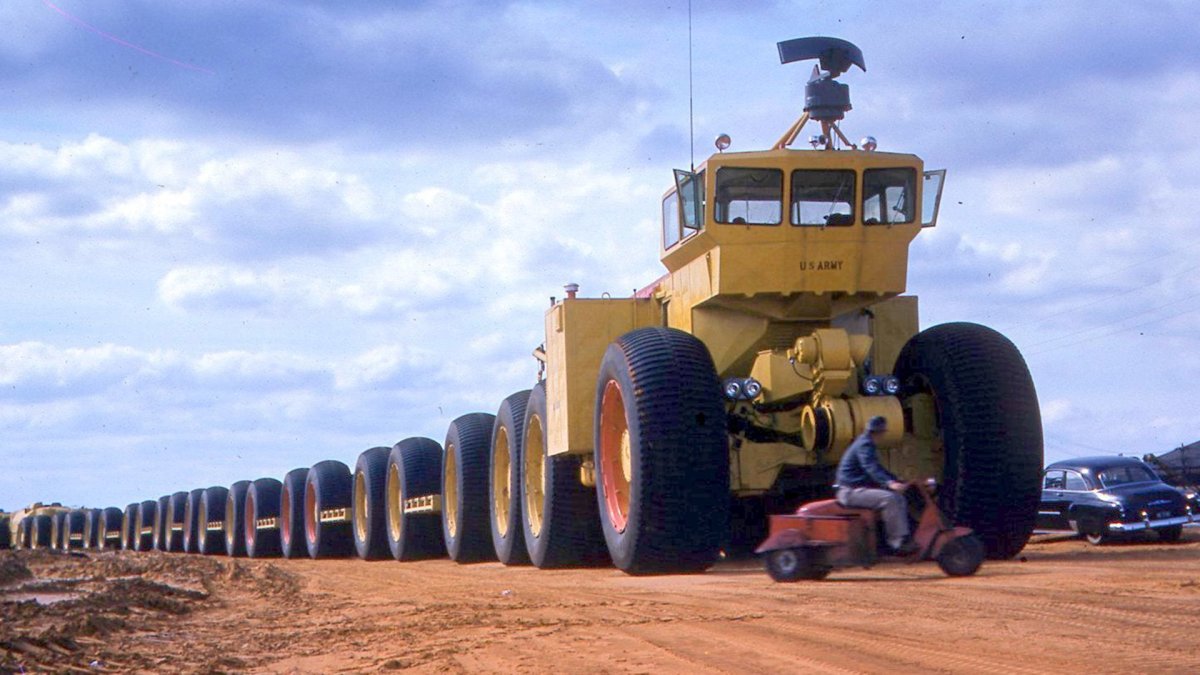
The Incredible Story of the US Army's Earth-Shaking, Off-Road Land Trains
Oh, your pickup has a lift? That's cute.
The Drive
284 points · by lbrito · 4y ago · 148 comments
https://en.m.wikipedia.org/wiki/Guardian-class_radar_picket_...
My father as a newly minted ensign in 1958 served aboard the USS Interpreter and would recall fondly one of his first conversations with the captain. My father asked about how the analysts they reported contacts to would know “when it was the real one”. To which the captain laughed “You damn fool. They’ll know it’s the real one when we don’t report in.”
NATO being dissolved is pretty deterministic as well. The average American in 1984 couldn't conceive of the Russians actually making it all the way over to the US. Nuking the US, but not a successful land invasion. So there had to be some reason the US got weaker. NATO dissolving doesn't put any blame for that on the US, which is important for a flag-waving film.
I don't recall exactly where I read it (it was some interview or something with the people who made the movie 10+ years ago), but I think it was a little more extreme than that. IIRC, (the perhaps unstated) bit of the backstory was domino theory was true and the US was badly on the wrong end of it. The NATO dissolving thing was just part of the picture.
It would have starved, if that were true. The Soviet Union was a grain importer for much of its existence.
"Couldn't conceive" is pretty strong - it was the era of the Cold War, GI Joe, a hangover from the Cuban Missile Crisis, the contras. Maybe accurate to say the average American would find it highly improbable, and our eventual victory always assured because Chuck Norris, Rambo, and the inherent virtue of our cause against totalitarianism.
Anyway, I think the paratroopers that appear in Red Dawn are from Cuba or a socialist country in Central/South America, right? Which isn't terribly far-fetched in the context of the eighties imagination - maybe more accessible idea than a Soviet D-Day-style invasion. Also not out of line in history - didn't the Germans court the Mexicans in WWII? The French during the Civil War (I use the word "court" loosely with the French 'intervention', but hell, we got a holiday out of it).
The film was marketed saying that no foreign invasion of US soil had happened, though it ignored the Japanese invasion of Alaska. The "average American" probably still doesn't think of Alaska very often except for reality TV, much less its history.
https://www.archaeology.org/issues/433-2107/letter-from/9780...
In the 1984 movie, paratroopers dropped from supposed commercial flights, which was the approach the USSR used for their 1980 invasion of Afghanistan
Nukes were used later against the Chinese, which was why there were 500 million screaming Chinese in our side. 13 year old me was a big fan of the movie.
John has a big mustache. The chair is against the wall.
"John has a long mustache" is a callback to the movie "The Longest Day" as a signal to French Resistance.
Funny story: I sat at the table for lunch with my 20-to-30-something colleagues, and I purposely brought up trivia or esoterica, to watch them all dart to their thumbs on phones to answer. I said, STOP!. Try and think it out. It's fun, even when you are wrong, because the conversation flows nicely. Disclaimer: I use Google a lot to check myself ;)
Of course. The DEW line was mean to warn against a Soviet nuclear attack, but in that movie no such attack occurs.
In the backstory for the movie it wasn't just the Cubans. The Russians directly led it, and also Mexico went Communist and the invasion actually proceeded from there, so I'd assume Mexican forces participated as well. That would have been obscured because the main antagonist characters were a Russian commander and a Cuban commander.
https://en.wikipedia.org/wiki/Red_Dawn#Plot:
> In an alternate 1980s, the United States is strategically isolated after NATO is disbanded. At the same time, the Soviet Union and its Warsaw Pact allies aggressively expand. In addition, the Ukrainian wheat harvest fails while a socialist coup d'état occurs in Mexico.
Why make a mere train to eventually make a building, when you can make a large building that moves?
https://en.wikipedia.org/wiki/Big_Muskie
Interesting to think that Big Muskie was significantly larger in all dimensions than the residence hall I lived in for my first year of university. One machine moved more material than two panama canals in its lifespan...
Big Muskie was not a fast mover but it could have made that proverbial 400 mile trip in about 5 months, which isn't all that bad. I do believe it would have cost more overall, which is why they didn't do it this way. I would imagine trying to ford a river with Big Muskie would have been very exciting indeed.
And if you enjoy that, be sure to check out his video on the Soviet Kharkovchanka Antarctic cruisers [2]. It's just as entertaining and what initially led me to his channel.
[1] https://www.youtube.com/watch?v=abGyX2uwXsw [2] https://www.youtube.com/watch?v=f6R-h06IsJw
My favorite fact about land trains is that the tires were later reused on Bigfoot monster trucks[0].
Edit: Found this https://www.researchgate.net/figure/Steering-scheme-of-a-roa....
^1: These are probably called schematics or something...
The usual design is to use mechanical linkages to steer the wheels, with varying levels of complexity that have different compromises. A complicated double Ackermann example (scroll down for plan view): https://planindustrie.de/en/products/industrial-heavy-duty-d... and look at other products of theirs from the menu for simpler linkage examples.
Academic papers are about the design of linkages and turning paths, with consideration for tyre slippage, obstacle avoidance, following, etcetera. The more mathematical papers use an idealised world on a flat surface (ignoring: surface tilts; terrain elevation changes/steps; slippery or soft surfaces especially if variable). Some modern systems use computer controlled power and steering to wheels to help avoid the errors in reality of idealised systems. It is a huge industry, but we need a https://ciechanow.ski/ type person to give us a nice model to play with.
Although I am calling it a delay, I assume the mechanism is mechanical and there is probably a better word to describe the action where the wheels do not turn at the same time or with the same severity as the tow bar.
problem: "We need a machine that can grab these logs from these trees we cut down." solution: "Why not make a gigantic claw and put it on wheels?" https://www.imcdb.org/i236846.jpg
problem: "All these trees are in the way. We just need a way to quickly clear the area." solution: "Why not just stomp them down?" 'Stomp them down?' "Yeah" http://cyberneticzoo.com/walking-machines/1964-tree-stomper-...
problem: "Ok, RG. Some trees we can't just stomp" solution: "Ok. Let's just drive over them them." https://www.youtube.com/watch?v=s-9yvNESLPo
There's this saying: "Any idiot can build a bridge that stands, but it takes an engineer to build a bridge that barely stands."
RG was never guilty of making anything "barely". Dude straight over over did it on a lot of projects. He took small simple machines and just scaled them tf up. He didn't do small. "You've got a big problem? You just need a bigger machine." is something that fits with what his machinery says about his design choices.
He filled a niche for sure. His style and creations fit at a unique time in American history. American steel and manufacture was very much in it's heyday. He had access to all the stuff needed to execute his big ideas. His conservative religious fervor also fit the politics of the day, allowing him to link up with Billy Graham which had some factional differences of opinion from the likes of the overly conservative Bob Jones and Oral Roberts. Seeing large numbers of GIs returning from WW2 eager to work, RG put them to work building gargantuan creations. My personal, somewhat cynical take, is RG also saw that each of those veteran workers had GI Bill money sitting unused. He formed LeTourneau Technical College on the grounds of a shuttered military hospital to train employees at his factory a short walk from the campus. Being a "college" meant he could charge exactly the dollar limit amount of tuition the GI Bill afforded. Being a private college meant he could control what and how they studied. It remains a quite conservative Christian institution and students and faculty alike are reminded how it's a "ministry" until it comes time for a student who can't pay or an employee that asks for a raise. Suddenly the "ministry" facade shatters and the word "business" hops into the wording. As soon as the matter is closed, it returns to its "ministry" persona (esp when asked to do something above-and-beyond).
RG is a fascinating character nevertheless. He's even listed in the Offshore Drilling Hall of Fame in Galveston (yep, it's a thing) for his work on Scorpion an offshore rig for the Zapata Oil Company, then run by a young businessman named George H. W. Bush.
Eh, they could have done that with a shelter built in a tunnel or something like that. But that would have been boring; it's a train because trains are cool. And they could have had the train circling a city or even continent, but they made it circumnavigate the world instead because that's cooler.
I'm sure they thought of it, I just wonder why it was ruled out.
The implication then is that without a port, transferring that much material from ships to shore would be prohibitively difficult.
They could build a port, which would provide permanent infrastructure for the logistics, but again I'm sure someone thought of that.
[*] I'm sure that name makes sense to someone, but not to me...
https://en.wikipedia.org/wiki/The_Amtrak_Wars
Which I never got around to starting
Now, the nuclear land train didn't materialize, but this guy is the guy that Elon Musk wished he was. The OG ironman back in the 50's or whenever you'd classify his active years to be in. Presumably because he died, on the nuclear powerplant front, but I got the sense from reading it that he was adored enough that despite the safety risks he could have relatively handily gotten something like that in production.
Which would have changed the nature of our transportation today in a big kind of way. If you make a portable nuclear generator that can sit on a military land train (and this man could, just read his engineering reasoning you'll see why I speak of it with a sense of awe and wonder), then you can make that same generator and use it to power rural neighborhoods, remote electric vehicle stations, etc. The cost of infrastructure maintenance and installation would go down, and we'd have one more good option during the energy crisis today, with global warming and such as it is.
Really and truly a peek into what could have been almost our current "alternative future". Probably not a bad one either, though presumably there would be negative consequences like Appalachia getting hit more hard economically due to further lowered coal dependence, etc.
I also don't get the Musk hate. That man created more than 100k jobs for Americans, made rockets land and cars go electric. And with "made", I mean that he enabled the engineers at these companies to do what they did. If you don't believe that then mentally substract Musk from SpaceX or Tesla and ask where they would they be today? (Answers: Tesla would have died in 2004 or soon after because Tesla was not much more than an idea back then and SpaceX would have never existed at all).
"He enabled the engineers at these companies to do what they did" is a weird way of saying he's an extremely abusive manager.
Work at enough companies and you'll see that a lot of them succeed despite their "founder"/owner, not because of them. They end up surrounded by people who insulate them enough, clean up their messes, and so on.
With a competent manager, it's likely Tesla would have long ago mastered things like "paint a car properly", not taken a decade to make a single-gear transmission that lasts more than 30,000 miles (and can be driven in heavy rain without risk of water ingestion) and "have body panels align the same on the left side of the car as on the right", as well as not faced the huge production problems they did because Musk was obsessed with switching to automated production.
The man sent an email saying that Raptor 2 engine development might bankrupt SpaceX about 1/2 a year ago but is now spending lots of money on Twitter for reasons that make little sense.
If his dream truly is Mars then funding SpaceX is a much better use of his funds and time.
The way I see it, that project is in trouble. The last time it flew it caught fire after landing, and the time before that it blew up. I know rockets in development blowing up is nothing new for SpaceX or the industry generally, but even so things don't look so rosey to me. In one of the tests the engine was plainly seen to be burning its copper lining, which is exactly the problem with engine cycles using oxygen-rich mixtures, and this precise difficulty is why nobody has ever succeeded in making an engine like Raptor 2 before. This isn't like Merlins, there was nothing particularly novel about the Merlin engines. Gas generator cycle burning LOX / RP-1 is 1950s technology. Raptor is a new kind of engine and success is by no means a foregone conclusion; it may fail no matter how much money is thrown at it. Extant material and/or manufacturing technology may not be sufficient for this sort of engine.
As for bankrupting SpaceX; if the Raptor engines don't work, then Starship doesn't work. And if Starship doesn't work, then Starlink probably makes no economic sense (even with Starship working, it seems questionable to me.) If they can't make any of that work, they're stuck doing satellite launches on Falcon 9. Is that enough to keep SpaceX in business? I think they've already been using Starlink to buy launches from themselves to cook their books, so if Starlink is on the precipice of failure, I think the whole enterprise is at risk.
As for Elon Musk still having a lot of money, that's technically not SpaceX's money and SpaceX could go bankrupt without Elon Musk ever being at risk of bankruptcy. And would he even continue to fund SpaceX if Raptor fails?
> If his dream truly is Mars
I don't believe it is (I know he claims it, I just don't believe him. I think the whole business is about Defense contracts, particularly for massive constellations.) But assuming for the sake of argument that Mars is earnestly his plan: for that to make any sense at all he'd need a rocket like Starship. And if the Raptor 2 can't be made to work properly, then his Mars plan is kaput anyway. Why would he bail out the company if his idea for the company is a technical failure?
All of his companies are fine, but it just sucks that we're at a point in time where the way he behaves is basically optimal behavior from a market standpoint.
If Musk just stuck to SpaceX and Tesla, a lot fewer people would have problems with him. The issue is that he comes across as a smarter-than-thou narcissist who needs to "solve" every problem [1], can't stand being told to shut up (cf. coronavirus restrictions, or the Thailand cave rescue incident), and generally acts like a petulant asshole.
I'll also point out that--in my opinion--Tesla just isn't as revolutionary as people think it is. Yes, they are today the largest producer of electric vehicles, but there is a very good chance that they will not retain this position by the end of the decade. And while Tesla may have accelerated adoption of electric vehicles, without Tesla, it's still likely that we would be moving to electric vehicles before much longer.
[1] I could insert a long discussion about why his efforts on Hyperloop and Loop are worse than useless, but details aren't really germane.
Even if he "just stuck to SpaceX and Tesla," he'd also have to stop over-promising to the point where he seems like a pathological liar.
[1] https://en.wikipedia.org/wiki/Goi%C3%A2nia_accident
[2] https://en.wikipedia.org/wiki/Ciudad_Ju%C3%A1rez_cobalt-60_c...
This was a decade before hippies and greenpeace. It was casual to them. It was like saying "we're gonna use batteries and DC motors" would be today. About the most condemning response you'd get is "good luck with that I don't think the numbers pencil out".
[1] https://en.wikipedia.org/wiki/Aircraft_Nuclear_Propulsion
Reminds me of The Big Bus, which was also nuclear powered.
Ridiculous sized stompy robots powered by "fusion" engines and the default measurement for something is in tons - including targeting computers for projectile prediction.
The Pacific Rim-like awe and wonder is cool.(I am a mecha fan, however ridiculous it may be.) The actual effectiveness compared to other options is less so...
Don't pump the water, move the heat source!
Where can I do this please?
I'm also generally curious what "engineering reasoning" is and how I may be able to use it to sell in new ideas at work
https://www.amazon.com/Mover-Men-Mountains-Autobiography-LeT...
The man was a 5 year old in an adult's body, in terms of size. Nothing was too large for the man. He would have been the Mecha king if he had lived for 50 more years, assuredly. XD
Most incredible takeaway from the article.
I guess the future really is here but poorly diffused, as another great author once said.
The US Army's earth-shaking, off-road land trains - https://news.ycombinator.com/item?id=23304788 - May 2020 (118 comments)
The land train goes "anywhere on land" (clearly not anywhere but many/most places) as opposed to "anywhere on rails".
IE a train of thoughts, a camel train (where one camel is tethered to the behind of the one in front) and of course the far more commonly used train of railway cars.
Hence the word train is - through common use - a contraction of railway train. "Railway" being scope/domain of the train in question. IE the train of cars is intended to only ever run on rails.
So riffing off "railway train" for a vehicle that is limited to land but not rails ... land train. A train of cars that intends to be capable of going anywhere on land.
Plane is a contraction of aeroplane - aero referring to air. Clearly, aeroplane is intended to be limited in scope/domain by air. So saying "sky aeroplane" is similar to saying "ATM machine" - somewhat silly. But saying "land train" is an exact reference to the machine and what it's intended scope/domain is.
Now.. what is a sea plane? Strictly, a "plane"(no aero) limited in scope/domain by "sea" IE a submarine.
But no... what we have is a contraction of "sea-landing limited aeroplane". Again, sea refers to scope/domain but only of a portion of the capability of the vehicle.
The contortions that language goes to for improved information density can lead to ambiguity instead.
EDIT: trying to remove ambiguity myself!
Usually indeed. Besides accidental derailments, there was a time in the late 90s when a town in Canada intentionally derailed a diesel-electric locomotive and drove it down the street half a mile under its own power so they could use it as an emergency generator. The road needed to be repaired, but apparently the locomotive was fine and eventually returned to regular service.
https://gizmodo.com/that-time-a-canadian-town-derailed-a-die...
https://steemit.com/history/@kiligirl/remembering-canada-s-w...
Etymology 1 From Middle English trayne (“train”), from Old French train (“a delay, a drawing out”), from traïner (“to pull out, to draw”), from Vulgar Latin traginō, from tragō, from Latin trahō (“to pull, to draw”), ultimately from Proto-Indo-European *tregʰ- (“to pull, draw, drag”). The verb was derived from the noun in Middle English. (https://en.wiktionary.org/wiki/train)
A group of people following an important figure such as a king or noble; a retinue, a group of retainers. [from 14th c.] A group of animals, vehicles, or people that follow one another in a line, such as a wagon train; a caravan or procession. [from 15th c.] The men and vehicles following an army, which carry artillery and other equipment for battle or siege. [from 16th c.]
lots of trains don't go on rails.
https://i.postimg.cc/G3N3x4LQ/u-Block-Origins-plus-No-Script...