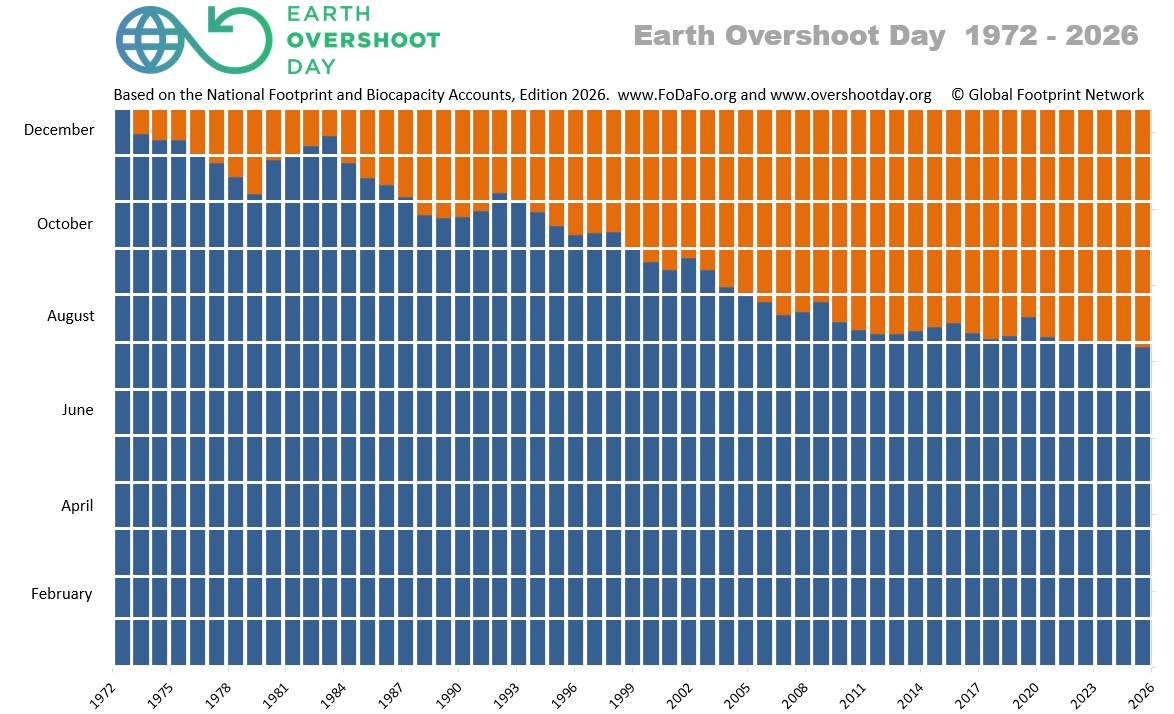
Earth Overshoot Day - when humanity starts to use more than our planet can renew
Overshoot occurs when humanity's demand on nature exceeds Earth's biocapacity. In 2026, Earth Overshoot Day fell on July 30th.
Earth Overshoot Day
133 points · by ciconia · 4y ago · 173 comments
The Haber process and modern agriculture feed us all, and cheaply. We get five times more milk per cow and eight times more corn per acre than we did a century ago. We synthesize fertilizer out of thin air instead of scraping bird shit off of remote islands.
On top of that, human fertility rates have dropped far, far below replacement in substantial parts of the world, and when the developing world is developed, I suspect they also will see declining population. Each person needs slightly more than one child for us to have a stable population. So, a fertility rate of ~2.1 (2 children per woman). In the US it's 1.7, in Germany it's 1.54, in Japan it's 1.36, and in Korea it's 0.94. China: 1.7, Brazil: 1.72, India: 2.2 (just above replacement, and dropping)
We can outsmart, and have repeatedly outsmarted, all sorts of potential disasters.
We can't ignore our problems, but neither have we met with any sort of defeat.
Defeat against whom? Is human race at war with someone?
Earth overshoot day isn't about survival of human race, it's about human being in balance with Earth. Countless species are extinct because of us. Is this victory?
All the other animals want our food. Many of them want our flesh. Plant viruses destroy our crops. Locusts will starve human children to death. We are absolutely at war.
A trillion parasites want our blood: hookworms, ticks, mosquitoes, you name it.
We destroyed smallpox for ourselves, but we also eradicated rinderpest to the benefit of a great many large animals (deer, giraffes, goats, cows, etc). We never started a Save the Hookworm campaign for good reason. We will wipe those fuckers out eventually.
We don't even have to worry about our children being eaten by wolves in most forests now... because we killed most of the wolves. A fairy tale ending.
So yeah, we're at war and always will be. Let's kill HIV next.
Ecosystems are not "at war" with us. Parts of it are beneficial to us, parts of it are not. We cannot simply exterminate the parts we don't like because they are all intertwined. Of course, it doesn't mean that we should breed hookworms within us and spread HIV for the sake of it, but treating it as a war is a bit ignorant of how ecosystems work.
So do all the other people. It is a very dangerous ideology that is willing to justify any action on the notion of increased survival.
There is this nonsense idea that the earth would be fine if humans didn’t come along. It wouldn’t. This planet is in its death throes. Life has delicately established itself in a habitable zone that is coming to an end. The carbon cycle has a good 800M years left before photosynthesis starts grinding to a halt. That might seem like a long time, but life’s been here for a good 4B years - we are 75% through life on earth. It’s taken evolution 4B years to print its first ticket off this rock: humans. That it’ll print another in 800M years is a poor bet.
The idea of saving life on this planet by curbing human progress is a fools errand. You save life on this planet by bringing it with you when you leave this rock.
I have never meant anyone who's concerned about Earth's ability to perpetuate its ecosystems in 800 million years. People are concerned about its ability to (comfortably) support human life 20, 200, or (maybe) 2000 years from now.
It seems as if you're trying to imply that industrial humanity hasn't had a uniquely destructive impact on the natural environment over the past two centuries.
I don't feel completely safe in ruling out cephalopods in that regard. That said, life on dry land would seem to be a precursor to scientific advancement such as chemistry.
What?
Unfortunately, the main one we can't outsmart is volcanic winter, which has produced planet-wide famines on several occasions, and is all but certain to happen again.
Geologically speaking, the 20th century was pretty quiet. In the 21st century we've already had two tsunamis (including the 2nd or 3rd biggest earthquake), and the Tonga volcanic eruption, which was fortunately below sea level, but still likely the second loudest noise in human history after Krakatoa, and Eyjafjallajökull which had the potential for volcanic smog but fortunately didn't happen.
We're overdue a Cascadia mega-thrust earthquake which would have "interesting" repercussions for the tech industry, given how much of it is based on the US west coast.
I agree with your point though, we've largely progressed through normal seasonal issues with crops, and dramatically improved yields via science.
And yet, here we are still.
https://en.wikipedia.org/wiki/Great_Famine_of_1315%E2%80%931...
I suspect you are right.
What is less clear is whether earth has the resources to sustain the standard of living rising in these developing nations.
There is currently 1.2 billion people living in developed countries and 5.4 billion in developing countries. Even if the developing populations stabilise, if their standard of living increases to match that of the 1.2 billion developed population, will our natural resources and environmental systems cope?
If not, we need to work on ways to maintain a developed world standard of living without using nearly as many natural resources.
We are sitting on a big ball of matter, so at long as we have the energy, we can make all the gadget we need. (You can even make food underground in multiple levels, if you have enough energy to burn on lighting.)
So the real problem is energy. Luckily, renewable are currently getting a lot cheaper. And we also still have nuclear, if we really want to go that route. Fission works, and fusion is in the works.
I mean there was already alarm bells from UNESCO today or yesterday that the food program is at risk due to rising food costs due to the conflict in Ukraine and sanctions on Russia, which in turn puts a lot of people that depend on that food program at risk.
And it's closer to home as well; the amount of people that start to rely on food banks has gone up sharply with the high inflation.
I mean it's dumb IMO; while all companies are eager to raise prices with inflation as soon as it happens, wages lag behind.
It could also translate into an increased rate of extraction/depletion of natural resources, as the economic incentive grows stronger.
It ultimately needs to reach an equilibrium where a developed nation lifestyle for the entire world population would only consume natural resources at the rate that they can be replenished.
Sometimes it was just mankind surviving as a species though. Humans as a whole are probably hard to kill. But that says nothing about one of the defining traits of mankind: Their ability to form advanced cultures and civilizations. The survival rate of these cultures is abysmal and there is no reason to be believe, the current culture with its incredible high standard of living for as many people as ever before, will not fail. I blame Hollywood and their stories about the eternally advancing human race for this fallacy.
Sure humans will likely survive a great many catastrophes but they might find themselves again in an agrarian society and in far fewer numbers.
> We can't ignore our problems, but neither have we met with any sort of defeat.
Yet.
The problem is that the developed world needs too many resources per capita. The developing world will have similar issues when it reaches a standard of living where they start declining. Also this decline is too slow and too far out to matter. We need to effectively at least halve global resource usage in the next 1 or 2 decades. Waiting until the developing world stops growing in 30 years is not a solution.
While this is my general take on these kinds of things as well, it's good to keep in mind that it takes just one outlier disaster to never be able to outsmart anything ever again, and perhaps it's just dumb luck that we're in a timeline where that didn't happen so far.
Apparently the volcanic winter of 536 lowered global temperatures by around 2.5C, which puts global warming in a worrying light, though.
When does it become advisable to start ignoring the people saying "don't worry, it's not too late, we'll figure it out"? While this may still be true, it's a great way to rationalize putting off the massive social, psychological, legal and technical changes we desperately need.
We are so smart it took us two hundred years to realise we are creating a disaster ourselves, and we still can't figure out how to stop it. Because we are so smart we keep outsmarting ourselves. Or our greed does, I'm not sure.
(with tongue very slightly in cheek)
If we continue down this path, were going to run against a wall
This [1] article explains some of my frustrations, but doesn't address everything mentioned on the Overshoot website.
[1]: https://noahpinion.substack.com/p/people-are-realizing-that-...
This is proposing that people are lacking faith. You believe something must work because an economic theory proposed that it does. In reality these theories often fail to predict anything substantial.
Our economic system is very primitive and requires steady growth. But in reality the productivity of a finite area of land cannot grow any further even with technological advancement and long before you hit the limits of thermodynamics. The only thing that can grow in an unlimited fashion are excuses by economists to be honest.
Sorry, perhaps I just don't have the growth mindset.
Not proposing that the end is nigh, but bullshit has to be called what it is in the interest of progress.
Ehrlich might have been way too early but still have something interesting to say.
If you haven't, I would suggest "The Limits to Growth." I'm not arguing for "de-growth," but I think your fundamental assumption that we can innovate or Silicon Valley our way out of climate change without inadvertently sacrificing economic prosperity is too late and highly naive. https://www.amazon.com/Limits-Growth-Donella-H-Meadows/dp/19...
Not quite convinced about that. That, or the solutions you read aren't up to par with what science has to say about it. For starters not all presented solutions are even about degrowth?
Just one example, take land use: the last talk I heard about that be a professor from a local university, people aren't exactly advocating 'less growth, less land use' but more like 'we expect synthetic meat to be x% of food intake so there's y% less land needed for animals and if all of that would be taken up by the produce needed for the synthetic meat that is actually i% more protein produced/acre' and 'x% of nice fertile land is going to degrade within the next decades because of erosion so if we implement some relatively simple measures that can be countered' and 'instead of dividing land into massive fields for production and some small dots of nature in between, as far as preservation goes it is often actually better to not do that but create one area for nature as large as those dots and optionally but even more optimal create lines of nature to connect those bigger patches'.
Sounds economically viable to me, or at least certainly not 'extremely illiterate', and also not impossible.
I think what the site is saying is we depend on ecological systems and natural resources to sustain our current standard of living, but we are consuming them at a faster rate than they can replenish. We need to use the available resources more efficiently - doesn't necessarily translate to less or even slower growth though.
I think I agree with the author about degrowth as a goal being a political nonstarter. But I'm pretty skeptical about the notion that future growth can consist of ever increasing amounts of "dematerialized" goods and services without ceasing to be real, meaningful growth (however it might be defined).
I also think the political and physical challenges inherent in technological or "pro-growth" (I need a better word) solutions for getting out of overshoot are widely underappreciated. This [1] article runs some numbers to show that, for our global civilization to satisfy its current level of energy consumption without emitting significant amounts of greenhouse gases in 2050, we will have to bring online clean energy generation capacity equivalent to one nuclear power station every day between now and then. Given that, I'd be extremely surprised to see us get there by 2150, or maybe at all.
[1]: https://www.forbes.com/sites/rogerpielke/2019/09/30/net-zero...
https://en.m.wikipedia.org/wiki/Citizens_Convention_for_Clim...
Also economy is just numbers going up and down, it's not real. You just need to change some variables of what makes economic growth if you want your numbers keep going up in gdp. Earth overshoot is not as flexible, we don't make the rules.
This fixation on growing every single year hurts prospects to grow more over longer periods of time. It also causes needless environmental destruction. We would rather deplete the soil for a quick buck than maintain it and make it better every year at the cost of lower initial yields.
economics is a psuedoscience like all social sciences and astrology. They've predicted absolutely nothing of value. It's just people studying these things prior to them becoming scientific, like people did with alchemy and whatnot before chemistry.
Unless you're referring to the obvious horrific cost to human lives, war isn't "expensive" in any real sense in terms of national finance. War is profitable: any money "spent" goes somewhere. Many wars have lifted countries from recession.
The only slight argument one could make for the expense of war is military consumption of fossil fuels (but we're already talking about control of that resource, so that's self-fulfilling).
Sure, if you simplify things enough you could argue that all wars are about resource interdependence because attacking someone for cutting you off from resources or for withholding your resources is also "about resource interdependence" and even civil wars are ultimately about unequal access to resources. But at that point you could say a peasant revolt is about "resource interdependence" because the lords own the land and the peasants provide them the food.
I don't think "resource interdependence" is the right framing. Colonialism was essentially "resource interdependence" but that is clearly a different dynamic than e.g. the European Economic Area (or EFTA).
Realistically, it's probably more about a mix of defensive pacts (essentially military MAD), economic interdependence (essentially economic MAD) and a somewhat level power dynamic (limiting the potential for exploitation).
I guess we will have to unwind back to definitions because afaict, Colonialism was about domination of a people to extract their resources, by using the people as a disposable resource. I don't think the people being dominated depend(ed) on the colonisers.
> Most wars involve resource control. That doesn't mean most wars are about capturing resources.
What's the difference beyond technicalities? Resource control -vs- resource capture, both are issues of resource interdependence. External resource control isn't a priority in a system of resource independence.
The idea was to make the idea of going to war unthinkable because we relied on each other, and it's quite easily to calculate the deficit in deaths in Europe after that.
There are statistics saying it was extremely effective; Even when you account for Russian conflict against the Chechen's and the Serbian/Albanian conflict in Kosovo..
https://www.statista.com/chart/15458/the-estimated-number-of...
Seeing what the likes of Gerhard Schröder is doing and given other economic incentives that favoured Germany I don't think that was the main idea behind it.
That's at best a nice side-effect, if it actually works.
Nah, the main reason is that specialisation and trade is just so much more efficient. You get more from less.
Hardly. It just hadn't on gone long enough and far enough. I'd say that the entire cause of the war is just that- that the interests of the two sets of elites didn't line up yet. They eventually would have because ownership would have become much more distributed as always happens as a result of neoliberalism.
She did a very nice job changing my mind about nuclear power: [1]
[0]: https://backreaction.blogspot.com/p/about.html
[1]: https://backreaction.blogspot.com/2022/04/is-nuclear-power-g...
While we currently use about ~50% of habitable land for food production, if we all adopted the diet in Bangladesh we would only need about 14%. If we all had the diet as in New Zealand we would need 190%. The dutch fall at 100% in the data that they published: https://ourworldindata.org/agricultural-land-by-global-diets
Not exactly the 3.6 worlds listed in the link above, but diet is only one small part...
My transportation is at 0.2.
Same thing with me living alone in an apartment caused my shelter score to grow to 0.7 from 0.4 if I was to claim that two people shared this apartment. Which kind of makes sense, many people living alone generally means more buildings have to be built and more energy be used to heat/cool and light them, and land have to be used to build them on.
We are sitting on a huge ball of matter, and even consumption typically does not destroy any matter nor loses any to the void of space.
(The sun is a great source of energy. We also have nuclear fission and fusion, otherwise.)
Yeah if you scale back to the universe nothing ever changes and nothing matters at all.
If you start looking at air/soil/water pollution (which is only a fraction of our problems) it's clear that our ways of life are far from ideal. But sure, the atoms are still all there, I don't think that's the part that matters tho
Humans have eliminated anything even close to being their predator at any significant scale, except our own behaviour. As a result, we run the risk of exhausting our own food (read: resource) supply.
I'm assuming you include 'disease' as a predator (i.e. viral/bacterial/microscopic actors).
Oh, well, no risk of that predator disappearing anytime soon, then...
I've heard this metric before and I find it believable but I'm curious of how it is calculated and what assumptions it's based on.
So a bit under 5.1 earthes.
Although interestingly because the USA are a large, sparse, and resource-rich country, it doesn’t live that much beyond its own means ecologically: 2.4 USA would be enough to fulfill its needs, whereas (per the above) the netherlands being a dense and resource-poor country it would need a bit more than 7 of itself.
And further, it brings up interesting moral questions touching on eco-justified anti-natalism. Would it be morally justified to have a hundred kids?
EDIT: I largely take back the first paragraph, but I'll leave it for posterity. Helping girls to create a career for themselves probably has a larger impact on population growth. The anti-natalism thing is still interesting though.
Reading general comments on the web about the likes of the UK only have a tiny part to play and it being 'almost pointless' to combat climate change and conservation (vs larger population countries) seem to forget we've been industrialised and polluting for a quarter of a millenia. On the same token, the technology acquired over that time can solve the problem.
Overshoot day is a good reminder that we're still living above our means.
We instead need to get sustainable holistically and need technological advancements and policy changes. It doesn't matter much if we are 6 or 8 billion (currently) or 11 billion (UN forecast for 2100) people on the planet if the smaller number already overshoots resources x-times.
But it does matter, because the world won't end on 2100, the world healing from current damage will take several centuries at minimum, the less damage that is done to the ecosphere during this period of heavy growth will help the recovery and healing process on the upcoming centuries
If you achieve these metrics while aiming to set up a renewables vertical, then you can overshoot and more easily at least metrics wise control co2 production
[divider line_type=”No Line” custom_height=”40″][nectar_btn size=”jumbo” button_style=”regular” button_color_2=”Accent-Color” icon_family=”none” url=”https://www.overshootday.org/newsroom/webinar-dutch-overshoo... text=”DUTCH OVERSHOOT DAY WEBINAR” css_animation=”bounce” margin_left=”40″]
What’s the deal?
The truth is that, once resources become scarce, various optimization mechanisms kick in. For example, Israel produces a lot of food in the desert thanks to various water usage optimization techniques.
Human civilization uses a tiny percentage of the total energy delivered to Earth. This again is tiny percentage of power generated by Sun. There are abundant resources all around us that we simply need to learn how to effectively utilise. This is not sci-fi stuff, these are "merely" engineering problems.
The challenge is to get to that "post-scarcity" (or whatever you call it) future sustainably, without killing ourselves or making Earth a toxic hellhole. This requires cooperation, but you won't get that by going around and claiming falsehoods or persuading people with fallacies.
I think the "we simply" is the least simple part of it all. We act as if everything is just a matter of time and engineering, but nothing assures that, and even if it does we're still running against time. This isn't a CIV game, we don't know if these hypothetical saving techs will ever exists.
It's pretty much all sci fi for now, and without intent it will still be sci fi. There is no law of the universe that guarantees what we call "progress" actually makes us move towards a better future. You can call it "tech progress", "engineering progress", "discoveries", the wording doesn't matter. Lead paint was progress, freon was progress, gas powered vehicles was progress, &c. Anything that's new is called progress and only decades later we can really assess what was beneficial or not. (cue electric personal vehicles)
In French we have an idiom: "fuite en avant"; "Not facing one's problems, running away from one's problems without solving them, or continuing a problematic action without considering its future consequences" and I feel like it can be applied to tech very easily, especially when the main technocrats argument is "we'll do more of X, Y, Z and eventually we'll find a solution"
It's just an easy to understand illustration of how our current civilization is largely resting on unsustainable foundations. Finding solutions to the engineering and societal challenges that you mention seems to be the goal of the project.
I can definitely get behind some of the solutions they propose! But it is important to give a truthful rationale for these. Otherwise this is a slippery slope, like lying to your children about medicine because they will get better if they take it.
I stand by my assertion that the methodology they picked ("pick a subset of civilization, make a prediction as if everything was it") is fallacious. Imagine a sustainable, closed-loop civilization, satisfying all the goals you can dream of. It is inevitable that not every part of the system will be balanced when looked at in isolation. If you are allowed to cherry-pick a subset of that civilization and scale it arbitrarily, you are guaranteed to arrive at the same unreasonable conclusion as they give us.
To make it less abstract, let us consider nature itself. There are siberian tigers which eat 9 kg of food a day. This is a lot! If every animal were to eat that much, all animals would quickly starve. Clearly, nature is not sustainable!
Why so?
Life needs energy, we can harness energy better to produce engineered food and desalt water.