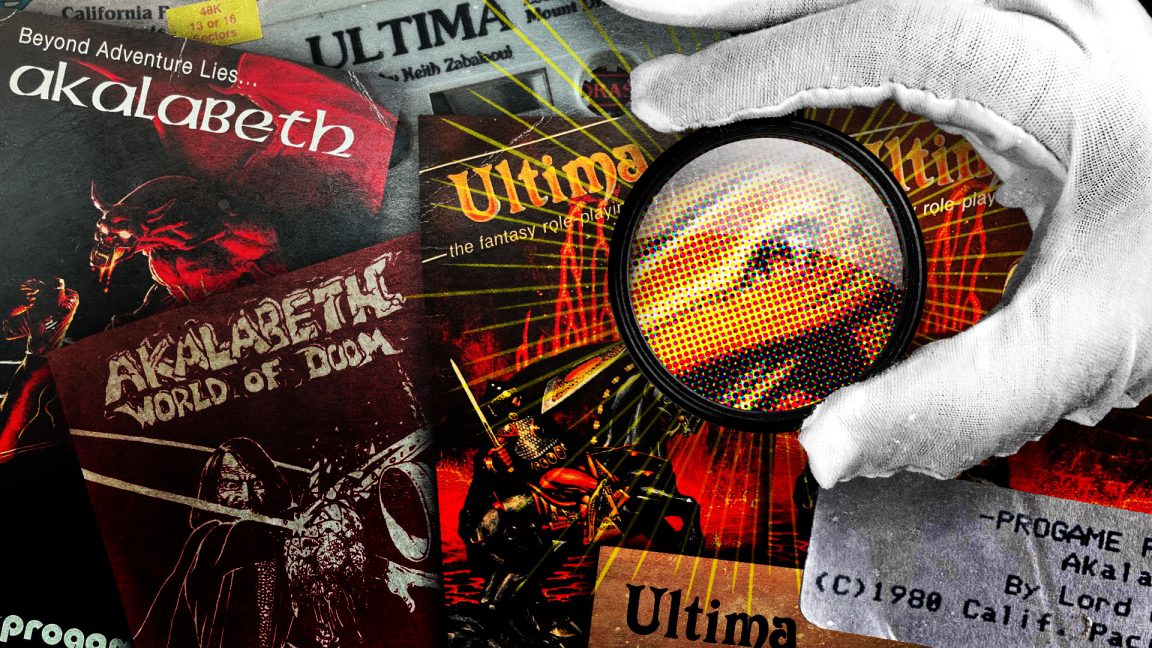
Inside the $100K+ forgery scandal that’s roiling PC game collecting
From Akalabeth to Xenobia, many rare PC titles are now considered elaborate scams.
Ars Technica
153 points · by DeadNeurons · 4y ago · 166 comments
About 5 years ago I was moving house and just got rid of everything because I was tired of moving it. I started regretting it 6 months later and even more today.
I've got two big boxes and when I move to another country, these come with me. We've already done three countries together. The Atari 600 XL and the Commodore 128 were still working during the first lockdown (I was stuck at home and took the time to test them).
Once in a rare while I boot the non-modded, time capsule, C128 of my teenage years and launch the game Commando just to hear the song on the SID chip.
I take it they still bring me some joy!
but yes, I'm found of it as it was my first computer and grew up on munch-man and parsec (amongst other things)
Ok, yes, I’m still jealous that everybody else had a //e. I also had the early Amiga 2000 with the bad ROM revision, the base model NextStation, and I don’t even want to talk about my non-turbo Porsche 944.
They tossed the floppies about 5 years back, and that’s probably what I would have wanted to save. Custom lode runner levels. That ultimate Iv saved game. The disks and disks of AppleWorks docs.
While it still hurts and emulators are a different beast, it freed me. I filled the hole with doing modern stuff, like learning JavaScript back then.
While I regret getting rid of my beloved hardware, I never regret the decision to move forward.
With small insular communities like this, I wonder how often people end up making counterfeits they never intend to sell. Maybe you're having a dry streak or you've been swearing up and down you'll something, and you tell yourself there won't be any harm in making a fake and telling the guys you got it. Before the recent value explosion in the market there wouldn't be much value in it - but people like their hobbies and like to boast and it seems very normal.
There are lots of legitimate reasons to come out of this kind of experience feeling like you don't want to have anything to do with the scene - but also it could be that what was intended as a private forgery has gotten out of control.
But I can never do this, because I could never feel certain that I didn't purchase a forgery
Ignorance is bliss."
- Cypher, The Matrix
IIRC in the last matrix movie there were humans that picked matrix over zion (might be wrong, it was such a firgettable movie)
It's a rewarding experience to ask "what's in that rock?" to discover it's invertebrates from millions of years ago!
a lot of people are confused, and seem to think that purporting to share an interest makes a community.
they're disappointed time and time again.
I have purchased duplicates of instruments for parts or preservation though.
It turns out the violin he performs on was made by a young violin maker called Richard Howard, but never assembled by him: he was drafted for WW1, and died in 1917 at the battle of Messines.
I think that's the kind of history that matters, that adds a certain context to the music. To everyone in this thread saying the history of a thing doesn't matter: if something like that doesn't matter, what does?
The FBI estimates 70 percent of all autographed sports memorabilia are frauds.
https://www.amazon.com/Billionaires-Vinegar-Mystery-Worlds-E...
Probably, still seems like quite a bit of work to get even this level.
Get super rare game for $10k, make as perfect a copy of it as you can, sell the copy for $10k, keep the original, even if privately.
But if you're doing that, you wouldn't need to make disks containing obvious fakes.
In the guitar world it's a running joke that only 5000 of the the 1500 1959 Gibson Les Paul's survive.
($$$$, 6 digit prices for real ones is the rule, and top examples go for $500k+).
Especially records from the legendary Harthouse label, seems to be ubiquitously available. Harthouse was famous for its limited edition policy and restricted selling of its records. They were very selective and that's how the famous "sound of Frankfurt" was born: access to Harthouse records was limited, and distribution took mainly place here in Frankfurt. It was tough back then to buy certain records even in the famous Delirium store.
Nowadays you simply place an order in the Internets...
In between comes the Protestant Reformation, more than a century of religious wars across all of Europe where one side in many cases actively sought to destroy relics and the gradual conversion to Islam of many densely populated Christian areas.
A catalogue from the 1870 is next to worthless for telling us how many relics existed in the early 1500s.
https://en.wikipedia.org/wiki/Holy_Nail
That said, I'd like to know the carbon date on those wooden fragments.
'Master!' I said, shocked.
'So it is, Adso. And there are ever richer treasuries. Some time ago, in the cathedral of Cologne, I saw the skull of John the Baptist at the age of twelve.'
'Really?' I exclaimed, amazed. Then, siezed by doubt, I added, 'But the Baptist was executed at a more advanced age!'
'The other skull must be in another treasury,' William said, with a grave face. I never understood when he was jesting.” ― Umberto Eco, The Name of the Rose
Frankly though, I consider authenticity overrated.
https://www.youtube.com/watch?v=EPY9Mxg3OJQ
Long story short, go for the $700-$2k guitar unless you're an "art collector" that will never play it.
Then again, I doubt many people can tell the difference between a $200 guitar and a $700 one.
Once you get past a certain price, you're paying more for different (e.g. custom build) rather than better.
I'm a weirdo in that I generally like modern (even ultramodern, I own a Strandberg) - guitars for playability - thinner necks, comfort contours, that sort of thing, but vintage for tone...so I have a couple I've commissioned that try to combine the best of both worlds.
Here are two of mine: https://i.imgur.com/pVQiOfC.jpeg
They both look like weird, but both have vintage roots...
The one on the left is heavily inspired by vintage Gibsons in the ways that mattger... neck and body are korina, the top (very not vintage) is flamed Hawaiian Koa.
The one on the right is basically my take on a Fender Strat... but headless (better weight distribution, and allows for the..) and with an excellent modern tremolo bridge.
Then I saved up and got an American Fender Jazzmaster that's a recreation of one of the 60s models (cost around $2k used), and I can easily play that for 3-4 hours at a time without straining my hands. Everything just feels nicer in your hands because of the wood quality and you play better since it's more ergonomical.
I agree that you probably can't hear the difference between a Squire and a Fender unless you are really familiar with how guitars and the pickup electronics work and have really good musical hearing, however I'd say in general the cutoff for a good sounding guitar (that's almost indistinguishable from something in the $750 to $2k range) is around $400. Anything less than that and the quality of materials and wiring will probably be bad enough to be noticeable, or things will wear out sooner rather than later (and poor ergonomics can keep you from playing at your full potential).
There are exceptions to that though, I have a cheapo Washburn fretless bass that plays and sounds great, and I think I got it used for around $100.
Then above the low 4 figures you're getting diminishing returns and/or just getting a collectible instead of something you intend to actually make music with.
My favorite story along those lines was when I got paid $300 to own an exotic bass for a decade.
The bass in question: An Alembic 6 string fretless. Original retail price in 1991: $6800 ($14.4k inflation adjusted).
My local small town music store took it in on trade...tagged it at around $2500 or so... it proceeded to sit on the wall for the next 3 or 4 years. Owner of the store was a quirky older dude who doesn't do internet sales at all.
So, finally, I catch the owner in a good mood one day and say look - I'm the only guy with weird enough tastes in this town to ever buy that...but I can't afford it at that price. I'll give $1000 in cash, today.
...and he took it.
That was, if memory serves, about 2003.
Had a bit of cash crunch when I was laid off for about 6 months circa 2012 or so, and put up a few of my instruments at a high end consignment shop (but in a big city, with an actual instrument market). Even aftger their cut I ended up with about $1,350.
A $200 strat will never be in tune, the tuning pegs will all have weird amounts of varying resistance, the bridge might rattle, you probably need a fret leveling right out of the box unless you're ok with either a crazy high action or nasty fret buzz, and so on. Oh and it sounds pretty terrible relative to something with decent pups in a decent amp.
Personally the sweet spot of cheap guitars is more like $500 with inflation these days. The expensive stuff from China and cheap stuff from Korea is great. Those are giggable, serviceable guitars. In the $1k range for cheap American, expensive Korean, or Mexican or Japanese guitars you're paying for quality control. One model will play and sound like the others.
My Yamaha FG800 cost $200 and is probably 70-80% as good as my Martin that cost $1300.
There is even less of a difference between cheap and expensive electric guitars. Especially if you learn to do a good setup yourself and replace the pickups.
Just about every cheap electric I've ever seen has shitty pots, bad or no shielding, maybe even bad grounding.
Hum sucks.
Back in the day my old man parted ways with a 60s Tele - he doesn't appreciate being reminded about it
I don't understand I don't understand paying a premium for a rare or old item that is easily replicated. The same goes for art forgeries. Why not buy a reproduction? There is no difference in the functional value of the item before and after this revelation. I assume these games are available for emulation. I'm sick of people bsing and scamming each other by turning fun things into investment vehicles.
Collecting antique crap falls in to that type of category, I think, no matter how much people try to gussy-up the behavior.
Edit, to add: there seems to be something more attractive about truly old things vs copies, just like certain petals are more enchanting to a Bower Bird. Why this is such a strong impulse I have no idea.
The value of history is the story, which doesn't need to be attached to the object.
I think the NFT space just provides transparency into the size of the existing collectibles market.
Even the proxies we have for digital gaming stuff is just buried deep in quarterly reports of a few publicly traded companies.
Most of the facepalm worthy NFT headlines would be non-news if we even had the ability to compare it to the pre-existing collections market.
a relic in the right hands is both a time machine, and a constant reminder, via all our senses, of our fleeting existence, and of what we can do in that brief time, and what we can leave behind
it's also why I like old-growth forests, which don't really require purchase
buying something mass-produced last month doesn't give the same sort of visceral, emotional connection
That's why Amazon.com counterfeits are bad.
But this risk doesn't really apply to video game boxes.
Yes. How could you not?
My loved one died. If there was perfect replica of her somewhere ready to spin up how could I not consider her equivalent to original person?
Everyone would do this unless you believed in the intrinsic nature of soul
Humans are the sum of their lived experiences and epigenetics, so if you could replicate both, to you as an observer what would be the difference?
Every time your loved one respirates, ingests food, and defecates, a portion of their body is replaced. The material person you know now may be completely different from the person you fell in love with.
Part of it, of course, can be the "I couldn't get this when I was young, now I can" which drives up a lot of prices on old Lego sets, but there's more to it than just that, especially when collectors start buying items because they're rare, not because they once had them or wanted them.
Why would you want to do that? That horse is tired, that cow is milked, give it a rest.
But hey, I had David Gerrold's War Against the Chtorr for training wheels ;-)
That being said, I understand in principle that there's an extra emotion & joy to be had with something possessing one of those attributes. Perhaps I'd enjoy a book signed by Arthur C. Clarke or guitar used by Mark Knopfler - though I'd make a point to read/play them rather than hide and never touch. On any given day, I have higher priorities for my money. Others with more money or different priorities, however, will make different choices.
(This simplistic framework is complicated by the notion of "Value" of course; some people believe, or tell themselves, that this is an "Investment"; like many things, this then becomes a abstract tower built on mutual belief, and people become invested [har] in believing ever so strongly. This can lead to interesting conversations unless & until you realize you have different axiomatic principles / beliefs / value perception).
Unless you're pretty good at playing, you won't notice though
> 'All afternoon assorted officials examined the alternatives,' Mr. Tagomi said. 'This is most authentic of dying old U.S. culture, a rare retained artifact carrying flavor of bygone halcyon day.'
> Mr. Baynes opened the box. In it lay a Mickey Mouse wristwatch on a pad of black velvet.
> Was Mr. Tagomi playing a joke on him? He raised his eyes, saw Mr. Tagomi's tense, concerned face. No, it was not a joke. 'Thank you very much,' Baynes said. 'This is indeed incredible.'
> 'Only few, perhaps ten, authentic 1938 Mickey Mouse watches in all world today,' Mr. Tagomi said, studying him, drinking in his reaction, his appreciation. 'No collector known to me has one, sir.'
Of course in his story something else is happening too:
> In fact, as far as he knew, it had never occurred to them to ask themselves if the so-called historic art objects for sale in West Coast shops were genuine. Perhaps someday they would . . . and then the bubble would burst, the market would collapse even for the authentic pieces. A Gresham's Law: the fakes would undermine the value of the real. And that no doubt was the motive for the failure to investigate; after all, everyone was happy. The factories, here and there in the various cities, which turned out the-pieces, they made their profits. The wholesalers passed them on, and the dealers displayed and advertised them. The collectors shelled out their money and carried their purchases happily home, to impress their associates, friends, and mistresses.
Historical artifacts are not valued for their functionality. It is for the associated historical relevance. Many have more value even when their current functionality is worse than a replica.
If replicas and copies of the thing make you happy, do that, other people do see value in originals, that's ok too.
I once worked at the library of a university. Part of my job was to check the catalogue against the actual bookshelves to make sure the books are physically present.
So I got to social science section. In particular the Communist Manifesto by Karl Marx.
Now this is an national university with >170 years of history. The spreadsheet in my hand showed that there should be 9 copies of the 1908 edition on the shelf.
I found none.
Every copy has been stolen. The irony of this is just too much. Communism supporters stealing from the general public to satisfy their personal desire of collection.
Aside. A regret I have was not checking out 'The Hitler Youth' at the same time. Although I suspect the university might have removed them from the shelves.
Why do vintage PC game collectors care whether the product in their hand was manufactured in 1995 by the original company or in 2021 by someone in their garage?
Is the goal to play the game or to acquire bragging rights about an old object just because it's an original copy?
To draw an analogy, if I was a collector of vinyl records and I purchased a first edition album that actually turned out to be a poorly reproduced print made from modern MP3 files, with a label that was printed by some dude's inkjet printer at home, I would be furious.
I don't really buy that for functional objects. I've restored old Teletype machines, some almost a century old, and provenance is not a big issue. In fact, because of the way they were maintained, many are not an original set. There are four main components of a Model 15, keyboard, typing unit, base, and motor. All are field-replaceable, and the first two are easily swappable without tools. Maintenance was often a swap, not field repair. The units went back to a repair depot, were repaired, cleaned, and oiled, and then went to another rental customer. Retired machines rarely have the original subunit combo, and nobody cares.
It's just not the same.
But it's normal for most people to think collectors of certain items are silly. I used to collect books, and most people think it's utterly stupid to obtain books and only read copies of them rather than the original (opening a binding causes it to deteriorate a little bit).
To you.
99% of 20 y.o. games aren't compatible with anything newer than a 2010's hardware and for 30 year old games you can't even copy/try to run them on anything modern - floppies died ~2010.
20 y.o. video games are roughly equivalent of Late modern period art.
30 y.o. video games are somewhere between the classical antiquity and the Middle ages.
40 y.o. are closer to Egyptian Pyramids.
The content on the disks are cracked copies that contain missing or modified data and are not the original game.
If you wanted to just play it you'd just play it in an emulator.
I will point out that the history of video games is not that old in itself, meaning a several decade old game is falling into the "one of the first games made" vintage tier.
There are definitely some collectors who do play the games so this is not a universal statement.
Also, the packaging apparently wasn't identical. It was hand-cut at least some of the time and imperfect.
[0]: https://www.theatlantic.com/culture/archive/2013/12/most-ame...