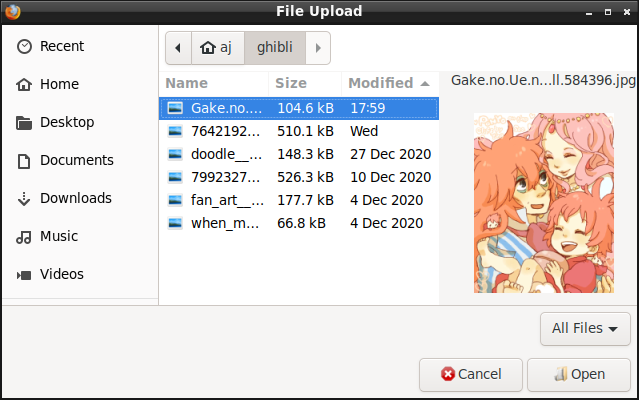
GNOME has no thumbnails in the file picker (and my toilets are blocked)
GNOME filepicker and my toilets are broken because of culture of mediocrity.
jayfax.neocities.org
365 points · by weberer · 4y ago · 290 comments
As of right now if you File->Open in any program using modern Gtk3 and try to paste a file path in you'll get an error instead of pasting your filepath in a text field to open, "The folder contents could not be displayed\nOperation not supported" http://erewhon.superkuh.com/gtkfilechooserwidget-paste-fail....
It's unfixable behavior because the GNOME devs stopped respecting their own gsettings, org.gtk.Settings.FileChooser location-mode, to FORCE the path-bar experience on everyone. Because no one needs to type file paths, apparently. So why bother respecting the settings for path-bar or filename-entry? Their demographic doesn't care. Unfortunately gtk3 is used by far more than GNOME's demographic.
They have fixed this bug in gtk4, for all the good that does.
That's happening! Gtk 3 and 4 include GtkFileChooserNative[1]. It works like a file dialog except the application doesn't know about its widgets. That means it can proxy another application.
So if you're running a Gtk app in a sandbox like Flatpak or Snap, Gtk will use the Xdg file chooser portal[2]. In GNOME, this is implemented by an application (in the host) which, itself, creates a GtkFileChooser. In the future, it could be a beefier application. One benefit of that taking a while to happen is, once the implementation gets fancier, there won't be too many weird mismatched applications.
(Also, I mention GNOME, but it's important to notice the file chooser portal is itself platform neutral; KDE apps use this, too, and the implementation depends on what desktop you are running. Yay, decoupling!).
Not everything uses GtkFileChooserNative, but pretty much any recent Gtk app that doesn't have weird requirements probably does. Off the top of my head, Firefox, Secrets, Bottles, GNOME Builder and GNOME Text Editor (although they still ask for access to all of the of the files for other reasons), … even Slack and VS Code! (Electron switched over recently).
[1] https://docs.gtk.org/gtk4/class.FileChooserNative.html
[2] https://flatpak.github.io/xdg-desktop-portal/#gdbus-org.free...
That bundling file chooser with a GUI framework is a bad idea should be obvious since well, ... Java Swing?.
And a easy to use system interface for a file chooser isn't hard to make, could have been (preferable) a binary you call and communicate with pipes with or similar or could have been something else (e.g. shared object).
It's kinda sad that the various Linux communities where so focused on their GUI framework being the best that it didn't happen until it was technically needed (for sandboxing) ...
EDIT just to be clear 95+% of applications could use a cmd with Linux style arguments which once done emits the selected file(s) to stdout, but there are a minority of advanced use-cases which require a bit of two way communication. Through most of them are bad ideas anyway, so maybe that could have been ignored.
Why though? Am I the only one that hates modal windows? Why does the parent window have to be blocked by the dialog window? Can't it be like the color picker dialog in GIMP?
Wayland might be more difficult since it likes to isolate processes more but considering this should have been common before Wayland was designed it could and should have influenced that design.
I really wish we had another popular GUI toolkit that isn't Qt.
Control + L will turn the path bar into a simple string w/ autocomplete. Am I missing something here or are you talking about pasting a path into the filename portion of the dialog?
i only need a terminal, emacs, browser, thunderbird, the occasional screenshot and it was still horrific.
to be clear it was only the usability that was a nightmare. i experienced no bugs. it's solid. but wow it is unusable.
please, please, please someone at gnome headquarters ... can you make it usable? look at win10, win11, macos, kde, chromeos they all work fine. can't you do something like that? i believe you have the best software stack out there, and you're throwing it away with that frightful design.
this is tragic.
I know lots of people don't like Macs because they're not super tweakable, and that's fine. It's still my impression that Gnome is aiming for that target, while not quite understanding why a lot of people do like Macs.
and you're right. macos is fine from a usability point of view. everything in gnome UI feels like they started strong, stayed strong, and then gave up half way ... (so many examples there's no point listing them anymore) and yeah put the clock in the middle of the bar while we're at it too.
and yet, you feel the potential no? no bugs whatsoever for me.
:/
back to xfce4. clunky, but consistent. some bugs. it's ok.
I simply do not understand people.
The only thing that makes GNOME bearable for me are a handful of extensions and post-install tweaks. Specifically Dash-to-Panel and ArcMenu.
The biggest thing that still annoys me is the GNOME folks have this fetish about stuffing as many widgets as they can into the titlebars of windows.
For very basic desktop usage, GNOME 3 does about 65% of what I need. Because it's Linux, I can have TTYs that run KDE, i3, or more customized shells that accomplish the rest.
Not doing this would be an exercise in learned helplessness, which is exactly what I chose Linux to get away from.
1. spin up a new file picker: GTKFilePicker.c
2. add a deprecation warning to gtkfilechooserwidget.c
3. wait 20 years, then git rm gtkfilechooserwidget.c
I wonder, why can't they introduce something like gtkfilechooserwidget2.c leaving the original widget intact?
When someone posted this as a bug because of the obvious unintended idiocies with this a being a default immutable behavior, the maintainer essentially told him to f off and go build his own version.
https://bugzilla.redhat.com/show_bug.cgi?id=1644986
Made another MacOS covert with that exchange, I'm sure.
GTK is a GUI toolkit. It is literally made for building GUI applications. The Gnome developers are building a graphical DE. Your reasoning doesn't seem to sensible to me.
If those developers have a perfectly good work around, then there is no pain point for them. It doesn’t matter if it is a pain point for their GUI-exclusive users. If they don’t feel the pain, it won’t be prioritized.[*]
This isn’t a criticism of Gnome per se, but rather a reality of time management. There is only so much time to go around, which means features and bugs get triaged. If none of the developers feel like this is enough of a pain to get into the quagmire that is the GtkFileChooser (?) widget, then it will not be touched.
[*] That is, of course unless they are being paid to do the work. If you are volunteering, then you get to choose what work to do. If you’re getting paid, the suddenly not working on the file chooser could become a pain point for the developer (as they might not get paid). Which is the major advantage commercial OSes have over their open source competition.
sigh
it could be so awesome if a non-schizo designer got involved. it's frustrating really. so much potential, such thick window bars.
it is so stupid.
- the (all too well-known) file picker issue where when you type something it interprets it as file name filter rather than, you know, the file name you want to save under
- missing top menu (but a bar is still there wasting space for a ... clock wtf)
- general window positioning; like, if you open an app, rather than just opening a window as new top window, gnome opens it behind others and pushes a notification "FF is ready" wtf
- mainstream desktop apps not ported to dark mode, so those icons look even more puzzling
I could go on, but I'm definitely leaving gnome/gtk apps behind. I've eyed KDE Plasma which could give me everything I ever wanted from a DE, but I was using Ubuntu/gnome because it was mainstream enough that everything just works OOTB. I'm also totally not looking forward to wayland, containerize-all-the-things such that basic file workflows stop working, and other attitudes, all the while the apps I'm using are exactly the same I've used 15 or 20 years ago, without new ones coming.
I think I'm going back to Mac.
That one drives me insane.
>> general window positioning
I want my applications to come up where they were when I last closed them. This used to be up to the app under X, and I'm fully on board with the Wayland idea that an application shouldn't know or be able to modify its window position. But that means putting things where they were is the DE/compositors responsibility now, and I fear they're going to fight that idea forever. I hope I'm wrong though.
Why? Genuine question - that sounds like an incredibly opinionated position for the display server to force up the stack, and I don't have a good intuition for why it should be necessary.
The security model in Wayland seems to keep the application largely isolated from its environment. No warping the mouse pointer, no reading pixels, no understanding of what the user might be doing outside the application window. I can agree with all of that in principle. It is not the applications place to move anything on the desktop including itself. Those are to be done by the user. Also for consistency this kind of thing has to be done by the DE.
It was also nonsensical to have have applications be responsible for remembering their own positions instead of the "window manager". Read that again "window manager" ;-)
If their design philosophy is like this in general, no wonder no one is adopting it. It's just a worse X.
Kubuntu was my first distro and posts like these reconfirm my decision to stick with KDE.
I deeply hate this one, it always gets me when I'm saving in a hurry.
And let's not forget about buttons on windows title bars. Someone please tell GTK developers that most of us aren't using tablets; computers with actual keyboards and mice are here to stay for a long time.
This is poor conclusion imo. KDE might better suite your needs. Plus, macOS comes with its own wtf's: https://medium.com/@parttimeben/mac-it-just-works-horribly-c...
The slowness and leaks of not having a V8 class implementation, has made me embrace XFCE for the surviving device I still run GNU/Linux natively on.
And to think 22 years ago I was arguing for GNOME, advocating for Gtkmm versus Qt.
https://gitlab.gnome.org/GNOME/gjs/blob/master/doc/Home.md
It appears to be broadly competitive with V8.
https://www.anandtech.com/show/16078/the-2020-browser-battle...
https://gitlab.gnome.org/GNOME/gjs/-/issues/231
https://gitlab.gnome.org/GNOME/gjs/-/issues/361
https://feaneron.com/2018/04/20/the-infamous-gnome-shell-mem...
Just to give you a taste of the issues.
When I complain about something, usually it is based on experience and knowledge.
And if I wanted to have a desktop where JavaScript gets used everywhere I would buy a Chromebook instead.
I like this behavior. It only happens for apps that take too long to start. When an app takes too long to start, it is usual for me to continue doing other things while it starts, when it starts, I don't want it stealing my focus. I think this feature works exactly as intended.
This has worked as expected to me. It generally opens windows on top of the stack unless the app takes too long to start and you've interacted with the window on top. In that case I appreciate it doesn't change focus (I could be typing something for example).
Moved to mac for main desktop around 2008. I look back some times and KDE5/plasma/whatever might be worthwhile to check out again. Mac annoyances are piling up over the years, but I suspect it would be "the grass is greener" somewhere else, and I'd find a lot of the KDE annoyances which led to me leave may still be there.
* (It's successor MATE has not aged gracefully, unfortunately.)
I'm curious, what do you expect won't work under KDE?
Such reasonable / obvious requests linger for decades and after a while the system has been rewritten and bugs are auto-closed.
I no longer report any bugs nor care.
It can be especially inane if the issues are also locked automatically, you're already ignoring the issue why the f can't you let people discuss workarounds or request reopen.
Sure they close a lot of junk from drive-by question askers which helps maintainers, but they piss off a lot of good citizens providing information on actual bugs/feature requests that are just waiting for attention too.
When you're picking a file, you can even tap space to get a blown-up preview of an image or PRF. I use this feature almost every time I need to pick an image.
Things like, the buttons on a dialog should should be a verb indicating the _action_ the user wants to take. Like "Run This" and "Go Back" instead of "Yes" and "No". (Or worse, the old Windows "OK" and "Cancel", which is rife with ambiguity in so many cases.)
And the tone of the document was that it was intended to be useful to _all_ user interface designers of all software and on all platforms, not just OS X. I just skimmed over the current edition and as far as I can tell, these days it's basically just about how to stay "on brand" with the Apple experience when writing your own UI.
And they have claimed in the past to have done UX testing with actual users.
https://docs.microsoft.com/en-us/windows/win32/uxguide/guide...
The problem is getting the app developers to actually follow them.
Wait, what? That would have been super useful, but how was I supposed to find out?
This is a downside of macOS and iOS design - lot of hidden gestures. For example, you can right-click the text title of a Finder window to open a quick navigation to all the parent folders of the current directory.
First one also mentions the ⌘-click on a window's title
Past that point years back, kept going.
I just don't use anything Gnome related, if I can help it. I have found some things that unfortunately use the toolkit and somehow manage to not be intentionally irritating, but I assume that's an oversight to be corrected once I'm dependent on it.
Like is too short to use irritating software.
GNOME has no thumbnails in the file picker and my toilets are blocked - https://news.ycombinator.com/item?id=25719796 - Jan 2021 (724 comments)
The Gnome Project has always struck me of having this Apple-Like attitude of "We know Best", and subsequently ignoring/shrugging off user concerns/issues/etc.
It's pretty obvious that Gnome is at the very least "inspired" by macOS. Heck Apple started version bumping by whole numbers at right about the same time Gnome switched from 3.x to 4x.
I use it on my Touchscreen Convertible Laptop (with Wayland), since it supports multi-touch gestures (on the touchpad too), and as long as I install extensions to bend Gnome to my will, it seems to work pretty darn well for me. (For example, adding window tiling with the https://github.com/Leleat/Tiling-Assistant extension).
Perhaps there is a better way that I should switch too, but currently I remain ignorant.
Personally, I've bailed on the whole DE thing. Take the tiling-wm-pill and move on. Now I have to deal with tumblerd random high-cpu usages and thunar's unexpected crashes.
I would use a tiling window manager (and have) on something like a chromebook or if I'm a youtuber that does everything in a VM at 1080p. I have a hybrid approach that I use with XFCE (aggressive window snapping with custom shortcuts), but it's hardly a typical tiling window manager experience.
Regarding Thunar, I don't have any issues, but if you are not using it in XFCE, you might want to try and see what plugins you are loading. Some expect XFCE and could be the root of your issues.
I'm using i3 / sway on both, my Workstation's 40" 21:9 (5120x2160) and my private 32" 16:9 4K displays, and see no reason why a bigger display, or one with a higher DPI, would make using a tiling window manager working worse, on the contrary, for me, it's all the more important to have good management if I got more "screen estate" to handle.
IME using tiling WMs on bigger/HiDPI screens is a fantastic experience.
i also run sway on my 14” laptop simply because i share my OS config between the two machines. i like its workspaces and notifications and being able to tweak `waybar` exactly how i want it, but the actual tiling functionality is pretty useless. at _most_ i’ll do two panes per workspace — at which point you’re in territory any DWM would do well in.
But I don’t live in a terminal and/or text editor — my most frequently used programs are IDEs, VCS UIs, and graphics editors… stuff with lots of panes and palettes and such. Simpler apps get use too, but it’s skewed enough that popping some apps into floating mode in a tiling WM isn’t enough. My ideal environment is floating-first with light optional tiling, like macOS with something like Moom installed.
I do this. How is it a bad experience? If anything I get more mileage out of my tiling WM on my large screen than I do on my laptop, where I tend to just use a lot of full screen apps and change tag/workspace a lot.
But that doesn't really solve the issue with the file picker...
Also, since a twm is not tied to a DE, you can pick KDE set of apps for example in i3. Then you'd have a file picker with thumbnails.
That said, I do neither of those things and I suffer from this bug. So you are right in a sense.
I am now running a hybrid setup with KDE + i3. It works really well because I get to have all my network settings, display settings, etc on the fly, I can use konqueror, and i still get i3 nicely.
I think the gnome foot is a better icon, though.
My pet peeve: "<ctrl>-s filename <enter>" does something horrible instead of writing to filename.extension.
Anyone who still has their brwoser sent cross-site Referer headers in $current_year deserves what they get.
Navigating file system via GUIs is slow, painful, and for me takes a ton of cognitive effort after a short amount of time of accumulating files. Coming up with a system for organizing files is kind of hard in itself. Reorganizing as the number of files outgrows the system is also painful.
And choosing a place to save a file is often the best time to start a reorganization. But if I save a file in a new location, having to switch apps and now go back to that same spot in the hierarchy and reorganize is painful.
I don't have a good solution, just complaints, unfortunately. But after ~50 years of GUIs and hierarchical file systems I'm surprised somebody more clever than me hasn't come up with a better solution.
These sort of pseudo-directories honestly bother me more than just plain old hierarchy. For example on Windows, "This PC/Documents" is really "%userprofile%/Documents", but to get to %userprofile% you have to go to C:\Users\<username>. But there's TONS of other stuff that lives in %userprofile%
But it's not a good reason why pseudo-directories are bad.
I'll never use Kontact for this reason but I do like most of the rest of KDE.
GNOME has never struck me as a project interested in implementating polish work. Polish work is disproportionately hard (it sometimes upends your understanding of the problem, forcing you to rethink your core structures, which impacts other features. In short, polish work has a tendency to explode).
> Second of all, how do users so casually ignore this issue?
GNOME users are accustom to polish not being the priority of the developers. Those who couldn't take it stopped using GNOME.
Wasn't the whole spiel of Gnome 3 that it was all about "UIXP" and perfection on defaults, sacrificing power-user functionality if necessary? That's effectively all about interfaces that do very little, but do it very well - i.e. they are super-polished, if less featureful.
It is true, though, that a lot of people stopped using GNOME. In fact, despite Ubuntu and RedHat effectively pumping users into the ecosystem for years, most Linux folks I know use either KDE or boutique DEs.
A super-polished UI (in the sense of "well-rounded, meets expectations, minimizes user surprise, behaves predictably") has messy abstractions because humans are messy. I've never met one that looked good on the outside and didn't have ugly snaggy bits on the inside to get all that good-lookingness to actually work in the corner cases. Perhaps GNOME has fallen into the trap of sacrificing features for purity of form. If they're saying things like "We'll have thumbnails when someone can figure out how to do it cleanly" they've fallen into that trap.
Scratch "if necessary". Power users have privilege, so deliberately throwing them curveballs for the sake of equitable outcomes seems to be the GNOME way.
I don't think it's the right answer, but it's an answer that works (GNOME continues to be the dominant Linux desktop environment in spite of lacking that feature).
Just because we went without something, doesn't mean we should accept life without it at this point.
I still remember KDE going through what felt like years of being unusably broken during its clumsy transition from 3 to 4. That's a lot of the desktop Linux experience, really - everything constantly in flux, never quite usable. I don't blame anyone for this, it's hard to get stuff done without someone paying a team to do it, but it's really unfortunate.
GNOME has no customers and can't lose sales, therefore they don't have to care at all.
I disagree. Microsoft and Apple[1] had both had immense blunders that users hated, yet those users still paid money for the blunders.
At least with Gnome, people switched.
[1] I've used almost all the Window Managers and Desktop environments since 1995, I've used Windows since 1995. The current apple GUI is more painful to figure out than I had expected when I started using it last year. It's easily one of the least intuitive environments that I've come across, and watching non-tech users struggle with it reinforces my point.
It's hard to coordinate and improve software effectively among people with different ideas of what something should look like.
This is why Windows and Mac will always remain dominant desktop operating systems, I think. It only takes a few issues like this for a user to give up and go back to the big two players.
I'm not sure what the proper term is but having thousands of MS developers working and being led by managers, defined organizational processes and sense of direction vs hundreds of thousands open source developers led by their own ideas, what good and should look like, and different motiviation, a lack of coordination and a organisational process as big as a paragraph inside an obscure README.md
Too many cooks in the kitchen sour the soup.
That sounds like a translation from another language? The English idiom is remarkably similar: "Too many cooks spoil the broth"
https://www.youtube.com/watch?v=QrGrOK8oZG8
(Is that RMS with the machete?)
e.g.
- "Passwords and Keys" <-> "seahorse"
nautilus <-> File Manager
evince <-> Document Viewer
eog <-> Image viewer
baobab <-> Disk Usage Analyzer
Similarly dolphin shows "File Manager" next to it, and when I to search for "file manager" it is right at the top of the list.
However I can at least remember "Finder", "Preview" whereas I can never remember "eog" and have to look in old shell scripts to find out. Worst name ever with no way to discover it.
Of course I'm not even remotely in their targeted user base since I don't run GNOME, but it annoyed me nonetheless.
So in short it looks more like an organizational problem than a technical or even political problem.
https://en.wikipedia.org/wiki/Conway%27s_law
>Conway's law is an adage that states organizations design systems that mirror their own communication structure. It is named after the computer programmer Melvin Conway, who introduced the idea in 1967. His original wording was:
>Any organization that designs a system (defined broadly) will produce a design whose structure is a copy of the organization's communication structure.
>— Melvin E. Conway
In Gnome's case, the structure of its design is a copy of its disorganized communication structure.
If you search for this issue, there are countless discussions and half broken attempts to work around this problem, including Chromium bug reports including some that are now nearly 10 years old. It’s 2022 and scrolling in Chromium and Electron apps with a mouse on Linux is still unbearably slow with no way to adjust that. There used to be a hidden CLI option, which was added for ChromeOS which probably had the same issue, but that was later removed.
The best solution I found so far is running patched libinput that multiplies the scroll amount delta by whatever you want, and having a daemon running which watches the window that is currently being scrolled and alters that scroll multiplier accordingly. It’s absurd that this is what I have to do to get acceptable scrolling behavior with a mouse on Linux.
As is unfortunately typical of articles like this, it overstates its case to the point of making it difficult to engage with. No, it isn't as bad as a file picker that doesn't list the names of the files. No, for most things one uses a file picker for, it isn't essential.
For that matter, I was actually completely unaware that my file picker (I use KDE) supports showing a thumbnail view. I did not know this because I have not ever needed to use such a feature. I use the file picker in "details" mode exclusively. On the rare occasional where I need to disambiguate two files because I don't know the name of what I'm looking for, the image preview has been more than sufficient.
I'll certainly grant that this is a feature that it makes a lot of sense for a file picker to have, and for a handful of use cases (trying to find a single image in a large directory of badly named image files) it might even be essential. But this tendency to overstate one's case is at the very least irritating, and IMO it leads to unwarranted attacks on developers that makes people shut down and resist spending their time on solving your problem.
pretty much describes most of today's software
Integrating a GUI into a programming language library is inherently wrong. And while Sun was on the wrong path they doubled down and spread it across multiple platforms because they assumed their GUI was a solution. It wasn't and luckily Java based applications disappeared - with the exception of Java based developer tools.
The problem with open source is that programmers often set priorities(Which is why I'm a fan of Cathedral model software).
FOSS programmers love to program so much, that everything they write is usually a tool to help make other programs.
Without outside feedback, or some kind of strong mission to really focus on the mainstream, the whole entire ecosystem can turn into jusr one massive IDE made of loosely coupled utilities.
This is best counter argument to the old saw that “Open source will always get better.”
Seems like a channer problem. It's not suprising that no one from /g/ has made a patch yet.
Edit: Actually, I just checked and apparently it's because the file picker actually does show thumbnail icons, just very small ones. For example, https://files.catbox.moe/h3s3c3.png
I guess I can usually make out what the image is from the small thumbnail icons!
Everyone has a cell phone capable of holding thousands of images, most of which won't get an appropriate title.
For example, I'm tiling a bathroom now. It was very easy to just take dozens pictures of tiles send them off for approval, and get the top five back for a further price check. That entire workflow was enabled by thumbnails. If we had to check the filename of each image we were sending, it would have slowed things down immensely.
grand-canyon-001.jpg grand-canyon-002.jpg grand-canyon-003.jpg grand-canyon-004.jpg … grand-canyon-991.jpg
Or maybe
grand-canyon-east.jpg grand-canyon-west.jpg grand-canyon-north.jpg grand-canyon-south.jpg … grand-canyon-northeast.jpg
Thumbnails solve real problems and other guis have had this as a completely solved problem since literally the mid-nineties.
They did. Apparently the Gnome devs didn't want it. You can get it from the AUR.
https://gist.github.com/Dudemanguy/c172394e30e1e7d0f477ad15c...
https://aur.archlinux.org/packages/gtk3-patched-filechooser-...
You guess you just use proper file names?
This attitude is EXACTLY what the author is describing, and why Linux on the desktops fails to take hold.
Whether you like 4chan or think anybody who goes there is the devil incarnate, using 4chan as your excuse for dismissing such basic functionality as thumbnails in a file picker is deranged. Why not abolish file pickers entirely, since 4chan uses it? In fact lets ban drinking water too, I hear nazis like to drink it. Ban air too, we wouldn't want anybody using it to say something hateful. Is there any insanity "but 4chan exists!" can't be used to justify?
I love GNOME, use it on both desktop and laptop, but this is one of those things that's just bad.
Maybe instead of just using GtkFilePicker on linux, it should first check if there's an available "xdg-file-picker" in the environment, which gnome sets to nautilus with some flags to run it in file-picker mode.
They are a bit smaller than I'd like though... let's see if there's a configuration option for that.
But, MATE isn't Gnome. That's almost their slogan, how could you not know?
> No, individual file previews aren’t "thumbnails."
I tested both in Pluma and Firefox - this seems normal for MATE file pickers, but I don't know if it was normal in Gnome2 as well and I never noticed.
... although reading superkuh's comment, maybe the explanation is more mundane (and sad) than that.
My advice: download a live-system with a KDE desktop and give it a spin, maybe?
What I mean: Imagine you bought a ticket for Matrix 4, and they showed John Wick.
That's what GNOME 3 did. They made a new and different product; whether you like it more or less than the last one isn't the point. They betrayed the reliance we had on the old thing by a "lie of omission." A more honest approach would have been to name Gnome 3 something different (and perhaps hand the Gnome name off to the MATE people?)
there is an xdg-desktop-portal feature that allows this, or pretend that a different desktop is used by setting XDG_CURRENT_DESKTOP for the application, as well as KGtk which is a library that can be loaded with LD_PRELOAD.
either of these have to be applied per application though.
O_o
— No, using custom CSS isn't "dark mode"
I mean, in this case, it literally is as easy as adding an alternate CSS style and then managing the proper dark-mode switching.
...not that this is really a concern in the first place. If you read through someone's blog and the best comment you have is on their website's OS integration, I think you've got your priorities misaligned.
To someone it's easy to recompile Nautilus with one of the thumbnails support patches or implement thumbnails generation via an external script.
Literally.
Edit: It looks like the specific complaint is that the Gnome file picker does not allow icon view. That is true, but I still see two thumbnails: one next to the actual file, and one in the thumbnail pane.
A better title might be "Gnome has no file picker icon view and I create flamebait titles."
When forced to use windows the first thing I do is turn this feature off. Something doesn't feel right when a tool to list files tries to process content of files (e.g. image processing did come with severe security holes in the past, and it probably still does today).
Both of my toilets are working perfectly though.
Better to do that part by hand to be on the safe side.
This is the nature of desktop UI. Your argument for purity of function is sound, but users want their desktop UI to read images for thumbnails and previews anyway because an image file means more to them, semantically, than a pile of inscrutable bits inside a file pointer. Desktops, over time, become a junk drawer of the features "most users want" for "controlling their computer" in the space between dedicated programs.
I agree with the conclusion though, these little missing conveniences add up to a worse experience for converts. I understand open source apps choosing not to do things exactly the same way as proprietary solutions, but we at least need something as good.
That said, it has always been the case that if a feature didn't exist in the pile of software that was freely and openly provided to you, you would either contribute the feature yourself or just go elsewhere. So the bounty would have sufficed, there is no point in being a shithead about it.