379 points · by AuthorizedCust · 4y ago · 355 comments
Ideally they should have given LibreOffice the OpenOffice name, but even if they had just said "openoffice is dead" then it would have been easy for people to find libreoffice.
Unfortunately, by taking over the OpenOffice name and absolutely refusing to admit that development has ceased, Apache has caused tons of confusion that has massively harmed libreoffice, because for years people who had heard about "openoffice" would see the terrible, out of date, insecure pile of junk being distributed by the Apache Foundation and not realize that the actively developed LibreOffice was available.
In the case of linux distributions it was less of an issue since they just switched to LibreOffice, but I wouldn't be suprised if there are windows users who are still downloading OpenOffice (and possibly taking one look at it and giving up and switching to Office 365).
Apache should have killed OpenOffice years ago but at the very least they should take it down and honestly apologize for fucking this up so badly.
Even ignoring the harm to LibreOffice it's just irresponsible for Apache to keep distributing OpenOffice when they can't even make new releases to simply apply security patches for years.
Maybe because when I tried using OpenOffice while I was at university it sucked really bad.
I tried LibreOffice like 5 years ago and I am using it day to day and I donated money to them and consider donating again.
When I hear Open Office, I think "That dystopian floor plan corporations use when they decide cubicles aren't soul-crushing enough"
There's no accounting for taste, but if past threads on the topic are to be believed, there is not even a consensus on how it's pronounced. That alone makes it a highly questionable product name.
I can't imagine how on earth it would be possible to be so unaware of other languages that one could even arrive at the second option.
[1] In both cases the A is a "short" A.
What comes to mind when I hear the name LibreOffice is historically mediocre FOSS that you'd only choose for ideological reasons, which is why the libre part needs to be advertised up front. When I imagine what it looks like, I'm imagining some creaky UI that looks like GIMP from 1999. It's worse, even, than OpenOffice, because OpenOffice is the obvious name if you're going for the ideological angle, which suggests that LibreOffice is a shitty knockoff of a shitty knockoff. Honestly even StarOffice is more appealing to my ears.
I'm positive that all of this is deeply unfair, but that's what comes to mind. Part of the negativity probably relates to conflating LibreOffice and OpenOffice in my head.
Now THAT's a name I haven't heard in a while. And it does sound vaguely attractive, certainly more than the two alternatives.
I disagree. I associate "Open" with corporate-interest driven "open source", BSD licensing, and cynically misleading branding (OpenDNS). 'Open' is the word you use if specifically don't want to invoke GNUy left-adjacent ideologies.
"FreeOffice" would have been better, if available. If you want mass adoption, use a word the masses use.
Apple doesn't spend billions on branding because it doesn't work.
I wonder what the modern equivalent is, probably the websites that show up in results if you google for US free tax software or video conversion tools that are just bad ad-filled guis around ffmpeg probably.
It gets about 235,000 downloads/week, most of which are for Windows.[1] It doesn't seem SourceForge shows the absolute number of downloads, and while ~235k/week isn't a huge huge number, it's still pretty significant. Dunno how this compares to LibreOffice or other software packages (e.g. Firefox).
[1]: https://sourceforge.net/projects/openofficeorg.mirror/files/
Compound interest on that negative goodwill...
Summing up the daily numbers the total downloads is about 1.7 million for the 4.1.12 release from May.
I'm far away and can't help my parents. They recently replaced their computer and asked a local tech to reinstall their apps. I told them to ask for LibreOffice. The guy put OpenOffice...
The damage from Apache is real and massive.
so yeah, it definitely happens
Apache is in an unenviable position, here. Might as well let nature take its course.
edit: oh right, licenses. LibreOffice is MPL, and the Apache Foundation won't touch it.
Definitely. I have been using OpenOffice for years until I found out by accident that LibreOffice exists... It's a shame!
I wouldn't be surprised if as many or more Windows users were downloading it than downloading Libreoffice. The problem is that the name isn't punchy and is unpronounceable in English. Plenty of people who are completely knowledgeable about the situation still refer to Libreoffice as Openoffice.
It's intentional sabotage, more than probably covertly initiated and maintained by Microsoft, and destroyed the entire Apache Foundation for me. I avoid all of their projects, because if that project has a commercial competitor with deep pockets, I can't trust it not to be intentionally bad or broken.
Do you have any evidence for this? I would like to think that HN is above making these kinds of totally unfounded accusations.
(I'm not affiliated with any party here and don't care about the conflict at all.)
The best way to look at Apache and simular foundations is as infrastructure maintained by big companies to redirect open source effort to their goals. They use third parties to do this because the companies themselves enjoy very little trust from the open source community.
Speaking, I don't bother to even try to be technically correct, I just say leebruhoffice. It's honestly about exactly as fast and easy as openoffice, but 1, it's only made equivalent by being wrong and sloppy. 2 still the mental process of reading it is just, more work, somehow.
The name just isn't as good at what good names are good at. It's ok. It's accurate. But it's not good. It's just annoying to crank out and stumble over in a way that neither StarOffice or OpenOffice are. NeoOffice is good on those fronts but is bad simply because the word neo is too I don't know, stupid. I can't take anything seriously that calls itself neosomething. "Drive the new neorunner..." pass.
That's fine, but if you're curious, the Spanish pronounciation is "li"- as in "list" or "ligament" and "bre" as in "Brenda" or "bred".
This just means it has ambiguous pronunciation, and there are many things like that. It's not "unpronounceable". Something unpronounceable to an English speaker would be something like words using a non-latin character set or words using latin characters in long or unfamiliar ways like random Finnish words or some words resulting from trying to romanize another language.
Seriously.
This is a perfect test case.
It should start with a 15 day demand letter, and progress from there.
Stop using their software. Stop bullying people with lawyers.
> This is a perfect test case.
Indeed, and maybe your legal theory fails.
News that Apache had been forbidden to perform downloads to France, and then more places, might help raise awareness that it shouldn't be downloaded at all, nohow.
Maybe it would even push Apache to stop offering it entirely, and to link to the Libreoffice site instead.
One is an innocent problem. The other is willful negligence.
And we need to start suing for this sort of thing. We need fines for companies willingly causing harm.
Sue them... for what? What do you plan to put in your paperwork? What are you going to say to the judge?
I think the reason you’re getting downvotes is that Apache is a non profit foundation, not a for profit company. So fining them isn’t going to do a lot of good (as well as being very unlikely to succeed)
I've done this several times, and certainly development went on much slower than before, but them's the breaks. At least I did the right thing.
For such a big organization, with so many open source projects under its big wing, Apache has failed on this mark of maintainership completely. It failed so badly that at this stage, deploying Apache-maintained software for a customer or employer is downright irresponsible.
Would you organize all your company's internal communications around Google's latest messaging thing? That's insane, you know it'll bite you in the ass in a few years time when it gets cancelled. Apache is no better.
The whole OOo, mysqL, OEL junket within a span of a few years, made sure I'd never use them, ever, for anything.
These days, I think it's maybe in alignment with why nigerian style scam spam is always so poorly worded, and looks so obvious.
They want the easy marks. They want those not easily fooled, to not reply.
And so this is how I see Oracle, and their horrid, childish, terrible behaviour. The want to weed out anyone who senses the scam, be it licensing hell, or just horrid core/services.
Sadly, big corp and governments are slow to get the message, and I suspect more easily fleeced.
The amount of times I've heard of a CEO or CTO in big corp, buying a product without even talking to devs/IT?
The scam lives on.
The question "do we really want to port yet another minor improvement/fix from Libre to Open instead of porting our own grown mess from Open to Libre?" can be answered with a short-sighted "yes, of course!" any number of times. And Open cannot be formerly declared dead as long as this form of contribution keeps happening.
So what business model was libreoffice disrupting, exactly? Because IBM at the time was mostly driven by NIH syndrome rather than some 4d-chess anti-freedom scheming.
Besides OpenOffice, there is generally reduced downloads of both OpenOffice and LibreOffice. This is not surprising.
The world is moving past system-installed, standalone editors, saving them into a file and exchanging them over emails. The convenience that comes with editing, sharing and collaborating right from the browser is picking up speed, and it's a good thing. We have unlimited version history and the social features (comments, reactions and data tables, with ratings and upvotes as column types like in Coda / Notion) is unmatchable with what a traditional word processor can offer.
The world is evolving into a different future of Office apps and Apache's projects don't fit into that ecosystem.
Sure I can see the cases where the collaboration is useful, but there are many, many more cases where it’s not needed and cloud introduces far more risk than reward.
I really hate online document editors.
The only cases where I want sophisticated formatting features are for other people's documents, which means it's their business to pick the format. They don't always pick Office 365. Sometimes it's Confluence, or a company-branded tool that I don't even know what it actually is, or Zoho, or G Suite.
Between running some random word processor that someone else picked for me in my browser, and giving it unrestricted access to my home folder (or having to fiddle around to get it running in a container of some sort), I prefer the browser.
I definitely prefer the browser over imposing a monoculture on word processors. Not so much because I think there's much room to innovate in text editing itself (I often enough copy-and-paste between web-based word processors and Sublime Text), but because of the opportunity to innovate in the data model.
It would be helpful if OpenOffice were formally killed though. The name "Libreoffice" is not particularly catchy and I can never remember which is which even though I actually have LibreOffice installed on the computer I'm using right now.
Edit: Oh here's an example: https://river.apache.org/ but it took them several years to come to terms with it, but then again that was quicker than OpenOffice, yes.
Edit again: I think coincidentally (or not) Apache River has a similar history to OpenOffice, in that after buying Sun Microsystems, Oracle "donated" it to Apache, "donated" meaning "Good luck, this isn't our problem anymore." One of those things that looks like goodwill but really isn't...
> Projects whose PMC are unable to muster 3 votes for a release, who have no active committers or are unable to fulfill their reporting duties to the board are all good candidates for the Attic.
PMC = Project Management Committee
Still, I think it might be good to have more warning for the consumer-facing tools.
I was on the PMC for a project that is now in the Attic. The project had been dead for a long time already. There was a discussion about killing it - only one company still had any interest and even they weren't actively doing anything. Apache wanted to see 3 active PMC members, so I volunteered to be one of the 3 if other people were interested, but then the next time they asked it was clear that no one was actually going to do anything. No releases. No mailing list traffic. No votes. THAT was what killed the project. The project had basically stopped innovating soon after graduating to a top-level project and had been that way for years - but there WAS active maintenance and an active mailing list of users. And Apache is fine with it - it is, as they say, a natural part of the life cycle of a project to go into maintenance mode.
As long as people are responding on the OpenOffice mailing list and releases are happening, Apache can consider that community alive. That they're not keeping up with LibreOffice or making major releases is not really a big concern. If the community really dies, yeah that's what the Attic is for.
That said if they don't plan to change, I'd love to see the community endorse LibreOffice as a successor.
So, yeah, you make a perfectly valid point.
Who cares about "keeping up with LibreOffice?" The idea that this is a competition is an idea that seems to only be constantly promulgated by the LO camp.
AOO exists and releases on the pace that they can. If that isn't sufficient for some people, those people are welcome to jump to LO. For people who are happy with AOO, so be it. How about a little more "live and let live" here people, instead of the LO camp always trying to bully AOO out of existence just so they can declare final and complete victory? Maybe they'd like to drink the blood of the AOO developers out of their skulls as well just to emphasize the point?
I don't see anyone rooting for AOO to die. The only reason I see here for people to care about keeping up with LibreOffice see that AOO got a much better known brand and clearly haven't done as much with it, causing people to try out an open-source office suite and have a subpar experience with FOSS.
[[[ I urge you, or the Apache board generally, to look at the facts, and not get yourself into the mess of trusting AOO project members' gut instinct that everything is fine or that the board's oversight is the problem and you should just stop looking. For sure, it is possible that they'll actually manage to turn this around. But there are already AOO people convinced they've done it, and there were six months ago, when in fact as you know they were in deep trouble already. Their feelings about this aren't going to be objective. If in say, three months, there's no measurable evidence that AOO is back on course then regardless of what is said by the handful of AOO people, retirement is the right choice.
For example, shipping AOO 4.2 in 10 weeks at ApacheConEU. That's not crazy. Libreoffice goes from feature freeze to release in 10 weeks. A healthy AOO development community should be able to do it, or come so close as to leave no-one in any doubt. ]]]
https://lwn.net/Articles/699680/
Again, I wrote that in September 2016. Did Apache in fact ship OpenOffice 4.2 at that year's ApacheConEU? No they did not. OK, so when did they finally ship the "imminent" OpenOffice 4.2? Never.
Here's what the most recent quarterly summary from the Apache OpenOffice project to Apache's board said about version 4.2, "An alpha and/or beta release is planned for the next quarter". That sounds optimistic doesn't it? Well, sadly that's also what it said in January 2020. Huh. Who writes this stuff? Funny, it's Jim Jagielski, the same guy I was addressing six years ago.
Try to avoid caring whether people are incompetent or liars, you will find it difficult to tell which is which, so if you ensure you can treat both the same you needn't distinguish. In this case I needn't worry about whether Jim was too stupid to know what the problem was in 2016 or just didn't care.
At this point I think Apache has about 15 different data streaming/queueing/event processing systems.
Giving Apache ownership of something is always a signal that whoever was maintaining it before, doesn't want to maintain it anymore. Whether or not that thing dies depends entirely on who ends up running the project post transition to apache.
Funnily, there have been a few cases of projects that have seen a breath of new life by moving over to apache. Netbeans and Groovy seem to be standouts there.
I used that ten years ago
I though they were dead by now
On the other hand the ASF has a few very active and healthy projects under its umbrella, sometimes being among if not the go to solution inside a specific problem space.
Apache presumably has criteria for accepting an open source project? Although all I can find is this, marked "draft": https://www.apache.org/dev/project-requirements
But I'd suggest they need some, and also minimum requirements for remaining an Apache project, which if not met, the project will be either removed, or perhaps just clearly marked archived/unmaintained/historical on apache pages. (a status from which perhaps there is a way to escape with renewed attention as well).
ASF governance is weak, and that's why it might as well be the Abandonware Software Foundation.
https://lists.apache.org/list.html?announce@apache.org
But just eyeballing that really quick I can see it's not authoritative, because a new version of Apache Spark just came out and isn't announced there.
https://spark.apache.org/news/index.html
There is also this, but it's very cluttered with submodules, but it does appear more authoritative.
Practically never used anything but httpd (which I no longer use) and everything else looked like bloated software being Java taking huge resource and usually has a better competitor.
I occasionally see Kafka being used as parts of software stack but not sure if that is the best choice with huge resource use.
I used to have it installed, because I had installed it for my father-in-law and I was his tech support (he passed a couple years ago).
The API in Writer is a mess. Okay? I am sure I'll get some people sqawking for be saying that out loud, but I also know a bunch of you will be nodding in agreement.
And don't get me started on Calc.
Lets get another thing clear, I don't love Microsoft Word. I don't. But then, my original experience writing documentation was in nroff/troff using Writer's Workbench. Then later, TeX. But the truth is, through work, or school, a ton of people have become accustomed to be productive in Word.
And Excel is simply Superior to Calc in every way.
And yes, Microsoft is up to their old tricks, the bastards. We all know it. I mean, WSL2 was pretty good in Windows 10, but OMG WSL2 in Windows 11 competely rules. Native Linux USB support. Wow. That is some wicked bundling there. And then, if you have a family, Office 365, just for the fact that you can hand it out to a total of five other people, and you each get 1TB of cloud storage. For $99 per year. Again, wicked sneaky bundling. Six instances of 1TB cloud for $99? We only use five here, so $20 each, per year, for 1TB of cloud. Oh yeah, you get to use Office 365 if you want, as well.
So year, Microsoft pulls under handed market bundling.
But that doesn't excuse the fact that LibreOffice is Klunky. Now that I no longer have to support it, I don't miss it at all.
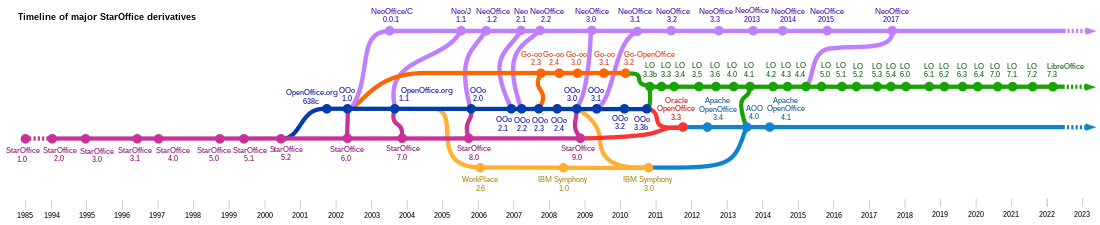
The only problem is that Apache still distributes what they are fully aware is an abandoned husk, misleading people like yourself.
Does it still work? Sure... is it secure and has feature parity with modern offerings? Definitely not.
Perhaps that's fine - but since LibreOffice is also free and is actively developed (by many of the original OpenOffice team too), I don't see a compelling reason to not make the switch.
What would it take to make LibreOffice a web-centric app companies could host themselves? Maybe Apache's resources could be directed that way.
But I'm old and my 14yo son never saw even MS Word (leave along LibreOffice) until I showed it to him, they do everything in Google Docs and that's all they know. So maybe I'm part of a dying breed :-)
https://www.collaboraoffice.com/collabora-online/
It is integrated into NextCloud I believe for self-hosting
Most of the time I would take a good offline office app over the application that requires an internet connection, stores my data in the cloud and forces its design choices, from the UI to the security, down my throat "because of the way cloud apps work". My 2c.
https://books.google.com/ngrams/graph?content=microsoft+word...
Note that 2010 is the year that MS first started adding cloud-based collaborative tools to MS word, reducing the downward trend.
I enjoy using it and it has been a life savior for the times I need to work on a document with someone else since I can just send them a share link for it. The fact that it uses leaflet which is meant for maps does mean that the latency to the server matters quite a lot to experience but I don't mind that much, personally, with my not great 120ms RTT to my server.
They have a downside for privacy and security.
What I'd really like is on office suite that lives on my own device (e.g. my router), where I own my data. That's not the way the world went, but c'est la vie.
I think the fact that I'm The first person to mention it here, and the fact you didn't find it yourself, is revealing about the true level of demand for such a product.
https://en.wikipedia.org/wiki/Synology
The products menu on their web page doesn't mention it.
https://www.synology.com/en-us
IF you go to Solutions -> Data Management -> Office, you find it. One more link, and you're there:
https://www.synology.com/en-us/dsm/feature/office
Of course, there's no way to try it or to buy it from there....
I see random devices for sale for under $200, but I'm not sure if they include it. If I bought it, I'm not sure how well it works.
We have no idea of the level of demand for a product that well-hidden. The fact I just spent 5-10 minutes without figuring trying to figure this out without success means we have no idea.
As a footnote, I do have a random machine running a random online office suite. It works, but not well enough to be generally usable.
What if you could host it on your laptop or a server you pay for?
When I suggested something a company could host I imagined it replacing Office 365 or Google Docs (a concern governments may have about having American companies host their data). Being able to self host and allow collaboration without relying on a third party application is important.
I'd much rather send documents back and forth, with comments I integrate with the material. If I _need_ to do something live, plain text is actually not just perfectly sufficient - it's either _exactly_ what I want, or what I want is a white board (and therefore please let's just use self-hosted Excalidraw - but remember to sponsor it if you're commercial!).
But outside of very rare occasions, let's just set up a plain old mailing list, write proposals in basic text, and then once we have something complete, let one person integrate the whole thing into a single pretty document with like LaTeX or Markdown or something. Or even Word, I don't really care.
And yes, that's hostile to brainstorming. Good. I too am hostile to brainstorming.
1) editing documents I wrote some time ago. There was a time some months ago when LO would warn you when opening an older oOo doc about changes in the format. I saw this with drawings and Impress files. (I need to see if this still happens with latest LO).
2) one of my employers has oOo on their standard desktop image alongside MS Word and all. So I want the same as them for their documents
3) I know the menus and the little UI glitches well in oOo having used it since StarOffice days. LO is (entirely reasonably) refactoring stuff and therefore changing the ways some features work (drawing tools I recollect)
4) gives the impression of running snappier on an ancient laptop that I use. LO does seem to need a full DE (e.g. Gnome/KDE/xfce)
...if oOo life support was switched off, I'd shrug, move all the documents over to LO, and move on I suppose.
LibreOffice seems to do just fine for me here without a DE. I wonder if there's something I'm missing that I don't realize?
But I'd assume lot of OpenOffice users today are just legacy users who use it just because they're familiar with the brand and that's what they've always used.
2) I did use it on Ubuntu sometime in college (around 2016 for class) and I just didn't like the feel of Libre. OpenOffice still had a lot of feature parity with Excel without buying Excel, so I got that instead.
It's been available for Windows for years. The first option on the drop-down menus says "Windows (64-bit)"[0]. 90% of their 10 million worldwide users in 2011 were on Windows machines[1].
[0]https://www.libreoffice.org/download/download/
[1]https://en.wikipedia.org/wiki/LibreOffice#Users_and_deployme...
On the download page, just above the "Download" button, there is a dropdown to select the installer. There should be "Windows (32-bit)" and "Windows (64-bit)" there along with the Linux and MacOS installers.
One thing I noticed is that the web based MS Office products are significantly snappier and less quirky than their desktop counterparts. Maybe that is part of it?
Unrelated: I also noticed that Visio, which I previously found quite pleasant to use, actually is nigh unusable (Desktop - no web version exists). Was it always this bad and have my standards simply gone up, or did it deteriorate?
They've clearly stopped investing in quality, every time I go back it is buggier and less reliable than before.
I don't use Visio, but even Word is becoming a nightmare.
The story of CentOS should be telling that, no, many pieces of software that are backed by a company will not be future-proof and will probably experience certain changes as a consequence of that, be it being transformed to better fit corporate goals (CentOS Stream), or being retired eventually so the company may focus on something else (Atom), or will just be left to slowly rot over time as happens with most code (OpenOffice).
Then again, it's not like open source projects are that future proof or safe from "drama" either - for example, the Lubuntu project has 2 homepages for no reason: the official one at https://lubuntu.me/ and some other one that serves old versions and is not trusted by my ad blocking solution https://lubuntu.net/
There are also cases, when open source projects experience fragmentation like happened with Gogs https://gogs.io/ and Gitea https://gitea.io/en-us/ and sometimes there are cases where particular individuals simply cannot work together and as a consequence pretty much the same happens, as was the case with Swoole and Open Swoole: https://github.com/swoole/swoole-src/issues/4434
Treat most pieces of software that you use as if they might not be there in a year. Or, alternatively, as if you might need to take over the maintenance of whatever you're using, if you can.
Atom should be manageable enough in size that if people really wanted to keep it, they could fork it. Maybe they have.
But if there's enough of a user base the company probably won't abandon it.
Things like Fedora are potentially at a bit more risk, because if IBM decides to stop developing it for whatever reason most users will probably just switch to an entire different distro (or a related one) than bother continuing the existing.
Yes: for a small + useful + easy to maintain project.
No: for bloated or difficult to build projects, which makes most of popular browsers, corp-driven programming languages, devops tools, office suites, corp-driven IDEs, Linux distros...
Not to mention non-copyleft licenses that allow proprietization and discourage communties.
The second best bet is from a consortium of many companies with a track record of not dropping projects.
Unfortunately most developers still jump on hyped-up corporate-controlled bandwagons.
It even seems it usually is pretty aggressive in doing so.
Maybe there isn't even a person in charge of the project to make the decision anymore, or it's an Oracle employee whose job it is to NOT sunset it.
Projects under Apache really only works when the developers are involved and follow the project. At this point I'm a little unsure what The Apache Foundation provides, beyond hosting and some legal support.
Libber-what? Lib Re-Office?
Yes, yes it does. The very definition of unfounded is having no foundation or basis in facts. That's some "stolen election"-level logic.
It's been long enough; this is not unintentional and the lack of any response for so long has gone beyond what can be excused by a slow-moving bureaucracy. Moreover, updating the site to acknowledge that the project isn't updated is trivial, truthful, and needful for its users. Therefore that is a more than reasonable expectation for an app with its recognition - even if there were no other competing apps. But nope, nothing.
At any rate, I'm just pointing out that (1) any decent project would address this situation once they were aware of it, (2) Apache is aware of it, and (3) they had way, way more than enough time to at least acknowledge the issue. Neither ignorance nor bureaucratic slowness can excuse their complete lack of taking any action to protect their users. If you exclude ignorance and slowness as reasons, this is intentional.
I don't know why, but the fact that something is actually wrong on a significant scale and is intentional in no way matches "stolen election logic".
There is no evidence, though. :(
Oh we are playing major version minor version!
Let me try: Libreoffice is only at version 7.3 ! That makes it hundreds of versions behind office365! Proof once again that free software has no business competing with software build by professional commercial developers. Now excuse me while I try to reboot my futuristic Windows 2000. /s
Versions may as well be marketing names for most software. If anyone even mentions them I might as well assume a minor case of serious brain damage. Java just flat out dropped the leading 1, Firefox is in the low hundreds, some software just goes year/moth.
As Apache office still releases updates I find the claim that it is dead highly misleading, but that is presumably the intention if the post.
I also had some doubts, especially after a quick look at Apache Open Office[1].
Then I checked the announcement of 4.1.{9,10,11,12}. They are all maintenance or security updates.
Compared to the Release Notes of LibreOffice[2], there are improvements with each release.
1: https://www.openoffice.org/ 2: https://wiki.documentfoundation.org/ReleaseNotes/7.4
Here are the release notes for the 2022 release of OpenOffice:
https://cwiki.apache.org/confluence/plugins/servlet/mobile?c...
This is pretty clearly a minor version update. There are only four entries under their improvements / enhancements section, and all but one would be more accurately described as a bug fix. They even identify this as a "maintenance release".
Here are the release notes for the 2022 release of LibreOffice:
https://wiki.documentfoundation.org/ReleaseNotes/7.3
Aside from the fact that this is much better documented, you can also at a glance see that this is, in fact, a major version update. LibreOffice isn't padding their versions, they actually are adding new features while OpenOffice fixes a few bugs.