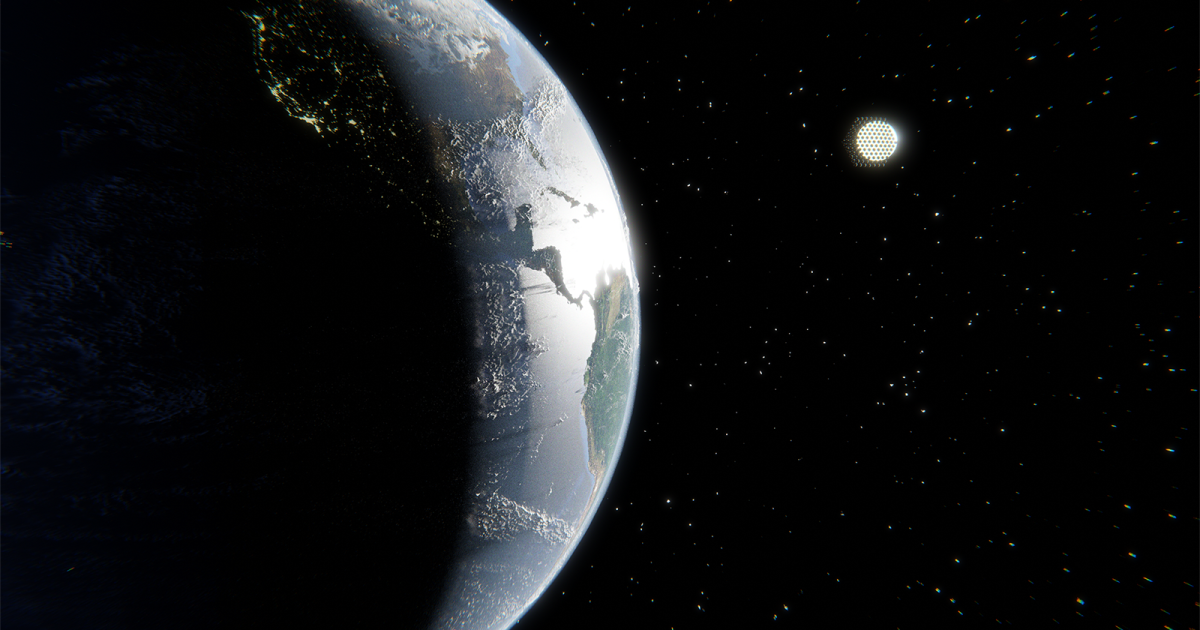
MIT proposes Brazil-sized fleet of “space bubbles” to cool the Earth
A raft of “space bubbles” could be used to reverse global warming, according to an MIT group's solar geoengineering proposal.
Freethink
174 points · by excalibur · 4y ago · 362 comments
This is what the world's yearly CO2 emissions look like: https://www.statista.com/statistics/276629/global-co2-emissi...
For us to not fry the planet, this graph needs to start going down. Fast. And it needs to go into negative territory.
Now look at what's happening in the world today. Russia invades Ukraine. Gas and oil supplies get disrupted. Now inflation is running rampant, the people of the developed world are angry, and their leaders are desperately looking for fossil fuels to keep their economies moving. They're decommissioning nuclear plants and bringing coal plants back online. Biden wants to kill the gas tax to keep from getting swamped in November. Meanwhile, China and India are being flooded with cheap Russian oil.
Does this sound like a world that is moving in the right direction to imminently push that emissions curve way down?
Pie-in-the-sky moralizing about what humanity should do does not keep the planet from frying. Let's consider other options and accept some risk in exchange for the opportunity to avoid a looming, inevitable catastrophe.
We already know what to do: build out renewables. Tax and otherwise cut burning fossil fuels. Renewables are already radically cheaper than any energy source ever devised, so the faster they are built out, the cheaper it gets.
Anything else is a dangerous distraction. Any big enough distraction is disastrous.
I see no evidence or reason to believe this at all, let alone with such extreme certitude. Shouldn't we try harder to have a realistic scientific assessment?
> We already know what to do
But it's not happening and it isn't going to happen. That means your plan doesn't work. That means that, however well-intentioned you are, your plan is do nothing and fry the planet.
Doing things to increase inertia makes things worse. Distracting people with pies in skies makes things worse.
The planet fries, regardless, if CO2 is not brought down. Fooling around with anything that does not brings catastrophe nearer.
Perhaps not in the US, but other parts of the world is full speed on the renewables track
But we've already warned the world 1 degree or so. Renewables won't do anything about that. A sun shade can.
And renewables provide huge opportunities. Do you have any idea what it unlocks if you have unlimited clean energy? You could have massive, vibrant, beautiful cities and agriculture in the middle of the Sahara, and that's just the beginning.
These things are not bad in and of themselves, they are bad because of their externalities.
If we can find a way to offset the negative effects of burning coal, that’s great; it means poor countries can spend more GDP on healthcare and education, and less on upgrading to clean power.
Fossil fuels were never a good idea environmentally and even socially as it concentrated power massively... we just didnt know. You know how romans used to put lead in their drinks because they had become accustomed to the taste? I think our situation is similar.
I think this is due for a much longer discussion but it seems really silly to think we simply ought to repair externalities when theres just so many of them.
Poor countries should spend more in education for sure but, realistically, under our current economic and social systems: is it even desirable? I think the answer is no. Why would you want people who are mining cobalt, young men in many cases (an euphemism for kids) to be educated? Who would want do such an onerous task? If you give these people knowledge then how will that affect the price of these materials?
I mean, as I said in another comment, the inertia of this machine is too much. But, yeah, ideally we could just get rid of externalities and I think in many ways we try to hide them... but it seems to me (and i live in a mining country) the externalities really are much more difficult to deal with than it might seem at first glance.
The issue is not having MIT do it, but the Russians and chinese and indians and Jakarta and Alberta and ...
The UN would be a good place to put a geo-engineering shared facility where all these ideas are experimentally tested, with scientists from dozens of countries so they can go home with accurate models and say "yeah nah, that's not an attack".
And while we are at it we can set up panels on reducing car use, better routing of airplanes to avoid contrails (see recent podcast from freakonomics).
We have the answers - but there is no single solution - just intelligent long term society wide changes that are not sexy or populist and won't pay off for decades. We might struggle to find politicians
Nope, not with the data we have today. None of this stuff is backed by any decent research, yet it always seems to be suggested. We have no idea what the effects are of doing any of the things you suggest. For example NASA has flip-flopped on the whole idea that volcano's spewing ash into the sky could be a means of cooling the earth.
https://www.nasa.gov/feature/goddard/2022/flood-basalts-may-...
Putting a bunch of metal filings in the ocean or in the upper atmosphere sounds like a very dangerous to do that would need a tremendous amount of caution before attempting.
Is this something to rush into - no. Is this something to be researched by worlds scientists to find the least worst option - yes.
I am not saying "chuck iron filings in the sea now" I am saying "research it now, so we have globally understood trade offs and impacts for when things get bad"
So, your're esentially suggesting fighting pollution by creating even more pollution of even more kinds?
To me this does not match the first word, only the latter part:
> intelligent long term society wide changes
Doing something like Geo-Engineering may be an important and vital stop-gap to mitigate the worst effects of climate chnage. But it is also dramatic and potentially causes other side effects from crop failures to god knows what.
So when things get so bad that humanity says "yeah let's block out the sun for a bit" we really really want to have studied it hard and have as many countries in the world to have signed up to pieces of paper that say "we tried this crazy thing with our best scientists and it seemed ok, so we trust that it's not a deliberate way to F%%k us over"
The UN might have better wording.
This is radically dangerous, and is only being proposed because we refuse let extractive industries die or change our lifestyles even slightly.
Volcanoes of the same scale happen around every 50 to 100 years, but larger ones with more sever global cooling effects happen every 1000 or so years. Every 50 000 years we can expect a mega-colossal super volcano. The Youngest Toba eruption over 70 kya caused a nuclear winter for over 5 years with an accompanying cooling which lasted possibly for another 1000 years.
Even though these events are natural and happen regularly, they are usually devastating for the life on earth, usually with several species going extinct as a result. There are theories that the Toba eruption almost wiped out all of the human races and created a “bottleneck” in our evolution.
So evidence suggests that a quick dimming event range from being insignificant to catastrophic for the life on earth. There is for sure a reason for caution here.
>One of the most serious potential risks of solar geoengineering is termination shock. If we were to use solar geoengineering to suppress global temperatures, but we didn't do anything about CO2 emissions, and if for some reason you were to stop suddenly, all of the solar geoengineering, then those temperatures would suddenly spike back up. And that would mean that human and natural systems had less time to adapt to the new conditions.
So if it works for awhile, and then for some reason stops working, we end up shocking every system on earth. I appreciate that the scientists are hammering "we need more research" but I don't think we are capable of identifying all of the catastrophic failure modes.
Source: https://insideclimatenews.org/news/15092021/global-warming-j...
https://globalnews.ca/news/2934513/empty-skies-after-911-set...
https://www.wired.com/2002/05/hot-on-the-contrails-of-weathe...
https://edition.cnn.com/2002/TECH/science/08/07/contrails.cl...
https://www.bbc.co.uk/sn/tvradio/programmes/horizon/dimming_...
> NARRATOR: For 15 years Travis had been researching an apparently obscure topic, whether the vapour trails left by aircraft were having a significant effect on the climate. In the aftermath of 9/11 the entire US fleet was grounded, and Travis finally had a chance to find out.
> ...
> DR DAVID TRAVIS: We found that the change in temperature range during those three days was just over one degrees C. And you have to realise that from a layman's perspective that doesn't sound like much, but from a climate perspective that is huge.
> NARRATOR: One degree in just three days no one had ever seen such a big climatic change happen so fast. This was a new kind of climate change. Scientists call it Global Dimming. Two years ago most of them had never even heard of it, yet now they believe it may mean all their predictions about the future of our climate could be wrong. The trail that would lead to the discovery of Global Dimming began 40 years ago, in Israel with the work of a young English immigrant called Gerry Stanhill. A trained biologist, Gerry got a job helping to design irrigation schemes. His task was to measure how strongly the sun shone over Israel.
The thing with contrails (and we can turn it up by running rich) is that we have seen that we can turn this on (and off) relatively fast (days).
--
Further reading: https://en.wikipedia.org/wiki/Global_dimming
I'm not automatically against geo-engineering approaches, but we do need to consider them desperate moves compared to the reduction of the GHGs
Isn't that a fundamental claim made by those who support pumping sulfur dioxide into the upper atmosphere, however? That if you stop pumping, it quickly degrades and the atmosphere returns to baseline?
And going badly is guaranteed, because CO2 would continue on up, and the ocean ecosystem would collapse. There are quite dramatic fossil records of such events.
But civilization would collapse first, so there is that.
What's wrong with that ? That's the issue many have and fortunately, you tell it like it is. People don't want to change.
Public transportation, changing the "dream of traveling" into another one, having electronic that lasts for 10 years instead of 5, better insulation, and the list goes on. Yes, one can change the global standard of living into other not lesser global standard.
Or you think it's already too late and then, well, it's effectively too late.
Ambitious (and probably also clueless/disbelieving) ideologues will spin junk food narratives that move the masses.
And you will have war everywhere.
So it makes sense to roll the dice on remediation and hope slow social change takes. The only alternative is a horrible age for humanity, one way or another.
I should think that was fairly obvious. People do not like to be "dramatically" poorer, or even just a little.
It's not a vote winner.
Anything that interferes with building out renewables as absolutely fast as they can be brings global catastrophe nearer.
Global civilization collapse would be hard on people.
People who like looking ahead when investing should be thinking the same about all coastal and low lying regions. Resale value will be nil.
By the time a 30 year mortgage is over, the next buyer will be looking to the end of their own 30 year mortgage, and what they see won’t look good.
So there will be no buyers.
People don’t want to leave worthless property to their children, so the smart people who foresee this chain of events will get out now.
If we keep warming to 3 degrees, do you think the sea works will not be enough?
Attempting any sort of "quick fix" guarantees quicker failure.
Civilization collapsing would anyway slow CO2 rise, but at substantial... cost. Probably mass extinction would happen either way.
And, addressing symptoms does not actually put off catastrophe.
Unfortunately we past the point of just needing to address the causes. This patient is in the hospital and needs all the medical intervention we can provide.
At a big enough scale, GHG may start to reduce globally. That is the disease. Without that won't be any solution, just fragile mitigations in our way to the end of civilization as we know it. No matter how expensive or damaging it looks, the alternative will be always worse.
If, besides doing that, you want to add some mitigation to the warming, and that don't slow down nor stop GHG reduction, be may guest. But applying nail polish instead of stopping an hemorrhage is somewhat shortsighted, priorities should be clear.
Dropbox: https://www.dropbox.com/sh/gk415yke8shtb84/AADfZbzC8xISX-lTm...
Press release: https://www.dropbox.com/sh/gk415yke8shtb84/AAAaHVK7WNKCUN2rl...
PDF with more information: https://www.dropbox.com/sh/gk415yke8shtb84/AABLA5kYXUrrZfidU...
---
They don't give more information about the size than "brazil", they do state the density as ~1.5g/m^2. Just multiplying that by the area of brazil we get 1.3×10^13 grams or 13 million metric tons.
That's a ton (heh) of mass, but within the realms of what SpaceX is claiming they want to make possible (at least if they launch it over a decade or two): https://wccftech.com/spacex-aims-to-haul-more-than-a-million...
Is it possible to talk about space faring without mentioning spaceX theories? Why not talk about companies that have been sending stuff up there for decades?
No one else has suggested that they are anywhere close to lifting this amount of mass, or even have any future plans that might change that. For reference, all time total mass to orbit so far is < 20k tons.
We could try to lift that much silicon from earth's gravity well, or try to build a refinery and launch system on the moon, with ~1/6th the gravity of earth.
During the Permian extinction CO2 was 3000 ppm - weathering rocks is how it was fixed back then. We just need to accelerate that natural process.
I don't think it would last a year before it was taken down, regardless of whether or not it did what it was supposed to do or was responsible for any meteorological event.
I truly don't know.
That has happened before, immediately before massive global extinction events. It would be a mistake not to avoid that.
I get why MIT has done the research, but this publicity is poised to create yet another distraction and delay necessary actions. We have to stop focusing on the symptoms and have the courage to go after the root causes.
More knowledge and options are always better. It's up to the people we've chosen to lead us to actually choose an option and follow through, and I don't think one more option there is really what's preventing that.
Preventing more options from being presented is just a way to attempt to control the populace by restricting information. Necessary action won't be taken unless there's strong leadership willing to make it a priority, and there's already enough options on the table that whether none or 100 new ones pop up, it makes no functional difference to getting started seriously, but it does possibly allow for a better option to be chosen when we do.
That's not even true in theory. Given a simple problem A, when adding more options, at some point, choosing among the options requires more effort than solving the simple problem, if only by brute force. There's a reason why RDBMS sometimes skip indexes.
And in practice, GP is right: with humans, too many options eventually only distract from the problem.
Hick's Law, more or less: https://en.wikipedia.org/wiki/Hick%27s_law
Only if you require that every option must be assessed. You can always choose a random subset, or the first X entries, as use those as the solution space. Additional solutions provide for additional strategies in choosing a solution, but at any time you can ignore additional solutions and treat them as if they don't exist.
> And in practice, GP is right: with humans, too many options eventually only distract from the problem.
The whole point of government is to provide a structure such that decisions like this can be made be reducing the set of people that needs to reach consensus to a manageable about. Those people can choose to accept or ignore any solution presented, and call on whatever expertise they need to make that decision.
The whole idea of there being too many solutions only makes sense when you you apply it towards the general public and people whose job isn't to make such a decision or be domain experts. Since those people aren't the ones actually making the decision, providing too many solutions to the problem to them is a non-issue, and for the actual decision makers and domain experts they have on call, additional solutions are beneficial.
Whether you or I are getting overwhelmed with the possible solutions is irrelevant. We aren't ultimately the ones that will decide what action to take (at least directly), and we aren't the domain experts advising those that will decide the plans (or present the ultimately small set of options that are valid). At least I don't think so, unless you're a domain expert, but even then, your role would just be to provide advice (or if you're a politician in charge of making this decision, but that's even less likely).
For the same reason that the next option presented could be the worst possible option, it could also be the best possible option. I reject the attempt of others to tell me that we should stop entertaining any more options at all.
That said, I think you've simplified the options presented for discussion to the point of being not very useful for said discussion.
However that would request so much Earth resources to launch everybody and everything (and thus would definitively destroy the biosphere in the process), that it is just not feasible.
So far this strategy has consistently lead to complete and resounding inaction. The stronger the leadership the more likely we are in actually going in the opposite direction (see e.g. Businaro in Brazil or Trump in the USA).
More options have also shown to be a major distraction at best and actively damaging at worst. Take carbon offsets as an example of an option which actively hinders climate action.
What climate justice activists have consistently been calling for since at least COP 15 in Copenhagen 2009 is International agreements, carbon tax, and green infrastructure. There has always been fierce resistance from polluters in any of these three items, and so far the political class has consistently cited with the polluters. Then they use distraction policies with questionable results (like cap-and-trade, carbon offsets or magic bubbles) as an excuse not to enact proven policies.
If the cause of climate change is heat gain from the sun being higher than cooling via radiation to space, then GHG reduction works by changing the second part, and partially blocking insolation works by changing the first.
Here's what I think will actually make sense: put space orbitals and power collectors at the Sun-Earth L1 Lagrange point (roughly 1.5M km from Earth). This is readily accessible in terms of planetary distances, will involve minimal communication delay with Earth and if you build enough of them you can reduce the solar output hitting the Earth however much you want with little to no visible impact from Earth.
[1]: https://usm.maine.edu/planet/sun-getting-hotter-if-so-why-wi...
[2]: https://www.smithsonianmag.com/smart-news/weve-got-15-billio...
The first time I saw the plans for the Starlink fleet I started wondering if you could use a fleet of satellites to manage incoming solar radiation:
https://news.ycombinator.com/item?id=18474244
Maybe more an idea for a science fiction novel than a serious plan, but I like the sound of it.
I think it may just be one of the most viable thanks to SpaceX bringing down the cost of space launch. With starship this might just be one of the cheapest solutions. Certainty cheaper than building seawalls around all our coastal cities - something that no reduction in emissions will save us from now.
To be clear, we have to reduce emissions, but it's obvious now to me that it will be too little, too late. We'll need something more radical as well. Currently emissions are still increasing and the rate of emissions is even accelerating still. We're pretty fucked overa long time span.
But disaster comes on just as fast, however much you make it look like it is not.
Blocking sunlight, by whatever means, is a disastrously bad idea.
Why would blocking sunlight be a bad idea?
Rising CO2 is acidifying the oceans, something shade helps not at all. Resulting ocean ecosystem collapse eliminates access to protein for a large fraction of humanity. Mass famine provokes global war. War halts sun blocking activity. Temperature shoots up faster than ever.
Furthermore: rising CO2 is already interfering with cognition. Shade helps with that not at all.
Money is fungible. Money spent on shade is money not spent on addressing the cause of multiple identified problems that shade does not help.
How much more heat forcing do you suppose would be driven by burning enough rocket fuel to put millions of tons of crap into orbit?
The whole prospect is BS, but it exerts a sick fascination that is harmful by itself, as it makes it seem like disaster can be averted any time with no fundamental change.
We do know we’ve had mini ice age as a result of "Grand Solar Minimum" [1] (in addition to volcanic activities) which means reducing the solar output does reduce surface heat.
At this point we need to really focus on taking action an approaching this from many facets. As cutting of greenhouse gases alone will not work. It requires the entire globe (at least the G20) countries to invest in such endeavors.
[0] https://www.businessinsider.com/us-taxpayers-spent-8000-each...
[1] https://climate.nasa.gov/ask-nasa-climate/2953/there-is-no-i...
Right now, we're effectively lying about how much action we're taking in just one facet. Adding "many facets" just allows those who fail to make hard choices to hide their bullshit in more places. Only once there are strong controls on carbon emissions could doing other things make sense - not just because carbon emissions are the source of the problem but also if we allow geoenigeering to be done to the standard of "carbon credits" and other worthless hokum, it too will be hokum. We need something - a popular political movement, strong institutions, a coalition leaders, something - that force this stuff 'cause the failure is now and visible.
Dressing up temperature helps not at all, but makes it look like something is being done as it steals capital from doing anything actually useful.
Normal people aren't giving up their 70 degree indoor air conditioning in the middle of Florida, Texas, or California summers of 100+ degrees, either. You know what else us normal people aren't going to give up? Going to the store and getting a ribeye steak.
Technology is going to have to come up with solutions that we can live with, and we're going to have to accept some of the negatives of climate change. Period, end of story. Rich people aren't going to voluntarily suffer. And most of the Western world is "rich".
"Two ways. Gradually, then suddenly."
The situation is even more dire when you consider that increasing CO2 levels inhibit cognitive function.
I wish this solution won't be implemented
I assume that Earth would heat up more rapidly than ever in human history. This would be especially bad if we keep on emitting vast quantities of greenhouse gasses in the meantime.
Seems like a misguided idea to me, and one which wouldn’t solve the root cause of our climate problems.
Unless you really like the idea of ocean ecosystem collapse.
Step 2 build another dooms day weapon that blocks out the sun to counter act the first doomsday weapon
Step 3 nations start selectively blocking out the sun for Russia because they invaded Poland
Step 4 Russia builds a space fleet to attack and hijack the space array directly
Step 5 western nations build a space fleet to defend it
...
Step 66 the sith have infiltrated the senate
We need to fix the root of the problem, we need to find sustainable alternatives to energy production, protect natural ecosystems, find sustainable ways to make use of resources, not put some god damn sunroof over our heads and get an extension on dealing with this problem.
We cannot "do both" because money is fungible. Spending on a space boondoggle means not spending those dollars on PV and wind generating capacity that displaces fossil combustion.
For those who think this is absurd, this is a "what if, emergency solution" as it explains.
Fortunately, it would collapse and blow away before long. Unfortunately, that would make things even worse, for a while.
See page 84 of the Technical Summary, "TS. 5.6 Agriculture, forestry and other land uses, and food systems"
https://report.ipcc.ch/ar6wg3/pdf/IPCC_AR6_WGIII_FinalDraft_...
Keep in mind that net emissions is the concern, and simply stopping ongoing deforestation would contribute much. The total Agriculture, Forestry, and other Land Uses (AFOLU) sector accounts 13--21% of present greenhouse gas emissions (2010--2019), and could absorb about 1/3 of total human emissions.
So yes, forestry, among other land uses is a partial and probably necessary but not sufficient mitigation.
If by the time the new trees fall and rot, we have stopped burning coal, then they won't matter.
At what rate would they expect bubbles to get punctured? Would those punctures result in movements as the trapped gas escapes?
The JSTW at L2 has already been hit by 4 as of June 11th [0]. Are we expecting fewer at L1?
[0]: https://www.forbes.com/sites/jamiecartereurope/2022/06/11/th...
It's an idea. Not a budget request. Let's not blow it out of proportion.
If this is truly a "life and death" situation as some people cast it, then this is less than useless behavior and is probably an actively malicious plan to just make money off the whole morass.
"An active stabilization mechanism is needed and will have to be designed, preferably through geometry modification [aerospace engineering, planetary sciences, robotics]"
See https://www.dropbox.com/sh/gk415yke8shtb84/AABLA5kYXUrrZfidU...
Fewer ordinary days at MIT would be a plus. A few days of actually thinking beyond hare-brained scheming would improve MIT and its graduates.
Any device located there must actively maintain its location , using calculated thruster firings, generally on the order of months, or it will drift out of position in less than a year.
So we're safe from that scenario. If the satellite loses power, it will just drift out of our line of site of the sun. No intervention required.
Other active spacecraft located at L1: NOAA's DSCOVR climate observatory, and NASA's Advanced Composition Explorer
Edited to add a visualization of the ACE spacecraft L1 orbit: https://izw1.caltech.edu/ACE/ASC/DATA/browse-html/gse_color....
- the wind patterns on Earth change, resulting in climate change. Seasons will alter. Rains will be affected. Widespread famines and floods.
- Point 1 rendering a lot of solar and wind energy farms unusable.
- Less sunlight results in less photosynthesis. This again causes chimate change, loss of biodiversity.
What else?
The best plan, Plan A, would be drastically and immediately decarbonize and cut CO2 emissions globally.
However, we have ample evidence that that is not going to happen, or at least not fast enough. This is a tremendously difficult problem because it requires a supermajority of actors to agree on a course of action, despite some game-theoretic reasons not to. Without a dramatic geopolitical shift, it's simply not going to happen.
Geoengineering is Plan B, strictly inferior to plan A. But it has the advantage that one sufficiently wealthy state or actor can do it unilaterally, meaning there is a non-zero chance of it actually happening.
Right now I am pessimistic enough about Plan A that I expect Plan B may be necessary if we want to avoid the horrors of a +4.5c climate change. And I sincerely hope someone eventually has the balls to do it (after a massive amount of scientific due diligence to mitigate risks like termination shock.)
But promoting Plan B demonstrably generates enough sick fascination to distract from determination to make Plan A work.
My new design envisions a robot spider which basically weaves a web.
That said, I would bet there’s better economies of scale / ability to innovate lower cost zero-carbon energy sources with direct air capture rather than a giant space project.
At a cost of $1,000-$10,000 per kg it seems possible to get this to space with a total cost on the order of hundreds of billions of dollars.
You could do a estimate of the graphene itself but I think the cost would be similar.
Civilization collapse is cheapest of all, but has perhaps undesired side effects.
Every bit of money and attention spent on this or any other "shade the earth" scheme just brings collapse nearer.
The main physics problem I see is that Langrange points are naturally unstable [1], so the bubbles would need to be constantly correcting their orbit. This problem would be compounded by solar radiation "blowing" the bubbles back to Earth. There are clever ways to mitigate this for other designs which are addressed in the video, but I don't see it addressed in the article.
Edit: it looks like it is addressed somewhat in the source article linked in another comment, by placing the bubbles a bit further towards the sun than the L1 point to compensate for solar winds. Also, If a bubble does eventually become unstable, they may be cheap enough to destroy it and send another one up.
However, the primary problem I see with this approach is that we are simply not politically ready as a species to attempt a global-scale engineering project like that. Some countries may find that climate change actually benefits them [2], or may even impact a geopolitical rival even worse. These countries may be inclined to send a few missiles toward L1 if thats the case.
Edit: Additionally, even if this does succeed, countries may see this as an excuse to keep burning stuff despite the additional negative consequences of carbon emissions [3]
[0]: https://www.youtube.com/watch?v=G-WO-z-QuWI
[1]: https://en.wikipedia.org/wiki/Lissajous_orbit#:~:text=In%20p...
[2]: https://www.nytimes.com/interactive/2020/12/16/magazine/russ...
[3]: https://www.noaa.gov/education/resource-collections/ocean-co....
What's the point of bringing this up? Are you saying that their research is futile and that they shouldn't bother? That we should be funding something else?
There are separate groups of people working on the social aspects. Let MIT and other research institutions deal with coming up with solutions, and let politicians and activists deal with getting the world ready.
From everything I've seen, it'll take a global-scale engineering project of some sort to solve this problem. Might as well have the group of solutions ready for when/if the world is ready.
Not at all! We should absolutely be researching and developing this type of solution. I fully believe that eventually every populated planet will have some form of solar mitigation strategy like this, but our political structures would have to evolve as well.
I sincerely hope we're able to politically and societally support such a project this century, but I'm not optimistic on that timescale.
The primary problem is that even attempting it would bring on global catastrophe just that much faster.
Animal husbandry is one of the main culprits of global warming, pandemics, deforestation, ocean pollution, world hunger, destruction of ecosystems, continuous extinctions, and much more. That's the fact.
With stopping "the burning machine" and also "the killing machine", we could reforest most of our agriculture lands (more than double our forested lands) and solve all this problems in one go.
It's THE HACK we need.
https://climatehealers.org/the-science/animal-agriculture-po...
tldr: https://climatehealers.org/wp-content/uploads/2021/09/Climat...
P.S. If you live in Europe and would like to support two days old initiative "End the Slaughter Age" to transfer animal ag. subsidies to alt-protein (plant-based & cultivated meat/dairy), read more & sign at https://eci.ec.europa.eu/025/public/#/screen/home and https://www.endtheslaughterage.eu/
There are plenty of inflatable space-based structures that have been proposed and some number of them tested (large inflatable antennas, inflatable elements to increase drag and bring space debris in, inflatable space habitats).
Granted, nothing is even within a few orders of magnitude of what they are proposing building so there are certainly still technical challenges.
Edit: Another technical challenge is the L1 lagrange point is not a stable point, so the bubbles will require some sort of control system (i.e. thrusters) to perform small orbit adjustments and remain in that spot.
But L1 doesn't mean it won't get hit. James Webb has already been hit at its point in space.
If the James Webb telescope gives a reasonable indication for the amount of stuff floating around these Lagrange points, it would be popped around once per month [1]!
1. Four hits after 5 months: https://www.theatlantic.com/science/archive/2022/06/james-we...
What the bubbles do address immediately is the manufacture of something in space with a high planar surface area compared to the volume and density (for getting it into space).
Or
Just blast sulfur, calcium carbonate, or some other particles into the stratosphere to reflect sunlight. Elon Musk could do this by himself. Single digit billions with technology we've perfected decades ago.
Waiting patiently for a a majority of people to realize it's the only realistic path to buy us enough time to transition to renewables.
Also, please don't give Elon any ideas, he already has enough futile showboats.
Ignoring this reality will just guarantee our collapse. Geoengineering gives us a plausible way out.
The alternative is people continuing to clamor for global cooperation, a comically naive goal that has gained near to zero traction in 40 years.
We know what works: cut CO2 emission. Nothing else does.
The only point is to buy us time, not permanently change anything.
This truly is horrible reductionism ala "it will be fine, NOTHING will go wrong, TRUST me".
Your reaction is why I mentioned that I will patiently wait for others to give up on this absurd idea of saving the planet with renewables. We need more time. Geoengineering is the only way to buy us that time.
Cheers to waiting for more to come to this realization. Let’s talk again in 2030.
Meanwhile, global warming will outright benefit some nations, such as Russia. The idea of global cooperation is comically naive
Maybe we don't know how to engineer the earth and we should just focus on terrestrial efforts before we die from HUBRIS of something this drastic.
jeeze.... that don't look up movie had it right.
We need to reform the crazy polluting way we run our economies. There is no pareto optimal path, any more, so some very powerful people are going to have to loose a lot.
It can be peaceful, violent, or the world can burn.
The Earth will survive. I expect civilisation will too. But the losses will be catastrophic
Arrogant schemes like these have a purpose: to cover up the underlying corruption.