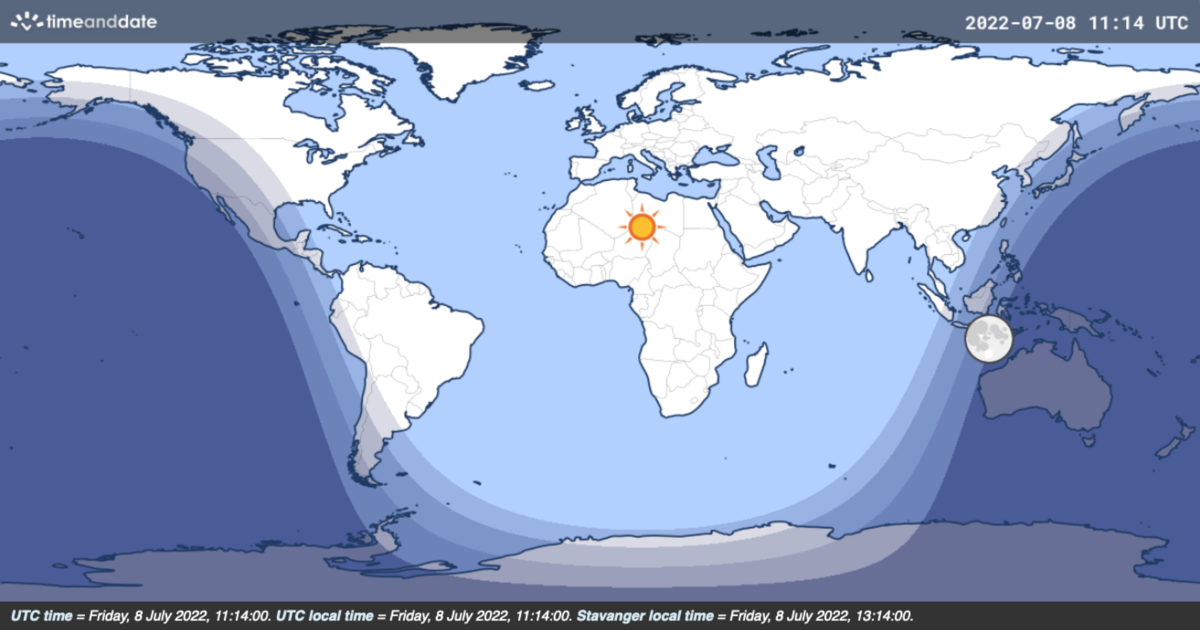
99% Of Us See Daylight at This Moment (Or Do We?)
Is it really true that 99% of the world's population see daylight at 11:15 UTC on July 8?
timeanddate.com
590 points · by cft · 4y ago · 118 comments
Also makes me wonder what fraction of the world population is awake at a given time, and what that fraction looks like plotted against 24 hours of the day.
Some quick guesses:
- the most people are awake at around 14:00 UTC. That's 23:00 in Japan (the easternmost big population, at UTC+9 - sorry eastern Australia!) and 6:00 PST/7:00 PDT; most people who would be sleeping are in the Pacific.
- the most people are asleep at about 22:00 UTC - that's 23:00/00:00 in Western Europe (depending on the season) and 06:00 in China, so you get those two big population centers (and India in between them) sleeping.
http://census2012.sourceforge.net/images/geovideo_lowres.gif
So if you want to be as close as possible to as many people as possible, somewhere in Myanmar would be a better choice than London.
Of course the calculus changes if you also consider how much money each of these people has access to.
- Access to capital? - close to "action"? - Airport hub city?
Sufficiently advanced technology
http://physicsworld.com/cws/article/news/2012/mar/19/neutrin...
https://en.wikipedia.org/wiki/Valeriepieris_circle#/media/Fi...
https://commons.wikimedia.org/wiki/File:Globe_-_Pacific_Ocea...
Another way to put it is that half of Canadian's population lives ~between Toronto and Montréal.
0: https://i1.wp.com/metrocosm.com/wp-content/uploads/2016/08/c...
... the future.
> This is especially true for those who reside on the outermost edge of the twilight zones, within the darkest twilight phase called astronomical twilight. Here, the Sun is 12-18 degrees below the horizon. At that angle, the indirect sunlight becomes so thin that it is usually indiscernible to the naked eye.
The article suggests 83% to 90% (not 99%) of people will find it to be light out (daylight or civil twilight) ... not including Californians.
(1) If astronomical twilight and other indirect sunlight counts, then moonlight counts doubly so!
(2) If indirect and thus spatially separated sunlight counts, then temporally removed sunlight, in the form of airglow, should count as well!
Given that, the caviet of direct and indirect sunlight is a huge factor not quantified.
Percentage of world population: China 18.5 - India 17.7 - USA 4.25 - Indonesia 3.5 - Pakistan 2.8 - Brazil 2.7 - Nigeria 2.6 - Bangladesh 2.1 - Russia 1.9 - Mexico 1.65 - Japan 1.6 - Ethiopia 1.5 - Philippines 1.4 - Egypt 1.3 - Vietnam 1.25 - DR Congo 1 - Turkey 1 - Iran 1 - Germany 1 - Thailand 0.9 - UK 0.9 - France 0.8 - Italy 0.8 - Tanzania 0.8 - South Africa 0.8 - Myanmar 0.7 - Kenya, South Korea, Colombia 0.6 - Spain, Uganda, Argentina, Algeria, Sudan, Ukraine 0.6 - Iraq, Afghanistan, Poland, Canada, Morocco, Saudi Arabia 0.5
It would be fascinating to ask people around the world - "What percentage of the world's population lives in your country?"
7 billion people => 7000 Million.
1% of that, 70 Million.
Population of australia, 25.7 Million people. So not only less than 1%, less than 0.5%
I tend to think of Australia as pretty similar (if literally polar opposite) to Canada. Similar population and standard of living on a similarly large but largely inhospitable landmass.
Australia by an large is an inhospitable island with only a few pockets of population.
[1]: https://en.wikipedia.org/wiki/Valeriepieris_circle
[2]: https://en.wikipedia.org/wiki/Land_and_water_hemispheres
timeanddate.com has a clean, fast interface, and if you don't like ads they have an ad-free option
https://www.yahoo.com/now/ozone-hole-found-over-tropics-1538...
To cook our power grid, small enough to be surprisingly common: https://en.wikipedia.org/wiki/List_of_solar_storms
It would be like you stepping outside and shooting a bullet in a random direction a few times a day, with Earth being a golf ball miles away.
The golf ball would be destroyed by a bullet. But your odds of hitting it are very low.
Of course, over time the odds become an inevitability.
I don't know that there has ever been a CME strong enough to cook all animals on the side of Earth facing the sun, though. The sun is pretty far away and Earth has a nice magnetosphere that is one of the reasons life exists in the first place. It protects us from stuff like this.
Incidentally, a CME cooking the entire Earth was the plot of a pretty terrible Nic Cage movie called Knowing a decade or so back.
"The old Axolotl" - Jacek Dukaj
I hadn't realized we were closed to 8B than 7B now.
> Sunlight
pick one
In the extreme north it’s worse: “ In Svalbard, Norway, the northernmost inhabited region of Europe, there is no sunset from approximately 19 April to 23 August.”