Why Sri Lanka is having an economic crisis
A textbook currency crisis, triggered by a bunch of policy mistakes.
noahpinion.substack.com
382 points · by paulpauper · 4y ago · 367 comments
Any level headed person, forget a politician, would want to experiment first, see the results, gauge and then expand selectively. That is common sense.
I guess when you are a dictator ish government and you rule the country with an iron first, the institutions of the state stop being anything and simply become rubber stamps.
This also underlines the importance of self sufficiency in necessities. A country ought to feed its people, provide basic services like power and medical facilities on its own, without depending on imports.
There are also a lot of unresolved tensions left over from the vicious civil war that devastated the island for decades, so it's sadly possible that things take a turn for the worse.
> A country ought to feed its people
This is much harder than it sounds, not just for dense tiny countries like Singapore but for much of Western Europe. The UK hasn't been able to feed its population from native production only since before WW2. I see a Norwegian making the same point in this thread; the proportion of Norway's five million people that could be sustainably fed by fishing, reindeer hunting, and agriculture on the few flat bits of the country is probably very small.
> provide basic services like power and medical facilities on its own
Even harder. Only a superpower could begin to attempt having its own production chain for both of those. Everyone else has to buy from Siemens or Westinghouse, or Pfizer etc.
It sounds like you're saying that only superpowers or mega-countries should exist? Would the EU count as a self-sufficiency unit for this purpose?
(edit: Singapore imports 90% of its food! https://www.sfa.gov.sg/food-farming/singapore-food-supply/th... - not really suprising given that it's an island megacity with a population of 20,000 per square mile)
Gundam 00 comes to mind as an example, https://en.wikipedia.org/wiki/Mobile_Suit_Gundam_00 , one of the main characters is a former child warrior from the then severely economically depressed post-oil 'middle east' region, while each of the three economic superblocks has it's own space elevator connecting to an orbital ring of solar collectors.
Nineteen Eighty-Four (from 1949) literally has Oceania, Eurasia, Eastasia :-)
What does this mean though?
That the UK does not generate enough calories to meet a certain minimum baseline? That the UK does not generate enough calories to meet the current consumption? That the UK eats things that they do not grow?
https://www.gov.uk/government/statistics/united-kingdom-food...
Result: The UK grows enough wheat alone to give enough calories to support its population, with plenty to spare. It also produces all the major food groups in quite large quantities. If cut off from the world, the UK people wouldn't starve, but they might have to switch out their caviar for something else.
Self sufficiency is advisable for the poorer countries though.
It reminds me of Mao ordering all sparrows be killed because they eat agriculture seeds.
This of course caused a much bigger crisis with insects destroying crops - because everyone knows sparrows also eat lots of insects.
If you have bigoted populace, it's dead easy to bait them into voting for some immediate emotional relief. Sri Lankan's wanted to have fun watching Tamils and Muslims get hurt, so it wasn't all that hard for some politician to get the people vote for him. The worse thing is they even put up with his bad decisions for the same reasons. And they did this for years.
The population is entirely responsible for this.
As it turns out they ran out of time, there's always that one point after which everything comes melting down.
Sri Lanka clearly is a democracy, albeit a degenerate one
Sri Lanka is a democracy, in that they have elections, but it is also hilariously corrupt, with extremely authoritarian governance.
To the extent they have less mental free space to actually do work.
Even in abridged form... that's a lot. https://campbellmgold.co.uk/archive_definitive/red_book_chai...
I know nothing about P and K though.
For Sri Lanka, it was the perfect storm of covid decimating tourism AND overseas demand for their produce.
Without Covid, they might have been able to stay afloat on tourism dollars until the organic farming thing started showing results.
Beyond that, it's easy to get rid of modern fertilizers, but the tradeoff is significantly lower yield. To make up for the loss of yield, you need more space. Sri Lanka is a small island that is densely populated, so space is at a premium. Yielding less crop for the same money might have worked out if not for the pandemic, except for the fact that they domestically consumed most of their domestic staple goods, exporting the surplus. Now they've resorted to importing.
This also affected staple crops like rice which are eaten domestically, effectively forcing the country to start importing food instead of fertilizer.
It's not plausible to move the entire agricultural sector towards luxury exports by government fiat.
Perhaps your niches are smaller than mine. Some people regard tea as an indispensable bulk commodity.
"When Sri Lanka's foreign currency shortages became a serious problem in early 2021, the government tried to limit them by banning imports of chemical fertiliser.
It told farmers to use locally sourced organic fertilisers instead."
it is a bit moot point as organic fertilizer can't be practically transported/imported for any significant distance.
I would argue that the current energy crisis was also partly caused by the ESG drive which while laudable in aspiration got ahead of physical practical implementation capacity.
I know it is tempting to pin this one on the environmentalists, but this is on the establishment. Starting with Schröder who realized he could find an easy way to keep German industry competitive and line his pockets and live a comfortable life forever.
This is similar to the Sri Lankan situation. It does not matter how you label it. The lack of fertilizer was clearly not voluntary.
I wonder how many people died in Fukushima vs how many Ukrainians were killed by Russian soldiers this year.
New nuclear is expensive. Existing nuclear is not.
Wind and solar cannot guarantee production. This means you need storage. The problem with storage is you need to determine how much you want. If you decide on 1 month of storage what happens when you have limited wind and sun for a month and you are running out of stored power?
Nuclear doesn't have that problem. This is why nuclear is a must in the future.
* collectivitzation leading to the Holodomor in Ukraine, mass famine in Kazakhstan, and hunger throughout the USSR, killing millions upon millions through starvation. All the act of a single, paranoid, murderous tyrant.
* Kruschev's love affair with corn, that ended up being a crop failure after a few lucky years in smaller trials. This is actually the more level-headed play than Stalin's, but such a large shift, even with a trial, was a gigantic failure.
Lately I've been completely enamored with the book How Asia Works lately, and in detailing the success and failure of many different Asian nations development in the 20th century, it homes in on agricultural independence as a corner stone for further economic development to industrialization. Without a broad base of independent small farmers, that have small farms that they can directly profit from, a large base of a middle class can never develop. Large industrial farms, favored both by capitalists and Marxists concentrate power into too few hands and are also far less productive in total agricultural output, even if they they are more profitable. It doesn't talk much about Sri Lanka, focusing more on north east Asia, but I would be quite curious about how and if Sri Lanka's land reforms from the 70s were effective.
You can see elements of this in the West as well: agricultural work is often done by precarious non-citizens, and every now and again an entire semi-trailer of these people being imported turn up dead.
Of course there is the human cost of such rapid change, but I wonder if the swiftness was compacting human immiersation into a tighter time frame rather than having it evened out over a long period of time. Perhaps the huge economic disruption led to more overall immiseration? Or did the planners think that rapidness would have resulted in less overall immiseration like a trolley problem? If South Korea was an example, students depised the pro-industrialization military dictators, but later generations have started to appreciated the fruits and sacrifice of pro-industrialization.
Interestingly as a side note, North Korea has a more corn based agriculture out of necessity to adapt to the poorer agricultural conditions of the north versus south, which was traditionally the farmland of Korea.
Thanks for the recommendation.
Yes. How did Sri Lanka, in Asia, get it so wrong?
Although the crisis is not nearly as bad as in Sri Lanka. Sri Lanka now needs to import rice, even when they were an exporter before!
It was abundantly transparent to all commentators at the time that this was purely to try and reduce capital outflows.
It's not clear that switching to organic agriculture in any way reduces capital outflows. Do you mean reducing import costs by not having to import chemical fertilizer? If that were the case, I think Sri Lanka would focus on boosting domestic production and finding cheaper suppliers.
It might be more profitable in the long term, but a hard cutover sure isn’t.
Ah, wouldn't that be nice!
I live in the UK, a country that hasn't been able to feed itself using only its own produce for centuries; Napoleon called us a "nation of shopkeepers" because we couldn't survive without trade. Our staple is wheat; but our wheat isn't as good as North American wheat, and anyway we are far from self-sufficient.
We used to export coal, oil and gas; but the North Sea has largely dried up, the coal mines are mostly closed, and anyway coal is sort of un-hip these days.
I wish the NHS would stop putting services out to open tender. Private (overseas) medical companies bid for the business, so that more and more of our health services are provided privately, by US medical companies. We're perfectly capable of looking after the health of our population without overseas help; but apparently our politicians don't think it's a good idea.
From the past few centuries, Britain has been doing just fine colonising bulk of the world and taking their resources.
I guess the past before that wasn't all that glorious.
The issue is that often people come to power based on unfulfillable promises and corruption. So the food supply is one constraint, but so is the fact you promises 1001 bribes and special favours. So now you have to deliver on the latter soon and the former can wait for months. So you do and desperately cling on.
There is fundamentally no difference between this happening in Sri Lanka or here in the UK with Brexit and Boris. The only difference is that the Pound devaluing doesn't cause food shortages etc where as the LKR does. In both cases, corrupt leaders picked by a corrupt electorate that think they can get something for nothing.
https://www.macrotrends.net/2549/pound-dollar-exchange-rate-... : ouch. Hard to believe it was £1.70/$ only eight years ago. The referendum itself slips it from $1.45 to $1.30 and it never really gets back up again.
I wonder how long the government will last with energy bills doubling and diesel hovering around £2/l.
https://web.archive.org/web/20190122012624/https://www.wefor...
That's because it was a desperate response to a currency crisis.
They couldn't pay to import fertilizer, so the government trotted out the absurd idea of using domestically produced fertilizer.
The whole "organic" thing was a red herring to dress up what was a last ditch attempt to compensate for gross mismanagement of the economy.
Unfortunately, a lot of politically motivated folks have bought into this narrative--either deliberately or unwittingly--and are using it to attack sustainability initiatives, not recognizing that they're falling for simple propaganda (see cloutchaser's comment in this thread for a good example of that).
Embarrassingly for your argument, trying to be self-sufficient is exactly what brought on this crisis. Reckless attempts at protectionism and nativism can be just as damaging as reliance on unreliable trade partners.
Economic security is very important of course, but for most countries self-sufficiency is either flat out unattainable or an incredibly expensive luxury. Fortunately there are other ways to achieve economic security, the most important of which is figuring out who you can trust, and hedging the risks of any exposure you have to those you can't.
Chemical NPK fertilizer is something terribly effective for that matter. It would be a huge improvement to regulate how much is allowed and farmers need to be compensated for the additional land usage to be able to do sensible crop rotations and allow the soil to actually build up nutrition. Overall this could easily take a decade or two.
Of course the motivation wasn't ecological, fertilizer got more expensive and there was no money to buy it with. Industrial fertilizer is made from natural gas after all... You could probably also use oil...
> I guess when you are a dictator ish government and you rule the country with an iron first, the institutions of the state stop being anything and simply become rubber stamps.
The precautionary principle. I've noticed this is ever-more fiercely applied to anything involving protection of the environment, but never, ever applied to protection of national ethnicities and culture in Western countries - where the mere mention of latter invites being cancelled.
We are also not doing that here in the West when it comes to pushing almost of our energy inputs into renewables. Also, see the recent Dutch farmers' revolt and the reasons behind them, seems like not that much thought was given there, either.
Maybe this is just a result of things being filtered for newsiness, but a lot of our politicians seem to be not so level headed a lot of the time.
Are you kidding me? The complete religious level consensus on the "save the planet" or "climate change" side of the discussion is everything should go back to being organic and sustainable, and unquestionably right now, with no testing.
Take a look at the greens in germany, who are still getting the last 3 nuclear plants shut down RIGHT NOW. I mean what the fuck.
And this isn't politicians. Politicians just reflect what their voting base want. There is an insane dogma now that anything artificial is basically evil, for many many of the public.
From https://foreignpolicy.com/2022/03/05/sri-lanka-organic-farmi... :
> By 2020, the total cost of fertilizer imports and subsidies was close to $500 million each year. With fertilizer prices rising, the tab was likely to increase further in 2021. Banning synthetic fertilizers seemingly allowed Rajapaksa to kill two birds with one stone: improving the nation’s foreign exchange situation while also cutting a massive expenditure on subsidies from the pandemic-hit public budget.
> But when it comes to agricultural practices and yields, there is no free lunch. Agricultural inputs—chemicals, nutrients, land, labor, and irrigation—bear a critical relationship to agricultural output. From the moment the plan was announced, agronomists in Sri Lanka and around the world warned that agricultural yields would fall substantially. The government claimed it would increase the production of manure and other organic fertilizers in place of imported synthetic fertilizers. But there was no conceivable way the nation could produce enough fertilizer domestically to make up for the shortfall.
You don't get anything "for free", and cutting supports like this will inevitably doom a sputtering economy, when the actual solution was almost certainly more government spending, not less.
The US is actually lucky to understand this at the deepest levels of policy and law making, with massive aid packages to prevent total collapse. Even Europe tried harsh austerity in the wake of 2008, and the fad lasted way too long there.
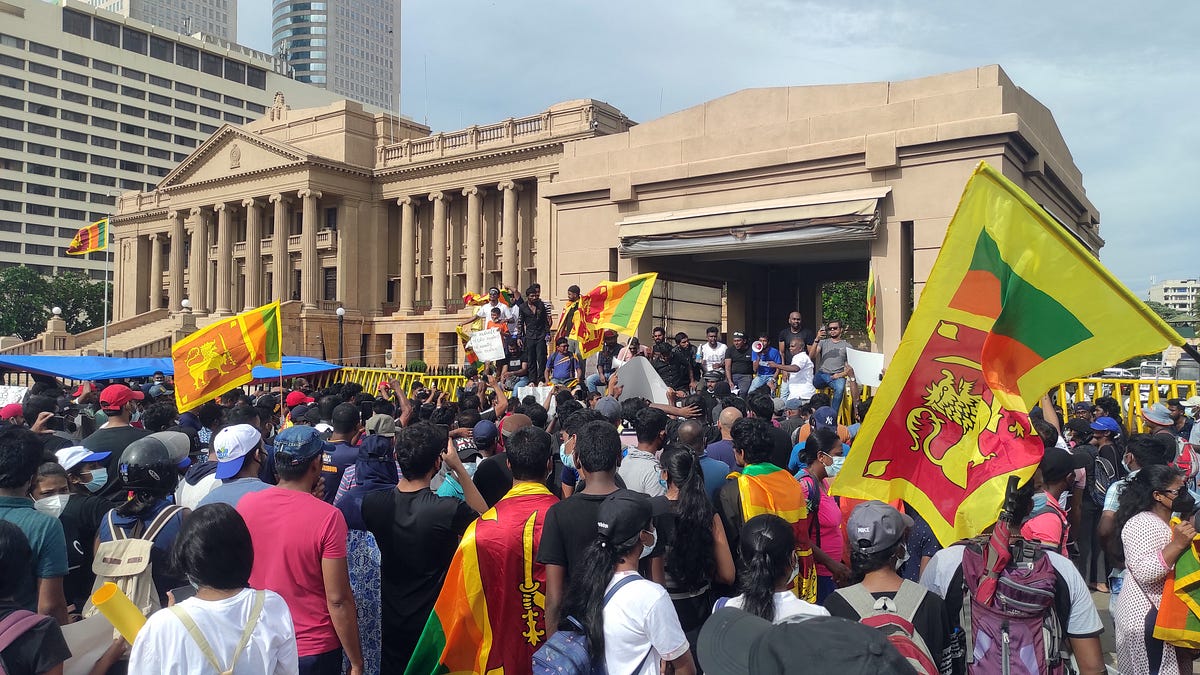
The Sri Lankan leader's hostile attitude towards the Sri Lankan population is what made protesters storm the leader's home.
In the US that might be a sensible policy decision but SL can't do that.
The concrete supports that are needed (fuel, fertilizer, food) are bought with dollars and yuan. The government ran out of those, because it was already spending unsustainably to prop up the economy.
The current inflation crisis suggests that even the US economy can reach its limit with endless money printing and stimulus.
With the cost of borrowing going up, the executive and congress are going to start feeling pressure to cut spending or dramatically raise taxes.
I remember seeing tons of economics articles talking about how the consequences of monetary expansion were historically being overrated by economists in the past and that countries have far more capacity than previously thought. But that was easily said during the good times when spending is high.
Blaming it all on a war in Eastern Europe seems to be convenient excuse but there’s a reason you don’t spend wildly during good times, so you have the capacity to spend during the bad times. This has consistent been a critique of modern monetarist and Keynes policy (although you could argue it’s far more monetarist since a Keynesian approach would be via things like infrastructure investments for working class jobs, instead of just endless spending on backchannel megacorporate dealing in thousand page bills).
India also didn’t print much money in the pandemic. The effect is clear now. We only had a short lived inflation spike after the economy reopened and its now getting back to normal.
Like in the 1970s. Crude oil prices went up 10X between 1972 and 1982. Is it surprising that the price of everything went up during that time, or economies everywhere experienced stress?
Fiscal and monetary policy isn't the whole explanation, no matter what certain recipients of the Sveriges Riksbank Prize in Economic Sciences in Memory of Alfred Nobel would have you believe.
Hmm, not sure that's the case given recent headlines in Politico.
The nutrients in soil are a non-renewable resource. You can’t grow on the same piece of land and expect a bumper crop every year if you don’t use fertilizers.
No one is expecting bumper crops without any nutrient inputs. Synthetic fertilizers are not the only possible nutrient inputs.
I'm sorry but they actually are. Every time you do tillage you start from scratch. Hence you run out of nutrients much faster than if you used no till. Most of the fertilizer in tillage operations just gets washed away during rain which results in an over application of fertilizer and the runoff results in algae blooms.
To keep land arable in the longer term, you need to do crop/usage rotation, no-till farming, etc.
Agriculture is fun.
...which results in water that's so clogged it can't support fish, aquatic arthropods and so on.
Perhaps that doesn't matter, if the river rolling past your window is the Mississippi; but in this country, our longest rivers are only 100 miles or so.
What will happen to this country if the next president actually stops spending in order to do what his voters want?
Then you have other things like Walmart and similar McJobs where the government is indirectly subsidizing the companies, by various child food aid, healthcare and benefits to employees because the company doesn't pay enough for its employees to live without aid.
It's also possible that it's impossible to get subsidies spent in a way that isn't rife with such corruption. I would say that the only way it may be possible is small government. Not because subsidies are bad, but the only way to watch government closely enough to keep corruption low is to make it small enough to watch in entirety.
Like a computer program, if it has less lines and less features, or less overall complexity, it should be easier to spot bugs and egregious mistakes. That's not the same as not wanting features at all. Or, it can become a political version of Zawinski's law where people want more from government and the resulting size and complexity is such that a group of corrupt developers can spread their corruption across so many branches and parts of the project that no one can watch it all (after all, isn't that how the 3 letter agencies undermine security software?)
What can cause this is welfare cliffs and systems with asset tests like SSI.
Bernie does like to say this because it sounds good, but he knows it’s false.
My mother in-law complained about letting refugees into the country and says we shouldn't allow due to the cost yet she is a war refugee herself. When asked about her situation, she says she deserved it.
Also how many companies opted out of PPP loans.
> Also how many companies opted out of PPP loans.
This is exactly what I was going to highlight, people who use the narrative that some how a $1200 stimulus check sent nearly years ago is what is keeping people from taking low paying, dead-end jobs are the first to overlook the fact that PPP was the biggest welfare handout to the business class in some time, compounded on top of lower tax obligations. And 75% of the PPP [0] was never actually used for payroll!
It's insulting to working class people to see this narrative be as persuasive as it is, even amongst their own, but if I've learned anything about US culture is that was it 'trashy' for the lower class, is some how 'classy' for the rich. It's a pathetic attempt to divide people into already highly contentious tribes in order to maintain the illusion of business as usual.
0: https://finance.yahoo.com/video/report-shows-most-paycheck-p...
Government spending isn't free magic money either. You increase the amount of money in circulation, hoping that people will produce more goods. Instead, you increase the size of the bullshit economy - low-effort activities that only exist under the abundance of money. So more and more stuff gets imported from China because nobody in the right mind will take a $1/hour factory job if you can be a wellness youtuber for a multiple of that. The amount of useless bureaucracy grows, the number of people willing to take responsibility dwindles, but everyone is happy because, well, Mother Government takes care of us all.
Occasionally you notice that the wages don't grow and the housing is unaffordable because the workers don't really have any leverage anymore, but you brush off those thoughts because there are far too many distractions anyway.
Then BOOM, that fragile supply line involving slave labor in China and natural resources from Putin's friends gets broken, and suddenly, we have a shortage of everything, can't manufacture our own stuff, and that freshly minted dollar can buy you many shitcoins, but won't get you any baby formula.
I think, we are about to find out that excessive spending was nothing more than borrowing from our future prosperity, and the time for that debt to mature is coming fast.
Yes I suppose it falls into the category of swap, because people bring euros and exchange them for local currency to buy local goods and services. But it was a big part of the "swap" that vanished for 2+ years.
How did these island nations sustain themselves before ? In other words, what has changed that they can’t live off the land anymore? And by that, I mean the sea.
Has Sri Lanka’s fish been pillaged? Is it being exported to wealthier nations that command higher prices, even as there is a domestic food crisis?
How much of this is because of globalism and developing hard dependencies? I’ve traveled to all 47 of Japan’s prefectures and I still see bountiful agriculture in the countryside. Even as developed and wealthy as Japan is, with many global dependencies in imports/exports, it is still heavily invested in agriculture.
It's often a series of mis-steps that lead to catastrophic failures such as being suffered by Srilanka. Here are a few that come to my mind, in no particular order.
  1. Tourism took a big hit due to COVID lockdowns.

  2. They took on huge debt from China to fund their massive infrastructure developments with close to zero plan as to how to reap the benefit of that infrastructure. For instance this airport[1]

  3. The knee jerk banning of fertiliser.

  4. Corrupt and authoritarian (despite being democratically elected) government favouring their cronies.
[1] https://www.forbes.com/sites/wadeshepard/2016/05/28/the-stor...
[2] https://www.reuters.com/markets/commodities/sri-lanka-rows-b...
See this detailed report by The Atlantic: The Chinese ‘Debt Trap’ Is a Myth https://www.theatlantic.com/international/archive/2021/02/ch...
And this study by British campaign charity Debt Justice, which found that the situation in Africa is similar: https://debtjustice.org.uk/press-release/african-governments...
The Chinese debt trap is a lie made by mainstream media, who for some reason blindly writes negative China articles without any kind of factual investigation. Worse, these lies distract us from actual debt traps initiated by western actors — over we which we have far more control than China. If we actually care about these countries then we need to first demand from the media that they do factually correct reporting.
Same is the case with Africa, and many projects of which do not benefit the citizens of those countries in any way too. [2]
[1]: https://www.nytimes.com/2018/06/25/world/asia/china-sri-lank... [2]: https://www.youtube.com/watch?v=aJSD8XV3qzE
My understanding is more of the Chinese debt is unproductive. 5% borrowed to build a useless port saps FX in a way 20% borrowed to buy yield-boosting agricultural inputs does not.
Funny what being unable to import can do to a country. The US cannot have this problem since it controls the world reserve-currency. It can in principle print itself out of any problem.
you got that the wrong way around. The US has the world reserve _because_ it cannot have this problem (of not having enough domestic production of necessities).
The world isn't entirely controlled by the US - even though they do dictate a large portion of financial policy all over the world, the countries of the world decided to use the US currency as an intermediary because of the stability and assurances (that has recently been shocked by financial sanctions of magnitudes never seen before).
After WWII, the world agreed to use the US Dollar as reserve currency because the US promised to exchange every 35 USD for one troy ounce of gold, as per the Bretton Woods agreement.
And when the US defaulted on this obligation in 1971 the world continued using the USD since there was no other politically viable alternative.
https://www.macrotrends.net/countries/LKA/sri-lanka/populati...
Japan imports about 60% of its food.
https://www.merlofarminggroup.com/agri-view-japan%E2%80%99s-...
The point is not about whether a country imports at all, but whether it can mobilize domestic production of essential food crops in times of crisis.
Even China import and has rice reserves. There is a reason these government have and subsidized rice reserves rather tea reserves.
To put it crudely Japan doesn't need to grow all its own food because people send it money for Toyotas and Mitsubishi cargo trucks and such, and it uses that to buy whatever food it wants.
Sri Lanka could, but not with the chemical fertiliser ban.
It sustained itself thru tourism and local food production.
They have sold tea overseas since being a British colony.
Also, another factor is they have to import all their medicines and oil, which is also dependent on foreign reserves. So now not enough food, no cooking fuel, no medicines, no petrol, and not enough fuel for electricity. Truly a wretched set of problems.
You can buy Dilmah tea to help, Hand made Batik shirts, and visit. It is a truly lovely country, with good tourism facilities.
In my experience, exported goods provide very little profit to the original manufacturer. The middle layers greedily absorb all the profit. In fact, in the west, labor costs to stock/sell it in the supermarket are significantly higher than what the manufacturer made for their effort.
Instead, I’d really recommend donating the money to an action group or trusted charity, ideally if you can also verify they are doing actual things on the ground.
But longer term, having Sri Lanka goods be valued on the world market will help the island. Dilmah employs a lot of people on the island.
Not to mention the people. Absolute wonderful human beings despite years of war and turmoil.
Because spending on fertilizer was a lot of their foreign currency spending, and the government thought "We'll just force 'organic farming' so our spending will look better!".
My risk appetite is significantly higher than the average tourist, but even I'm not stupid enough to go there right now when there's the potential for things to get much worse, very quickly.
In Japan agriculture is heavily subsidized, in particular rice production. Stuff that is not heavily subsidized focuses on high margin premium. They can't compete on volume/price but can on quality. After eating expensive apples or grapes there nothing really compares anywhere else
Rice, unlike tea, is a defensive measure for times of crisis. Even as Japan imports food, the point is whether the country can quickly mobilize and ramp up to essential food crops. The point is having options and a hedge, which allows you leverage during economic negotiations for other things.
The percentage of imports you can have should be bounded by the runway and time horizon you have.
It seems Sri Lanka went all in on one crop without a hedge, and it would infeasibly take years to convert.
We have had enough bad experiences in the past however to give up having some level of self-sufficiency.
If you ever wondered why nearly every European country is in the EU, except Norway well there you got part of it he reason.
The risk is asymmetric because your specialty (tea) isn't an absolute necessity (may be 'cept to the brits), and yet, you _need_ food (an absolute necessity).
https://www.canr.msu.edu/prci/publications/Policy-Research-N...
The fishermen can no longer afford or acquire fuel for their boats to go out and catch the fish. Due to the non fish related economic disaster outlined in the article.
Fishing is not a modern activity. Rafts existed long before people rode horses.
/s
Well the chemical fertilizer ban means no living off the land. ~85% of the farms are expected to fail or have failed.
>Has Sri Lanka’s fish been pillaged? Is it being exported to wealthier nations that command higher prices, even as there is a domestic food crisis?
No, they have tremendous inflation(54.6%) and therefore fishermen cant afford fuel to go get those fish. Major fuel shortages means no eating food in sri lanka.
https://www.scmp.com/news/asia/south-asia/article/3172540/pl...
>How much of this is because of globalism and developing hard dependencies? I’ve traveled to all 47 of Japan’s prefectures and I still see bountiful agriculture in the countryside. Even as developed and wealthy as Japan is, with many global dependencies in imports/exports, it is still heavily invested in agriculture.
It's not dependencies persay but rather yes globalists are entirely at fault. This is the work of Davos/WEF.
https://www.sundaytimes.lk/180902/news/pm-this-is-how-i-will...
This used to be an article on WEF but they deleted it because obviously WEF is responsible for what is happening in Sri Lanka 100%.
The funny thing about the WEF conspiracies or for that matter the sri lanka politicians didnt see the trap they were falling into. Personally I dont believe WEF has done anything, they just convince stupid politicians to do stupid things.
Sri Lanka believed and even achieved an ESG score of over 95, beating most countries.
The true cost of feeding the world is much higher once you take away the subsidies and security architecture that makes all of the above possible.
They didn't. At least by today's standards. The poorest parts of the world have become immensely richer over the past 50 years. In the 80s it was still common to have famines that could wipe out millions in a small area.
Despite a massive population growth in the world's poorest areas, such famines basically don't exist anymore.
For Sri Lanka, the right thing to have been done (in hindsight) is to keep the country open for tourism and disregard covid impact. Kind of like Texas/Florida.
They had to choose between the lesser of the two evils. This is a hard decision to make.
but even if they did, would tourists still be arriving? I suppose if the leaders thought that the human toll is worth keeping the economy alive - but then again, they wouldn't have mandated "organic" farming if they could come to that conclusion.
And in any case, the inflation and war in ukraine raising fuel prices would not have been helped by tourism imho. A double whammy isn't easy to recover or prevent tbh.
Also, the rest of the world had curbs on travel, which would have made it non viable anyway.
There are several other reasons, involving bad policies and bad rulers, but that was one of the main reasons for the sudden implosion.
[1] https://www.ft.lk/article/1778/Tourism-%E2%80%93-Engine-of-g...
[2] https://www.orfonline.org/expert-speak/how-tourism-in-sri-la...
It was a series of events, all mistakes done and compounded by the Rajapaksa clan over decades in power. All their assets need to be seized/frozen, Everyone of them need to be brought back to the country, made to stand trial and put in jail for ruining the country.
Who are the biggest "friends" of Sri Lanka? The US, China? Who profits from a weaker Sri Lanka. That's the real question. I know this site has people from all over, so I'd love to read more from the people who are NOT on the other side of the world.
1. https://github.com/binka/essays/blob/master/us_atrocities.md
2. https://twitter.com/justinbaragona/status/154695519704541593...
Everything starts when people elect leaders based on hatred instead of good governance. Citizens of Srilanka or any of the countries that may follow the same step cannot just blame this cronies and escape. People needs to self realize their part.
I was there in December 2021. There were some extra long queues at petrol stations, but nothing too out of the ordinary.
Incredibly beautiful country and very generous, friendly people. Hope they see better times.
Maybe churches will need to install the kind of security fixtures commonly found furnishing synagogues in Europe. It generally does the job of keeping pathetic misanthropes who think it's good to bomb religious communities out on the curb where they belong, to issue empty threats and get carried away to a nice new home.
I thought the reason was that Sri Lanka's fertilizer and pesticide supplies were all imported, and were therefore contributing to the BoP crisis. I'm not for a moment suggesting the ban wasn't dumb!
The Rajapaksa family are a bunch of cruel, racist, venal despots. I fail to understand why Sri Lankans kept electing them to power.
Don't get me wrong; it is necessary for the US stop the inflation spiral, in particular now that it is in a defacto war with Russia (whos resource rich economy benifits from inflation).
But imagine having your loans/expenses in US dollars and your income in Japanese yen.
What is MIA in the Sri Lanka discussion is the underlying reasons for the situation.
It seems one of them was misguided govt policy, in that they banned common fertilizers in favor of ESG-friendly fertilizer. It seems said fertilizer collapsed output, which meant less exports, less hard currency to import (late on the game) regular fertilizer.
I still sont know why ESG was favored. I also dont know what was the upside for sri Lanka to do this.
Nothing so sophisticated. No money left for fertilizer, no fertilizer. Dressing it up as "ESG" or "organic" amounts to blame-shifting.
They wanted to appeal to Blackrock and their insane ESG rating.
> Production of tea -- Sri Lanka's main cash crop -- fell by 18% in a year. Production of rice -- the main food crop -- fell by even more.
The problem isn't the currency.
I have a hard time believing in such a gross mistake.
https://web.archive.org/web/20190122012624/https://www.wefor...
Inflation, coupled with a rally in the strength of the US Dollar, is going to push many smaller nations into resource shortages and ultimately towards revolution.
Even many of the major world currencies are doing poorly. The Euro is tanking(back to parity with the dollar, for now, but it may go lower). The Yen is in trouble. We may need another Plaza Accord. There is also a very real risk that we see populist governments come to power across the EU and much of the world.
If you think the recession and upheaval is getting ready to be over with you need to take a deep dive into the macro world and see what's happening. Bank runs and a major economic collapse in China. Brazil and India cozying up to Russia for oil, with Europe and Japan utterly dependent upon them as well. Industry in Germany and much of the EU about to grind to a halt.
It's been striking how little discussion there is of this in /r/europe and /r/germany. (The latter has pinned a megathread for the topic, the classic way of killing discussion.) /r/de is slightly better, if only because of the absence of the constant "I don't know German but want to move to Germany and get a job" posts.
I don't mean to say that there's been nothing, along the lines of the 100% censorship that happened at /r/news the day of the 2016 Orlando mass shooter. There has been some. But there is far, far, far less. Just this week we've had
* a German minister stating that becoming dependent on Russian gas was a "grievous mistake", and that his country is begging for turbines from Canada "with a heavy heart"
* His government stating that entire industries might "collapse"
* Rationing of gas announced
* Local municipalities planning warm buildings that those without heat in their homes can visit during the winter
This is the greatest German catastrophe in 80 years. It is an existential threat to the German (and, thus, European) economy and nation. Any other topic half as serious would occupy far more of these subreddits' front pages.
I suspect it's because most Germans don't hang out there and those forums are populated mostly by expats.
While I do not have personal experience with /r/germany's moderators as I do with /r/europe's, if they are similar (likely, given how much inbreeding there is in big subreddits' mod teams), I suspect that submissions of said news coverage is being suppressed to avoid blurring The Message(TM).
Ouch. I find the current ones already pretty populist.
Ignoring the volatility and environmental concerns, why shouldn’t all these small to medium-sized countries standardize on a cryptocurrency?
Controlling your money supply can be needed to improve your country's position with regard to foreign trade. Greece would probably have been better able to manage its recent debt crisis had it controlled its own currency rather than being tied to the Euro, for example.
> Ignoring the volatility and environmental concerns, why shouldn’t all these small to medium-sized countries standardize on a cryptocurrency?
Because people still need to be able to transact with something, which is not a function well-served by cryptocurrencies, most of which have the bulk of trade in them carried on off-chain or via stablecoins that track a fiat currency.
This is basically protectionism, an economic theory that has been debunked time after time. If it were true, then why doesn't it hold true for individual states within a country? And while we are at it, why not a currency for every city or neighborhood?
> Because people still need to be able to transact with something, which is not a function well-served by cryptocurrencies, most of which have the bulk of trade in them carried on off-chain or via stablecoins that track a fiat currency.
Those same systems could simply add support for cryptocurrency. Paypal did a few months ago (not sure if they enabled merchant support or p2p transfers, but there's no technical barrier preventing them to do so). Credit cards could also add crypto to the long list of currencies they already support. Etc.
That’s a bit like saying the dollar isn’t a suitable currency because most transactions don’t happen directly through the Federal Reserve. Most people would transact through “layer 2” systems like Lightning, or even paper currency issued by one or more countries but backed by cryptocurrency reserves.
The cryptocurrency bit is to allow mutually distrusting countries to standardize on a single currency, if that’s something that might be valuable.
They simply don’t make anything to sell that has value other than tourism and natural resources.
Trade imbalance has been an issue for decades and they simply hid the problem by taking out loans.
They have simply run out of credit.
My two cents
To get as screwed up as this you can only achieve with centralized planning, where a single decisionmaker mistake can mess up the sustenance of millions.
Good chunks of the North are still somewhat off limits and fucking littered with landmines too.
Also, most countries end up managing their currency reasonably well (better than having a fixed money supply). Sri Lanka is in the news for failing, but most nations are quietly doing reasonably well.
Do you have a source to back that up? I can think of many countries where it was done successfully (e.g. Hong Kong, UAE, Panama, etc.).
Lots of deflation or inflation has bad effects by influencing how people spend.
Because money has a liquidity premium that allows you to disregard location, to make money less liquid you have to bind it to a national economy, otherwise buyers might decide to only import products from a handful countries. Look at Greece they run a trade deficit because German products are cheaper, this means Greek debt is impossible to unwind until Germany starts importing from Greece.
What happens if one of the countries needs to print some money to get out of a bind?
What happens if external countries don't want to receive the crypto in exchange for imports/exports?
I dont think crypto makes any of the above any better than an existing currency owned by the fiat banking system.
Controlling interest rates is incredibly important, especially in times of crisis. If you were pegged to the USD right now (which is skyrocketing relative to most other currencies), you would be in trouble.