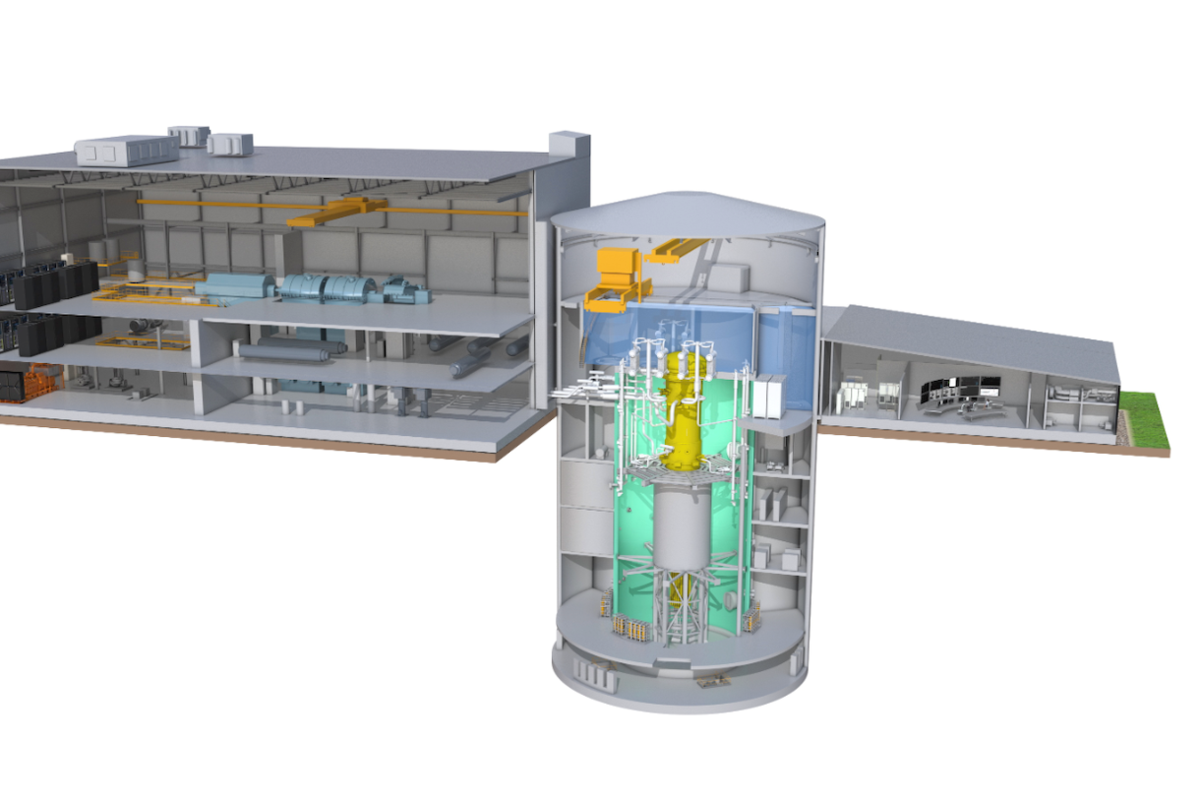
Saskatchewan, Ontario to roll out mini-nuclear reactors
The GEH zero-emission reactors – each with enough power to fuel more than 200,000 homes - could be deployed by 2030s
Western Investor
422 points · by voisin · 4y ago · 400 comments
The article was published on July 11, 2022, but opens with: "Saskatchewan and Ontario have each chosen GE-Hitachi as the supplier of small modular nuclear reactors (SMRs), which could be deployed in the Prairie province by the 2030s and in Ontario by 2018." Then, the article concludes with: "GEH and Ontario plan to construct up to four 300 MWe small module reactors, with the first coming online by 2028."
A separate source by The Canadian Press [0] also reflects an estimate of 2028 for Ontario: "The governments of Ontario, Saskatchewan, New Brunswick and Alberta have put forward a nuclear plan that they say will transition them toward cleaner energy. The provinces’ energy ministers agreed today to a joint plan for small modular reactors, with the first 300-megawatt plant to be built in Darlington, Ont., by 2028."
[0] https://financialpost.com/commodities/energy/renewables/onta...
Saskatchewan wants to have a mining contract. While Doug Ford of Ontario, wants to maintain the energy monopoly in the province, and has actively torn down recently completed and functional wind farm projects.
I would gather that you will be hearing less about this after Doug Ford leaves.
[1] https://www.newswire.ca/news-releases/canadians-support-gove...
[2] https://www.cer-rec.gc.ca/en/data-analysis/energy-markets/pr...
WTF?
Just saying.
https://www.ieso.ca/power-data
Nuclear is the base load, alternatives supply what they can, and hydroelectric dams and gas plants act as the variable load supply.
If we can just lose the gas plants, we'd be pretty close to zero carbon. And I think that achievable.
e.g. refurbishement of Darlington was hundreds of millions over budget: https://globalnews.ca/news/3795801/darlington-refurbishment-...
I just came back from a few days up in Grey-Bruce and there are signs all over the place angry about the proposed NWMO waste diposal site up in Teeswater there. Very divided community about the issue. (Then again the same rough area or just east of it was extremely bitter about wind turbines some years ago, too, so can't please everyone...)
Another 2500-3000 MW of nuclear would take up some more of the base load, and allow hydro to deal with most of the variable load.
Look at Texas- they only fall apart 1-2 days per year, but that's enough that it's a crisis every time. How confident are we that our hydro dams can sustain us in the worst case every year or decade?
I think to achieve it, we would need to see financial incentives, direct or indirect, to have everyone buying up power batteries for their homes, reducing the variable load. Maybe price incentives like nearly free electricity at night and extra costs during the day, etc.
So yes, there were new power plants coming online, but after budget overruns and missed timelines.
Anyway, nuclear is still great baseline source of energy, so pity we don't build it better.
In the UK, the Hinkley Point C project is over-budget and late, partly because they had problems with their initial concrete pours that necessitated exceptionally costly and time-consuming rebuilds. But as Hinkley gets closer to completion, the lessons learned are being transferred to Sizewell C, another EDF plant. [1]
The world needs these large nuclear plants and we can’t just give up because the first few constructed went over budget and took too long.
[1] https://www.economist.com/briefing/2022/06/23/energy-securit...
Other significant projects to check is the building by KEPCO and ENEC, I think BARAKAH-1 was the first unit connected: https://pris.iaea.org/PRIS/CountryStatistics/ReactorDetails....
There are a lot of teams working on this issue, like Oklo: https://oklo.com
[0] https://www.french-nuclear-safety.fr/asn-informs/news-releas...
In what way? For the price that they actually cost after construction you can get double the capacity in wind, and double the capacity in solar, and a CAES plant capable of storing several days of energy at the same capacity, and the same capacity in a combined cycle gas plant, and a redox flow battery with 12 hours of storage, and a hydrogen electrolyser capable of producing enough hydrogen or methane to run the gas plant with change left over.
All so you can make your energy infrastructure beholden to one fuel supplier where your country is not allowed to produce any yourself. Then you have to find somewhere to put the waste for millenia.
And that only if you're on the short list of countries that the US, China, or France will even sell fuel to.
None of this have ever happened beyond "research" projects at extremely small scale. You can't take nuclear "actually cost after construction" - which in some countries like Korea or China is maybe 20% more than original estimations - and apply assumption that anything of this is actually able to scale, not even talking about cost of this.
If I can choose the time and place for when to do the trade, I would make a huge profit trading 2 units of energy and getting 1 unit back later at my specified time and place. The top price is around 40cent per kwh when the wind is still and demand is at its peak, compared to ~3c kwh when the wind is at the maximum production and demand is at the lowest. paying 6c worth of wind power and getting 40c when I specific it would be massive profit.
Green hydrogen if burned for energy would cost about 3-10 times that of nuclear per kwh. In the future that cost might go down but for now that is a bit (which is why no one are producing green hydrogen in order to produce energy). Again, if you are willing to sell green hydrogen for the price of nuclear, eating the loss, then sign me up. I will happy buy that and sell it for minimum 3x of what I pay for it since there are plenty of industries that want energy when demand is high and supply is low.
The cost of energy is not determined by how much it cost to produce. It is determined by the time and place it is delivered. 1 unit of energy produced today is not fungible for 1 unit of energy produced tomorrow. Only energy produced at the same time can be evaluated based on how much they cost to produce.
That's a lofty claim and I have heard CAES storage at economic scales is still unsolved, else we'd see a rocketship company in the space. If you do know of a stealthy rocketship here, who is it?
you are aware that you are posting on an article about Ontario and Saskatchewan, correct?
How about you go review the tables showing how little solar energy these provinces receive in the winter?
So when we need energy to heat our homes and power our lights, our solar output is also greatly reduced?
Solar may be great further south, where it is sunny all year round, but in the north we need reliable power all year long, including our cold and dark winters.
It doesn't get cold and snow here for no reason, it is caused by the reduction in solar energy we receive.
And the capacity factor of wind is ~33%, which means you need ~3 times as much wind as nuclear. The capacity factor of solar is ~25%, so you need four times as much:
* https://en.wikipedia.org/wiki/Capacity_factor#United_States
One more thing though that makes this calculation even more ridiculous: They're comparing today's wind+solar prices with a tech that's supposed to be available in the 2030s. Like, they're assuming wind+solar won't progress in the next 10 years. That's... a very unrealistic thing to assume.
Renewable prices are computed as : "I put $XXX and got this much electricity during the year, so price per watt is $YYY -> renewable is cheap"
That calculation is not reflective of the reality of the needs. People - and anyone in charge of maintaining a power grid - think like so :
"I need YYY watts of electricity now, how much $XXX do I need to put down to get it ?"
That amount is massively higher in price per watt with renewable, because renewable can sometime works at >90% of their potential, and provide cheap and abundant electricity or they can decide to work at < 1% and be completely useless. And I have never seen anyone advocating for renewable that is willing to say "Please do cut my home line to save electricity when it's dark and windless - even in November - if batteries are low. I think it's better than building reliable backup supply".
Nuclear is the preferred choice here because you are going to get electricity in those situation at the push of a button. Maybe prices will be higher than the price per watt of renewable, but it will provide electricity when no amount of wind farms and solar panels are going to do the job. Meaning when prices of renewable are approaching infinity. In that case, expensive nuclear is still cheaper than failing renewable. Batteries can help renewable, but no one in anywhere near the ability to store energy for a whole country for weeks in cold countries, when days are very short and wind can just decide to stop blowing. There are other options than nuclear - like the usual coal, gas and oil, but they have their own problems - like CO2 emission. Other options include geothermal and hydro but they have ecological aspects as well, and tend to be more expensive than nuclear.
Sure they do, the storage is just called hydroelectricity. There are parts of the world (eg Tasmania) with months of energy storage.
For the realised cost of nuclear and construction timeframe of nuclear, you could build a resilient supply with a distributed transmission grid and a mix of batteries and pumped hydro.
And it's STILL cheaper than nuclear watt for watt.
That being said, I think nuclear power is a necessary part of a sustainable energy mix, because it is much easier to satisfy ground load with it, and you don't have storage issues. (But this article is stupid at best and disingenuous at worst)
We need energy at a specific place and time. Renewables don't meet those needs. We get them where the weather permits when the weather permits.
This is not fine, for multiple reasons:
1. Nuclear is probably not the lowest number. See Lazard's analysis of levelized energy costs: https://www.lazard.com/media/451881/lazards-levelized-cost-o... on the whole / on the average, Nuclear in 20221 is $167 / MWh while solar is $36 and wind is $38. Now, granted, maybe these mini-reactors are cheaper than the average, and maybe solar and wind are effectively more expensive etc. - but I doubt it's that much of a difference; and the figures quoted are not "levelized costs", so they may be neglecting various factors, such as maintenance of older reactors or waste storage (which needs to happen for hunderds or thousands of years).
2. The reason you yourself gave - "over schedule, over budget" : Even if you want to choose what's cheapest, it can't be what's cheapest as proposed, but what's cheapest as projected to cost.
3. Price is not everything. On the one hand, there's the question of availability of the renewables (e.g. you might need some storage as well); and on the other, there are the grave safety concerns from nuclear reactors.
4. Price is not everything. II : Greenhouse gas emissions. Nuclear is not "emission-free", since you need to count emissions due to Uranium-mining and processing, not just the electricity generating reaction. IIANM, there are significant emissions to take into account as well relative to solar, wind, geothermal etc.
It will make their operations cheaper, saving on transfer losses alone on their scale is significant gain.
[1] https://media.kghm.com/en/news-and-press-releases/kghm-plans...
see https://www.science.org/content/article/fusion-power-may-run... for more info.
- "If not for CANDU reactors, D-T fusion would be an unattainable dream. “The luckiest thing to happen for fusion in the world is that CANDU reactors produce tritium as a byproduct,” Abdou says. Many nuclear reactors use ordinary water to cool the core and “moderate” the chain reaction, slowing neutrons so they are more likely to trigger fission. CANDU reactors use heavy water, in which deuterium takes the place of hydrogen, because it absorbs fewer neutrons, leaving more for fission. But occasionally, a deuterium nucleus does capture a neutron and is transformed into tritium."
- "If too much tritium builds up in the heavy water it can be a radiation hazard, so every so often operators send their heavy water to the utility company Ontario Power Generation (OPG) to be “detritiated.” OPG filters out the tritium and sells off about 100 grams of it a year, mostly as a medical radioisotope and for glow-in-the-dark watch dials and emergency signage. “It’s a really nice waste-to-product story,” says Ian Castillo of Canadian Nuclear Laboratories, which acts as OPG’s distributor."
"Whats your annual yield?"
"100 grams...."
I wonder if there are other elements being produced and sold that have such low yearly yields. Bonus points if they are super expensive.
How much botox is produced per year: 800 million units [1] = 0.04 grams
Average cost per injection is $466 [3]
Allergan’s $2.8 billion Botox empire (2017), on track to grow to $4 billion by 2020 [4]
[1] https://www.brightnewme.co.uk/want-to-know-what-its-like-ins...
[2] a unit is 5.0 x 10 power -11 grams: https://toxedfoundation.org/botulinum-toxin-and-botox/
[3] https://www.plasticsurgery.org/cosmetic-procedures/botulinum...
[4] https://www.bloomberg.com/news/features/2017-10-26/inside-fo...
In some cases the half lives of the isotopes are so short they literally have to be produced on demand at a facility nearby, which usually means they can only be produced/used by facilities with their own equipment for producing them, or they are colocated on some sort of larger campus where they happen to have a suitable isotope producing accelerator as their neighbour.
Fluorine-18 is used in certain kinds of PET scans for cancer imaging, and has a half life of 109 minutes! https://en.wikipedia.org/wiki/Fluorine-18
Technetium-99m is one of the most commonly used radioisotopes for medical imaging and has a half life of just over 6 hours https://en.wikipedia.org/wiki/Technetium-99m so the usual mechanism is to ship the material that decays into Technetium-99m because the Molybdenum-99 parent isotope has a half life of 66 hours so lives long enough you can actually ship usable amounts around. So while this one is obviously not a low yield isotope, it really shows how the half life of the isotope can be worked around to make an an isotope a useful product.
Its a little hard to give simple numbers for a lot of these since they get measured by "activity" in Becquerels (Bq) as that's the useful metric based on how they get used, so giving "mass" would involve a lot of math and some guesses based on how efficient supply chains are (since you might produce twice as much and just "eat the difference" letting it decay if you have no other good way to get it to the user faster) but its a very fascinating industry.
Theres some fascinating information about how this sort of stuff gets made https://www-pub.iaea.org/MTCD/publications/PDF/te_1340_web.p... if you want to find out just how "fiddly" it can be to do chemistry with elements that might just decide to change what they are while you're working with them.
Most of the synthetic elements (like technetium, it's in the name) probably have similar or far lower yields to tritium since they all are produced by transmutation and that requires monstrous amounts of energy.
Not an element, botulinum toxin has billions of doses made, but the total production is well under a gram.
That's one gargantuan "once", let's plan our energy generation assuming it doesn't materialize, we can always recalibrate if it does.
That being said, fusion will come too late to do something about climate change, so we should be building renewables as quickly as we can, and, if we have too much money, perhaps add a bit of nuclear.
If the answer is steam then fusion is as dead as coal and nuclear. Or is there some solid state like solar or very non-complex working method like a wind turbine which is the target?
Let's not take it for granted, for sure, but let's maybe dial back on the "fusion is always 20 years away" jokes. There isn't a bigger win for civilization than fusion, leaving aside unknowns: immortality might be possible, fusion was our only source of energy until the discovery of fission.
I hope you will allow people still being sceptical and cautious about counting on fusion for at least another 20-30 years.
The progress that the physicists and engineers made is tremendous and I appreciate everyone's sacrifices to make fusion a viable energy source.
However, it isn't one yet and likely it won't be for decades. There are still plenty of engineering challenges, and once those are solved, comes the economical, bureaucratical challenges (just take a look at how bad most countries are in building new fission reactors).
Both can be true at the same time.
I don't know about you, but I am planning my life with the assumption that the energy I use won't be coming from fusion for the rest of it (and I am around 30).
Total worldwide annual production of tritium is under 10 kg.
It is just barely possible Helion could succeed someday.
I forget which company, but I know one of these were sold as being tested to be safe under a direct missile hit in case of an attack! Super cool.
Edit: Territories, not provinces. All three of them.
You mean territories?
[1] https://www.nunavutnews.com/news/quassa-says-next-step-for-n...
I get that this is coming from a website whose name contains "investor". As combustible based options go, I think nuclear is the least worse, and a site-C equivalent in Sask is probably not even an option.
I find it dangerous to a) put nuclear and hydro/wind in the same "non-emission" category, especially when nuclear does emit radioactive solid waste and the occasional radioactive cloud when they go boom, b) to reduce the comparison to a price-tag, where indeed nuclear will win
All of these factors and more (except cost) are on different scales and dimensions, so comparing them requires human value judgements - inevitably people disagree.
There are ways to minimize this of course, like building giant storage tanks, but dammed rivers are going to (usually) dwarf man mad retention pools.
It doesn't emit anything, radioactive waste is captured entirely on the other side. They also don't go boom.
They're in the same category because they're both zero-carbon power. If you want to compare safety, deaths per TWh has nuclear right in the same area as wind and solar - less than rooftop solar.
There are very uncontroversial answers to your questions, even if you personally don't like them.
What I definitely do not "like" is the dismissal of nuclear by saying "nuclear waste" without considering all the forms of waste associated with other supposedly "greener" solutions.
Solar panels and the stands they are placed are shipped (half way round the world) wrapped in acres of plastic, cardboard and polystyrene for shipping that is then just discarded at worst, and possibly partly recycled at best. Broken wind turbines, which happens frequently, are often just buried, and so on. Digging the raw materials out of the ground and refining them causes waste. Doping chemicals to get the rare earths cause waste. Just because in the West we recycle much of this, doesn't mean that, in the race to the bottom, factories in Asia aren't just dumping this stuff out of sight.
https://weather.com/science/environment/news/baotou-artifici...
If you have an uncontroversial answer to his question, simply say it.
You seem to have taken personal offense to his question in general.
What's your point?
I'd love to see some figures that prove or disprove that. I'm inclined to disagree and say that more waste is produced making solar panels and wind turbines due to the sheer volume of them that are being mass manufactured.
> What's your point?
My point is that everyone talks about nuclear waste, but no one talks about the toxic chemical waste produced the mass manufacture of hundreds of thousands of solar panels and turbines, versus the one-off construction of a few hundred nuclear power stations, and the extraction of a relatively small-by-weight amount of fuel.
Nuclear power is always under minute scrutiny compared to "green" power.
storing it safely is a bit more complex than "large indestructible concrete bins"
nb. I'm not anti-nuke, just pro good risk analysis
If you’re concerned about human health, nuclear waste disposal is well studied and so are nuclear reactor safety. In fact, these small reactors are designed to be too small to create any catastrophic event in the astronomically unlikely event of a critical malfunction.
It’s odd to me that we all take planes despite the fact historically many have gone boom, and many a life has been lost. Must be something to do with no other viable alternatives…
It's worse than that. Let's say you get 12 hours of steady sunshine every day.
What to do the other 12 hours? For that you'll need storage.
Therefore, you will need to double the capacity of the solar array so that during that 12 hours you can both store power and deliver power to people who need it.
But then no power store is 100% efficient, so you'll also need to add more panels for that.
But then you're never going to get 12 hours of steady power every day. You're going to have to increase storage and panels to account for that too.
We really have come a long way in bringing down prices for wind and solar!
Per the article, they estimate wind and solar to produce at ~40%. The reactors will operate at ~98%, some downtime for maintenance.
I don't think handwaving away the long term storage of nuclear waste and the risk of contaminating large areas can just be ignored, especially with a new unproven reactor design.
The Fukushima disaster is expected to kill precisely no one from the surrounding area due to radiation exposure, and the highest exposure among 36,478 dosimeters in Fukushima city in 2011 was 2.7 millisieverts with an average of 0.26 millisieverts. The 2.7 millisievert is believed to have come from a badge left in luggage that was x-rayed. A dose of 0.26 millisieverts is the same as the exposure from to round trip flights between NYC and London.
Add 50% to the nuclear cost because they always go over cost and time budgets.
That's probably a fairer overall estimate.
In case this hasn’t already been shared
I mean, we have trade barriers between provinces. It's insane.
I assume 300W is actually 300MW. If that's correct, solar panels are still much more convenient, also considering that power plant will require many acres of land for the building, pipes, etc. Solar panels have zero waste too. What am I missing?
We're also talking Canada, which isn't the best for consistent sunlight.
Nuclear plants also need decommissioning of course. Seems to be expensive due to all the radioactive material.
Canada has plenty of sun. Most of the populated parts are at the same latitude as central Europe. They have hydro and wind too. And not a very large population.
Also, latitude is irrelevant. If central Europe got as much snow as Canada they'd probably have far less solar panels.
They are being warehoused against the time that they may be sold.
Until night hits. Then it turns out you need a ton more solar panels to overproduce in the day to store energy in your expensive energy storage system. Which is inconvenient.
Solar aligns very well with daily energy demands, and storage helps smooth it out. In the end we will have a massive energy surplus and finding ways to use that extra energy will be big business.
Well, people don't but heating does. It is quite popular to produce heat for floor heating during the night (because there are tariffs where night energy is cheaper) and disable it at (part)day - floor heating has large inertia and keeps the house (or at least feet) warm for longer.
Solar has this issue, that a lot of people mount them and the highest amount of electricity produced is during the same period of time and during summer, where you have the most production you don't need heating - some use air conditioning, but it is not necessary in cooler parts of the world (and it uses less energy than heating).
At higher latitudes, the sun doesn't shine nearly as long, and the days are often overcast for weeks on end. Your storage needs to smooth over weeks, not hours!
The cost of that storage, and the solar array, would be much higher than the nuclear plant.
Edit: I wonder why you had to copy/paste only part part of the line. They literally address this in the next word:
> ...provided the 1,500- to-1,800 acres of land needed was free and the sun shone steadily
Even during overcast or rainy days, you'd be surprised how much sun energy still comes through.
Oh, and bonus, wildfire smoke blotting out the sun regularly in the summers now!
Seems sensible to pick a power source that doesn't depend on the sun with that many variables.
Storage cost.
Isn't it better to put more effort into a big one instead?
> The IC [Isolation Condenser] pool has an installed capacity that provides 7 days of reactor decay heat removal capability. The heat rejection process can be continued indefinitely by replenishing the IC pool inventory.
It would be nice if we were building reactors that could shut down without any external input. NuScale seems to be closest to production with a walk-away safe design. In other words, change "7 days" to "infinity days".
> they consider things like the possibility of using a central facility to produce high-performance concrete parts for the plant, as we have shifted to doing for projects like bridge construction. But this concrete is often more expensive than materials poured on site, meaning the higher efficiency of the off-site production would have to more than offset that difference. The material's performance in the environment of a nuclear plant hasn't been tested, so it's not clear whether it's even a solution.
https://arstechnica.com/science/2020/11/why-are-nuclear-plan...
I know there is the storage problem. But most energy is directly consumed or has to be stores for a short period . Heat for example. And heat is stored in water.
https://en.m.wikipedia.org/wiki/Akademik_Lomonosov
Not without its fair share of criticism, budget overruns and all other problems associated with building new nuclear reactors these days, but it did happen
It produces far less harm to the environment than fossil fuel generation, which should be decommissioned as quickly as possible. Every time a government chooses too replace nuclear generation with fossil fuels out of choice (I'm looking at you, Germany), they're a traitor to their own people, and to all humans.
And I'll never understand "green" people who actively protest against nuclear power. Yes, renewable power is better. But most of the power generated comes from fossil fuels, that needs to stop as soon as possible, which isn't happening in the short term via only renewable power.
I highly recommend watching this video by Kurzgesagt: https://www.youtube.com/watch?v=EhAemz1v7dQ.
• our past failures to get long-term storage of nuclear waste right
• the cost and time overruns for building nuclear plants in the last several decades
• the possible catastrophic failures even in a country like Japan
• the long term storage issue and its cost.
These serious unsolved issues are being hand-waved away again and again.
* Any cases of that are management issues, not nuclear power generation issues.
* Making safe nuclear reactors is a well-understood challenge. Even if you do include all incidents that have happened with outdated, flawed reactors, going all the way back, nuclear reactors have cause far less environmental damage and far fewer deaths per power unit than fossil fuels do. Also, this article is about SMRs, which have very different requirements.
* Nuclear waste storage is a solved issue, this just repeats the first point.
These costs are astonishingly!
If the 10,000 year costs fell on the producers and consumers directly (this is how it should be), they would quickly have a different point of different view
It's really not that hard, except from a political standpoint.
I wonder why it's so cheap when calculated this way it seems competitive with solar panels when I expected it to be a factor ten more expensive (of course solar panels wouldn't really work that far north).
https://www.youtube.com/watch?v=cbeJIwF1pVY&ab_channel=Illin...
However can we figure out how to get the same result with twice the energy and the ability to store it indefinitely at 40% efficiency. Especially given that the costs of all these technologies are going down at two digit percent per year.
Coal plants in particular are dramatically unsuited for the rapid changes in output to respond to changing demands for power.
Gas plants on the other hand are. And gas plants are cheap!
Overbuilding renewables with combinations of solar, geothermal (where available) and wind gives pretty good availability on it's own and with gas plants as a backup it gives you plenty of grid stability.
Edit: A link you posted elsewhere (thanks!) points out how well this works:
> If other sources meet demand 5% of the time, electricity costs fall and the energy capacity cost target rises to $150/kWh.
Battery storage is already well below this $150/kWh price.
Also the land requirements for huge solar / wind installations is another downside. Nuclear at scale is a clear winner especially in seismically stable regions of NA.
> If other sources meet demand 5% of the time, electricity costs fall and the energy capacity cost target rises to $150/kWh.
So just 5% of grid supply from something like gas lets you use storage for baseload now!
Battery storage is now available for as low as $55/MWh.
https://www.lazard.com/perspective/levelized-cost-of-energy-...
* $300 million for equivalent solar
* $200-400 million for equivalent onshore wind (they don't mention offshore wind which is more cost effective over it's lifetime)
* $1.5 billion for the SMR
Assuming solar and wind stay the same price for the next decade (which they definitely won't) that's a 4-5x construction price difference. The article didn't mention lifetime, decommissioning or running costs, which is likely a significant difference too.
> ...
> A 300W-solar power farm would require 1.5 million solar panels and cost approximately $300 million.
... watt??
India has a plan based on a three-stage fuel cycle, where the third stage runs on thorium. However they've had significant delays and the first prototype breeder reactor of the second stage is projected to be finished at the end of this year. The third stage is probably still some years away.
India and China are probably the most ambitious in terms of thorium fuel cycle research. India has the world's largest thorium reserves, and hope to utilize it for their power generation. China's most pressing concern is their smog crisis, which they hope to solve partly with nuclear power. They are also aiming to own most of the intellectual property with regards to thorium reactors, and it is part of Xi Jinping's drive toward making China carbon neutral by 2060.
Other countries have some small research initiatives but no concrete plans to build anything so far as I know.
. . . with bonus '0' and misplaced comma at no extra cost I trust?
Note the "could be".
Can the myth of cheap, safe and quick to deploy fission energy please die?
It's not cheap, for good reasons[1]:
> Among the surprising findings in the study, which covered 50 years of U.S. nuclear power plant construction data, was that, contrary to expectations, building subsequent plants based on an existing design actually costs more, not less, than building the initial plant.
> The authors also found that while changes in safety regulations could account for some of the excess costs, that was only one of numerous factors contributing to the overages.
It's not safe:
> US nuclear regulators greatly underestimate potential for nuclear disaster, researchers say[2]
> Now I was serving on the Nuclear Regulatory Commission, [snip] In 2009, President Barack Obama named me the agency’s chairman. [snip] > Afterward, the falling cost of renewable power changed the calculus. Despite working in the industry for more than a decade, I now believe that nuclear power’s benefits are no longer enough to risk the welfare of people living near these plants. I became so convinced that, years after departing office, I’ve now made alternative energy development my new career, leaving nuclear power behind. The current and potential costs — in lives and dollars — are just too high. [3]
It's always slow to deploy[4]:
> Finland's long-delayed Olkiluoto-3 nuclear reactor connected to the power grid for the first time on Saturday, the plant's operator said, 12 years after its planned launch. Located on Finland's west coast, Olkiluoto-3 is the country's first new nuclear plant in over four decades and Europe's first in almost 15 years.
[1] https://news.mit.edu/2020/reasons-nuclear-overruns-1118
[2] https://phys.org/news/2017-05-nuclear-greatly-underestimate-...
[3] https://www.washingtonpost.com/outlook/i-oversaw-the-us-nucl...
[4] https://www.dw.com/en/finlands-much-delayed-nuclear-plant-la...
1) Burning fossil fuels is why we are facing global warming right now.
2) Anti-nuclear sentiment is why we aren't living in a nuclear waste right now. Even nuclear advocate's argument that "nuclear plants are much safer now and the accidents that happened at 3 Mile Island/Chernobyl/Fukushima are impossible now" implies that anti-nuclear sentiment was correct in the 1960's, 70's, 80's, 90's and early 2000s at the very least!
https://ourworldindata.org/safest-sources-of-energy
You're absolutely correct when you say that less regulated nuclear would have caused more incidents. You may also be correct when you say the risks aren't properly calculated at present. The thing is, that doesn't matter unless they're off by three orders of magnitude. Coal kills so many people through pollution that the world could suffer a Three Mile Island once a year without killing anywhere near as many people as coal does.
It is now theoretically possible that solar, wind, and pumped hydro could provide a substantial chunk of global baseload power. We could have gotten there decades ago with nuclear. It's the fault of the green movement that we didn't.
If Chernobyl itself was built today, without the post-accident modifications, and it ran 5 years and then exploded, it'd still be safer than a coal plant running normally.
Fossil/biofuel particulate emissions killing ~8 million people per year is no joke.
To your second: 3 Mile Island was not an accident that caused significant environmental damage.
https://world-nuclear.org/information-library/safety-and-sec....
Chernobyl was a terrible design that should never have been built.
Fukushima is an example of the dangers. It was however hit by an earthquake 1 magnitude higher than it was designed for and a Tsunami. Given it's location it should have been designed to handle these possibilities.
Every nuclear disaster so far has been unique, and this will remain the case going forward, because the nuclear sector is always defending against yesterday’s failure mode. Nuclear power plants are some of the most complicated machines mankind has ever built. In such a complex design there are too many permutations of failures that can arise to allow for designing away all risk. We need to fundamentally accept this risk and embrace it if we are going to adopt nuclear power on a grander scale. This is a big ask on a psychological level for humanity, and that’s one reason why I think a nuclear upscaling is not going to happen. (The other is high and rising cost of construction, which is the biggest problem facing the nuclear power sector that is on them to solve.)
The road to hell is paved with good intentions. It is unfortunate we have made Earth into hell though.
citation needed
> If other sources meet demand 5% of the time, electricity costs fall and the energy capacity cost target rises to $150/kWh.
Battery storage is already well under $150/kWh!
Now you wanna store enough solar-generated electricity for when the sun doesn't shine, worldwide? My napkin math says that either the price per kWh will go up, or that some poor country with enough lithium will be "politically destabilized" soon.
Utility scale wind = $26-$50/MWh + wholesale 100MWh storage ($55-$97) = $81-$147
Coal = $65-$152/MWh
Nuclear: $131-$204/MWh
These don't include pump-hydro which is a widely used and very cheap storage mechanism.
It's much cheaper and better to overbuild renewables and put a few cheap gas peaker plants around as backup.
https://www.lazard.com/perspective/levelized-cost-of-energy-...
Lazard uses the worst possible nuclear builds and ignores the good ones. They ignore China, Korea, Japanese, and Russian builds. In 2006 Japan was churning out ultra-modern ABWR reactors in 36 months (not the old Fukushima kind). Unbelievably cheap and effective. Today, China's Hualong One builds are fully serialized. Yet Lazard keeps on looking at the worst 2 nuclear builds in history and ignoring e.g. the necessary cost of new transmission and overbuilding in order to actually decarbonize at scale with wind solar and gigatonnes of batteries.
Lazard numbers are a farce. Please ignore.
My understanding is that there is no long term solution for storing dangerous nuclear waste. They try burying it super deep in mountains. But can't be sure that it won't get out in the next few thousands of years.
Everybody watch the documentary "Into Eternity" on the subject. Amazing.
Compare the risks of living near a nuclear waste storage facility and living downstream of a hydroelectric dam. I know what I would choose! If you demand absolute certainty over a thousand year period you'll be paralyzed into inaction. Any new technology and any political action could result in the eventual collapse of civilization. But inaction guarantees disaster because the status quo is unsustainable. So we have to make mundane risk/reward evaluations and from those we conclude that we can't do without nuclear energy.
Would you rather live next to an active nuclear power plant or next to an active hydroelectic dam?
There have been cases of increased cancer near nuclear power plants.