A Spectre is Haunting Unicode
In 1978 Japan
dampfkraft.com
268 points · by EvanAnderson · 4y ago · 180 comments
In order to record deeds and property transfers, we needed to enter people's names and official registered addresses into the computer system. The problem was that some people used non-traditional writing variants for their names, and some of their birthplaces were tiny places in China with weird names.
Someone might write their name with a two-dot water radical instead of three-dot radical. We would print it out in the normal font, and the people would lose their minds, saying that it was wrong. Chinese people can be superstitious about the number of strokes in their name, so adding a stroke might make it unlucky, so they would not buy the property.
The customer went to the agency responsible for managing the big character set, https://en.wikipedia.org/wiki/CNS_11643 Despite having more characters than anything else on earth, it didn't have those variants. The agency said they would not encode them, because they were not real characters, just printing differences.
The solution was for the staff in the office to use a "font maker" program to create a custom font with these characters. Then they could print out the deeds using a Chinese variant of Adobe Acrobat, and everyone was happy.
https://nymag.com/intelligencer/2016/04/princes-legendary-fl...
"Freur", or, "The squiggle we chose as the name for a band but that CBS Records insisted should at least have a pronunciation".
I see it is not in Unicode (well, you can never really know if you do not try), nor I can find pieces to reconstruct it.
The "freur" in foreground: https://d4q8jbdc3dbnf.cloudfront.net/user/6885/edb290c6183ac...
Later versions of Unicode support "Variation Forms" of Han characters as a way to be able to encode different variations. They are encoded as a Variation Selector code (U+E01000 and up) after the Han character. The forms are listed separate from Unicode versions in the "Ideographic Variation Database" <https://www.unicode.org/ivd/>. So far, it contains characters from a couple of Japanese dictionaries, a Korean and one from Macao/Hong Kong.
In fact going any place with her very nearly became an “are we living in a simulation” crisis for me because the number of times she would say her name and the other person would say it back incorrectly was… upsetting. The degree to which some people butchered her name, especially combining half of her first and last name into a completely different name, made us joke about buggy NPCs.
I could imagine how in some cultures writing it incorrectly hurts as much as pronouncing it incorrectly. Or possibly moreso in places where multiple plausible pronunciations have to be negotiated via an introduction, which is the case in China, is it not?
My name got changed when I moved to Spain and it never bothered me, while I have met people who took great offence at the use of standard nicks that they had not explicitly sanctioned in advance. I know a guy who makes a new name up for everyone he meets. Like or lump it. If you are too sensitive about your name, you risk people not using it at all.
Nevertheless there have been countless times where people automatically substitute the more common name, or even worse in text messages manage to misread it and reply incorrectly.
It sometimes upsets her. The npc analogy is very apt, i guess many people are just very preoccupied?!
There's a trick in Chinese to explain which character you are referring to when it could be any number of homophones- you repeat it as part of another well-known word. To use a crap analogy, you might say "Je like Jeep" or Ge like geography" if your name is Jennifer or Gene. The latter is a bad example since Gene is itself a single syllable, but hopefully it is illustrative enough. On the other hand, if you have a special stroke in a common character (or remove a stroke, as in the post above), I am guessing it's harder to explain.
The important thing for engineers to note is a technical shortcoming caused a tragic misunderstanding. Focusing instead on the well-known fact that some people have poor impulse control, knowing full well that is a non-controllable input, instead makes an excuse for poor engineering and implicitly expresses powerlessness to do anything about the problem.
As a contrived example if you had a symbol for 'happy' you want to be very cautious that it doesn't get converted to 'gay' because in your language gay and happy mean the same thing, in some repressive regime it means the leadership gets to execute you with the approval of the law.
https://news.ycombinator.com/item?id=226853 (18 comments)
You’ve added to it, as custom fonts wasn’t one covered.
I think it’s this thread: https://news.ycombinator.com/item?id=18567548
Edit: and it’s there, #11.
Heck, my initials are totally non-standard.
Why am I not surprised in the slightest?
The Kangxi dictionary (1716), an authoritative dictionary of Chinese characters, contains definitions for 47035 characters, even though only a couple thousand are in common use. Quoting from Wikipedia: "The dictionary was the largest of the traditional dictionaries, containing 47,035 characters. Some 40% of them are graphic variants, however, while others are dead, archaic, or found only once. Fewer than a quarter of the characters it contains are now in common use."
All of these archaic (or even bogus in some cases) characters found in the dictionary are now part of the Unicode standard, of course :) The unihan database even has a field that shows the page number where the character appears in the Kangxi dictionary. If you're wondering why 65536 characters isn't enough for everyone, the junk in Kangxi dictionary is a significant contribution.
It is the distilled essence of the idea that you need to be inclusive of everyone along with a fundamental ignorance of what anyone who isn't American does.
The idea that Chinese characters are glyphs in the same sense of Latin characters can only have come from someone who has never written Chinese.
It is as stupid as demanding a glyph point for each possible integral, e.g. https://quicklatex.com/cache3/8c/ql_9739884527bd893429657272... and https://quicklatex.com/cache3/18/ql_c51509950f58a52253c696a4....
Solutions for English are not solutions for all languages. You can tell because the solutions that were natively invented by people who spoke those languages were _not_ unicode.
Han Unification was in my view problematic but was driven by technical limitations (then again, if Simplified Chinese characters had also been unified I suspect there would've been more pushback to come up with a better solution, but ultimately Japanese was stuck with being the only one making a major compromise on that front).
I don't think a stroke based or combination system would've been better for many reasons: https://news.ycombinator.com/item?id=32102093. And if you don't trust Americans who at least tried to learn about the subject matter, how much do you trust any other programmer (who has no interest in other languages) to be able to handle a more complicated system for representing and rendering 漢字?
But copying how every Chinese dictionary renders characters as trees of simpler characters seems like a much better approach than the arbitrary letter to number mapping of unicode. That it works well in English is only due to the fact it has no accents.
I can confidently say that native solutions for scripts with accents were _not_ unicode like but overstrike. My grandfather has the source code, in Romanian, of a 1960s computer payment system he worked on which had to deal with both Romanian and Hungarian names.
The combinatorial explosion of possible letters and accents made unicode like encodings an obvious non-starter. Historically names could pick up any accent (some times more than one) on any letter. When you have 26 base letters and 6 possible accents you'd need 26 + 26 * 6 (182) unique representations for single accented letters and 26 + 26 * 6 + 26 ^ 2 (1118) for double accented letters. That makes a language which is fundamentally alphabet based unusable on a keyboard. Something that Unicode is still sweeping under the rug.
Even typewriters worked with a giant table: https://en.wikipedia.org/wiki/Chinese_typewriter
JIS did this in 1978 for instance.
It does appear that computerizing CJK languages has made them very different from handwriting them; native Chinese speakers now constantly forget how to write hanzi. But they did this to themselves.
This is separate to the question of encoding -- phonetic-based input systems (IMEs) are a far more likely cause (there are less-widely-used shape-based IMEs which still spit out a Unicode codepoint). The same is happening to Japanese natives, though it should be noted that it's not the case that they cannot write 漢字 normally, they just might forget how to write a relatively rare one (just like how you might forget how to spell a word in English because of a dependence on autocorrect and spellcheck).
Anyone can invent characters whenever they want, and it's only a question of them sticking or not.
I think this is also one of the reasons for the Chinese tendency to push for unification and uniformity.
Sometimes it’s mashing two previously unrelated ‘words’ together (aka the tons of compound characters in Chinese), other times it’s coming up with something completely new.
Same rules apply though, if it doesn’t add value worth the trouble (or get mandated by the powers that be), it’ll eventually just die out or be a curiosity.
Also, to keep it tech related:
RISC = English CISC/VLIW = Chinese?
That's not how it works. Most Chinese characters stem from a character C having a pronunciation A referring to a meaning M being used to note another word of meaning M' with same pronunciation A (sometimes slightly different A'). This of course doesn't scale really well, hence the existence of determiners in logographic scripts, which are words used without their pronunciations placed before or after another to give a semantic clue. The innovation of Chinese (which I think is why it's still an efficient script today) was to incorporate the determiner in the character itself to give birth to a character C' where a part refer to the pronunciation and another acts as the determiner, instead of padding the main text with (a lot of) determiners.
I think character proliferation in CJK languages are a result of each word having its own character. The proliferation isn't fundamentally a proliferation of characters, it's a proliferation of words, which happens all the time in all languages. But only in certain languages does this proliferation of words result in additional characters being added to the language.
There is a fundamental difference between pictographic languages where glyphs have intrinsic meaning, and alphabetic languages where letters reflect sounds.
Old English was much better spelled than current English because it didn't have a spelling. People wrote what they heard. The current mess is because we have 5 centuries of bad standards that can render ghoti as fish. I think you'll agree that the digraph ti, as in nation, is just as nonsensical as sh for the same sound and we'd be much better served by a single glyph for both.
We in fact have that already: https://en.wikipedia.org/wiki/International_Phonetic_Alphabe... English uses somewhere around 45 of those sounds depending on accent. Th for example renders two distinct sounds: ð and θ. þ is not any better than th, apart from brevity, because it also rendered to ð or θ when spoken depending on context.
Chinese is of course as much a pictographic language as English is an alphabetic one. A substantial number of glyphs come from combinations of simpler glyphs which have the same sound as the word you're trying to write.
12K characters in common use is equally impressing for me as a non-Asian.
Native speakers can probably recognise at least 3-4k kanji if not more but can probably only write around 2k from memory, depending on how well-read they are.
嘘 (lie) is the best example of an incredibly common word whose kanji form (which is used fairly often) is not in any official government list.
That means that if you know 4800 characters, and you read a text that is 1000 characters (equivalent to around 700 words) long, there's likely one character you won't recognize.
The funny thing is, if you recognize only the top six characters, you already know 10% of the characters in a typical text. The distribution is very top-heavy, but with a long tail that you do have to learn to become literate.
0. https://lingua.mtsu.edu/chinese-computing/statistics/char/li...
Considering that the majority of code is written by people who don't know Chinese characters, it would result in never-ending issues, pretty much everywhere.
Korean actually has a two-way system in Unicode. Every conceivable character (= syllable) possible in modern Korean has its own codepoint, which allows most software to display them correctly: from their point of view, it's just another CJK character.
On the other hand, there is a Unicode area containing Korean sub-blocks ("jamo") that were used historically. In theory, you can combine them and get some pretty funky archaic syllables. Almost no software renders them right.
I dread to think what an enormous mess would result if every character was represented as a build-it-yourself instruction manual rather than allowing font authors to correctly represent the characters. This is also ignoring that (depending on the font style), the apparent strokes for a character can change between fonts in the same language (this is because the computer font stroke style and the written font stroke style can be different) -- by putting stroke decisions in the encoding you're introducing a layering violation since fonts should be deciding how characters are styled, not encoding format committees.
Also nobody in China, Japan, nor Korea would switch to an encoding system so incredibly inefficient that more strokes results in more bytes being necessary to store the character (they already compromised with having 3-byte UTF-8 characters when JIS, GB, and Big5 all only required 2 -- and Japan was basically forced to compromise on Han Unification). This would've resulted in the failure of Unicode's mission to be the One True Encoding Format.
Currently stroke-based systems are used for calligraphic effect. You could generate new font types, e.g. bold., but controlling the shape of strokes.
Stroke systems are important for teaching character writing because the drawing order is rigorously prescribed. Once you learn the first couple hundred, you can pretty much guess future characters. Wrong order characters often look bad and suggest a non-Chinese speaker mis-copied them. (e.g. some tattoos)
There are somewhat more sophisticated systems which define both the rendering and stroke decomposition of characters (e.g. CDL: http://guide.wenlininstitute.org/wenlin4.3/Character_Descrip...). The general workaround for characters that aren’t on Unicode would be to use one of these stroke description systems to create the character, then render it to an image and insert it.
It gets pretty trippy, pretty quick.
As in "We don't have a clear idea what this rune was for, or what it means, but we see it in documents and so added it to Unicode."
This bug will be fixed in Unicode 15.
Documents? I had the strong impression that there are no documents written in runes. A rune we only know by its occurrence in documents would be far more interesting for the existence of a document than it would be for its own sake!
Compare what the page about Anglo-Saxon runes says about the corpus:
> The Old English and Old Frisian Runic Inscriptions database project at the Catholic University of Eichstätt-Ingolstadt, Germany aims at collecting the genuine corpus of Old English inscriptions containing more than two runes in its paper edition, while the electronic edition aims at including both genuine and doubtful inscriptions down to single-rune inscriptions.
> The corpus of the paper edition encompasses about one hundred objects (including stone slabs, stone crosses, bones, rings, brooches, weapons, urns, a writing tablet, tweezers, a sun-dial,[clarification needed] comb, bracteates, caskets, a font, dishes, and graffiti). The database includes, in addition, 16 inscriptions containing a single rune, several runic coins, and 8 cases of dubious runic characters (runelike signs, possible Latin characters, weathered characters). Comprising fewer than 200 inscriptions, the corpus is slightly larger than that of Continental Elder Futhark (about 80 inscriptions, c. 400–700), but slightly smaller than that of the Scandinavian Elder Futhark (about 260 inscriptions, c. 200–800).
So across every runic system we know, we have under 600 texts, all of those texts are short inscriptions, and even to reach that number of samples we need to include texts that we aren't even sure contain any runes.
One of the original goals of Unicode was to be able to computerize every document. I still have some old linguistics books in which characters have been handwritten into typed or even typeset text. So these are the types of documents being referred to: academic papers.
Some fancy books have photographs of ancient writing; I’m not sure if Unicode tries to encode such sources and I pretty much doubt it (how would you even know what to call the symbols? You touch on this in your comment). However often they are attached to treatises that order the characters in some way (I.e. index an alphabet) in which case the first case above would apply.
In other words: thanks to some scholars who wrote down and ordered runic alphabets, you can now discuss runes with your friends and colleagues through email.
I guess math has a similar representation in unicode as well.
All that said, I think people use runes to express magic and spells (even to this day). I don’t think all the magical runes are expressed in unicode (and perhaps they shouldn’t). If you want to use a rune in that way, you might have to draw it out in SVG or something and then email it to your friends.
That's a weird goal for Unicode to have. We've already accomplished that; a PDF file does the job better (note: PDF documents already support every character existing in the past, present, or future!) while being less complex.
There are. Such documents are called runestones and thousands survive to this day, most in Sweden.
> Documents are also distinguished from "realia", which are three-dimensional objects that would otherwise satisfy the definition of "document" because they memorialize or represent thought; documents are considered more as 2-dimensional representations.
I think "realia" - a term I had never heard before - describes runestones better than "document".
If a clay tablet counts, why not a runestone?
One of the biggest problems in the study of these cultures is that they left no written records. We know they had a writing system, the runes, but as far as we can tell they almost never used it for anything. Quite the opposite is true of Mesopotamian cultures, where we're buried in more records than we have the manpower to translate.
https://en.m.wikipedia.org/wiki/Runic_(Unicode_block)#cite_n...
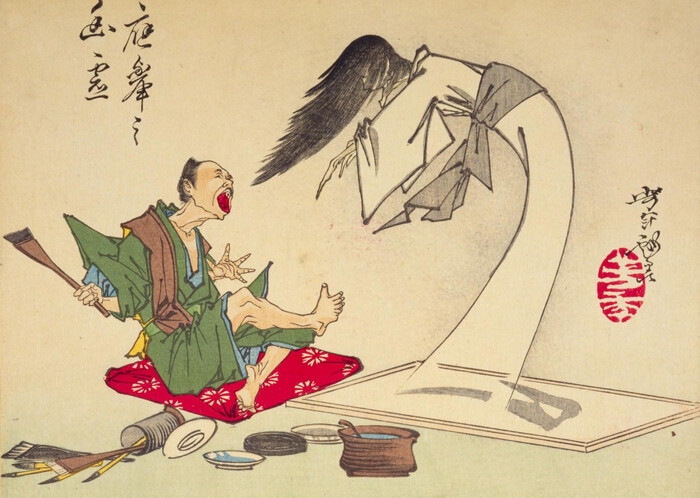
https://dl.ndl.go.jp/info:ndljp/pid/1312837?itemId=info%3And...
https://philamuseum.org/collection/object/84871
Googling for Tsukioka Yoshitoshi brings up so much SEO that it is hard to find information in English. If anyone knows anything about it, I'd be appreciative for a pointer about its content/subject!
So, that's a really interesting thought. Perhaps our solution to a permanent reminder of nuclear destruction[1] could be hidden inside a plane of Unicode.
[1] https://en.wikipedia.org/wiki/Long-term_nuclear_waste_warnin...
> This Unicode range is not a place of honor. No highly-esteemed symbol is registered here.
> What was here represented cultural signs that were considered powerful in our time.
https://www.unicode.org/mail-arch/unicode-ml/y2020-m02/0018....
Also if you google search for 彁 one of the results will be this video [!!!!seizure warning!!!!] https://www.youtube.com/watch?v=EsOU0V2kpUI that seems to borrow on the theme of a computer ghost character.
These days, we scroll though the Unicode standard and find rarely used characters that were accidentally added and imbue them with new meaning. (yes, this is seriously a thing)
"In the end only one character had neither a clear source nor any historical precedent: 彁."
my instinct was that this character could be retconned to mean "character whose meaning has been lost", thus creating a self-referential paradox.
Presumably someone would have to then separately come up with a pronunciation for it. Perhaps pronouncing it "duangu" would solve another problem:
https://coconuts.co/hongkong/lifestyle/duang-jackie-chan-ins...
There's also 奭 https://en.wiktionary.org/wiki/%E5%A5%AD which is occasionally used as a censorship workaround to mock one of Xi Jinping's gaffes in an early 2000's TV interview where he bluffed about being able to carry two hundred "catty" (~100kg)'s worth of wheat on rural mountain roads. The character is composed of two 百 ("hundred") and one 人 ("human/person/people") which is a pitoral euphemism to that line he said on TV. I can't find any sources about this one that's in English so please bear with my half-assed explanation.
The unihan database records pronunciations as well but I don’t think anyone takes it seriously. I’m not aware of any software that “prescribes” specific meaning or pronunciations to characters, so basically if you want you can pick a character and assign it a meaning and convince everyone else to use it. For languages that don’t have a fully standardized writing system , it’s something you can do and people have done it. (There’s also a bunch of people trying to convince people to not use the defacto standardized characters in favor of archaic ones that they claim are more “authentic”… but that’s a story for another day
Or you just make something up. If you’re coining a new character, you probably don’t care about whether the pronunciation is already known.
The previous owner had both highlighted and circled the word "spectre" and wrote "ghost?" in the margins. The rest of the text was similarly marked up.
Every time I hear the word "spectre" I see "ghost?" in my mind's eye.
Even a perfect unicode standard wouldn't be able to mitigate the arrogance of a programmer.
Unicode contains even some ancient and long forgotten scripts so historians can keep proper records of them.
Some Japanese characters that aren't real got accidentally built into the unicode code table. This is NOT related to speculative execution attacks at all. It's just "whoa, these kanji don't mean anything, how the hell are they here?!"
Other than that caveat (not security related), this is a fascinating article, especially if you've studied Japanese as a (foreign) language.
edit: ah the character (hammer and sickle) does not show up
The only circumstance I can imagine is where a Latin character has been erroneously encoded with an unused diacritic, for instance a T with a diaeresis.