302 points · by iamflimflam1 · 4y ago · 201 comments
First, make the deposit a function of battery size not item size or cost (small battery $5 deposit, medium battery $10, large $50). This way the environmental cost of a specific battery is linked to the consumer's cost in a way that it isn't really now when the variation in battery cost is swallowed up in the cost of the item itself.
Second, peg this deposit to inflation. 20 years ago the 5c deposit on a beer can meant a lot more than it does today. I'm old enough to remember my fairly well off grandparents saving up their cans and returning them. Today, nobody I know bothers.
As in tax them at the time of purchase, on batteries that render a device unusable.
If you want to tax non-replaceable batteries that will just be factored into the price and the thing is that easily replaceable batteries are in conflict with other design goals consumers are willing to pay for (like water proofness).
I understand the frustration with non-replaceable batteries creating some kind of planned obsolescence, but there is no easy solution without sacrificing other things.
Adjusted for inflation, 5¢ in 2002 would just be 8¢.
That would make the inflation value closer to $0.38 in today’s money. It’s not a lot, but when you’re getting almost 8x the amount for each can, it adds up.
That $0.04 doesn't sound like much, but say you were collecting enough cans to make $50/day in 1995 money (560 cans) - now you're making only $28 a day. That's the difference between having a home and being homeless.
It's also the difference between "worth saving up and taking a trip to the return center" and "meh, chuck em". Though at least the latter helps people trying to collect more than 500 cans a day.
$1-5 for vape devices would be similar.
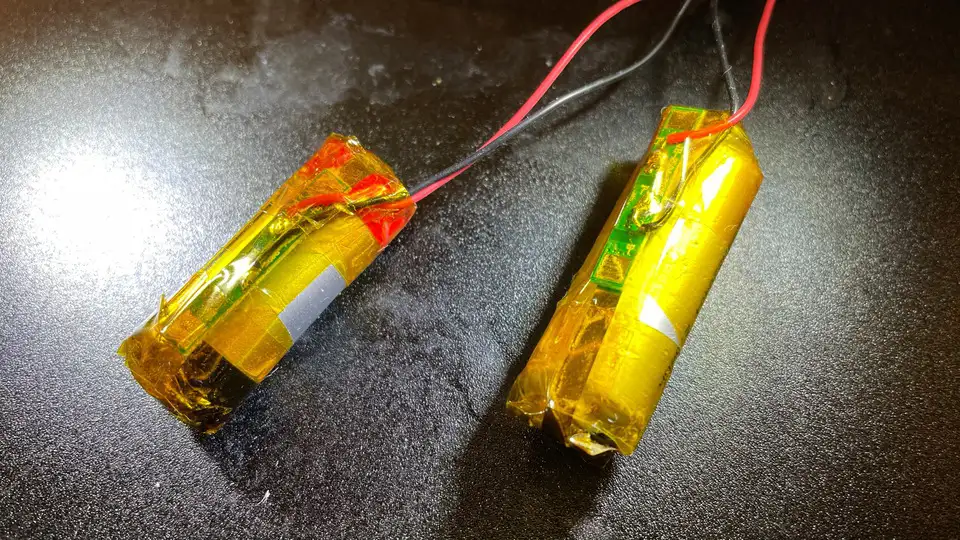
It's fine to tinker around with it for your own experiments, but you don't want to ship it to anybody who's not going to be using it in a fireproof lab wearing eye protection.
A better idea would be to find a way to properly recycle the raw materials (i.e. extract the lithium from a dead cell), but that could be several orders of magnitude more challenging.
[0] https://www.batterypoweronline.com/news/a-look-inside-your-b...
Yeah exactly what I was thinking.. I'm sure the cells used in these disposable devices weren't exactly the cream of the crop in manufacturing either. Probably cells that didn't pass QC or something.
It's pretty risky messing around with them like that.
Lithium batteries are absurdly cheap, and it's not too expensive to buy essentially off the shelf, rated capacity and lifetime cells in order to be reasonably sure 99% of your products last for 99% of their rated puffs.
If your disposable vape doesn't produce as much as competitors because you cheaped out on your lithium cell procurement, your competitor will happily scoop up that business as word of mouth spreads.
This is already a thing in EU, and parts of US and Canada.
https://en.wikipedia.org/wiki/Electronic_Waste_Recycling_Fee
The reason what you said was dismissed/started an argument is the reason a lot of arguments start: using terms whose definitions have been overloaded. People can both be talking about "green" energy but mean entirely different things and get frustrated talking past one another, as happened here.
Specifically, for many people right now, the pressing reason for "green" energy is climate change. Ergo "green" energy is energy which does not release significant amounts of CO2 when used. Solar panels are "green" energy in that they help solve a chronic environmental problem.
At the same time, as was pointed out, solar panels require some incredibly toxic chemicals to be created, and to the extent they are recyclable, that recycling process also involves, creates, and produces as waste even more horrific chemicals. Therefore solar panels are not "green" energy in that they directly contribute to an acute environmental problem.
The root of the issue is picking some abstract label, "green energy", and then each person argues whether something meets their own personal definition of that abstract label.
A more useful question may be "in which ways are solar panels good for the environment, in which ways are they harmful, and does one obviously outweigh the other?"
A supporter of solar would probably say "solar panels breakeven for co2 in just 3 years, a fraction of their lifespan, so they spend most of their life replacing fossil fuels which is good. While toxic chemicals are a byproduct of their creation, and those toxic chemicals would be harmful if released into the environment, they can be contained, stored, and disposed of in a way that localizes all harm to the point that there is no widespread environmental impact from their manufacture".
That means more materials and better future recycling process discoveries
> deposit of 25€ for small electrical
> devices and 50€ and more for bigger ones
That sounds like a terrific way to encourage even more device theft.https://www.youtube.com/watch?v=N65DpT2nqEI&ab_channel=bigcl...
I must admit the ones with 1500 mah batteries are very useful.
Of course these sell better with higher margins than the old liquid bottles. Hope they get taxed into oblivion, wayyy worse for society than an equivalent box of cigarettes
Due to the highly taxed nature of nicotine products, the battery/circuitry cost is negligible if it helps getting around restrictions.
I have the IKEA Eneby Bluetooth speaker. Uses 3 AAA. I can just reuse what rechargeable batteries I have. And I can use the speaker as long as I have batteries so I can charge up as many AAAs as I have. The speaker is no larger than most speakers. You can also recharge the batteries inside the speaker if you want.
So many things would be just fine with normal AA or AAA batteries.
I'm trying not to poo-poo lithiums since they honestly are super good. I'm just upset about this immense level of waste.
I don’t find pennies, but the first lock picks I made I made from street cleaner bristles someone gave me. I’d never seen one before up close, but since that day I’ve been unable to not find them and pick them up, typically one or two a week. Except that day I was working really late and when I looked at the empty parking lot as the sun rose and the ground flashed at me :-)
The same thing happened with four leaf clovers: a friend claimed they are reasonably common and we went out to a lawn and looked. Within a couple of days I’d trained my brain to detect them as I walk around.
EDIT - whoops, I stand corrected, metal or plastic.
Same. At a previous HOPE, I'd mentioned to someone in the lockpicking village that I had never been able to find them, despite living in a city with weekly street sweeping. We walked outside and promptly found 10 or so. As you say, after you know what they look like, and where they usually are, you can't help but see them!
The ADC can instead be clocked by the I2S peripheral, and when doing so it seems to bypass that particular bug. I did that for a hobby project. I was trying to detect 500uS wide pulses, and I went from regularly missing them to getting every single one.
I suspect that the software trigger mode goes through an intermediate MCU in the guts of the ESP32, and there's some race conditions in it's firmware.
I can't believe this is tolerated, that is a massive amount of environmental damage for an incredibly stupid distraction that lasts for a day or so.
Damn!
I made a lithium battery pack for amateur radio once. I was scared of it for a while and charged it in my fireplace. If it catches on fire, well, that's the place, right? (They were A123 cells though. Not as firey as other chemistries.)
Thankfully we all awake and our garden hose was enough to put it out, but it was pretty clear to us that safe/proper battery storage is needed asap.
Please find a different solution. Lithium + water = boom. Don’t put water on an electrical fire of any kind, to be honest.
And not just for the goop inside the thing, people had this thing in their mouth.
The next paragraph confirms the author came to this conclusion too.
Here are some pretty graphs of fake and real VTC6es:
https://notes.stavros.io/maker-things/battery-discharge-curv...
The software is called Assault and Battery:
Neat idea though, will see if i can find any.
2800mAh NiMH AA batteries are like $1.50 each. Will they not do the job?
Lithium batteries are pretty great except for the fire risk. And Lithium mining is bad for the environment (lots of chemical waste during extraction) so using them for single use stuff is horrible.
Edit: Yeah it has some but it's reversible according to that article. I didn't know that part.
Woman at the store counter (peering suspiciously at the battery): "What kind did you say they were?"
Traveler: "Plutonium."
My only thought at the time was "My god, what an ecological nightmare that would unleash when people start throwing these things out with the trash!"
Real evil villain stuff tbh- wasting rare metals, getting kids addicted to nicotine, probably shipped by the boatload from China...
Why not all? Externalities are hard to determine but in general this should be a principle in a capitalist market economy.
I despair. I really do.
This gives us the feeling that electricity is almost free and green, while in the meantime we damage entire area through lithium mining (E.g https://www.nytimes.com/2021/05/06/business/lithium-mining-r...)
It's possible you are thinking of Cobalt which is very bad?
[1] https://css-tricks.com/almanac/properties/f/font-feature-set...
[2] https://helpx.adobe.com/fonts/using/open-type-syntax.html#dl...
Using https://developer.mozilla.org/en-US/docs/Web/CSS/font-varian... you can disable font ligatures (yayyy!).
Safari Mobile allows JavaScript shortcuts to run in any web page: I created a web shortcut in the Apple Shortcuts App to disable ligatures using JavaScript, and run it from the page share icon in Mobile Safari - unobvious functionality! I only learned that feature was available on the iPad today! I would prefer a user style sheet override. . .
For example, one could enable them for headlines only, or only for smaller font sizes, only with a minimum DPR...
If I can think of a "disaster for the human race", it's probably people being paid obscene amounts of money in exchange for advancing the destruction of the environment.