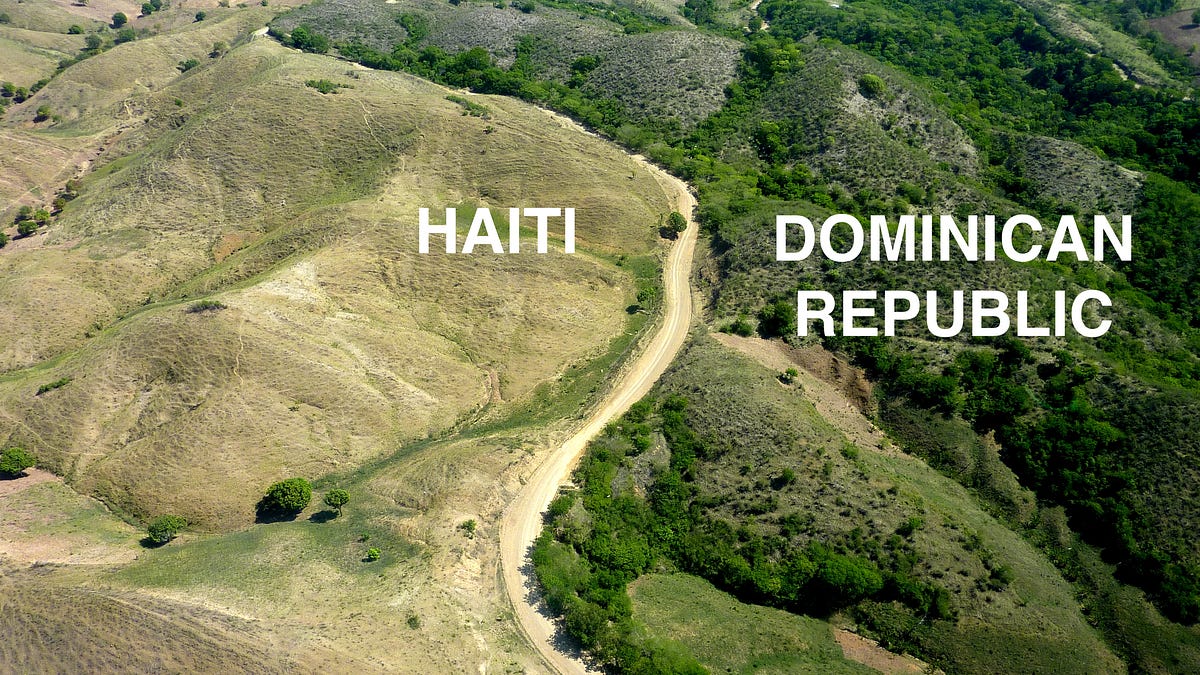
Hispaniola's Great Divergence
Why are Haiti and the DR so different?
thefitzwilliam.com
137 points · by MajesticFrogBoy · 4y ago · 224 comments
It has been essential for the development of almost every country in a similar situation, to initially rely heavily on agriculture. If you remove that, then that's a recipe for disaster.
There wasn't knowledge/investment in the country to jump to an industrial economy so they got stuck in their developmental phase, because of the massive deforestation.
> For decades to come, the United States was the dominant power in Haiti, dissolving parliament at gunpoint, killing thousands and shipping a big portion of Haiti’s earnings to bankers in New York while the farmers who helped generate the profits often lived near starvation.
https://www.nytimes.com/2022/05/20/world/americas/takeaways-...
https://www.nytimes.com/2022/05/20/world/americas/takeaways-...
Just the way they seem to be comparing the supposed cost of those reparations over all time to one year of GDP here seems pretty slimy. The part you quoted is clearly intended to make an inattentive reader think Haiti's GDP would've been eigth times larger if not for reparations, but not only is that not what it actually says, it's impossible to tell how big the supposed loss is compared to the size of their economy - the two are stated in incomparable ways.
There to me, is clearly more afoot here than the evils of France.
"The Haiti indemnity controversy involves an 1825 agreement between Haiti and France that included France demanding a 150 million franc indemnity to be paid by Haiti in claims over property – including Haitian slaves – that was lost through the Haitian Revolution in return for diplomatic recognition, with the debt costing Haiti $21 to 115 billion of economic growth over a period of two centuries and affecting the nation to this day. The payment was later reduced to 90 million francs in 1838, comparable to US$21 billion as of 2004, with Haiti paying about 112 million francs in total.[4] Over the 122 years between 1825 and 1947 the debt severely hampered Haitian economic development as payments of interest and downpayments totaled a significant share of Haitian GDP yearly, constraining the use of domestic financial funds for infrastructure, public services and ultimately making the nation ungovernable."
[1] https://en.wikipedia.org/wiki/Haiti_indemnity_controversy
Aren’t there other crazy divergences out there? Singapore and mylasia or something?
The classic divergence is North vs South Korea, which were practically identical until the Korean War. Historically the North was richer, now the South is orders of magnitude wealthier.
in Haiti the US ensured that nothing much changed in the last century. this article is the typical mouthpiece of such propaganda
Haiti has, and has had, an utterly corrupt and incompetent government/state. That's why they are in the situation they are in.
So does the Dominican Republic government.
According to Wikipedia, the Dominican Republic has the fastest growing economy of the Americas while Haiti is the poorest country in the Americas (And neither has anything to do with France, and since the US meddled in both and even occupied both they probably have little to do with either as well)
Relevant Reddit post: TIL that Haiti has had 23 constitutions since 1801, with the most recent being enacted in 2012. At least two have declared the country to be an empire.
<https://np.reddit.com/r/todayilearned/comments/3t5wzt/til_th...>
Can you explain your theory here?
Deforestation happened all over the world and usually increased agricultural output (by creating more farmland). Why do you think deforestation led to a different outcome in Haiti?
"To the west of the island of Hispaniola is Haiti, only 3% of which now has forest coverage. Although the Dominican Republic that makes up the east of the island still has 23%. At least 90% of Haiti’s soils have been severely degraded by deforestation and inappropriate cultivation as compared to 40% for the Dominican Republic." [1]
[1] - https://www.researchgate.net/publication/269670285_A_Case_St...
tl;dr, they needed cash crops, the forests were cut down to grow coffee.
Since they were basically doing the same all across Europe in the same period, putting down the first tentative steps into modern European democracy, we don't really need to frame it as Haitians Vs French, but (literally) right-wing vs democracy.
https://www.history.com/.amp/news/how-did-the-political-labe...
Which also would appear to be the basis for the current split in opinion too.
Southern India vs. Northern India, Southern Italy vs. Northern Italy (in the other direction), Estonia or Poland in 1990 vs. Estonia or Poland in 2022 (the very same ethnicity in a single generation, so cannot be blamed on genetics), Rwanda vs. Congo, Lebanon pre-1973 vs. post-1973. Somaliland vs. Somalia.
Greece and Italy were countries with very low levels of governmental debt as late as 1975...
In cases of obviously broken countries, people tend to search for a guilty external party, most often the colonialists, but even though they may be sometimes right, this is a lazy pattern; plenty of colonies have grown obscenely rich (cough Hong Kong, cough Singapore) and plenty of colonial countries stayed relatively poor (Portugal, the Ottoman Empire, Russia).
Are you suggesting that Poles and Estonians are the same ethnicity?
This article seems to try to hand wave the "double debt," as the NYT calls it, away but that seems irresponsible. The two reasons given don't make a lot of sense either:
(1) Debt payments were small. It seems likely that the government was negotiating the lenders into the smallest payments possible, so this isn't a surprise. This only meant that Haiti was in debt longer and paid out more. Besides, it seems like the relevant consideration should be the economic effect of the payment on government policy, rather than the size of the payment on a balance sheet. A poor country should be hurt more by having to pay out a small fraction of GDP than a rich one.
(2) Economic divergence with DR happened after debt was paid. So what? Economic impacts have many reasons to lag behind the factors which cause them, especially here where the argument seems to be that destruction of natural resources is an underlying cause.
Indeed, Mats Lundahl, the leading economic historian of Haiti, does not even include the indemnity in his list of decisive events in Haiti’s economic history."
Can you explain how this is not addressing it, or "hand waving it away"? It addresses it explicitly and criticizes it. Seems like a reasonable criticism if in fact that NYT article ignored those two big problems with its thesis. Also, how did the NYT article address Lundahl's work which it disputes?
[0] https://www.nytimes.com/2022/06/03/podcasts/the-daily/haiti-...
In any case, you might disagree but you're wrong that this article does not address it or fails to give it due attention.
The price was 150 millions francs, or one year of revenue. They took private loans to pay it. Later the debt was lowered to 90 millions and was paid in full in 1883. The private loans however were paid back in 1947.
in the wikipedia page it seems like this was left as a small detail:
"The French managed to capture Louverture, transporting him to France for trial. He was imprisoned at Fort de Joux, where he died in 1803 of exposure and possibly tuberculosis.[63][79]"
https://en.wikipedia.org/wiki/Haiti#Haitian_Revolution_(1791...
But what actually happened is Louverture was captured under false pretenses of signing a peace treaty after the French were still actively attempting to stymie efforts from the Hatian government which essentially led to the Hatians paying the debt under unsavory terms:
"Leclerc's army had some initial success and Louverture was captured after signing a peace treaty with the French general, later dying in unclear circumstances in a French prison.[6]"
https://en.wikipedia.org/wiki/Blockade_of_Saint-Domingue
Unfortunately this a good example of the quote "When you strike at a king, you must kill him" by Ralph Waldo Emerson. Haiti was able to rise out of chattel slavery but still suffered under a form of financial slavery.
The two went hand in hand. Haiti wasn't recognised as independent but as a colony in rebellion, and thus embargoed by anyone of relevance (because they all had their own slaves and colonies and were afraid for their future). The French recognition paved the way for further worldwide recognition and thus normalisation of trade relations.
But yes, the French drastically misplayed their hand. Even Napoleon himself later admitted he should have used Toussaint Louverture and his troops against Jamaica and similar instead of wasting 60k soldiers to mosquitos trying to force the unenforceable.
Discussion on HN: https://news.ycombinator.com/item?id=27916733
But those satellite photos look like the North-South Korea divide, and that is due mainly to unworkable political philosophies in the North. So I lean towards assuming ineffective leadership philosophies here too. There are some hints of that in the article, but not enough to draw conclusions.
The process is (a) observe a bunch of facts about history, geography, economic policies, politics or whatnot (b) explain the present (or future) state as a consequence of these facts. If you're inclined to observe certain facts or emphasize certain fields (say history), then your conclusions reflect that.
The "method" of analysis is hopelessly prone to biases, from professional biases to ideological or chauvinistic. As the article shows, ideological (anti slavery) can affect the geographic (soil erosion/smallholdings) affecting and being affected by other things.
"Why is Haiti Poor?" isn't, perhaps, as important to answer as "How can Haiti become wealthy." You need a less comprehensive theory for that. If our theory-building practices are free-style and bias prone, IMO it's better to minimize theory zize.
banning foreign ownership and handing over a state's land to a presumably largely uneducated populace of freed slaves
Isn't this just a complicated way of saying that the other countries still had slavery?
> Latifundios relied mainly on peonage, which is a form of unfree labour or wage labor in which a laborer (peon) has little control over employment conditions, with features of feudal serfdom.[2]
Fits with this theory mentioned later too:
> Lundahl thinks this failure is related to the land redistribution: since everyone had land, there were no landless laborers to exploit, so the elite’s only chance at rent extraction was through overthrowing the government. Given the dearth of business opportunities, one of the only ways to get rich in Haiti was to back a coup in exchange for special treatment from the new government.
I think the key is that at independence Europeans in Haiti (and thus all land owners) pretty much disappeared, so there was redistribution among former slaves, although this wasn't fully carried out.
This also feels like an even more complicated way of saying slavery.
Not like the DR had an easy time either.
France humiliated, and the United States panicked by this huge slave revolt-imposed trade blockades and sanction's on Haiti
Haiti (1825) was compelled to pay France reparations (equivalent of 32 billion in 2022) for the loss of the slaves... this was an extreme national debt.
Haiti of course had no immediate ability to pay the debt, after decades of isolation. The first payments required taking further loans from French banks and American banks causing the debt to only increase, these loans were backed by giving control over natural resources and monopolies to foreign entities.
(This is a pattern well known and understood today)
Haiti is simply the first country in the world to enter the debt-trap spiral, and of course the longest to be in a debt trap spiral. A wholesale transfer of wealth from Haiti to the USA/France.
The result of all of this is that Haiti entered the modern world with very small and weak governments, with very low infrastructure, and educational support, with most of what ever remained of an economy controlled by foreigners and foreign interests.
It is difficult to see how any nation in this situation, can turn it around.
https://en.wikipedia.org/wiki/Haiti_indemnity_controversy#In...
Note that I am not claiming to know anything about Haiti's history, I've listened to the Revolutions podcast series on it and read a bit but I know very little. I am just pointing out that the "this didn't happen until later" doesn't necessarily explain away the impact of the way foreign countries treated Haiti.
If it's important for you to know, dig deeper.
For something more in-depth, but still very accessible, check out Mike Duncan's Revolutions podcast. He does a series on Haiti. He has his own obvious biases, but is much more in-depth than wikipedia, and gives a much better sense of things.
Might be better off (for Haiti) not doing something about it, if there's any truth to things I've read previously that blame US aid/intervention.
e.g. https://www.theguardian.com/world/2019/oct/11/haiti-and-the-...
One interesting point, is that Haiti was charging more than any other port in the region, for docking fees. People went elsewhere due to cost.
The US may have stopped building the dock, if they discovered this highly counter-productive practice might continue.
Speculation, but regardless, Haiti seems to be the problem, not those helping.
The author is right that soil erosion, caused by overuse of land without replenishment, is one of the most important factors. Consider: So much land in Haiti is in such poor shape that for decades the country has not been able to produce enough food, in sufficient variety, to feed its own population. The DR, in contrast, is a lush paradise full of greenery everywhere, capable of feeding itself well, whereas Haiti is full of deforested, eroded land, much of it unfit for agriculture. You can see the difference in satellite pictures from space.[a]
However, the author mentions only one of the root causes of soil erosion: ideological government efforts preventing the emergence of large-scale agriculture in Haiti. There are at least two other root causes contributing to the poor state of land, as Jared Diamond points out in his book Collapse[b]:
* The DR's soil is naturally more frequently replenished by storm systems continually coming from the Atlantic, bumping against the island's central mountain range, and causing nutrients and minerals to flow down large rivers to the DR's valleys at a much greater rate than in Haiti.
* From early on, the DR government has actively defended the country's natural greenery against deforestation -- with armed forces who would shoot and kill illegal tree loggers!
Surely there are many other factors at play (including the fact that many Western governments had a de-facto policy of ostracizing Haiti in international trade throughout the 19th century and for much of the 20th century), but Haiti's inability to feed itself well, decade after decade, due to overuse of land without replenishment, is possibly the most significant factor.
[a] https://substackcdn.com/image/fetch/f_auto,q_auto:good,fl_pr...
[b] https://www.amazon.com/Collapse-Jared-Diamond/dp/0143057189
Looking at the rough area on the satellite view in Google Maps [1] suggests that there's not all that much difference between Haiti and the Dominican Republic. Indeed, in your [a] link, you can see a decent swath of the Dominican Republic that looks as bad as the Haiti side in the picture... were you to continue a little southeast, the Dominican side would open up to an area just as large and just as deforested as that Haiti side. For most of the Haiti-Dominican border, it's actually challenging to distinguish the Haitian side from the Dominican side.
http://www.sal.wisc.edu/~jwp/revolutions-episode-index.html
He covers a number of revolutions in detail, with his own spin, but is entertaining and educational.
The Haitian revolution and the French revolution are both covered.
^Great article on the same topic
It’s believed that Papa Doc pocketed $150 million during his presidency, which is a pittance compared to the $1.6 billion his son grabbedBy contrast, for what it's worth, France's payment to Germany after the Franco-Prussian War was about 22% of GDP. Paid over 3 years, so the payments themselves would have constituted like 7% of GDP.
The disaster is within liberty without bounds and mistaking societal complexity (division of labor) for enslavement. It has also repeated in other locations (ruanda, zimbabwe come to mind).
However, the article's central claim (small farms destroy arable land, so large foreign-owned plantations are more sustainable) is invalidated by comparison to Cuba:
> "The reason why this does not occur in all countries is that larger farms benefit from economies of scale. Haiti’s small farms were too small to justify investments in labour-saving technologies. They were also too small for basic investments in soil fertility, like leaving land fallow. It’s hard to leave land uncultivated when your family must eat from a small plot. Finally, small farms create erosion through a tragedy of the commons. Erosion does not just affect your farm, it affects neighbouring farms. Investing in erosion prevention for your own land has little effect if your neighbours do nothing. Farmers on small plots, therefore, have an incentive to ignore the erosion problem and overfarm their own land."
So, why has Cuba been successful when it broke up the plantations and distributed the land to small farmers?
Ranging from the Clintons to Hollywood, also the music industry and the oil industry. They all seem very interested in that place.
I wonder why, there is no shortage of poor countries in Latin Americas. Bitcoiners for example chose El Salvador
Character is fate, for individuals and nations.
https://en.wikipedia.org/wiki/Benin#Pre-colonial
>The kings of Dahomey sold their war captives into transatlantic slavery. They had a practice of killing war captives in a ceremony known as the Annual Customs. By about 1750, the King of Dahomey was earning an estimated £250,000 per year by selling African captives to European slave-traders. The area was named the "Slave Coast" because of a flourishing slave trade. Court protocols which demanded that a portion of war captives from the kingdom's battles be decapitated, decreased the number of enslaved people exported from the area.
This history's still a very sensitive subject in Benin:
https://www.washingtonpost.com/world/africa/an-african-count...
I am not OP but I take issue with this. I feel like this is the whole thing. Why did you feel the need to write “European”. That’s wrong and denigrates entire ethnic groups in a very ignorant way. The poles for example surely you would agree are european but did not participate in the slave trade. But, this is not my main point.
My main point is, the slave trade was a multicultural, multiethnic affair. In different periods of times, different peoples were enslaved by different other peoples.
Just so you don’t mistake my comment, this is not an apologia of slavery. It was a horrible institution worthy of condemnation and I am happy it was ended.
I just find it very annoying when I see this automatic assumption “europeans were slavers”. No, not all of them practiced slave trading, some of them were enslaved as well, the ones that did practice slavery collaborated with non europeans to create the supply chain and there were other non european peoples also actively engaged in the slave trade.
Slavery is not the sin of Europe, it’s the sin of all man kind.
The only possible outcome of advocating such a position is that destruction of our ability to discuss the issue at all. The only type of person that would want that outcome is an apologist who simply wants the topic dropped, even when talked about tangentially, such as occurs in this article.
And they were ripped from their homes — referred to in passing without saying by whom.
I feel your comment tries to inject something not relevant to the article.
Because it is completely irrelevant to the article.
"Whenever that fact is obscured, we promote the false perception that slavery is the fault of one race in particular."
This is untrue, and it is ridiculous thing to say. You do yourself no credit, trying to drag racial politics into a situation where they do not add explanatory power.
The reality is that Haiti demonstrated how racism drove policy and actions of the colonial power. French colonial society was different than the US and evolved differently. France was distracted by its own problems and wasn’t able to maintain the dehumanizing regime necessary to maintain the slave system.
The whole thing is gross and disgusting. It’s a scar on society, and was no better in antiquity.
In that situation, one does not have to be a Nazi whitewasher to be somewhat suspicious about the author's agenda. Not every story can cover every detail, but some omissions are glaring.
Or one could simply stick to the subject that one is writing about.
Also not mentioned in this article: - the genocide of the native Americans that allowed Haiti to be a thing in the first place - the continuing oppression of women at the time - the oppression of LGBT+ that was a constant reality of society in a Catholic country
And yet these comments seem to only care about calling out oppression that happened a continent away. Slavery isn't even really that big of an piece of the article. The majority of the article is about what happened after slavery ended in the 1790s.
If you’re looking at the evolution of concentration camps, you’d probably want to also include the evolution from the British camps during the Boer War to the Imperial Germans in Southwest Africa or the Ottoman Turks in Armenia.
The Nazis evolved the tactic into a mass killing factory. The Soviets were more about political oppression; they went about the business of mass murder in other ways.
Yes, this is boiling down a lot of elements and caveats that can (and should!) Be made but at the core this is what happened.