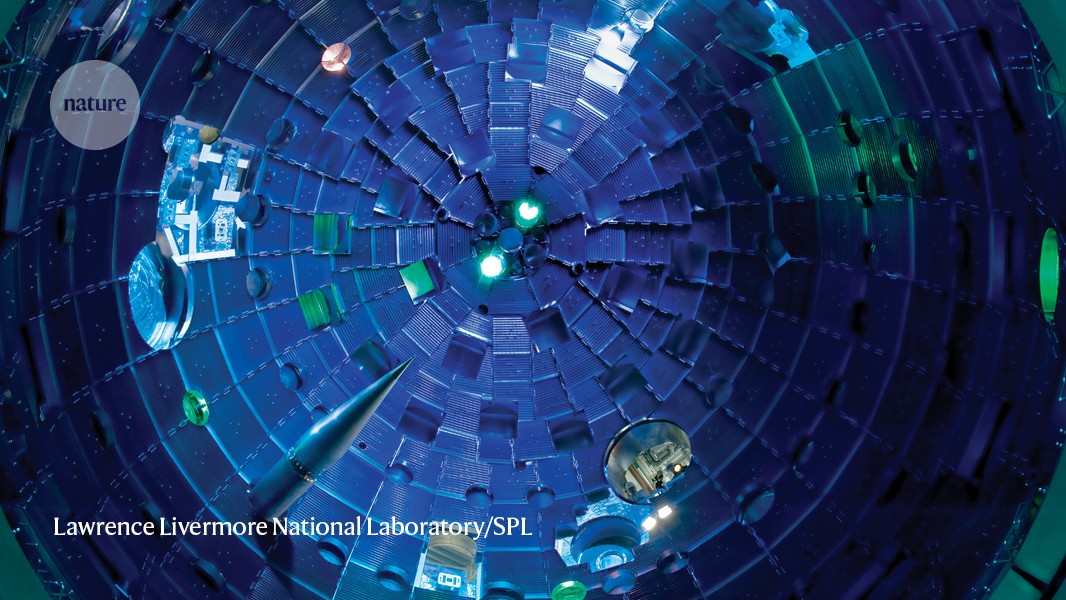
Exclusive: Laser-fusion facility heads back to the drawing board
US scientists evaluate their options after failing to replicate record-setting experiment from 2021.
nature.com
82 points · by anigbrowl · 4y ago · 105 comments
It's good to remind people about weapons research interests. It's less good to completely dismiss the interests concerning energy production, or basic scientific research. They don't go away just “omgz military funding!”
So this is weapons research and basic physics research caked in the language of power generation.
1: source: a seminar I attended last year
where in the world have you seen anyone that is planning to try to use inertial confinement fusion for energy production?
The kid in me says this was/is the coolest option.
Regardless of outcome, I'm glad we were able to test the idea.
Sometimes it's just nice to have something to compare your simulation results to.
It really matters that nuclear weapons go bang when you want, but not when you don't.
An example of why one needs to care about such things in stockpile stewardship -- plutonium's own radioactivity means that helium is effectively being born within the crystal lattice, causing damage, distortion, and swelling. It isn't a guarantee that a bomb that worked 50 years ago will work today.
Thanks.
In the longer term, who could have known then or even cared how to maintain the transition to a no-test regime? What the treaties' drafters might have been thinking is now moot. Those people are long gone, it's your problem now.
ITER : https://www.iter.org
Take a small cylinder of pyrolytic graphite (it is diamagnetic, repelled by magnets) milled to be in the ideal axis and polystyrene layered in it. Then shoot it into a somewhat large ring of powerful magnets that have a trough in them to such a degree that it can trap the cylinder as it accelerates around the loop. The cylinder is propelled by successive shots of laser bursts that are not powerful enough to ablate (but close). One of the electromagnets can be quickly deactivated to allow for the cylinder to escape. Then it travels for a safe distance into very large lead target. Fusion could proceed if the speed is fast enough as the fuel is inertially kept together and friction should raise it’s temperature. If it produces neutrons, they will be absorbed by the lead. You can just collect the heat.
Edit. I think the lead target would be a no go. It would be no different than a bullet hitting a soft block of lead. Better would be a block of silicon carbide with some kind of borehole made of tungsten metal with fuel packed at the end of it. So the rice sized cylinder of nuclear fuel shoots right into the borehole and before the material can squeeze itself out, it has to overcome the enormous inertia keeping it going in one direction. Might be better though if the target itself was fuel. And it would be much easier to fuse lithium dueuteride than hydrogen and carbon.
I seem to recall a recent story on HN about something similar. So it isn't really a new idea. Perhaps making it run a circular course is different or that it doesn't use ablation for propulsion, it uses light pressure. I think the project was in the UK.
https://en.wikipedia.org/wiki/United_States_Department_of_En...
Who are in charge of nukes.
Sounds like what goes on at the focal point of the laser requires nanometers of accuracy in design, position and orientation. Perhaps part of the problem is that we abandoned physical engineering and manufacture in the west in favour of outsourcing it all?
The engineering and fabrication side is just that precise.
In this facility they indirectly drive the target with the lasers. So instead of uniformly heating a sphere with lasers, they heat the inside of both ends of a gold tube (holhraum). This causes a bath of x-rays to uniformly heat a glass sphere that contains your fusion fuel. That glass sphere needs to be suspended in the center of the tube, but any inconsistency can cause huge knock on effects on yield. So they hold it between two <1um thick sheets of plastic. But if you can imagine, part of the sphere will be in contact with this plastic and part will not. That adds some reduction in how uniformly you heat the glass sphere.
But let's back up, how do they even make this perfect sphere of glass that is hollow? And how big is it? Well the sphere can be anywhere from 420um to 800+ um in diameter. From what I recall, the only way to make these is to drop small amounts of glass from a tall tower into water. Then do metrology on it, and toss away >90% of them right off the bat. Another issue is that some of the fuel leaks out of this hollow glass sphere over time. So timing from when you load the target from storage to actually firing the lasers can have non-zero effects on the yield.
Long story short. It's really hard to convey how close to the edge of precision ICF research is to the edge of micro fabrication. Now add the fact that some of these targets need to survive going from atmosphere to ultrahigh vacuum, and not break or tear... Remember that 1um thick plastic?
So yeah, no one is outsourcing this stuff. It's not being negatively effected by brain drain or lack of funding. It's just absurdly difficult to build to the designed tolerances the physics demands.
Fun fact, this is why a lot of physicists got behind the ITER project. The bigger you make something, the less important the minor fluctuations are to the overall yield. :D
And no, this has nothing to do with outsourcing. There are no outside experts in this field.