74 points · by imartin2k · 4y ago · 159 comments
There is a project for doubling the tracks in the city center, that is on a good way to become more notorious than the Berlin airport: they are talking about it since the '70, they started working in 2017, with planned opening in 2028 for ~3B euros, and now they are talking about opening it in the late '30 with an estimated cost of more than 7B euros. 1B for each km of tunnel, that's madness.
Without it, we cannot have fast connections to the airport (currently 40 minutes away from the city center), and cannot increase the number of trains, currently running in a 20-minute cadence because 7 lines meet in the city center, so 7 lines on 1 track.
Another thing I don't understand; why Italy and Germany aren't to start building the access tracks to the Brenner Base Tunnel (BBT)?
BBT is incredibly on track with all the deadlines, so if they really open it in 10 years, we will be able to do Fortezza - Innsbruck at 250km/h, and then Munich - Innsbruck at <200 km/h, as Fortezza - Verona. That's simply ridiculous.
I don't own a car and try to fly as little as possible, but it is quite difficult for distances that, frankly, should be a no-brainer.
The ICE-Terminal at the airport Frankfurt am Main (FRA) is a bless! I live in the middle of southern Germany. Sitting into the ICE and wait for FRA is joyful. It is more comfortable to reach than Stuttgart and Munich. The only annoying part is the old Stuttgart "Kopfbahnhof" but luckily this will be fixed soon. I'm thankful that the peopledecided to go for this effort, despite Germans fear changes.
Sadly ICE tickets are very expensive. When you travel with more than one person using the car is often better. If I could wish for some things:
* Affordable inter-city tickets, instead of very cheap local tickets
* An ICE every 30 Minutes (high frequency, not just high speed)
* Therefore Deutsche Lufthansa can focus more on mid- and long range flights. They prefer that and complement with the Deutsche Bahn.
* As rpadovani I hope for a connection Brenner Base Tunnel
* Munich should also become through station "Durchgangsbahnhof". These "Kopfbahnhof" thing is a weird concept from the old kingdoms and doesn't make sense. Even in Paris this concept is questionable.
* Please Germans. Get more courage and appreciate useful changes. From windmills, airport runways or train lines. It is not about ruining the landscape.
For entertainment, the (in)famous speech of Edmund Stoiber about the Transrapid. It is weird for native speakers, too.I remember as kid that some people dreamed about the Transrapid (a high speed train, hovering with magnets). The politician above wanted to connect Munich Central-Station with Munich Airport (FJS) with it because the local trains are a pitty.
That's part of a long term infrastructure project dubbed "Deutschlandtakt": https://de.wikipedia.org/wiki/Deutschlandtakt
The current estimate is that the overall project will take until ~2040 (though I think we all know how that'll go) with ongoing improvements to frequency on individual lines.
As you mentioned - additional tracks through the city center are re-planned for 203x, but with current handicap on all planing and execution levels it will realistically be finished at 2050. It makes public transportation completely unreliable since the city is heavily overcrowded already. Absolutely the same story with S7 extension from Wolfratshausen to Geretsried. No way to build anything before 2040.
Let’s face the true, Germany lost grip on infrastructure projects. The fight against car goes on without offering any alternatives. In theory my journey to the office takes 10 minutes more on the train than with a car. In reality I don’t know where train gets stuck and for how long.
That is usually apparent IMO, what do you find stressful? Having trains that split is quite common in my experience.
> It makes public transportation completely unreliable since the city is heavily overcrowded already.
That's very true. And with the 9-euro tickets, rush hours are a nightmare (and it is extremely hot these days).
> Let’s face the true, Germany lost grip on infrastructure projects.
I'm afraid that's very true as well. Coming from Italy, I expected big things from Germany, but HST is way better in Italy, to my surprise.
On a brighter note, it seems that in the last years they are accelerating on infrastructure again, both local and national. It will take years, if not decades, to see the results. However, as the says goes, “The best time to plant a tree was 20 years ago. The second-best time is now.”
Here in Barcelona it's 2-3 minutes between trains. The metro is faster than driving if you're on the same line.
The S-Bahn in Munich has only one track in the city center, so there are trains every 3-4 minutes, 20 minutes is on the outskirt.
U-Bahn has a 10-minute cadence in the outskirt, and 5-minute on rush hours: in the city center 6 lines become 3, so in there you have 5-minute cadence, and 2.5-minute in the rush hour.
I live near both stations, S-Bahn is the quicker way to go to my office, but being the station in the outskirt, I need to know when trains are coming.
We also have something similar here for more long distance and less city stations. In fact we have two operators with their own networks! Both are not nearly as frequent or reliable as the metro, sadly.
Rodalies is also more like 20 minutes (If you're lucky and it comes at all - lol)
Sorry for the confusion!
Instead this was news to me:
> France is currently undergoing an energy crisis, because the heat wave is such that river water cannot safely cool down its nuclear power plants
Nuclear capacity curtailed due to a heat wave? That's a failure mode I'd not heard of.
Yes - a risk for all thermal power plants, since they need a cooling loop to re-condense the steam before putting it through another cycle in the turbines.
(In general it would be physically possible to still run the plant, but regulatorily impossible because the outlet water would be too hot and people don't take kindly to boiling a river and destroying its ecosystem)
The French reactor fleet also has some kind of problem with cracks affecting the longevity. https://www.newcivilengineer.com/latest/concerns-that-cracks...
There's trivial solutions to this, but they all probably run into other regulatory stupidity.
They could easily solve this just by offering giant 38-40C (100-104F) pools open to the public near their plants.
Or, just have a parking lot sized winding halfpipe before draining into the river, or otherwise easily make up for the missing cooling tower capacity.
In Iceland thermal plants will release boiling temperature water into rivers that didn't have it before, nobody thinks twice about it, as people are used to the natural equivalent.
You'll want to make sure to give the fish a way out, but otherwise the only notable side effects are some algea buildup.
> There's trivial solutions to this, but they all probably run into other regulatory stupidity.
> They could easily solve this just by offering giant 38-40C (100-104F) pools open to the public near their plants.
> Or, just have a parking lot sized winding halfpipe before draining into the river, or otherwise easily make up for the missing cooling tower capacity.
> In Iceland thermal plants will release boiling temperature water into rivers that didn't have it before, nobody thinks twice about it, as people are used to the natural equivalent.
> You'll want to make sure to give the fish a way out, but otherwise the only notable side effects are some algea buildup.
this will be my go-to example of how random computer programmers on HN have such profound over-confidence about things they know nothing about that their opinions on anything other than programming are actively dangerous. it is a good reminder for everyone else who still has self-awareness, though, to doubt themselves more when talking about topics they don't know anything about.
thanks!
There is nothing "manufactured" about not wanting to cook natural water bodies and the flora and fauna that live in said water.
Even very minor changes can have massive effects for everything living in, and around, such waters, as they are part of a bigger ecosystem these changes will also end up affecting wildlife outside of those waters.
> They could easily solve this just by offering giant 38-40C (100-104F) pools open to the public near their plants.
Did you do the math how big they would need to make these giant pools to effectively dissipate the heat? Where is the water for those giant pools supposed to come from?
> Or, just have a parking lot sized winding halfpipe before draining into the river, or otherwise easily make up for the missing cooling tower capacity.
From what material will that winding halfpipe be made, to have good thermal conductivity, while still having the stability to support such a massive structure and the pressurized water going trough it?
> In Iceland thermal plants will release boiling temperature water into rivers that didn't have it before, nobody thinks twice about it, as people are used to the natural equivalent.
Iceland is also not exactly known for its summer heatwaves, even without those I'm pretty sure they still monitor the temperature of those rivers to make sure it doesn't pass certain thresholds.
> You'll want to make sure to give the fish a way out, but otherwise the only notable side effects are some algea buildup.
Algea that will deprive the water of oxygen, thus killing a lot of other flora and fauna if they build up too much.
Will be a little difficult to cool the water down to 40C when the air temperature is higher[0]
0: https://www.independent.co.uk/climate-change/news/france-meg...
It's great there are "trivial solutions" but they need to be implemented.
About nuclear reactor, the river can cool down the reactor, but fish will die. Thus the power generation is limited in summer for reactor cooled by rivers.
Frances population is far more centered in mayor hubs while in Germany the population is dispersed much more homogeneous.
In some places the ICE stops every 20km, there are too many curves, or it shares its rails with slower trains.
There is no need for high speed rails here because you can not accelerate anyway.
"Looking forward rather than backward, nothing in Germany’s urban geography is an obstacle to a connected high-speed rail network. With central stations and less of the population living in truly isolated rural and small-city communities, Germany can expect to greatly surpass any other Western intercity rail network if it builds high-speed rail, more than reaching DB’s pre-corona 250 million ridership target."
But my understanding is that this is about environmental regulations that prevent power plants from heating the river water by too much.
The plant itself would be able to run totally fine with the current water temperature, but it would raise the temperature beyond what environmental regulations allow.
Instead, Europe is now burning Coal and Lignite. Which of course is much worse for the water temperature in the long run…
This means that the water table needs to be drained to keep the mine dry. The pumps in many cases directly feed the excess water into the power plant.
An example is the plant Neurath, which is the second biggest coal power plant in Europe, delivering 4 gigawatts of power without use of surface water.
Germany is the one that's closing reactors, over post-Chernobyl/Fukushima fears, and burning coal instead. It also has a surprisingly powerful coal lobby.
And also has to keep it running now.
> Germany is the one that's closing reactors
Three reactors while France has half of theirs offline. The irony is that if Germany is going to extend their NPP, it will be because the next German stress test runs under the assumption of a major French power plant outage. I can only already see the jubilant HN threads how this is a win for NP, when it's actually a testimony of its failure.
It's not a new problem [0], it's become somewhat of a regular issue in parts of Europe during summer heatwaves [1]. As the heatwaves will become worse, and the water scarcer, this will become an even more regular issue.
France is currently affected particularly badly because a big chunk of their reactor fleet is also going trough long-overdue maintenance.
[0] https://qz.com/1348969/europes-heatwave-is-forcing-nuclear-p...
[1] https://www.reuters.com/article/us-france-electricity-heatwa...
The regional trains are absurd. The platforms are completely congested with human bodies, and even the long double decker trains are often totally full. To me it seems that there simply aren't enough services every day to carry the capacity of people who want to use the trains. Even before the 9 euro ticket it was borderline unusable. I did a midday Monday journey last September from Hamburg -> Lübeck -> Stralsund -> Samtens and each part of the journey apart from the last was totally full. Lübeck -> Stralsund was ran by nah.sh but it was an absolutely tiny train with even barely any standing room, let alone seating. Germans just accept it and groan, in classic German fashion: this is how it is, it's not going to change, just accept it.
1. Build out a robust and modern electric grid that spans EU without country wise policy restrictions, allowing distributed domestic generation of power such as solar roofs, windmills in farms etc, while the existing nuclear reactors supply base load power. Any new renewable energy project should simply be plugged and play.
2. Build out a similar high speed rail network that doesn't have country wise signalling/power/track changes such that one does not have to worry about "connecting" Dutch, French, German, Swiss and Italian trains on a trip across.. Instead a singular train operator being able to run a train that seamlessly runs all the way through without changes. Also, while at it, make the train operators compete on EUR/KM of operation so that the costs become competitive with intra-EU flights.
We are missing leaders with long term thinking. Every politician I hear keeps trying to say what their voters want to hear for the immediate term and get elected to office.
All of Europe except Spain and Ukraine/Russia/Belarus runs on standard gauge anyway, and at least in Spain every new or renovated track is being laid with dual-position sleepers so that they can easily be retrofitted. Modern locomotives can use all power systems (25 kV, 15 kV AC, 3 kV DC) and the major security systems. For signalling, new tracks at least in the high speed sector are all prepared for ETCS.
The only thing needing exchange at borders today is the locomotive driver, and even that is not necessary if the driver speaks the language of the country and knows the signalling system there (e.g. it's pretty common that freight train drivers run the trip from Germany to the Netherlands and back).
Isn't that the case already? Or are the high-speed trains that go from Paris to Belgium / Netherlands / Italy / Spain just regular speed outside of France? I'm quite sure, at least the ones going North (UK/BE/NL) use the same tracks as the trains doing Paris-Lille (city in the North of France, close to Belgium).
> Also, while at it, make the train operators compete on EUR/KM of operation so that the costs become competitive with intra-EU flights.
I don't know if that's such a good thing. There are routes that are much more profitable than others. It's my understanding that, at least in theory, the profitable ones "subsidize" the others, such that people can actually use them.
I don't think that having new companies showing up on the Paris-Lyon line, for example, will be a net positive for the country as a whole (that's by far the most profitable line in France).
Or maybe force the new ones to serve all the other lines? I don't know what the best solution would be.
Yes, EUR/KM operation might come with its flaws. But, if that rail grid is treated as essential infrastructure, and business are allowed to run their train services not the grid competing with each other, it will be a revival of the golden era of trains, and public transport.
Yes they are, but that's only the high speed lines. In the Netherlands we have just one, towards Belgium and it's construction was extremely costly and troublesome. It has not delivered on it's promises, one planned service has been within the first year.
Towards the East we don't have any, and yes the ICEs from there run at slow speeds in the Netherlands.
That is actually an EU project: https://en.wikipedia.org/wiki/Trans-European_Rail_network and they are working on it, but it will take decades to complete, I follow closely the Berlin-Palermo axis for personal interest, and plenty of sections are still just announcement in some press releases.
What projects do you mean by this?
[1] - https://ec.europa.eu/clima/eu-action/funding-climate-action/...
I've been travelling by train between my home village and the capital for the last 20 years or so, and in general things have gotten better. More modern trains with air conditioning even far away from the big intercity connections, prices for frequent travellers are reasonable (with Bahncard 50), on average few delays (at least on my connection - the last few months have been pretty rough though).
If anything, comfort on the ICE connections is regressing, I'm not a fan of the new ICE4, it feels much more cramped than the old ICE3. A few more highspeed tracks in East Germany would also be nice.
This isn't really fair. You're looking at the cheapest possible fare - a loss leader - that few people actually pay. And those that do pay it end up paying significantly more in ancillary fees. You pay ~$30 for a personal item onboard, ~$50 for a checked bag.
The right way to figure out more or less what folks are actually paying to get between Stansted and Hamburg is looking at PRASM (passenger revenue per available seat mile) but I can't seem to find a published number for European LCCs.
Not at all. My parents visited and they didn't bring a bag. Just because Ryanair pressure you into paying more, doesn't mean that you have to. When I went home I took one carry on bag between my wife and I, so I payed the extra £20, still WAY cheaper. It's a fair comparison
EDIT: I can't reply because rate limited (as always). Fuck HN.
You can't seriously compare flying on Ryanair with just a carry-on rucksack to swimming the English channel. That's absurd. And even with the added baggage it is still way cheaper.
You can still bring a carry-on rucksack on your Ryanair flight for that base price, and many people do. You get one carry-on for free, and have to pay for the additional carry-on and/or a checked bag. A carry-on rucksack is easily enough for a weekend visit, or even a week if you stretch it. Why are you treating it like some kind of insane thing to do?
> How much time and money did you pay to get to and from the airport? How early do you need to be at the airport for check-in/boarding? How long does it take to get out of the plane and out on the street?
2 hours for check-in, and maybe an hour to get out. It doesn't cost anything to get to and from the airport for me. So sure that's a reasonable amount of time, but in the end it's still way cheaper, and I'd arrive at the HBF in advance anyway.
The point is that Hamburg -> Munich should be cheaper than London -> Hamburg
There is no such thing as "one-hour flights".
It's possible to swim the english channel free of charge, but that doesn't make $0 a fair comparison against the train. You don't benchmark Costco by the price of its rotisserie chicken.
Ryanair isn't flying planes just for you, they're flying them for average customers, so it makes sense to compare average fares. What if there's only two $15 tickets made available per flight? The problem is you don't know how many they're making available at a given price point or how they're distributed - it's a trade secret. That doesn't make cherry-picking the lowest possible value a fair comparison point.
Anyway, back to the regular schedule...
> It doesn't cost anything to get to and from the airport for me.
Of course it does. At the minimum, it is the price of the train ticket to get you back to the city. If someone is picking you up at the airport, they are paying for parking and their time to travel back and forth.
> The point is that Hamburg -> Munich should be cheaper than London -> Hamburg
The issue is that your plane ticket does not include all the externalities that it should. You are being subsidized by other passengers and you are not paying for environmental damage caused by the plane, the cost of the infrastructure to support the airport, etc, etc.
Connections do get missed, and if they do you are entitled to a 25% money back for 1 hour, and 50% for two hour delays.
So the supply/demand question is very different because the supply is more constrained for the trains.
Air travel does not require much costly infrastructure while building a high speed train track over hundreds of miles is very costly, especially when there's the sea in the way.
Also in my personal experience planes don't simply get cancelled (or replaces with one without my reservation) 1/3 of the time, which is an actually reasonably correct number for me taking trains in Germany.
That's the "great" thing about the old Intercity trains from the 80s (some carriages are even from the 60s, being initially used in Trans Europe Express Trains[1]): They don't have this feature. Those trains can and will be filled up until it's physically impossible to push more humans into it. Makes a great Sauna in the summer! :D
> The natural response of most German rail advocates is to sneer at the idea of high-speed rail
Yeah, seperate stations (edit: platforms, they can share the building) for high-speed trains will probably never happen, sadly. And as long as high speed trains share the platforms with regional trains, disruptions and delays will always affect both.
It's nice that you can drive from Munich to Augsburg in 20 minutes on a seperate high-speed track, doesn't help you if a broken down regional train blocks the station and everyone has to wait for hours. :/
The limiting factor is breaking. The PZB train safety system require that you get down from 160 km/h to zero within 1000 meters. For trains that do not have the break hundredths to make this, the maximum speed needs to be reduced. Freight trains usually have a maximum speed of 100 km/h or lower. Or, for passenger trains with varying amounts of mass, impose a mass limit.
Better brakes are difficult because the friction points between the wheels and the tracks are small. The french have approaches on this.
LZB and ECTS help by giving the conductor in-cab information about oncoming signals, but installation on the tracks has been sluggish. IIRC ETCS is mandated to replace LZB, but ETCS is quite expensive.
I'm not saying that it would be legal to drive an overweight IC in the upper PZB setting. :D
But I've used Intercitys (and old regional trains) that were so full that not even the conductors could move anymore. That doesn't happen anymore with the new trains. I have a hard time believing that the railroad carriages were not overloaded at that moment.
This is the case for some stations, e.g. Berlin Hbf or Dresden Hbf. Anecdotally I've never experienced delays due to waiting in front of the station there, unlike e.g. Hamburg or Hannover where platforms are shared.
Doesn't help that most high-speed trains drive on a mix of seperate high-speed tracks and normal tracks shared with regional and freight trains, making complete seperation impossible. :/
But yeah, it wasn't great beforehand, the trend was already there and it's not the 9-Euro-Tickets fault, IMO.
> I think the core problem is huge and extremely traditional management.
IMO a big part is also the neglected infrastructure. Many trains are new and old rolling stock is being upgraded, station buildings are being renovated, but the tracks and the signaling is often very old. There is just so much you can do when your (station) signaling still uses relays from the 60s.
That's modern. About a quarter of the network still uses purely mechanical signalling and switch operations - that technology is literally and in every sense from the era of the German Kaiser Reich days.
[1] https://www.youtube.com/watch?v=6TLcaJdsRr0 [2] with the exception of a few "weird" Intercitys that take very strange routes to reach tourist destinations like Berchtesgaden
Not saying that this is not a problem, but bulky management is a constant for DB, even during the years where it was considered world-class. I think it is the budget cuts and the resulting lack of infrastructure.
What you see is a problem amplifier. Any problem related to any train, track or signal is amplified there and becomes a much bigger problem, for too many trains and people. Some of the tracks you see are high-speed tracks reserved for high-speed trains, but the problems spread to those too.
Is it possible to build such intersections better, so they don't amplify problems to such a degree? Absolutely.
Blaming "management" is a fine thing to do to do when you've no clue what's wrong or how it could be fixed, but you want to blame someone. Nice and generic.
I don't and no one else at DB has it apparently either, that's the real problem :)
All the issues Germany has Switzerland would also suffer under if it ran it's rail network the same way. Money must go to the right places and maintenance is crucial. The Swiss network is not perfect but it doesn't have all the issues the Germans have and we have no autonomous trains, no AI dynamic time tables (not yet) and no ETCS L3 (not yet or very limited).
Unfortunately, lessons from small countries cannot easily be replicated in bigger countries (as for people that mention Estonia for digitalization: they are great, but there are 3 cities in Germany that have more population that the _entire_ Estonia)
I feel we are in a shit triangle here. Ticket prices are too high <-> quality is too low <-> overall cost is too high. There have been ongoing attempts to fix this by increasing rider amounts but at Germanys population density it's impossible to ever get even near to Japanese levels [2] of low total kilometers built with high usages. After my interpretation of things there is some innovation necessary to bring the per KM cost down before the Deutsche Bahn can play a more important role in the transportation.
On the same coin the cost of public transport for families vs. car ownership is just ridiculous. I've got a family of 5 - For every German intercity route going by car is significantly cheaper than going by train - usually 5x cheaper but often more. Same is true for traveling within a city that isn't your hometown (where you might have a monthly ticket). At this point I'm not even sure whether this is a problem that can be solved socioeconomicly.
I feel electric cars, robotaxis and in the future electric planes are much more likely to solve the larger part of of transportation than that railway is going to do it. Especially given that building another set of rails now in Germany is going to take from planning to delivery 15 years. The change of technology should be planned in.
[1] https://www.diw.de/documents/publikationen/73/diw_01.c.34457... [2] https://www.econstor.eu/bitstream/10419/141066/1/vjh_v63_i03...
I think most rail systems do this; it would be considered a reliability problem, not a punctuality problem.
You definitely have to be careful with the definition of these things, though. For instance, Irish Rail considers intercity rail to be on time if it's within 10 mins of schedule. Commuter is within five minutes of schedule. Given that, at peak times, some commuter services run once every ten minutes, and thus are ~always on time per this definition, it's wise to be a bit skeptical of the punctuality reporting.
I think that makes sense. If a commuter train leaves every 10 minutes, but due to some technical problems, the first train of the early morning leaves 20 minutes late which then continues through the day, does that mean every train is late? The users wouldn't know the trains they're using should have actually ran 20 minutes ago, they just know a train is to go every 10 minutes.
I think the Swiss actually do something like this, whereas in Germany they've only comparatively recently started doing it, too, and even then I think they're currently only looking at long distance trains, so connections to/from regional trains don't count (and never mind local public transport).
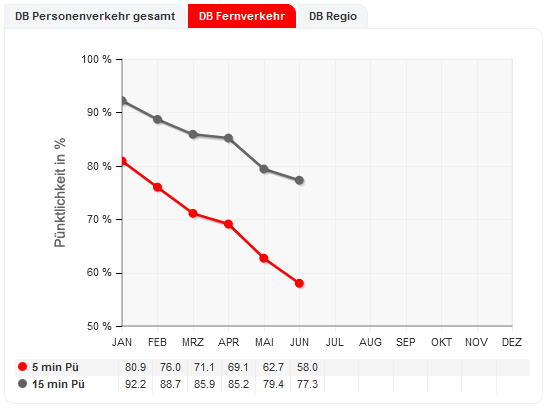
If you set out on a high-speed train journey, but your train stops at a station halfway to your destination, waits for an hour due to technical problems and then is canceled, that's a delay from the rider's perspective. However, when the Deutsche Bahn publishes its official on-time statistics, this train will not be counted as late.
In its public messaging, the Deutsche Bahn emphasizes its on-time rate. "We have an on-time rate of 65%" sounds like "You'll arrive on-time 65% of the time." If you're actually sitting in the middle of nowhere, with the next train an hour away, that doesn't feel like being "on time."
Also they finally need finish the access to the Alpentransversalen[2] which because of NIMBY and other things is extremely delayed.
[1] https://company.sbb.ch/de/medien/medienstelle/medienmitteilu...
[2] https://www.swissinfo.ch/ger/europaeischer-bahn-gueterkorrid...
The trains are still always delayed by 30 min because it’s single track on long stretches and delays always happen in the German and Austrian part of this line.
And the Basel-Karlsruhe line is still not finished.
Linking German Wikipedia because it has long history of them and current projects,
If the track would be used at anywhere near capacity the crossing would simply never open.
Alternatively a country could stop subsidizing cars. It’s weird that people complain about investment in trains but fail to realize roads are extremely expensive too and gas taxes don’t come close to covering costs.
There’s virtually no free parking in Japanese city centres and all highways there are tolled. For one person the tolls are similar to high speed train fare, and it’s a no brainer to travel by train instead of car for most destinations.
You sure about that because when I did some quick math on US road spending I found it would require about a $2.50 tax per gallon to fully fund our yearly road construction costs with taxes [0] and Luxembourg charges $2.23 per gallon [1] which is just 10% shy.
Guangzhou planned to offer free transit to ease congestion during the 2010 Asian Games. It was cancelled after a few days; metro ridership doubled, causing queues of up to twenty minutes to enter stations, and eight stations turned exit only to relieve emergency levels of overcrowding. Most rail transportation could not handle the crush of additional riders from free rides.
https://humantransit.org/2010/11/guangzhou-abandons-free-far...
Source for this claim? I would be surprised if it holds true.
> Most rail transportation could not handle the crush of additional riders from free rides
This is a problem with the infrastructure, not free rides. Of course capacity planning has to be adapted to keep up with increased usage, but thats literally what we want. We want more people to use public transportation, limiting or capping usage is the wrong approach IMHO.
> Residents of the Estonian capital of Talinn have been able to ride public transportation for free since 2013. Last year Estonia’s national auditor issued its assessment of that policy: It had induced many additional transit rides, but it failed to reduce car journeys. Dunkirk, France, and Frydek-Mistek, Czech Republic, have adopted free transit as well.
> “There’s no evidence at all that cities introducing fare-free public transport have seen their car traffic reduced,” said Mohamed Mezghani, the secretary general of the International Association of Public Transport, which has published a policy brief on the topic. “Most of the [new] people taking public transport used to walk.”
> The story was similar in Santiago, Chile, where researchers randomly assigned free two-week transit passes to residents. Those receiving the free passes took 12% more trips overall, but they did not drive less.
> If free public transportation failed to attract drivers in relatively transit-rich Europe and Santiago, there’s little reason to think it would fare better (pun intended) in the U.S., where scant transit service acts as a deterrent. An extensive 2012 study by the National Academies of Sciences noted that fare-free experiments undertaken in Denver (1978-9) and Austin (1989-90) failed to reduce driving; most new trips were taken by those lacking access to a car.
> Three MBTA bus routes went fare-free last August, and data showed that ridership on the 28 line rose 38%. (Other Boston bus routes, where fares were still collected, also saw increases, but smaller ones.) A survey of riders indicated that 15% of riders were new — but the fare-free rides replaced more biking and walking trips (8%) than driving (5%).
—-
Limiting or capping usage is the reality in most major cities because we cannot build our way out of the induced demand. Guangzhou is no slouch to public transport construction, in 25 years they have gone from zero to 621km of metro (the third largest system in the world) and yet even they cannot handle the capacity crunch. If there is no hope at Chinese levels of metro investment it’ll be impossible for anyone to actually build enough.
As has been mentioned elsewhere in this thread, the national rail networks in DE and UK is already operating at near-capacity so adding more passengers wouldn't exactly help, but making it cheaper to use local bus, tram and train networks would be brilliant.
When the rail infrastructure is alreay overwhelmed as it is in Germany it really doesn't make sense without first massively investing in the infrastructure - which will take decades.