213 points · by Tomte · 4y ago · 73 comments
It worked pretty well; I rarely have trouble with pages coming loose or bindings cracking in the books I've made. I have a few ideas for how to further improve the result, but those will have to wait for when I find time to pick up the hobby again; lately the most I've done is quick stitched bindings for small booklets when I want to include some essay or article as a supplement in my diary.
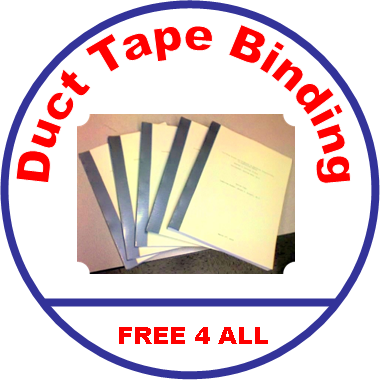
For spines I prefer black bookbinder's tape. It looks more handsome than duct tape, and takes silver paint pen very well for titling.
That said, I’m curious to try this process, which seems like it would go significantly faster and require less tools and setup.
The technique is called the double fan method, and would work fine with the rest of the techniques here.
This will leave between the pages for, ideally, less than 1/32nd of an inch or a quarter millimeter, which will vastly improve the strength of the glue's attachment to the pages without significantly impairing one's ability to open the pages mostly flat.
What the author could also do is get some board (like, say, the cardboard on the back of legal pads), clamp all that together prior to gluing, extend the spine an inch off a countertop with heavy books on the rest of the book block to hold it still, and then use a hacksaw to saw into the spine at intervals, about 1/32nd of an inch deep, crosswise to the spine. Take a piece of thread, dental floss, or fine string, and after gluing, press it into the first channel, loop back into the second, then the third, etc. Wipe excess glue and then put the duct tape over the spine, pressing it down evenly--THEN you fold the tape over the front and back at the same time, taping down the thread loops to the front and back of the board. Now you have a semi-hardcover, depending on the thickness of the boards.
Note that the duct tape adds little to the structure. You could also use a piece of cotton or linen in its place, you just have to glue it down to the front and back. This would be stronger, longer term, because PVA will hold better than duct tape adhesive over the years. If you do, cut the cloth "on the bias" meaning at 45 degrees to the weave. This prevents fraying and increases overall strength, for the forces it will encounter. If you do this, you can add another layer of PVA to the spine on top of the cloth, which increases strength.
My wife is a teacher and we created something like this as an exercise for all of her art students to make their own journals, with the final step being covering it with kraft paper. They loved it, used it for their art journals all semester, and asked to do it again at the end so they could have another.
If you get the basic assembly and gluing right, you'll be very surprised at the durability of something like this, including a lot of punishment like opening the book flat and using your hand to "break" the spine. It'll hold together.
In "perfect binding", which is the name for the overall class of binding the linked article is describing, where individual sheets are glued together along one edge, it's still called sawn-in cords for lack of a better name. It's not a typical addition in perfect binding, but it's exactly the same technique with the same purpose: adding cords to increase strength.
Here's a video of a well-known binder, Sage Reynolds, doing it as I described it for a perfect bound book: https://www.youtube.com/watch?v=VMXHmXSYXso
That said, let me present my decision tree for using duct tape:
if not closet.gaffer_tape then
if task.urgent then
online.order(gaffer_tape)
return closet.duct_tape or bail("ing wire")
else
return obtain(gaffer_tape)
end
else
return closet.gaffer_tape
endWhile the terms are frequently used interchangeably "gaffer tape" and "duct tape" are very different tapes with very different glues, and very different stretch properties, for very different use cases.
That being said, I'm curious as to how bailing wire would be used in this scenario.
You can tape over the stitch if you don’t like the look of it, but I personally like the texture.
This duct-tape thing still requires a bit of manual effort. 2-hole punch is a bit less popular (3-hole punch is everywhere), but 2-hole punch is smaller: both the binding clips and the punch itself is just more compact.
2-hole punch has two choices: the "long-side" 11.5-inch binding like a more normal book, or the "top-side" 8-inch. The standard clip works in both positions quite well.
Edit: Typo
One teacher had a moan because it wasn't strictly regulation but even they had to eventually concede it was a lot better.
But as other comments say, I may go with the purpose-made spinetape and maybe a cardboard cover (but then I'll start procrastinating over cover design!)
Any hints?
It can be jarring to hear in otherwise tame movies, now that we're conditioned to shun the word, but I'm pretty sure that conditioning is something that only a minority of people in the US have been exposed to, even today. Mostly those of us who are online too much, probably. Outside that sort of bubble I'm not sure how "problematic" it's actually considered to be, by the average person.
to be clear, i'm not trying to call you out with the following. I'm just using that sentence as an example because it's... such a _good_ example. It's not clear that you were even defending that sentiment so much as pointing it out, so please don't take this as me attacking you.
Statements like that are precisely the problem of abelist thinking, and precisely why we need to be active about speaking up for the minorities amongst us. It basically boils down to "it doesn't affect me or folks around me so it doesn't seem like much of a problem".
Most people aren't effected by stairs either, but they really suck for anyone in a wheelchair.
> Tons of movies from the 00s up to the early part of the 20-teens still used it freely and there was no major uproar over it—in general
Calling someone a "fag" wasn't problematic for the same time period too, except for all the people who it was problematic for.
I will agree that "retarted" is a word that a lot of Americans (most?) still think is fine to use, except for anyone with a family member or friend who people disparage with that word.
Does that mean we should continue to be "well, not a problem for anyone I know"? Or should we recognize that it hurts some people, helps no people, and stop using it.
The outrage honestly just comes off as white knighting.
As wiktionary notes, the offensiveness even within countries is variable:
https://en.wiktionary.org/wiki/spaz
But if you're writing for the wider english-speaking/reading internet, you probably want to be aware of these things to avoid unintentional offence, just as I assume Australians modulate their usage of 'cunt' for different audiences online.
You’re welcome.
It's not quite as pretty as duct tape, but it's fine for me.