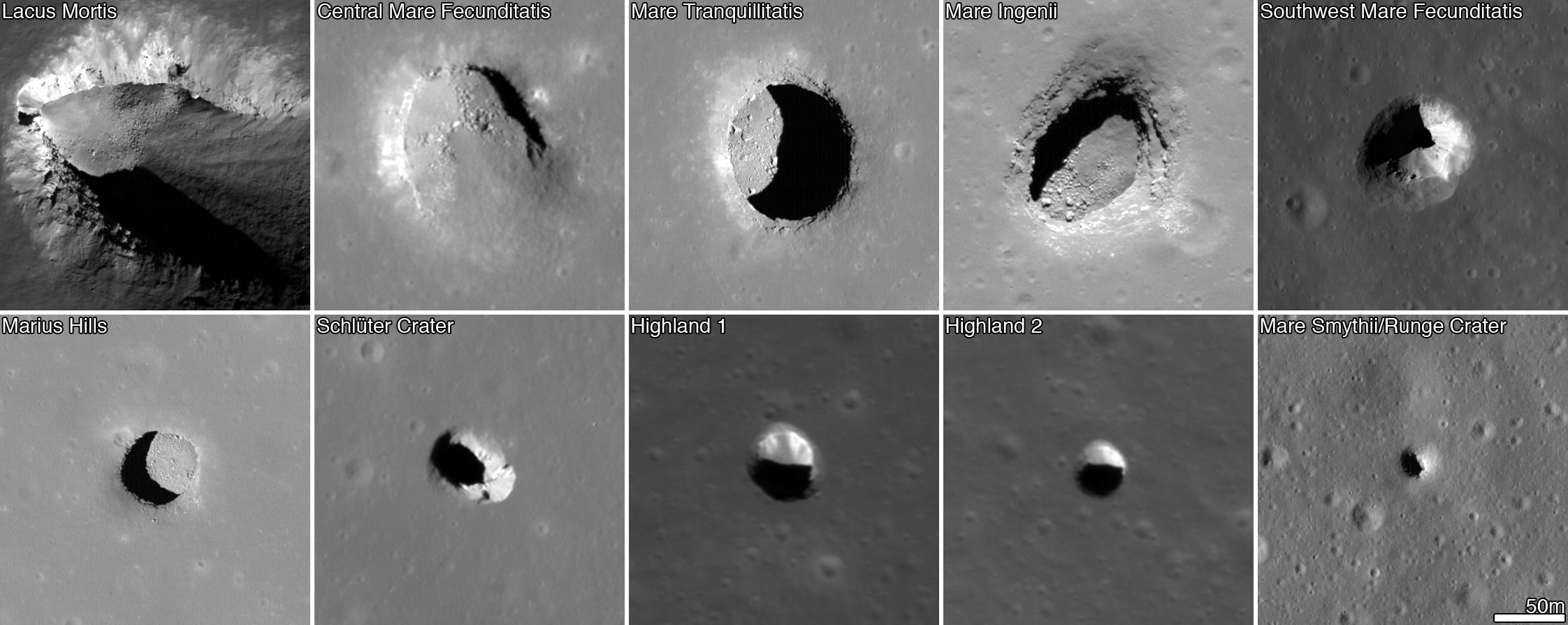
Lava Tubes on the Moon Maintain Comfortable Room Temperatures Inside
Universe Today
85 points · by pseudolus · 4y ago · 101 comments
There are other big reasons too, like help being only days away instead of months away in the event of a catastrophe.
Once we figure out how to do a space settlement on the moon, then we could try Mars. Mars is likely a better long term home for humans but it's about 60X as far away in terms of travel time.
Just imagine you need complec heart surgery - you can make it from the moon to a hospital in 3 days. On mars, you are probably dead
The huge temp swings, now that's actually a real problem.
Neither of the celestial bodies have mediums for growing food in so that either has to be manufactured or carted over. Either way it’s a huge challenge to overcome.
It'll be really popular for maybe 6 months, 1 year maximum. After that, everyone will lose interest.
We've already seen this before with the Moon: when Apollo 11 landed on the Moon, everyone in America (and probably all around the world) watched in on TV. With subsequent missions, no one cared, except when there was a big problem with Apollo 13 and the astronauts' lives were at stake.
...and every day parents around the world are making more new fans than ever.
- Lonely Island, Space Olympics
1. Lava tubes will be a cheap form of initial habitable space. Additionally, the Moon is geologically stable;
2. Gravity is too low in both places so you'll probably have to still live in spin gravity;
3. Mars has an atmosphere but it's basically a vacuum. It's just enough to cover all your stuff in dust;
4. Mars is poisonous. The surface is covered in many toxic substances (eg perchlorates);
5. People have a vision of living on the surface of Mars. That'll basically never happen. Radiation is still a problem. Living underground just makes way more sense. And any above ground structure (eg domes) can just as easily be built on the Moon;
6. Distance from Earth is a significant downside to Mars and a significant advantage for the Moon. You can still maintain real-time communication with Earth. And supplies are days not months away.
Mars really only has 2 advantages:
1. Day length. Mars day is almost Earth normal. The Moon is tidally locked so its day is ~28 Earth days long; and
2. Day-night temperature differential on the surface. It's really large on the Moon.
Why this matters is that even though you'd be living underground you still need power and solar power is really the best option. On the Moon this means your best options are the poles.
The standard retort is "terraforming". People who say this don't seem to comprehend what a massive undertaking this is. Example: the Earth loses (IIRC) ~1 million tons of atmosphere every year due to Jeans Escape Energy. That doesn't matter on Earth because the atmosphere is so much more massive.
So at actual atmosphere on Mars would have to be so large such that a similar loss would be insigifnicant.
3. Available water, required for any human/plant/animal life
4. 2.3 times the gravity of the moon
5. CO2 in atmosphere could be converted to O2 for breathing or methane for rocket fuel
4* Is that enough? We don't know, we've yet to do any centrifuge habitat experiments with small mammals
5* oxygen is so common, CO2 has the advantage of being gasseous, but silicates, aluminum and iron ores are the rocks you can't throw a rock without hitting and has the advantage that you only need to process a millionth the volume to get an equivalent number of moles to martian CO2.
Mars had much less harsh living conditions than the moon and having water and CO2 around makes living off the land, at least partially, a lot easier than on the moon. The delta-v to get to the moon vs. Mars isn't much different. Getting out of Earth's gravity well is the hard part.
Discovery - Other than spots where part of a lava tube's roof has already collapsed, how quick & cheap is it to discover and map the lava tubes under some non-trivial part of the lunar surface?
Scale - Let's say there's a lovely lava tube, X meters in diameter and Y meters below the surface, in a location where we'd like to build a moonbase. For a give size of moonbase, there will be fairly narrow ranges of X and Y values where the lava tube is actually suitable for housing the moonbase.
Cut & Fill Competition - Lava tubes aren't magical. If an area on the moon has deep, stable "soil" (vs. near-surface bedrock) containing ~few larger pieces of rock, then "dig a trench, install tubular habitat, fill trench back in" may give a far lower cost and/or higher predictability than "starting looking for the perfect lava tube...".
Stability - If you're not familiar with the things that often go wrong when humans start digging and building structures, Practical Engineering ( https://www.youtube.com/channel/UCMOqf8ab-42UUQIdVoKwjlQ ) is a pretty good intro. Note that we have a lot of experience with and data on how to do such things on the Earth. On the moon...not so much. Some very painful and expensive lessons seem inevitable.
https://www.nbcnews.com/mach/science/gigantic-lava-tube-coul...
At some point, the ideas start to sound like "wouldn't it be great to build a thousand-square-mile tropical island, in this spot where the ocean is only 3 miles deep?" Sure, if you know somebody who'll give you ~5,000 cubic miles of good rock, delivers cheap, and there's no "asteroid impact" in the fine print.
Check out the video on this page for a ton of details: https://www.kiss.caltech.edu/lectures/2018_Moon_Diver.html
That particular mission concept was not funded, unfortunately, but I'm hopeful that we'll do something like this soon. As others in this thread have said, aside from just being really cool these lava tubes on the moon (and Mars! https://en.wikipedia.org/wiki/Martian_lava_tube) are an interesting candidate for human habitats.
> The researchers used computer modeling to analyze the thermal properties of the rock and lunar dust and to chart the pit’s temperatures over a period of time.
I'm not sure I'd trust a lining applied to a naturally-formed tube wall to retain air. But if we were to build our own tunnels with a lunar TBM¹, where we could control what the tunnel wall is like, yeah, that'd be fine.
What kind of control do you think you'd have that would make the 'artificial' tunnel better?
1. You'd have a flat smooth surface that you could apply a liner to, instead of a surface that undulates and (probably) has fissures.
2. The diameter would also be constant, so that you could design your liner to fit based on known dimensions. Curves would also be of a known radius.
3. Also, our tunnel would go exactly where we want, and not wander around based on some ancient flow pattern. Or form oxbows where it loops back on itself.
4. So far as a structural liner, if you look at some of the tunnels under rivers where there is the danger of water intrusion, to my knowledge none of them have ever used a natural formation. Brunel used a brick structural liner under the Thames, and modern TBMs use interlocking concrete panels with rubber gaskets.
I think you're making a lot of assumptions, and don't have a comprehensive view of how the structure(s) would be designed and built.
With the daily big temperature swings, is this a viable source of power?
Earth is actually undergoing a similar process... IIUC, our planet isn't big enough to generate internal heat, and eventually the core heat should radiate away. I don't know if the time scale for it exceeds lifetime of the sun though.
I swear, every time I learn a new thing about Earth's internal structure it gets weirder and cooler.