100 points · by walterbell · 4y ago · 249 comments
There are descent people that are pushed into homelessness, but one camper can turn to a dozen in less than a week and only one of them has to start threatening to hurt your family, breaking into vehicles or set a fire to turn a benign situation into one that can threaten your life or livelihood.
Speaking from personal experience, we turned a blind eye to a middle aged man living out of his car next to our garage for a few months. Then we woke up one night to find the van had erupted into a two story fireball that almost burned down our entire block.
I go out and talk to people now when they start forming an encampment in our neighborhood. Its incredibly difficult work and I have never had both more and less sympathy for their situations and the real threats encampments pose.
This is a complex issue but it is an issue that is the city's responsibility to address. Shame on them for putting people on both sides of this issue in impossible positions.
New York figured this out in 1979. Cities have a constitutional obligation to build shelters for everyone that needs them. They did.
Those blocks will come down really quickly if business owners started getting fined for putting them up and van-dwellers started finding their houses getting towed. However, the city likely can't do one without the other.
My suggestion: If debris was left in front of my property irrespective of whether it was within my property or not, I’d get a notice to rectify. If I didn’t within a reasonable time frame, the city would rectify it for me and send me the bill. Failure to pay the bill within six months would simply result in it being folded into the property taxes. Consequences for not paying taxes don’t need explanation at this point. Very effective strategy. Not my fault someone dumped something in front of the house, but how to track who did it? Easier to shift it onto the property owner.
In my case I would simply put up security cameras that are clear enough to pick up license plates. The city would be only too happy to pass on the bill to the vehicle owner of whoever dropped off the crap.
Context and proportionality are important too.
> Speaking from personal experience, we turned a blind eye to a middle aged man living out of his car next to our garage for a few months. Then we woke up one night to find the van had erupted into a two story fireball that almost burned down our entire block.
This reads like an inflammatory article. Nothing but anecdotal reports of sample of one.
I'll bet there are a broader range of options available worth considering. What about trying the public sanitation angle? Does that open up some options?
The RVs arrived a little over six years ago after they were forced to move from a lot underneath a nearby overpass. There were around a dozen vehicles and some tents.
There was a lot of violent crime, including several shootings toward the end of the encampment.
There was a lot of trash and sewage. When they were moved the city hauled away several tons of trash and "shopping bag toilets".
There was a lot of obvious mental health problems and the deep fear and desperation that goes along with it. I've worked in enough urban service jobs to recognize people who don't have access to the mental health support they need.
There were single people, couples, and two families with children. The people I spoke with are mostly from Seattle and a few grew up in this neighborhood. They are homeless but not from some far away place. This is their neighborhood. They stay here because they know people and because they can sometimes find work here.
We failed as a city to provide a safety net when these people fell. My street is more safe and has less trash and it's true that I like it but to get that we didn't solve a single problem. We just moved it along.
It's really frustrating to be expected to follow the laws when the homeless aren't. I get cited for parking an RV in my own driveway because it is unsightly. 2 blocks away there is a full blown homeless encampment.
If you embrace only a purely strategic point of view, sure, choose from the palatable tools available to achieve your ends.
But most people have some kind of moral and ethical code, imperfect as it may be. The golden rule is nearly universal across various moral belief systems.
Be careful: if you only consider the purely strategic point of view you may find yourself as the primary casualty. Living without a moral code is perhaps the most self-defeating decision you can make.
I find that the people who espouse these views are usually insulated from the effects of them. Have you ever had a homeless camp near your residence? How close? How would you feel about your wife/daughter/mother being home alone near a homeless camp?
I'd love to be charitable and kind, but people have to protect themselves as well. Bringing a bunch of mentally ill drug users near your residence is a recipe for disaster. It should not be seen as some moral issue that we need to solve individually--the government and police should be able to resolve this on their own, especially considering the funding pumping into law enforcement and homeless funds. I think the big problem is we just keep creating more unaccountable programs and services instead of just giving people an SRO and a social worker. We're doing the dumbest possible thing because everyone wants to get a cut. Every other developed country has basically solved this--we could just copy a working model instead of dumping more and more money into hare-brained ideas every year that never work.
About my most recent experience in the East Bay (near San Francisco)... I lived (a) about 0.5 miles from a homeless person who lived in a truck; (b) about 1 mile from an industrial area with dozens of parked campers, (c) about 1.5 miles from a small tent encampment (maybe 10? tents), (d) and about 2 miles from a larger one (maybe 20?). In this experience, I did not personally feel threatened, nor did I hear accounts of them being violent or particularly troublesome.
But I get your point. I have been close to camps where I feel unsafe, and I would not recommend spending time nearby.
> I find that the people who espouse these views are usually insulated from the effects of them.
Would you give an example or two from your experience?
To summarize, when acting within the moral sphere (which Kane defines as the situation where people are acting in a way that respects other people's rights), we should act to maintain it.
But when it breaks down, we do the best we can to restore it, which might mean acting less ideally toward the people causing breakdown.
Blame drugs, blame political opponents, blame the government, blame developers, blame tech bros, blame whatever or whoever you want... but at the end of the day, still no solution is in sight. There is no widespread push for affordable housing or a pathway out of poverty, no real long-term care for people fighting addictions or mental illness. There is only the relentless push for profit for a few as society crumbles around them and more and more Americans get displaced.
It's going to get a lot worse before it gets better. We're circling the drain with no end in sight.
[1] https://sfist.com/2021/03/04/insanely-it-is-costing-san-fran...
A lot of money goes to politicians, their supporters, and bourgeois — while only a small percentage goes to fixing homelessness.
This is essentially looting the public by corrupt actors under the false guise of moral action.
The city has 815,201 residents as of 2021. I think they can spend more than 13¢ per resident per year on this. Maybe there are other details that compound the problem, but the math insists that funding is obviously a massive part of the problem. They should be spending $20M a year at the very least, just to start, and increase from there. $20M/yr is $25 per resident per year. Even a homeless person could probably afford $25/yr, while the median household income in San Francisco is $120K/yr. If they want the problem fixed, paying for it to be fixed is really the only option.
[1] https://www.sfchronicle.com/bayarea/article/S-F-has-an-unpre...
The vast majority of homeless people are drug users AND mentally ill. If you are living on the street when we have 3.6% unemployment--it's most likely drugs and mental illness (yes, there are rare exceptions).
The solution is what it's always been: a universal housing mandate, and adequate social services (including harm reduction). The things stopping that aren't "performative activism"; it's Seattle's pathological disdain for housing and a polite-society liberal ethos that values property values over human lives.
It is not illegal to arrest someone for stealing/drug use/etc. and then have a psychiatrist examine them to determine whether they should go to jail or be institutionalized. Courts regularly examine criminals for mental fitness to stand trial already.
> no particular evidence that you can disappear whichever group of undesirables you see fit and guarantee that more won't appear
Funny, because that's exactly what lots of cities do and it works pretty well. Take a look at any wealthy SoCal city and you'll find no homeless.
> a universal housing mandate, and adequate social services (including harm reduction)
So, spending more than the median American makes per year on tents? Or allowing crazy drug addicts to trash temporary housing and hotels? Because that's what happens in SF. From the SF Chronicle, which is a super left leaning publication: "Residents have threatened to kill staff members, chased them with metal pipes and lit fires inside rooms, incident reports show. At the Henry Hotel on Sixth Street, a tenant was hospitalized after a neighbor, for a second time, streamed bug spray into their eyes, public records show. Last May, less than a mile away at the Winton Hotel, a resident slashed another tenant’s face with a knife, leaving a trail of blood out of the building" [1]
And from the director running one of these programs: "“We throw all these people into our hotels who have no demonstrated ability to live independently, who have severe problems and need to be elsewhere,” Shaw said"
Clearly the problem is not housing, it's the lack of support around getting mentally ill people the treatment (i.e. institutionalization) they need. And obviously, a crazy person is not going to consent to treatment for their craziness, so you need to force them into institutionalization.
[1] https://www.sfchronicle.com/projects/2022/san-francisco-sros...
False. If you are a danger to yourself or others, then you can be involuntarily committed after a hearing with a judge, and it's completely constitutional.
https://www.samhsa.gov/sites/default/files/civil-commitment-...
When you start with an immediate falsehood, why read further? The italics don't help your argument either.
https://www.kqed.org/news/11209729/did-the-emptying-of-menta...
Rest assured, other parts of the world have this all figured out. My favorite term is Favela which Wikipedia assures me is "also known as community". Eventually the ruling class throws up their hands. You can't put people in poor houses, jails, mental hospitals, subsidized housing--all too expensive/illegal/impractical. So you let them live in an ill-maintained "community" like the rest of the world does. It's coming.
Hate to break it to you, but there are still plenty of ghettos and tenements, and replacing some of these with tent cities is not an improvement.
This is repeated often, but doesn't seem based in reality. Most of the people living on the streets are addicted to meth or heroin or mentally ill or some combination of the those. If you're on meth or heroin, you'll never be able to afford an apartment regardless of what they cost.
Wow, when Toronto put up concrete blocks (wtf is “ecology” in the name), they spent $100k for about 100 blocks to be bought and placed in front of various unregulated marijuana dispensaries. Then another $250k in bureaucratic/engineering/legal expenses.
https://www.thestar.com/news/gta/2020/01/20/blocking-off-ill...
Someone there spent $1000/block and since those appear to be about 4 feet long they would likely cost about $100 each so the labor cost to install each block plus profit to the installer eats up $900. Probably a kickback in there somewhere.
Of course with lawyers involved there was probably a round of blowjobs to buy for the team and the final cost of that would depend on which corner they visited for that service.
There are also composition requirements. Bin blocks are just made from remnant materials.
If we wanted that, we should've invested in low-income housing, and public transit infrastructure so that people could live elsewhere, and commute. Also, healthcare for folks who struggle with mental health.
Lacking investment in those things, I imagine we can't start the clock on when this might get fixed.
I want to focus on the "If we wanted that," part. The "we" part is notable and problematic. I'll mention two senses here:
* desire (measured by preference aggregation): what do "we" want, based on aggregating (somehow) individual preferences
* action (collective action): what can we agree to do?
My point is this: Just because _action_ hasn't happened does not mean that _desire_ is not there. There is big gap between the two. One recipe is:
1. define the group with the desire
2. find and organize them
3. identify the common preferences
4. accumulate political capital
5. wield the power
I'm not a naive optimist; this is hard. But don't assume the _desire_ is not there! It takes effort to align a previously scattered group of people into something with cohesion and identity.
I'd be surprised if anyone didn't want that. But I think the specific things when suggested, are things people oppose. "I want public transit, but I don't want them to put it on my street".
Also, full agreement that I'm not able to comment that people don't actually want this, only that the elected officials (and other powerful people) don't appear to want this (in Seattle). That is definitely who I'm referring to.
How far do you think Seattle can get on its own? What kind of assistance is needed from the county? ... Washington state? ... the federal government?
P.S. I realize this is an easy question to ask but difficult to answer in any reasonable amount of space. I'd be happy to read recommended articles on case studies or data-oriented comparisons.
There's a lot of the missing middle in Seattle for housing: https://www.youtube.com/watch?v=CCOdQsZa15o&ab_channel=NotJu... Which has been demonstrated to pay for itself (and support other businesses). Zoning for this would go a long way towards helping to alleviate the increasing cost of housing. (Also actively/readily) makes more money than it costs to maintain.
I think there's also something to be said for getting rid of cars in Downtown Seattle (still need to provide good accessible options). I originally clicked on this article in hopes that was what people were doing. Tangent: Shuffling homeless people around with cement "eco" blocks (legitimately interested in the etymology of that name) turned out to be the sad waste of resources we were going for here...
Mental Health feels a lot more difficult than this. Probably needs more of a national fix cause healthcare is too expensive and inaccessible in the US.
If placing them is illegal, but requires specialised equipment to do it, couldn't the city go after the operators of that equipment?
As I recently published at [1], my city of Berkeley does not raise anywhere near enough money from property taxes to pave the city streets. If you think the majority of roads in the United States are paved with property tax revenues, I'd like to see your math.
1: https://observablehq.com/@jwb/property-tax-whales-of-the-eas...
Of course if a business/person wants to provide free parking on their property, that’s fine. But they shouldn’t be required to by zoning.
edit: disabled parking should be free, that’s different
It's still crazy to me that I can park a block away from the world trade center for $0 (there's usually open spots around the federal reserve on the weekend), when the real estate there goes for $1500+ per sq ft
I don’t think public transit riders should be forced to pay the full price of their habit. Nor do I think cities shouldn’t charge taxes and spend the revenue on both roads and yes even curb side parking.
It’s quite reasonable for cities to fund numerous modes of transit.
But you also can't have homeless people around, that would be unsafe. Also they still expect people to live there and do service jobs for them, even though there is no place affordable to live.
And guess where the sewage goes when you can't or won't drive your RV to the dump site?
like, we can't rly make them stop unless we take they RV, now we got 1 more homeless. or we could take them to prison, now we got 1 more prisoner. none of this fixes the problem bc it's rly hard to punish ppl who got nothing to lose.
These guys do have something to lose - their RV and all their stuff in it. You can't ask them to magically with money they don't have, but you can effect behavior and priorities.
Now if you lose your RV and start squatting in a park, get warned for trespass and then stay anyway, while doing drugs in the open and shoplifting, etc. I'd love to see an escalation that eventually lands you in jail (not prison) and a 1/2 way house and treatment.
Rules need to be enforced. They can and should be enforced extremely compassionately and incrementally. But they need to be enforced.
And if they are not, this is a perfect example of what happens. The city has now de-facto abdicated a lot of it's authority and here we go, back to vigilance committees and self-help of 150 years ago. As shown, the self-help mechanisms lead to sub-optimal solutions for everyone. Now no one can park on those streets at all and the homeless are still homeless. Society just isn't going to just sit back and let shit-heads ruin it for everyone because the current city governance is too ineffective to take care of business in an optimal way.
This framing does a disservice to the homeless because it takes away any of their agency. What about the people who choose to live this way? Or does the government take that choice away from them too?
But it’s just that: a fantasy, born from ignorance.
These are mobile drug dens often inhabited by people with long criminal records who throw trash all over the area — not middle class people down on their luck.
It's complicated. You're right that many homeless people are just people down on their luck doing their best to get by. Many of them aren't causing anyone any problems. From what I understand, most of these homeless people get by doing things like couch surfing and aren't very visible.
In this particular corner of the city, most of the people living in these RVs are not in great shape. Most are drug addicts, or mentally ill, or both. There is a halo of crime that surrounds these encampments. In the past couple of years, I've seen:
* Multiple cars broken into.
* A drive-by shooting of one of the RVs right by my house.
* That same RV's owner almost certainly selling drugs from her RV for years.
* A woman, completely topless, staggering in the middle of the street screaming obscenities at no one.
* Many needles on the ground.
* People urinating on our garage.
* Someone taking a shit next to our garage.
* My neighbor's car was broken into and the urn containing his father's ashes was stolen. When he found the guy who broke into it at a nearby encampment and tried to get it back, he was attacked with a knife.
* Rumors of prostitution and hep-C outbreaks in one of the encampments.
* A large man beating the shit out of a woman in broad daylight.
* Multiple shootings in other RVs and nearby homeless shelters.
* One guy, clearly suffering from schizophrenia, who sits on the sidewalk and screams at no one for hours and hours.
* Someone climbed our fence and was shambling around our backyard until a neighbor showed up and scared them off.
* Package theft, obviously. Constantly.
* Many many screaming matches and other domestic disputes.
* Someone sitting on portable toilet seat in the middle of the street, taking a shit in the middle of the day.
* Piles of trash, human waste, buckets of piss, bags of shit, etc. Because when you don't have property, that also means you don't have trash pick-up or sewer services.
* Someone throwing rocks at someone's car and at people in their backyard.
* A woman walked up onto our porch and stole the lightbulb right out of our porch light. (I've heard they use incandescent bulbs to make some kind of drug paraphernalia?)
* One guy runs what he calls the "homeless recording studio". He has a venue-sized PA system in his RV that he cranks up to full concert volume and plays the radio. Then he plays his drum kit on top of that. With the doors open, at all hours of the day and night.
In fact, I literally just got back from walking out to see what a large police response was about after seeing several cop cars circling. I don't know the details, but an officer said someone in an RV was refusing to come out.
I have a lot of sympathy for people suffering misfortune and I think almost all of these people mostly need help and support. I don't want them to be punished. But I don't want to keep dealing with the kind of stuff they are doing either.
(You may be wondering why we don't call the cops about this. We do. If we're lucky, they come. When they do, it's hours later and too late to do anything about it.)
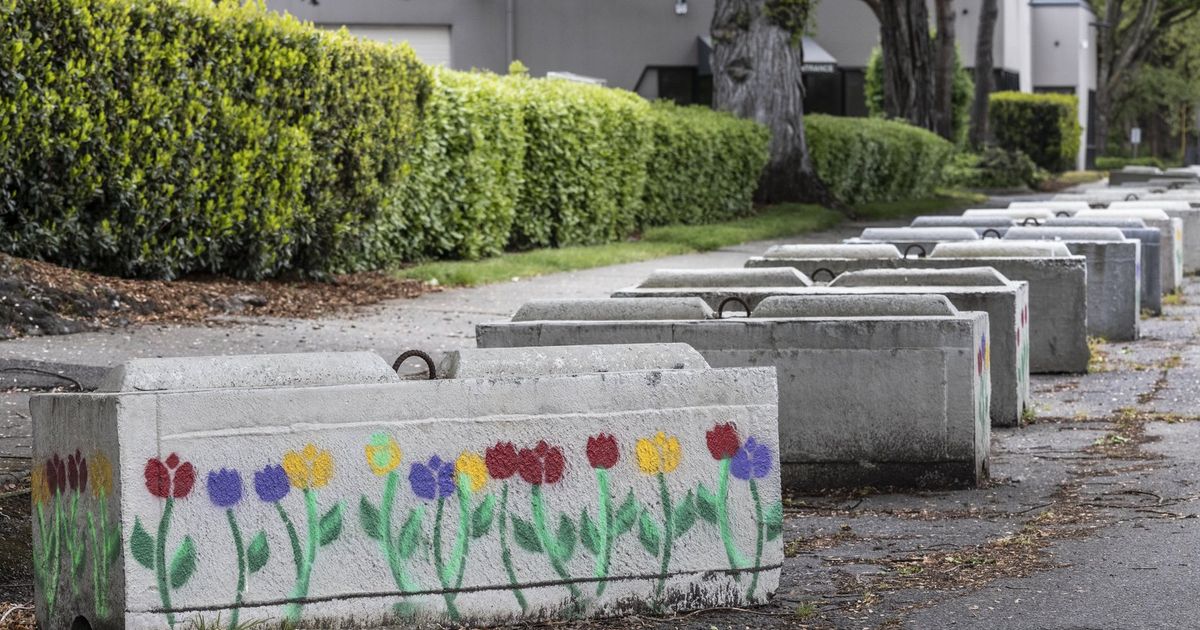
Homeless advocates say it is not fair that the city expects vehicle dwellers to obey parking laws..
It does not matter if it's to run errands or improvised RV housing, why should some obey the parking laws and others are allowed not to? The defeats the point of having parking spaces. Parking spaces were never intended to be dwellings. This seems really unfair. It's a difficult problem...everyone says that housing affordability/availability is the answer yet nothing get done.
To me, a permanent concrete block is an even worse violation of parking laws than a semi-permanent RV.
PNW = Pacific NorthWest?
We detached this subthread from https://news.ycombinator.com/item?id=32300502.
Cities do not give away public parking. Either you have to pay for it (metered parking), it's provided "free" to customers only (i.e. paid for by the profit margin on goods and services), or it's only available to people who live in an area (i.e. those people paid property tax, either as owners or renters).
> everything but housing will do, presumably
Housing doesn't solve rampant drug addiction, theft, mental illness, and laziness. The article in the OP literally cites trash accumulating, rats running rampant, and vehicle fires spontaneously occurring. That is not the environment that a rational person occupies.