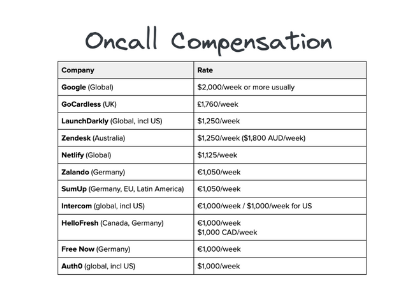
Oncall Compensation for Software Engineers
Which companies pay for oncall, and how much? Philosophies across the industry for paying for standby duty and numbers from 80 companies.
The Pragmatic Engineer
253 points · by kiyanwang · 4y ago · 306 comments
It's one thing to be on call where you get called 2-3 times a year, because you're working on a quality system where bugs get fixed more often than they get introduced. Then the pay, if any, is mostly compensation for hurting your social life.
It's another to be on call where you get called 2-3 times a week, because the organisation has decided calling you is cheaper than fixing the underlying problems. In that case, the compensation better be worth messing up your sleep cycle and upsetting your partner.
#1 and #2 are pretty obvious. These things actually eat into your life because you’re actually working.
#3 is hard to calculate how much that’s worth. If I’m required to be logged into vpn and starting to dig in within let’s say 10 minutes. That means I cannot reasonably leave my house to: eat dinner with my family, go to lowes to grab some pvc because the pipe for my sump pump started leaking, walk my dogs, take my kids outside to teach them how to ride a bike, etc.
I feel I should be compensated for having to be ready to go and not having the freedom to live my life. That in itself is an interruption.
When my spouse was on call for a hospital, they had to sit with their phone in their lap when we went to the movies. I had to be prepared to Uber home because they’d need the car. It’s not fun!
Being on call for a hospital is absolutely a different experience IMO than being on-call for a software system. But at the least when it comes to healthcare having had several folks in my family tree being in healthcare in different functions it’s absolutely clear to me that a big reason for the US having a buckling healthcare system is lack of supply of doctors and nurses at the very least to cover each other and to provide better care per patient.
That's one problem with a fixed on call rate that some organisations offer. It's a hefty chunk of cash and sounds generous to the engineers. But the cost is already known and sunk up front and not proportional to the amount of call outs so the business sees it as a fixed operational expenditure rather than an appraisal of how fucked things are.
The performance metric quickly becomes how many people you still have on cover who haven't quit to work somewhere else because they are burned out.
For partial on-call weeks, the standby comp was adjusted. For good or bad, it was a literal pager, so we could easily adjust things within the team and file paperwork afterwards, as the NOC just called the pager. The downside of that was that it required being in physical presence to hand the pager over.
If that's the case, you need to reconsider if you need a devops/SRE team in the first place, if you need an oncall rotation, or maybe if you need to be more proactive in implementing/releasing/deploying new features as long as you stay within SLO budget. We've had weeks and months where we just looked at our graphs and uptime budget and go "our systems are getting worse, we need to slow down releasing and tighten up the automation", and we've also had months where our load was so light that we'd consider doing large migrations or more daring experiments (for our devs) because those also improve our service and our users' experience.
Not really.
If the company loses $20,000 per minute when the system is down, the system should be well engineered, so it rarely goes down - but it's still worth paying $700/week to have someone available in 10 minutes if it does.
Trying to "optimize" these systems to use more of their error budget and save operational cost results in fiascos - There was a multi-day outage (not full outage, but several full days below SLA) on a minor system while I was at Google where it boiled down to "Bad Engineer tries to justify their job and management lets them implement a poor design over the objections of everyone".
If the rotation is spread only on 2 or 3 Ops in the team, well, being on-call every other week, even on reliable systems, can really suck (given you must always make yourself available).
Things can get even worse in periods with a lot of PTOs like Summer or Christmas. During these periods, if the team is small, being on-call 2 or 3 weeks in a row is not uncommon.
Someone finally said the quiet part out loud about ‘Devops Engineer’ as a job title. Only a matter of time before we wise up about SRE as well, I suppose.
I don’t know why we need to have a job title treadmill for this; I hate not knowing what your definition of “devops” or “SRE” is when interviewing. (Both as a person who interviews others and is interviewed by others).
Before anyone says it: Sysadmins could code (not to the same level as feature folk), shitty operators pretending to be sysadmins couldn’t.
There is a legal requirement (regulatory, but carrying force of law) for some industries to implement ITSM practices (and similar, don't quote me on specifics) . There is a requirement in those practices that Developers not have access to production, and that Operations have access to the code. That's incredibly wrong. It's misguided in the worst possible way - The point is to make sure the two audit each other, but it requires black box auditing, when you actually want whitebox auditing. (Note that allowbox and denybox are not acceptable substitutes here).
SRE is called SRE because of a difference in those practices. DevOps is an inexpert redevelopment of those practices. Sysadmin practices evolved into both, but what's modernly called Sysadmin is descended from the AD and Exchange people, and have bad practices. You can't walk back the evolution of words, you can fix them through evolution as well, but it's as slow or slower than getting there, because the ecological niche is already "filled"
DevOps itself as a concept was born in nebulous circumstances (“dev-ops days” being where the verbiage comes from but the founder of that conference called the job “agile systems administration; and the concepts espoused by the devops movement being almost exclusively borne out of the “10+ deploys a day” talk from Flickr).
Anyway, SRE is not materially different than Sysadmins except in three dimensions:
1. Hire only programmers, none of those operators who click buttons.
2. Treat reliability as if it is its own feature.
3. Solidify the contract between feature folks and people focusing on reliability.
I’d like Ben Treynor-Sloss to weigh in here as he likely knows best, but that’s the most condense version of what I understood
You’re right about the exchange people, but they too suffered title inflation, the exchange folks used to be called IT technicians.
The people automating AD deployments across sites and managing reliability were sysadmins, and they programmed in the most ugliest of languages to achieve that, autounattended.xml and bat files for days.
The tools are better now, but the work that devops/SRE’s do in most companies today is why sysadmins used to do in 2008-
Hmm...opaquebox and transparentbox? clearbox?
DevOps started as an idea that the development team should be responsible for operations. Before this, most dev teams created artifacts that got handed to an ops team to deploy and be on call for. That idea went to corporations that wanted to modernize, but you can't just disappear an entire workforce of admins used to doing things differently. It's a similar situation to where graphic designers started being UX designers. These people didn't magically develop a different set of skills...just a different set of expectations.
SRE-SE and SRE-SWE's are responsible for application code and often embed on application teams to bolster either code or system performance or both.
Please do not take companies bastardizing these practices as truth to what they are. There are companies who do this right and we should champion them above the garbage.
Put differently, I think one of the ways somebody goes from the "shiny/trendy and unstable" side to the "boring and stable stuff" side is by experiencing the operational pain of their choices. If the pain falls on others, will they still learn?
Of course, the way you talk about your job makes me wonder if you are already experiencing so many systemic/managerial issues that there the feedback loops are already pretty broken, so this one may not make a ton of practical difference.
Work has had three out of hours pages in the last two years, all self resolved within a few minutes.
I’m more focused nowadays on “what problems are you hiring me to solve?” since it feels more and more like the Venn diagram of the three job titles has nearly completely coalesced into a perfect circle.
Difference for me is I’m scrutinizing far more intentionally in job interviews about why an org is hiring for SRE/Devops before accepting any offers. Too often orgs are hiring for this talent and turning them into kitchen sinks for anything and everything the SWEs aren’t doing.
Compliance? Send to Devops.
Upcoming audit and need a pen test done in 3 days? Send to Devops.
Did a bad job prioritizing bug fixes and now shits crashing? Devops.
Etc. once you go through that a few times you start to figure out the right questions to ask in an interview and figure out if you’re about to join a company with Devops practitioners or pretenders.
Interviewed with dozen of companies over my career - never been able to get a straight or truthful answer to this
Having also worked at Google, I found this situation ridiculous. Facebook treats oncall as something you're just expected to do on top of everything else you're meant to do. So if you have 50 alerts fire, 40 tasks create, 5 UBNs (UBN = Unblock Now, which should be responded to immediatley and will probably be a SEV) and 3 SEVs, well you just have to do all that and your job.
Google oncalls (IME) tended to be fairly light. You'd often do releases too but there tended to be a lot of automated processes around this (ie building binaries, packaging MPMs, release to staging, release to canary, regression detection, push to production).
Facebook's releases (other than Web) were (again, IME) a dumpster fire.
Web was a special case because of continuous push. Push a commit and automated processes would build the (very large) www binary and handle the push to C1/C2/C3 (these are sort of analogous to internal testing, canary aka 1% and prod). Automated processes would verify a commit by deciding what tests to run. This wasn't explicit and would miss relevant tests for various reasons. This could (and often did) break trunk. This could back up pushes for hours. First thing in the morning it may take as little as 2 hours to push to prod. Later in the day it might take 8+ hours.
Facebook works around this by using conditional code, like... a lot, meaning certain code would only run if you're in right set of GKs (gatekeepers) and QEs (quick experiments). Behaviour would be flipped on by a separate GK/QE push, which is much quicker.
But this means when something of yours breaks (which it often does) you have no idea why. Is it a bad code push? A bad GK/QE push? By you? Or some infra you depend on?
I mention this because you had to deal with this sort of thing oncall a lot.
The problem with not giving oncall compensation is that the burden is never shared equally. The person or persons who do more than their fair share are never going to do it for the money because it is annoying but at least the money is some form of recogniation or, dare I say it, compensation.
Disclaimer: Xoogler, Ex-Facebooker.
For tier 1 oncall (5m response time), for each hour oncall outside of working hours, you are compensated for 40 minutes, which you can either take as time off or at your current pay rate (i.e. you are compensated at 2/3 your usual pay).
For tier 2 oncall (30m response time), the compensation is 20 minutes per hour outside of working hours.
For a tier 1 rotation, the team has a staffing requirement of 12 people, split between two sites. There's a max of 80h oncall, outside of working hours, per person per quarter. Because oncall is split between sites, you are never oncall overnight.
The saving grace is a lot of teams aren’t really doing anything that critical, so the on call is more a formality bc that’s what real teams do. Still pointlessly stressful but less serious.
I worked for AWS, and our service was critical for like half of the internet. Very hard oncalls.
* For every hour you're available for on-call you get your regular hourly rate.
* For every incident, which involves you working, you receive twice your hourly salary for the duration.
So companies based her tend to have that as standard, though I'm sure some companies would pay more to stand out.
1. Time on-call was paid at 25% of normal hourly rate. (Maybe holiday premium boosted the base rate? I can't remember.) 2. Issue-resolution pay was the normal overtime rate, including shift premium and holiday premium, from the time the pager went off until the issue was cleared. 3. The person on call had to: a) be able to get to the plant in 20 minutes, if necessary, but remote support was perfectly fine and paid the same. Only resolving the issue mattered, not where you did it. 4. The person on call had to remain sober and work-ready the entire time on call.
It's 3 & 4 that justify the 25% pay for carrying a pager. Friend having a party? I'll have cranberry juice, thanks. Fresh snow in Tahoe? I'll have to miss it this weekend.
Restricting someone's movements and social life without compensation is simply abusive. As an industry, we need to stop.
Company policy said we had to have different devices on different networks, so the company issued cellphone was one, and the pager was on another provider.
Why would you pay for a separate pager device and service when every cell phone in the world can receive text messages? Bizarre.
On-call #1. Averaged one page every week or two. Pages typically resulted from a failed automated process, which was scheduled to avoid running in the wee hours of the night. Most pages could be handled remotely, in about 10-15 minutes. For issues that required going in, even if the root cause couldn't be determined, the system could be brought to a safe state with further troubleshooting done the next day. If there was an overnight issue, you were not expected in until the afternoon, and supervisors would actively tell you to go home and sleep if you were there in the morning.
On-call #2. Averaged 3-5 pages per day. Pages occurred at random times during the day or night, with little to no predictability. All pages could be handled remotely, but typically took 1-3 hours to resolve. Issues frequently required creative problem solving, which was expected regardless of time of day. If there was an overnight issue, you were still expected to be on-site for the daily 7:30 AM meeting.
There was a drastic different in quality of life between the two on-calls. The first was as you say, an on call with the expectation that most of the time nothing will go wrong. The second would be more accurately described as a "working nights and weekends rotation", rather than an "on call rotation"
I have many friends "in the trades." These are usually unionized, and the compensation can be jaw-dropping. Many of my friends deliberately try to get overtime, which can include "on-call."
But the work can be tough, and the salaries -although good- are usually less than most SWEs.
Useless expectation as it still steals your freedom.
With the pay structure described above I assume this is applied outside your normal working hours, where you're not doing anything other than being on call.
Unless you are working half the weekend, every weekend you are oncall, the tier-1 OCC policy wins over time-and-a-half for time worked.
Doesn’t this only apply to SRE rotations? The dev teams I know of are definitely oncall overnight.
Tier 2 is still "proper" oncall and we were split between sites. I think devs would be tier 3 oncall instead which has no compensation and no expectation of a certain prompt response time (also SLAs and other metrics might be different since they usually aren't an SRE team). In that case tier 3 rotations wouldn't be handled by SREs and would likely not be split across sites (since dev teams aren't usually).
There may be exceptions, and I've never been in a dev team myself although I interacted with many so I might be wrong, but I can't recall ever seeing a tier 2 oncall SRE team not having a site split and having people 24/7 oncall overnight. Just my personal experience.
Am I doing this math right…
You get comp’ed 26 min for every 1-hour of Tier 1 Oncall?
If so, getting paid ~50% seems pretty darn good.
Google isn't even giving employees overtime rates for the work they do on call. It doesn't sound voluntary, either, and where are the handsome on call bonuses?
Google will pay you significant extra money for oncall, with the huge caveat that your management structure has to fight for it. I have worked on three teams at Google over four years. All three had some kind of rotation, and none gave extra compensation. Usually they call it something else -- "emergency contact," "caretaking rotation," etc.
The pager should be tuned to your SLOs, and you should be incentivized to exceed those SLOs.
- if oncall is a part of the gig, you compensate _somehow_ (demonstrably above market salaries, explicit extra pay, time in lieu, etc); oncall culture (or the lack thereof) should be explicitly mentioned in any hiring process and employment contracts
- the team should be striving for 8 or more engineers in the steady state; temporary vacancies should be temporary
- primary should be handling 80+% of pages in the steady state; if this is not the case on average across the team, you are not building enough resiliency into your oncall culture, or relevant tech debt should be high priority
- relatedly, kpis/incentives should be structured such that as call gets worse, progressively more immediate investments are made to address technical root causes (a la SRE error budget)
I'm tinkering with that last one my head. It's easy to say, hard to execute
Being on call is super stressful, and if it’s causing burnout, you don’t need to keep doing it. Does this increase the burden on your teammates? Yes. But so would you burning out.
Absolutely. Being on call means we have to be ready to respond. Can't ever fully relax, can't make plans that compromise that readiness. People need to be compensated for that. Where I live doctors get paid when they're on call.
Its worth going through; the worst that can happen is they say no (or, admittedly, fabricate a reason to fire you), but you’ll know where you stand.
Two key factors are "(1) the degree to which the employee is free to engage in personal activities; and (2) the agreements between the parties." Beyond these general factors, no universal rule applies since the details matter (frequency of calls, response-time requirements and geographical limitations, etc) in the degree to which they limit personal activities, as do any agreements laid out in a contract or company policy (e.g., how specific 'on-call' requirements and compensation are defined and agreed upon in advance).
Note that these factors have only to do with the time spent _waiting_ for a call; time spent _actually working_ while responding to a call is more clearly work that should be compensated.
I really wish this wasn't stated so matter-of-factly. Neither of these is actually supposed to be true. A lot of times on-call gets stuck on these folks because they're often treated as second class citizens in the softwarescape. There is really great structure for doing these roles right that doesn't involve them making them full time on-call.
Sadly spot on. For anyone that’s not been the ops side of the fence, you are expected to do major works out of hours as it’ll impact developer productivity. You can also lose your public holidays, weekends and evenings to issues while others get to switch their phone off and forget about work until they return.
It does a real number on you. Glad to be fully on the dev side of the spectrum now but some of the attitudes of interviewers I had to endure to get there… And that was with a CS degree and a truckload of IaC/glue-ware experience!
I mean, really, what's going to happen if you can't see the score of a baseball game until tomorrow?
Well, nothing. Unless you’re MLB.com and have tens of millions of people paying you >$100/yr to have that information readily available. If that’s the case, you’re issuing credits (which is a huge time and money sink) and losing customers.
They won’t. No one will. They want their salaried employees to also be firefighters and the premise is absurd.
I don’t take calls at night; you cannot reach me. What are they gonna do, fire me?
Good joke. I run interviews and staffing someone who knows their left hand from their right is nearly impossible. Leverage works wonders.
Hate to break it to you, but starting your own contracting/consulting company means you are forever on-call. It just so happens that it's not called that explicitly, and the people you have to answer to are your customers (aka your bosses).
I get back to clients typically within one business day or I will show up to any meetings scheduled a week in advance. This has never been an issue.
I do not carry a cell phone and I make sure every client knows this. If I am outside my office I am living my life.
You essentially get a week to find bugs, fortify the application, and make it so that the next person has an easier on-call.
If everyone goes into it with this mindset, eventually on-call becomes a quasi-freebie week where you can either work on "fun stuff", or it becomes invisible.
Not to mention that no product can survive without love and support from its devs.
That's independent from being oncall.
I prefer to spend my non 9-5 time with my wife and daughter. Sadly, many 'innovative' companies out there don't like this mindset of mine and reject people just because they don't want to do oncall rotations.
I have to give it to the companies and to the whole devops/agile movement. They have truly convinced us that being oncall is the right thing somehow. And that non oncall engineers are a somewhat inferior race.
If the business wants a stable and well working application, prioritise it as part of regular dev work. As a dev this is certainly not my problem.
Actually, a great way of managing this sort of stuff is implementing error budgets and SLOs. If you app isn't performant, the next sprint is dedicated to fixing issues, et cetera.
I don’t understand how it could tuen into extra time to work on fun stuff.
From the replies, it sounds like a lot of places have constant fires to be put out by those on call?
That doesn’t sound “well run” to me…
Not on-call engineers work on 20 story points a sprint (2 week sprints). On-call engineers (if you're on-call for a week) get 10 points of work + on-call.
Additionally, the impact on personal live of being Oncall on the weekend is bigger. At commercetools, we recognize this by paying more for an Oncall day on the weekend (200 EUR on Fri/Sat/Sun) vs. a day during the week (150 EUR).
But when I think about arbitrary companies and people having regular jobs, I think that of course people should be compensated. It's labor and we pay people for that. And especially when it's more than just a few people, having on-call time and incidents be uncompensated means a broken feedback loop. The company should have strong incentives to make sure that on-call people don't suffer for the sloppiness of others.
Part of that is small vs big, or startup vs established. But there's some part of me that seems too reluctant to insist on proper compensation for my own on-call time. Clearly something I need to chew on before I next take a job at someplace larger than a few people.
I get paid a static sum (which is very competative) just for having the phone for the week, and then if I get a call, doesn't matter how minor, it's 4h of normal hourly pay for the call. This is only if the call is outside of normal working hours (so between 8pm and 8am)
I do really like this setup since it forces the employer to actually fix issues that are causing "wake-up". It should be expensive to make the call and thus an effort should be made not to make it.
I'm not sure how it works in other parts of Europe, but in Iceland this is considered normal.
We also try to split it quite evenly so it's usually only a week every 4-5 weeks or so.
But that means that in one case you make 200k base, have an on-call and don't get any extra on-call money. In the other case you make 140k base, have an on-call and get 10k extra on-call money.
Ultimately you end up doing the same work but one of them gets paid less.
“7. “It’s part of the job for all software engineers and not paid additional.”
This approach is common at many companies. A few which stand out:
Companies paying top of the market. Places which sit in the top tier of the trimodal nature of salaries usually pay far more without compensating for oncall, than lower-tier companies with very generous oncall compensation do.
Big Tech. Most of Big Tech don't pay for oncall with cash compensation. Google is the only exception.”
What we're discussing here is how companies encourage and reward (or don't) for the inconvenience and impact of staying near your computer, not going out of town, or being woken up in the middle of the night. None are going to pay you time and a half on regular work commitments because you might get called.
Jobs like a fire fighter are completely different. They work a scheduled shift and either respond to calls OR do other work during that time. They're not really on-call as much as prioritizing work. They also don't get 1.5x for their regular scheduled work.
In particular with regards to US law, salaried computer employees (and highly-compensated employees) are 'exempt' from the minimum wage and overtime rules of the Fair Labor Standards Act, so while it's true that you need to pay someone for doing work on an on-call shift, I don't think a US employer is necessarily legally required to pay them any _extra_ if they're an exempt employee.
First, I suspect (but I'm not certain) most companies do it as X% of salary. So I have no idea if I'm looking at truly different on-call policies or rather salary spreads.
Second, there's no associated estimation of how much work "being on-call" is. For us, a small team with SWEs doing voluntary on-call, any out-of-hours page is immediately top priority for work the next day. The person on-call also gets the final say over risky deployments after lunch / on Friday. I know that's not universally true, and we've worked with companies that consider a page a week or even more normal (still without a separate SRE/OpsEng team). If any of us was getting paged once a week, we'd refuse.
Your second point is definitely a major concern, though - the author talks about it (calling out Amazon and Twilio as particularly bad), but doesn't provide any sort of hard data on what the workload is like, possibly because it varies heavily even between teams or groups within the same company.
Obviously bad places to work, but there are many of them.
Any company that I've seen put SRE/"DevOps"/... as the sole primary on-call rotation basically just created a glorified operations team.
Unless you have shared pain for botched releases, you will never get rid of these problems.