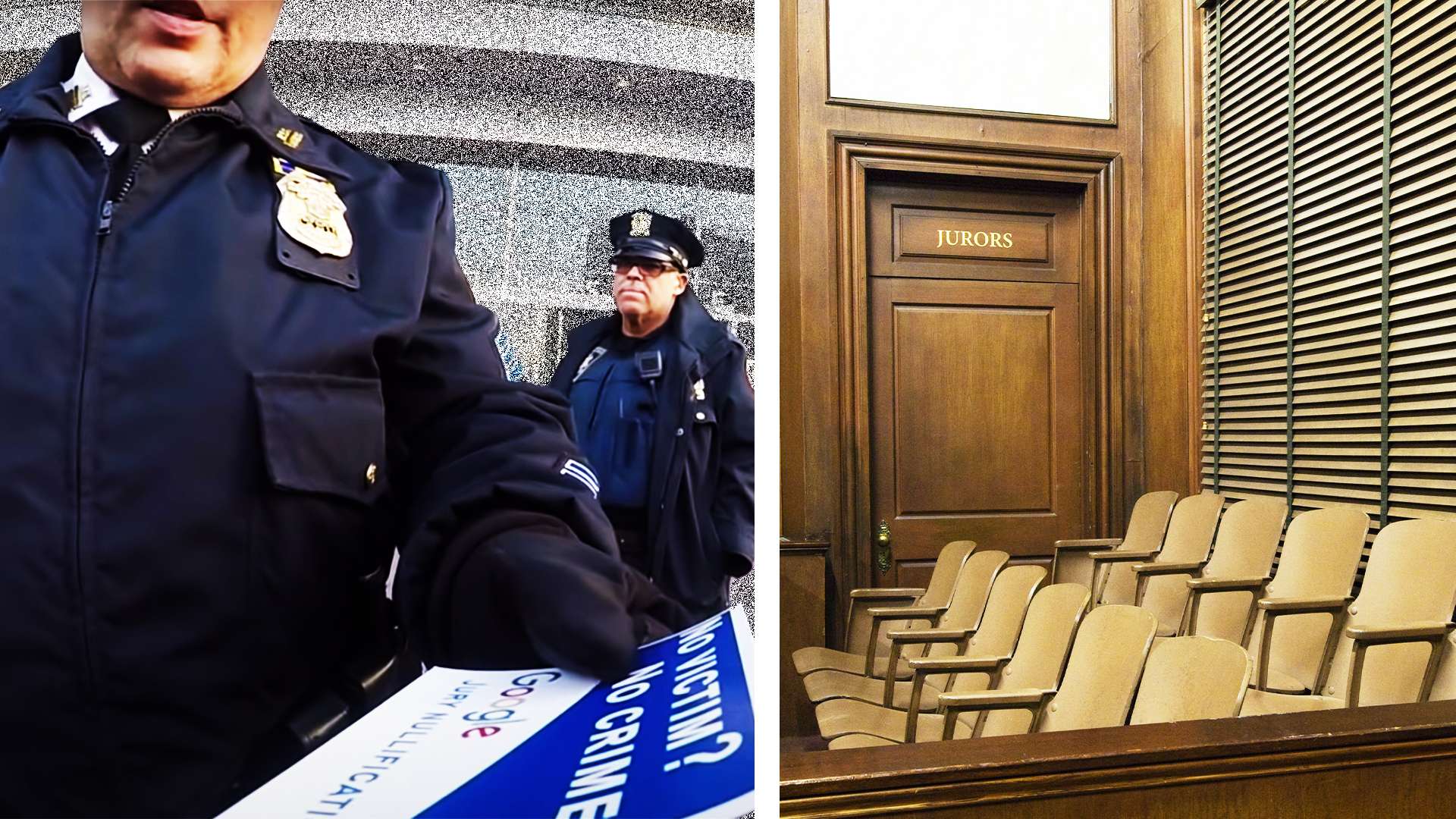
He was arrested for promoting jury nullification. A federal court says that was illegal.
Michael Picard's free speech rights were violated when he was booked for telling passersby to "Google Jury Nullification."
Reason Magazine
436 points · by olalonde · 4y ago · 435 comments
Good-ol'-boy-ism is a good thing when it let's the sheriff of Mayberry teach a kid a lesson without making him a felon and ruining his future.
Good-ol'-boyism is a horrible thing when it let's the sheriff of Mayberry teach a kid a lesson, making him a felon and ruining his future.
I have personally benefited from the former. I don't know how to reconcile the latter when the only difference was the kid's last name, or skin color, or religion. Every good thing can be abused. Sometimes the scale of abuse calls for the abolition of the "good thing". Sometimes it is better to tolerate some abuse because of the scale of good that comes from the good thing.
For me, this train of thought always breaks down to reasoning that good-ol'-boy-ism is good when the ol'-boys are good and bad when the ol'-boys are bad. But that's obviously broken when 'good' or 'bad' is left to the decision of the ol'-boys. Historically, we just have constant war to decide who gets to be the ol'-boys this week.
I'd prefer that situation over it solely existing in the hands of a few police/judges/etc. with incredible power in deciding the future of the lives of those without power.
However, the first amendment is not to be tossed aside when inconvenient.
The act itself is not preventable without invading the sanctity of the jury room.
The scenario you present shows no relation to the concept of jury nullification presented here; unjust laws versus yours; untouchable persons. One is a protest of society, the other a protection of a group.
https://wsvn.com/news/local/broward/foreperson-3-jurors-unwi...
You can find more examples. Jury nullification happens across the spectrum.
Otherwise, tons of poor people and minorities are arrested on drug charges, while suburban and rich people joke about doing coke and taking illegal prescription drugs.
Part of the problem is that there's so much policing of "social issues" that aren't what we traditionally see as crimes. Still even for people that are arguably pretty bad eg. street thugs, repeat DUI offenders, ect., I'm not sure of the wisdom of this policy... and that's not even considering small time first offenders (also ignoring our most serious crimes).
I concur, I think ruining people's futures can be a horrible thing. Depending on the crime, I do think that what we see in some of Europe around "Right to be forgotten" for crimes is a good path forward.
I do not want to advocate for laws that firmly set someone onto a path of crime because of some youthful indiscretions, or, that forever treats a person as a pariah because of something that happened 30 years ago.
The root issue is that human beings are racist or otherwise prejudiced and that’s causing way more problems in many more areas
And prejudice is natural human behavior. Anyone can become prejudiced if they grow up in the right environment
But if all your friends are from all walks of life, you will naturally not be prejudiced. So all we need to do is make sure that we have even the right outreach programs so forces are diverse. When people in places of power are going to cookouts and all theirs buddies are all sorts of different people, all these stupid problems will literally disappear in a generation
I'd be careful jumping to the conclusion you did based on this premise because there are a lot of subtleties here. More generally this is known as the contact hypothesis (and related to the diversity exposure hypothesis) and there isn't that much evidence to justify the idea that exposure to multiple walks of life reduces prejudice and on the contrary there is evidence that the opposite is true.
While there is substantial evidence that people who do have friends from all walks of life are less prejudiced as you point out, that's mostly due to self-selection. People less prejudiced have less issue with befriending people from all walks of life, so we should not be surprised that they do so. However, concluding that all people need is to be exposed to diverse groups of people will reduce prejudice is unsupported by research and in fact to the extent that research exists on this, it actually points to the opposite conclusion. For example in situations where people are required to work or interact among different cultures, studies show unfortunately that those people have more negative attitudes towards that community than the general population. This phenomenon is known as negative intergroup contact:
https://journals.sagepub.com/doi/abs/10.1177/136843021876156...
I’m not really expecting to fix older people. I’m an old dog now relatively and I don’t learn new tricks as well
I’m talking about people growing up together
for me, the quote from Supreme Court justice Oliver Wendell Holmes is important: 'The jury has the power to bring a verdict in the teeth of both the law and the facts.'
https://www.jurorsrule.com/quotations-and-comments-on-fully-...
Trials could be set up so that a jury is presented with specific questions of fact, and they must rule on those questions of fact. "The jury finds the defendant, Bob Bobson, did enter the house of Vick Victimson between the hours of 9PM and 11PM. The jury finds the defendant, Bob Bobson, did take Vick Victimson's property. The jury finds the defendant, Bob Bobson, did push Vick Victimson down the stairs, resulting in his death."
... but they do not. Juries decide on whether the entire crime occured. Guilt or innocence. Moreover, they aren't generally required to give reasoning for rendering their verdict, and only in cases where there is no rational train of thought possible to determine a crime was committed may a judge overrule a jury's finding on the issue of guilt. The full power of finding of fact of "Did any crime occur here" is in the hands of the jury.
I know of someone who sat jury on a case involving someone shooting into a home. Jury found the defendant guilty of reckless endangerment, but the interesting thing is that the jury's reasoning on the topic was that any discharge of a firearm in a city, by virtue of the denseness of the city's population, with no backstop and no planning on where the bullet would end up, should by default be reckless endangerment. I think one could easily find folks familiar with firearms who would disagree, but it doesn't matter. The jury has the power, in that case, to decide "common sense" dictates that's what the words "reckless endangerment" mean.
"This is a court of law, young man, not a court of justice."
So, from my very limited understanding, the point is kinda like you have to pass the legal steps before you have a chance at getting justice. Rules of evidence, Miranda warnings, whatever.
I think it's sorta like you have to pass the compiler before you get a chance at a working program.
Now, I'm going to strain this analogy, what do you do when there's a bug in the compiler? Me personally I patch the fucking compiler, and then submit a PR. Maybe that PR gets accepted, maybe not. But the problem I have right now is fixed.
I would probably not be a good juror.
Nullification, however, is the last bulwark against an overzealous State, and a powerful signal of no confidence. It's so destructive to the credibility of the system, it is one of the few things I can honestly say is only spoken of in hushed contexts, and with dread by many because of the unpleasant nature of the circumstances that warrant the existence of such a safeguard.
No one wants to believe a government could get so out of hand it has to get reined in in such a way. It can though. That's why it's important.
It implies that in that court, people care only about laws not justice. That may be so, but if that's the case, that's pretty sad, not something to be proud of.
> This Court has never held that the Constitution forbids the execution of a convicted defendant who has had a full and fair trial but is later able to convince a habeas court that he is “actually” innocent. Quite to the contrary, we have repeatedly left that question unresolved, while expressing considerable doubt that any claim based on alleged “actual innocence” is constitutionally cognizable.
i.e., Actual innocence is constitutionally irrelevant.
[1]https://www.supremecourt.gov/opinions/08pdf/08-1443Scalia.pd...
e.g. this is party why the death penalty is so unevenly implemented. Not because some or most people genuinely feel no crime is worth killing a criminal over. But because there are many issues over an irreversible sentence like death when the evidence isn't 100% ironclad.
It was always a court of men, justice Holmes, not law.
For example, if a jury finds a defendant guilty of some crime, because they really did it (let's say Aladdin stole some bread from the supermarket and it's clear beyond reasonable doubt that he did indeed), and the law dictates that the _minimum_ penalty is 10 years, then a judge is bound. It does not matter one iota that both the jury and the judge feels this punishment is excessive bordering on ridiculous; in that sense, it is 'a court of law' and not 'a court of justice'. It's not self-serving, it's self-denigrating: Awareness that the judge/jury can't just decide together how to proceed.
That's what jury nullification is about: If a jury member realizes the judge is going to be forced to give a to them utterly ridiculous sentence if the jury finds the defendant guilty, you can simply decide to find them not guilty even though you are well convinced beyond reasonable doubt that they are. Now they are meting out justice and flaunting the law. The jury can actually get away with this (as this news article again shows); a judge absolutely wouldn't be able to.
NB: Current SCOTUS seems to just do whatever the heck they feel like, flaunting all plausible readings of a given law, deference to expertise, and precedence (e.g. how modern SCOTUS opinions often write that Stare Decisis is meaningless – saying that it matters "unless it was wrongly decided" is a euphemism for "it does not matter", of course). So specifically modern day SCOTUS? They seem to think they are beyond the law. It also shows how I really, really don't think you _want_ a court to think itself a court of justice, meeting out excessive punishments because they feel that is just, and letting defendants clearly guilty of egregious acts go free or nearly so for some imagined reason. It also means that any clash with the law has utterly unpredictable consequences. By definition, minimum and maximum penalties clash with the notion that a court is 'a court of justice' instead of 'a court of law'.
Justice is much more subjective and is the domain of prosecutors and the executive branch.
Of course there are lots of other systemic issues with the US 'justice' system, but I also think the foundation is fundamentally flawed.
Note that a jury of your peers is rarely available. Instead, it's whoever didn't get out of jury service as weeded by competitive interests of the DA and defense. That might make a difference too.
Of course there could be upper laws blocking them from making it an official stance, but it really feels like fighting a reality with theorical boundaries.
The issue is not the abuse of a system hack, and probably more around changing people's mind (which can take centuries and get reversed in a few years...)
The process as we imagine it simply can't work under these conditions. The people are too deranged, and like misbehaving children, need to be contained.
Some say this would not be a problem because unlike in an acquittal the judge can overturn a guilt verdict. That's not a convincing argument because much of what a jury does is decide which of believable but conflicting witness accounts to believe. The judge often has no way to distinguish between the jurors found the prosecution witnesses more believable (and so the judge should let the conviction stand) and the jurors found the defense witnesses more believable but decided to convict anyway because they didn't like something about the defendant such as their race, or bad things they did not relevant to the crime they are being tried for (and so the judge should acquit the defendant).
You'd have to abolish double jeopardy if you wanted equivalence.
See George Stinney Jr. for an example.
Stopping the punishment of crimes is not halting all injustice.
The similarity here being that Congress sat on its hands regarding lynching for over a hundred years, followed by another 100 years of the Senate blocking everything the House brought up till just this year, long after everyone independently decided "hey, let's not lynch people". Its not supposed to be a defeatist approach, its just "hey lets focus on something that has consensus because trying this again is just a waste of energy". I'm interested in some aspects of fiscal and foreign policy, for example. That priority might not come from the same party.
In that lens I don’t believe jury nullification is much of a problem.
Besides the fact that this ruling was about free speech rights, not jury nullification. You can say all you want outside a courthouse as long as you're not disrupting the legal system or trying to sway a particular jury in a specific case.
After 4 years you can attempt to fix it. Though if the person who you elect actually tries to fix it there's a good chance they will be stopped by the courts from doing so.....
E.G. Let's say bad politician hires bad people who implement bad policies. New politician comes in and tries to fire bad people, they sue saying its political persecution and they haven't done anything wrong and haven't violated the standards of their job or their contract. Court upholds it. They continue implementing bad policies, to the point of snubbing their nose at the person who got elected. What is the remedy here?
That might be true, but the more specific issue England (specifically, London) ran into is that trials for theft were trials by jury, and the jury (staring into the eyes of the accused and recognizing a boy of only sixteen in the box) increasingly found thieves innocent rather than having to have the death of a child on their conscience. Facing a situation where theft was functionally un-punishable by law because no jury would convict on a crime like that with a death penalty attached, the merchant class petitioned to have the punishment stricken from that category of crime.
This is, incidentally, why "right to a jury of one's peers" and "right to face one's accuser" are baked into the US Constitution... A lot of actual justice happens at the intersection of the law and the humans who must execute it.
Having death as penalty for theft is pretty extreme in the first place. Even countries that only chop of your hand seem highly advanced in contrast.
The jury is an old form of democracy. The king/government can make what laws they like, but it needs to have enough popular support that a jury will freely choose to convict according to it.
Of course, like all forms of democracy, the outcomes don't always agree with your or my sense of justice.
> it has to be balanced against crimes that are in principle clearly wrong
In this system, whoever gets to decide what is "clearly wrong" has the real power.
Who gets to decide? The jury. That's the point. They have the real power.
Only in one direction, I think. Jury nullification still can't render a guilty verdict, when the law says the defendant ain't guilty. (At least in principle.)
Non-guilty verdicts are more final.
I think of an informed jury as the tire between the wheel and the road, to fill the gap between the abstract judgement of the legislature and the concrete particulars. Tires do fail, sometimes fatally, but they save a lot of wear on the whole system.
No one wanted to come back to deliberate another day, so we convicted on the counts we were sure of and acquitted on the remainder. The aggravated details made no sense as the verdicts were read as they ended up being grossly inconsistent. In the end, the defendant was sentenced to 6 years. It could have been 60 years if the judge had hung around though.
>In all, there were 46 potential witnesses to the shooting, including Trena McElroy, who was in the truck with her husband when he was shot. No one called for an ambulance. Only Trena claimed to identify a gunman; every other witness either was unable to name an assailant or claimed not to have seen who fired the fatal shots. The DA declined to press charges. An extensive federal investigation did not lead to any charges. Missouri-based journalist Steve Booher described the attitude of some townspeople as "He needed killing."
https://podcasts.apple.com/us/podcast/episode-66-bully/id809...
Doesn't the jury verdict need to be unanimous? If they can't come to agreement, they redo the trial I thought. So one jury member can force a retrial, but can't force a not guilty verdict.
Who has the magical power to know which crimes these are that are "in principle clearly wrong" with such certainty that they can override the community's beliefs? We're all fallible humans and nobody has a special private line to The Truth.
I don't think that this is a magical power.
There are good reasons why we try to minimise how much of law enforcement that are left to peoples discretion.
I don't know where you're getting this from. Practically all of law enforcement is left to people's discretion. The people exercising the discretion just aren't members of juries in most cases.
If the local community doesn't find them wrong, perhaps it is not as clear as you're claiming.
Juror with strong opinions "ohh no, never"
Lawyer: Are members of your profession stereotypically capable of independent critical thought?
Juror: Yes?
Lawyer: Dismissed.
(They just ask for professions and maybe educational background then infer the rest.)
You are under oath during jury selection, right? So I guess that could hypothetically get you into some trouble. Although I'm sure it is pretty much unheard of for them to go after somebody who lied during jury selection questions...
The jury of your peers is truly the last word in the United States, and many other common law nations. This is not perfect, but it is better than the alternative.
It's a check on the prosecutor's power that has been gradually eroded by the legal system. Grand juries, similarly, have been eroded in their abilities to check prosecutor power.
But yes, the US law system is deeply flawed in many many ways, and most of it is intentionally (through also historically).
In an ideal world a good judge is likely better for you than a jury if the law is on your side. Unfortunately good judges are hard to pick, and elections of judges don't seem like a solution.
In terms of the legal system itself, there is way too much room for power bias that needs reform.
In theory the law is blind, applying to everyone equally. In practice it is executed by humans who are anything but blind. Bad actors exist at every level, police, DAs, prosecutors, judges and yes, juries.
Humans, and humanity, should be in the loop, but equally its hard to find sufficient quantities of good humans to participate.
Especially in the current political climate, elections for judges seem particularly fraught. A blood-hungry mob favours those who take a "lock up everyone forever" approach.
Equally, seeing the court as a mechanism for politics, from the highest court to the lowest, while it might be good for politics is bad for justice.
There is a lot to dislike about the current system with its various prejudices - but reform is hard because quality people are hard to find. And every bad apple in the system erodes public trust - and once trust in the system has gone it is hard to regain it.
So what would be a better alternative? Not necessarily a better system, but a system populated with better candidates. In many places that means voting for moderate candidates who are focused on justice, not law. On people with character, not who screams the loudest, or has the most extreme viewpoint. On supporting those police honestly "protecting and serving" while at the same time having a police force actively rooting out corruption and prejudice.
Trust is hard earned, and easily lost. Mostly its in the "lost" bucket right now. It will take a lot to get that back.
This was an intentional choice, to err on the side of assuming innocence rather than guilt.
Yes, this is why juries are democratic: on aggregate, they ensure that interpretation of the law still reflects democratic will.
But more to the point - theoretically, regular people in a community already 100% control the law.
It is supposed to be the last, final defense against the perversion of the justice system into political prosecution.
The state can make whatever laws it wants, but it can't enforce them without the will of (some of) the people.
Probably worked, too, when populations were smaller and communities more cohesive.
The state says "take 3 years in plea bargain or risk 15 years and huge debt in jury trial".
It’s cool to be sympathetic to criminals now, but the people stuck living with drug dealers and pimps don’t share that.
Juries are generally charged with determining matters of fact; the judge matters of law. Even without jury nullification, a jury still determines whether the person performed a proscribed act, or did so with the requisite intent, etc.
When people talk about jury nullification, they generally mean the act of a jury actually believing that the person committed the act, but let them off because they don't think they should be punished for some other reason.
I've always found this deeply troubling. If the law isn't clear enough for 12 jurors to determine if an act was legal, then how is it possibly just to hold the accused liable transgressing it?
I don't see much practical difference between this and ex-post facto laws. In both cases, a person can be convicted for an act that wasn't obviously illegal at the time.
Sometimes this is relatively easy ("you left blood with your DNA at the scene") and sometimes hard (you have 3 eyewitnesses, they have 7 people claiming an alibi).
The only way to preclude jury nullification is to infringe on the rights of the jury as the sole determiners of fact, as you put it.
Without adding another non-jury body that can overrule the jury on what actually happened, how can you ever get rid of the possibility of jury nullification?
The most common place for this to happen is in civil court. A jury can come back with "11ty billion dollars" and the judge can decide "Ok, they got a little overzealous with that, $100".
If that is axiomatic, it's not the constitution of the US. I don't know about other jurisdictions, but it's silent on the exact duties of a jury.
Jury nullification is ignoring the law for any reason. In fact, it seems like the normal, "classical" interpretation is to find not guilty to laws you don't agree with. It's also used for people that did it, but the jury sympathizes with them. Otherwise, it could be they think the penalties are just unfair.
All of these things are jury nullification.
I also wonder how many HN readers would be allowed on a jury?
When the lawyers went around the room asking questions, one of the questions was something along the lines of “will you uphold the law as the judge describes it”. 40 odd people leading up to me all said yes, and then I said “maybe”.
I was asked to step outside to discuss my answer. I pretty much said “I know my rights as a juror and if a law is unjust it’s my duty to say so”. They said I could go home after that.
Instead ,I was on a DUI that resulted in a crash with some extra circumstances. The defense was entirely presented at closing and amounted to the claim that the defendant stopped his car right before the crash, let a hitchhiker take the wheel, the hitchhiker caused the crash, moved the defendant into the driver's seat and belted him in there so that the fire department arrived and photographed the defendant there, and then ran off.
Even if the crazy hitchhiker story were true then the defendant was still admitting to DUI, and, in my mind, being responsible for the crash. It was basically a huge waste of time since all jurors instantly voted to convict.
I don't know, but I was selected for a jury once. That said, I did not make any particular effort to get out of serving. I answered the voir dire questions honestly, but didn't go out of my way to volunteer something just because I thought it might get me out of jury duty. For example, I didn't say "I'm a radical Libertarian who considers the State invalid in principle and strongly supports jury nullification." Had I been asked "are you a radical Libertarian who ..." I would have answered "yes", but it never came up. So I tried to be honest and neutral, and in the end they picked me.
The moral of this story? I'm not sure. I will say this though: I learned a lot from the experience. Hopefully I'm never on trial for anything, but if I ever am, I believe my jury experience might actually be helpful to me.
I laughed out loud at this.
I was on a jury trial when a spouse of a prosecutor office employee was allowed on. People drastically overestimate what will get you moved out of the pool.
In general, they don’t like technical people on technical cases. My employer is known to pay for jury duty, so I always get picked.
Wouldn't that unduly bias the jury selection? In effect the employer is being allowed to buy extra representation.
Usually, there's a limited number each side can dismiss without cause. To dismiss more than that, they have to convince the judge that the juror will not honestly decide the case according to the evidence and the law.
If you say in voir dire that you wouldn't vote to convict even if the person is guilty, you're not going to get put on a jury.
When I observed jury selection I saw several people back down from stances that were clearly attempts to get kicked off the jury.
It's not like the lawyers ask one question then dismiss you.
I did see one guy who claimed he believed "all courts are invalid" hold up to some pretty intense questioning before getting dismissed. But by the grin on his face I could tell he relished winning that one.
No one, not the judge, the prosecutors or the defense want jury selection to take a long time and there are only so many people in the pool to choose from.
That said, on a different trial, a serial killer, it took almost 6 weeks to panel a jury. I was there for a week before being dismissed because I’m morally against the death penalty. Even then the judge interviewed me for 30 minutes on this point, including about my religious upbringing as a child.
He was serious, btw.
https://en.wikipedia.org/wiki/Fifth_Amendment_to_the_United_...
Indictment alone is serious business. It is enough to ruin someone's life, and is not to be taken lightly. So when a grand jury is only given police testimony as evidence, that indicates a shortcoming in the system.
I served on a jury. Can’t imagine why any given HN user wouldn’t be allowed…
They all say no matter how many test juries (their clients sometimes actually pay for them to try out arguments on a group of people), or how much jury study they do…. it is hard to predict how a juror will act / be influenced based on demographics.
My limited experience was similar, folks were not super predictable.
Most of them.
Simiarly: https://www.reuters.com/article/us-usa-court-abortion-zones/...
I live in a no jury country and I would probably feel a tiny bit safer with a jury of my peers, even being aware that this also has plenty of flaws. (That being said, I do prefer European inquisitorial system of justice over the adversarial one -- the latter is present in Anglophone countries and prefers reaching a decision over establishing the truth of the matter.) Even in Poland, the hamfisted "reform" of justice that is fought over with the EU does have some nuance to it. The government wants to control the judges, which is obviously against any sane separation of powers, but the public perception is that the previous system of judge corporations was also corrupt.
I do think, at the face of it, that all jurors should be made aware about nullification.
My mother was a court stenographer. She had a job in a small court once in nowhere northern california. They had a few jurors skip out of jury duty. The judge told the bailiff walk outside get 2 random people. Sure enough, there was a chef wearing a uniform and some construction worker. BAM. The court is ready.
The reaction from the right wing government and its supporters was barely short of apoplexy, followed by promises to appeal the verdict and change the law to remove this as an option for juries. (So far I don't believe any such legal changes have been made.)
Jury nullification is one of the strengths of the jury system, allowing a representation of the public decide if an act was truly criminal, and should be protected, otherwise it's just 12 people following a decision tree and no better than trial by judge.
[1] https://www.theguardian.com/uk-news/2022/jan/05/four-cleared...
Under the Criminal Damage Act 1971, no offense is committed if there is a "lawful excuse" for the damage.
The defence argued that there was a lawful excuse on several grounds:
1. The defendants believed they were preventing a more serious crime (public indecency because of the statue's offensiveness).
2. The defendants believed the statue was owned by the citizens of Bristol (as stated on its plaque), who they believe consented to its removal.
3. Their right to freedom of expression and assembly under the European Convention on Human Rights.
The judge instructed the jury that they were allowed to consider questions such as the statue's offensiveness in deciding whether these excuses applied.
I personally find jury nullification as the ultimate form of democracy.
Hero.
I suppose it's reasonable for a jury to decide that a prosecution should not have been brought, even if the criminal act can be shown to have occurred. I don't know what other body is in a position to make that determination, so I guess that in some kind of "natural law" view, returning an innocent verdict when the facts say guilty, is morally permissible.
But I'm not OK with juries deciding what the law is, or just completely ignoring the law. My experience (IANAL) is that jurors are interested in the judicial process, assess evidence carefully, and try hard to return a "correct" verdict.
I haven't served on a real jury; I did serve on a mock jury, in a mock trial for training advocates (barristers). It was a date-rape trial, and the "evidence" was equivocal. Interestingly, although all the jurors were sincere and honourable, the jury split male/female on the verdict (I'm a male, and I came down on the male side of the split).
Lawyers instruct juries on the law - "If you believe Bob's account (or, typically, something a bit more specific), then Bill is, by law, guilty of XYZ."
There are "facts" and facts. The undisputed facts are those where both parties "stipulate" - neither party intends to adduce evidence that the claim is false. Juries aren't at liberty to make up their own minds about facts that haven't been disputed.
It's the disputed "facts" that juries weigh - that is, the evidence and testimony.
> Lawyers instruct juries on the law
That's rather slippery; I think that technically, the lawyers are "servants of the court", so they really instruct the court on the law. And "the court" means the judge. The judge then instructs the jury on the law.
But in fact, these lawyers are advocates; their business is to expose those parts of the law and the evidence that are advantageous to their client, and damaging to their adversary. It's not reasonable to assume that the judge is unbiased (any more than the advocates).
I don't think that's right.
You express that as if "the law" is always clear and uncontestable. Reality is the opposite; few laws are drafted to be clear and uncontestable.
The task of the judge is to administer the case. He/she decides what evidence is admissible, what utterances by the advocates are forbidden/permissible and so on. The advocates and the judge may have three different opinions about what the law is, and so it becomes a question for the jury.
So the judge is the authority on the law concerning how cases may be conducted; but not on other legal specialties.
As far as I know, bench trials are successfully conducted throughout the world.
In terms of end-to-end "justice system" problems the inefficiency of a jury is a small problem. (As most cases never even see a courtroom. In criminal cases due to plea deals, in civil cases due to settlement, etc.)
Technically anything can be interpreted in two different ways by two people, so even if the judge gives very precise instructions to the jury, they still have a lot of freedom. (And this led to finding murderers not guilty, because the victim was black.) But a bunch of lawyers can be racist too, so that wouldn't have helped much.
That would be Magna Carta, I think. The word you're looking for is "parchment", not "paper". When it was drafted, it wasn't an "old convention" - it was an innovation.
I do think fans of jury nullification overestimate how much juries would be interested in such things.
That decision has nullified the process, and could lead to a hung jury. Or that one person could convince everyone else. I think you might be confusing the hole with the part, and not grasping the power of a single juror.
That way, the jury can decide, without any evidence, if a law is just. And that should be with as many biases removed, including things like sex, gender, skin color, clothing, etc.
There's always a disconnect in republics between the populace and the representatives. Reps may pass laws the populace doesn't want, and the reps say "we know your best interest". And, getting laws to legalize illegal things usually end up in its own malthusian trap of "politician is soft on crime!"
The check and balance on jury nullification is not telling people that it exists. Yes, it is a pretty crappy check and balance, but no one has been able to come up with a better one.
The story is usually a lot more complicated.
There also reverse cases of this too, because high-profile cases are usually dealt with more severely, not because of race. For example, a cop in Florida killed a 36 year old white man in very similar circumstances to George Floyd, and got off scot-free. So for better or worse, notoriety also comes into play.