Roger Craig Broke Jeopardy's Record, with an App
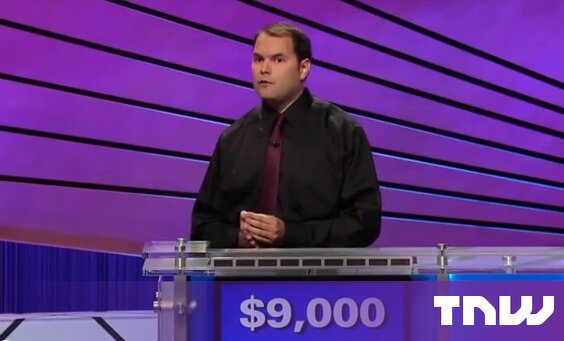
The man below is Roger Craig. He broke Jeopardy's all-time money record in a single game
TNW | Shareables
157 points · by soy714 · 15y ago · 24 comments
http://zachbaker.com/how-to-win-on-jeopardy-with-ruby-on-rai...
Although Jeopardy does not repeat questions per se, they often find different ways to clue the same fact or connection.
I would guess that if you took the text of a clue, ran some trivial clustering on the J!-Archive contents, and instantly displayed the top three clues and responses for a human, they could be quite competitive on the show even if they knew nothing on their own.
So if you put the J!-Archive into a Leitner-system flashcard app and put a few hundred hours into it, I imagine it would improve a contestant's chances considerably. It doesn't look like much, but that looks like the major tool here. If I had won my last game (the final regular game of Season 23, followed by a six-week hiatus) I was planning something like this. However, I never thought of using analytic feedback with categorization in this way. That clearly also gave him some valuable feedback on what to study and what categories to be confident about.
However, this is to take nothing away from Roger Craig's exceedingly impressive untrained skill at the game, which he was able to train effectively to unreal levels. He plays Jeopardy! like a boss.
To be honest, there's little information other than what he divulged out there on the net, as it was a private tool. If I find more i'll write a followup, it's pretty fascinating.
Allow both contenders to press the button within the first 2 seconds and, if they both buzz in within the 2 second window, the human answers first, because Watson could be trusted to "lock-in" it's answer.
Points are issued to whomever gets the answer right, allowing for both to receive or lose points on the same question.
The Watson show was a not a completely fair match-up since Watson had a much better average buzzer time than his human opponents.
If this was not the case, I would speculate a really good human opponent could beat Watson at least some of the time.
On the other hand, nobody would dispute that a machine has faster reactions than a human, so maybe that makes it less interesting. Tough to figure out a great way to resolve that.
I'm not really sure if Watson's model goes as far to consider other players' Daily Double behavior, or simply examines other players' scores. It would make sense to try and look at the game theory aspect though, especially in an iterative-game scenario. If a player bets hyper-aggressively on Daily Doubles (and Final Jeopardy) and gets most of them right, you'd think Watson would want to take that into consideration.
The author of the article just doesn't get it.
He didn't talk much about the algorithm he used to present questions for optimal memorization. I imagine it was spaced repetition, as used in SuperMemo:
http://www.wired.com/medtech/health/magazine/16-05/ff_woznia...
Code for parsing, if anyone's interested: https://github.com/mpobrien/jeoparty/blob/master/scrape_mong...
And code for scraping: https://github.com/mpobrien/jeoparty/blob/master/curler.sh