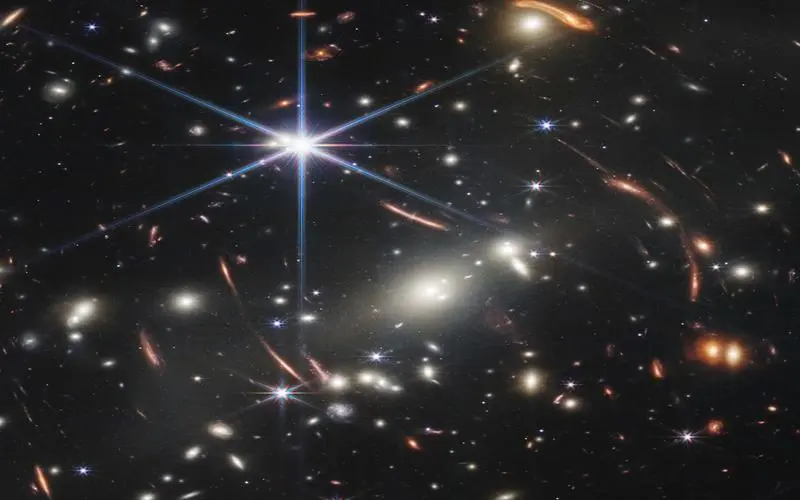
The Big Bang didn't happen
What do the James Webb images really show?
iai.tv
96 points · by jtbayly · 4y ago · 106 comments
Completely burying the full title "Panic! At the Disks: First Rest-frame Optical Observations of Galaxy Structure at z>3 with JWST in the SMACS 0723 Field" which is the best Panic! at the Disco pun I've seen in a long time.
I don't think it's disingenuous, just out of touch. The author is 75 years old; he probably didn't recognize a 2000s-2010s pop culture pun.
I get the impression he's regarded as something of a crank in astrophysics communities.
> We at LPPFusion have been applying that knowledge concretely to the development of a cheap, clean and unlimited source of energy that can entirely replace fossil fuels starting in this decade.
And I doubt that the website (iai.tv), that I have never head of, is a source that can be trusted.
I did not invest.
Science doesn't advance by consensus. It advances by constructing models and comparing their predictions with observations. As Einstein famously remarked when someone mentioned to him that a hundred scientists had signed a letter saying they were doubtful of his theory of relativity: "If the theory were wrong, one would have been enough." We don't believe our best current theories because there is a consensus. We believe them because they have made accurate predictions that have been confirmed by experimental data to many decimal places.
There are plenty of examples where science got it wrong. Were it took years, even decades to get enough people to listen.*
That's not the way science is supposed to work. Politics? Yes. But not science.
I trust you can do the math from here.
* And when the tides turn, these not even an acknowledgement, let alone an apology. Scientists shouldn't not be turning in their graves for lacking an apology. That level of arrogance is also not healthy and proper Science.
Shouldn’t the burden of proof be placed on the individual rather than the group?
Yes, but don't cover your ears and yell "burden of proooooof" so loudly that you can't hear them out.
That's two things he's bent to support his position within the first two paragraphs of this piece. Right out of the gate he's shown that he can't be trusted with data.
Are you being obtuse?
When Hubble published his observations of red shifted light from distant objects there were two possible explanations that came to the fore. One, originated by Georges Lemaitre, was that the Universe was expanding. The other, from Fritz Zwicky, was that light lost energy as it traveled, termed "tired light". At that time, ca. 1930, interstellar and intergalactic space were assumed to be perfect vacuums and thus there was no mechanism to redden the light. Now, 90 years later, we have actual observational evidence that Zwicky was right.
In the radio astronomy of Pulsars we find that the shorter wavelengths of the leading edge of the pulse arrive before longer wavelengths. The velocity of light, c, is NOT constant but varies by wavelength. This time dispersion is proportional to the distance from us of the pulsar, indicating that the reduction in velocity is cumulative. The observed effect is isotropic. The interstellar medium is not a vacuum but rather affects light waves in a way best described as having an Index of Refraction greater than 1, unity. We find the same phenomenon in the observation of Fast Radio Bursts from other galaxies, thus indicating that the intergalactic media is not an electromagnetic vacuum.
The universe is not 100% empty, so the index of refraction is not 1. This could be explained by lots of phenomena like dust particles or stray radiation, etc. Because of this effect, for practical purposes, light that we see as res “travels slower” because it has traveled through more media than blue light.
"The component frequencies of each burst are delayed by different amounts of time depending on the wavelength. This delay is described by a value referred to as a dispersion measure (DM). This results in a received signal that sweeps rapidly down in frequency, as longer wavelengths are delayed more."
[https://en.wikipedia.org/wiki/Dispersion_(optics)#Pulsar_emi...]
"dispersion measure (DM) is the column density of free electrons (total electron content) — i.e. the number density of electrons (electrons/cm3) integrated along the path traveled by the photon from the pulsar to the Earth"
"interstellar clouds of electrons retard the velocity of radio waves in direct proportion to their wavelength" in an article from a 1968 edition of Scientific American written by Anthony Hewish...the same guy who discovered pulsars
If universe is expanding is it getting thinner? That is same amount of matter is spreading over larger space. Thus wouldn't the refraction index be higher on average when observing the path from really old objects?
Is a hypothesis that, as a sole or primary explanation of observed redshifts of galaxies, has been thoroughly debunked in the scientific literature.
> the intergalactic media is not an electromagnetic vacuum
This is true, but it cannot explain the observed data by itself, because the observed data is not "redshifts" by themselves. The observed data is a combination of redshifts, apparent luminosity, and angular size for thousands of observed galaxies. These data have observable relationships that can only be explained by cosmological expansion. If the redshifts were caused solely by dispersion in the intergalactic medium, their relationships with apparent luminosity and angular size would be very, very different. That is a quick summary of the thorough debunking of "tired light" that can be found in the scientific literature over a period of some decades.
i wonder if the energy of empty space (yes, empty space has energy) plays a role in slowly dissipating the energy from light.
That was my point.
Nothing I saw demonstrated in any way that the Big Bang didn’t happen.
No, it isn't. Theories don't get "falsified" except in rare cases and in the idealized fanciful histories of some philosophers of science. The idea that you can run one critical experiment that, if the results come out a certain way, will falsify a theory, is a myth.
Scientific models like our current hot Big Bang model make thousands of predictions about observed data. No model ever matches all the data with 100% accuracy. But if there is no other competing model that matches the data better, we do the best with what we have. Saying the Big Bang model is "falsified" if the error in some prediction vs. data is over some threshold is useless if we don't have a better model to replace it with.
The dark matter crowd was able to convince quite a few people without hurdling such a high bar, not to mention stuff like string-theory..
Dark matter is the result of observations...of something
I don't know where you're getting this from. Dark matter models make lots of testable predictions, and they currently match the overall data set (which includes many different observations, not just the galaxy rotation curves that are most often mentioned) better than any other models.
> not to mention stuff like string-theory
Here I agree: string theory has not made a single testable prediction.
Somebody talking 'bout me? Why don't you all tune in next month to our debate in London https://howthelightgetsin.org/events/cosmology-and-the-big-b... Science advances by comparing predictions with subsequent observations. Right now the Big Bang makes 16 wrong quantitative predictions and one right one. The details are not in serious dispute in the literature. My conclusions are what's controversial. The consensus is "well we can fix all these problems, just wait." Sort of like getting on an airline that just had 16 crashes out of 17 flights. But throw out the Big Bang and you've got a lot of correct predictions. Details here: https://youtu.be/tK3OStArUqE
Also, I have the feeling Gravitational Cosmology has reached a point where most effort goes into “refining the constants” - was it Hilbert that said that was all that was left to do, right before Quantum Mechanics was introduced? - so a little bombshell discovery would make things very exiting and fresh.
Keep it up!
https://www.bbvaopenmind.com/en/science/physics/lord-kelvin-...
But for a moment I was just imagining a world where scientists agreed that the Big Bang never happened. How many physicists' work would be thrown in the trash? How many high school science books would have to be updated? How would the general public's trust in science change?
Would be such an interesting thing to observe.
Since photons travel at the speed of light, neither distance nor time are measurable. All that remains is the relative angular concentration of photons. If you imagine the universe as a sphere, the relative concentration of photons represents the pattern on the surface of the sphere.
However there's no longer any way to determine that sphere's size nor whether it is expanding, contracting or even the existence of time itself.
The crazy thing is how close this is to the early universe. You start with the cosmic microwave background pattern and that's basically also exactly what you end up with: a pattern/projection of photons where space and time basically become meaningless or cease to exist.
Science is /= fact or truth. Science is a process.
There should never be a “trust in science.” In fact, science only works if nobody trusts anything and every experiment is questioned and repeated. If this doesn’t happen, then that’s when the general public should be concerned.
Depending how it was taught.
When I was a kid, the T-Rex tail slid along the ground like a crocodile. Now we know dino tails were used for balance and they generally remained rigid.
Dinos didn't have feathers when I was a kid.
Pluto was a planet when I was a kid.
However, one crackpot clickbait article didn't change the three things listed above. Millions of person-hours of research did.
Definitely not ether, those foolish old scientists got the name wrong :D
Who? I've never heard of such an idea.
If the work is good, it's reasonably independent of the story being told.
One of the features of Big Bang is how it’s sufficient to explain the structure of the universe via Gravity alone, yet there’s a ton of data indicating that pervading Plasma and Electromagnetic interactions within are at play.
But since they have no place in the BB model they’re discounted as marginal phenomena.
But, if the paradigm shifted - to put it in Popper terms - a whole new box of interesting goodies would pop open!
according to wikipedia hes been funded by nasa. and also looks like youre incorrect about not being published
Quote: If the universe is expanding, a strange optical illusion must exist. Galaxies (or any other objects) in expanding space do not continue to look smaller and smaller with increasing distance. Beyond a certain point, they start looking larger and larger. (This is because their light is supposed to have left them when they were closer to us.) This is in sharp contrast to ordinary, non-expanding space, where objects look smaller in proportion to their distance.
I just woke up and I don't get this...
We understood explosions and how atoms would interact based on that.
It is similar to how in the 1800s we thought of the body as a connection of pipes and fluids because that is how we understood things. Then as we built a greater understanding of electricity, we now see the electrical components of the body. Which doesn't negate the plumbing version, but we now have a greater understanding of how muscles and the brain work.
Interesting misunderstanding of inflation.
Relevant xkcd: https://xkcd.com/2622/
Unofficial Explanation: https://explainxkcd.com/wiki/index.php/2622:_Angular_Diamete...
Wikipedia page: https://en.wikipedia.org/wiki/Angular_diameter_distance#Angu...
any theory that gets rid of dark matter is better than what we have now. the cosmological constant was one thing (turns out Einstein found the quantized minimum energy of empty space, before quantum mechanics). This dark matter folly is taking fudge factor to the extreme. it's lazy.
Forget the ad-hominem "he's a known crank" arguments.
He raises valid questions in his article, if he's a crank, then refute his facts or conclusions.
Not entirety of their production is bad. And they can offer some different perspectives.
Anyone know why this took so long to discover, if true? Is the James Webb that much more powerful than the Hubble?
I'd love if this turned out to be an epicycle moment. It reinforces my belief that being paradigm-flexible is valuable.
Hubble could not see as far into the infra-red.
The merger stuff JWST has falsifed was never really on solid ground anyway but tuned cosmological simulations. The simulations probably got subgrid physics wrong (same issue as climate models face).
We really are in a moment where serious astronomers and astrophysicists are evaluating validity and correctness of some of our most fundamental assumptions about the universe, to a degree that we simply haven’t seen since at least the mapping of the CMB, and perhaps longer.
Umm, wormholes maybe. Flying cars have existed for the better part of a century. The fact that nobody has successfully brought one to market yet means that you and I don't have them. But humanity certainly does.
This is science. It differs from the media's Science™
Now we have to worry about Big Cosmo?