216 points · by todsacerdoti · 4y ago · 64 comments
> Git does not currently have the capability to update a packfile in real time without shutting down concurrent reads from that file. Such a change could be possible, but it would require updating Git’s storage significantly. I think this is one area where a database expert could contribute to the Git project in really interesting ways.
I'm not sure it would be super useful, because of the delta-ification process. Adding "literal" (non-delta) files to a pack isn't much of a gain (file contents are zlib-compressed either way).
Decoding the pack files was notoriously difficult, probably there are still cases that I don't handle properly. The packfile is a really complex/messy format and in the top of that it lacks any proper documentation!
This article explains a lot of the concepts very good but doesn't go into implementation details (where the big snakes are). Another great resource for unpacking packfiles is this post: https://codewords.recurse.com/issues/three/unpacking-git-pac... and of course reading the source code of other git clients.
Unfortunately it seems that the official packfile format documentation is the git source code :|
Maybe it’s changed since you'd checked it, but I found the pack files to be documented, through nowhere near as well as index files (now that was a pleasure, the index file format is straightforward, pretty logical, and very well documented).
The problem I had with the pack files documentation is that it’s non-linear, so if you read it linearly as you implement it you hit areas which turn out to be documented a few screens later. Furthermore it doesn’t necessarily define or spell out what it’s talking about, so it can take a while to realise that it has 3 (.5?) different formats of varints, or that the size it provides is for decompressed content, and that it relies on zlib to discover the end of the compressed stream (and good luck to you if your implementation doesn’t expose that).
But in my experience, it’s really nothing compared to the documentation of the wire format. That leaves even more details out, some of the explanations are outright misleading (I spent hours convinced the v2 protocol was using an HTTP connection as a half-duplex socket and wondering how I would manage), and with TODOs covering half the protocol.
I wrote the 9front implementation (https://git.9front.org/plan9front/plan9front/HEAD/sys/src/cm...) more or less entirely from the official documentation in the git repo. For debugging, GIT_TRACE_PACKET=1 is very useful for getting valid packet traces.
Repacking efficiently for serving is the most annoying part, and I still haven't implemented delta reuse.
The pack format docs were one of the documents affected, it now lives at https://github.com/git/git/blob/master/Documentation/gitform....
I also used gitoxide’s source when I got unsure / lost about the nomenclature / varints.
I’d suggest giving it a pass unless you have to or are really interested though.
I work on concurrent editing systems (using CRDTs). People always ask about how we deal with the problem that if we store changes forever, the filesize grows indefinitely. Modern CRDTs are massively more space efficient than git but nobody seems to notice or care about the size of our git repositories. I think git supports shallow clones but I don’t know anyone who bothers with them.
"How does git deal with the problem that if we store changes forever, the file size grows indefinitely?"
Even though Git uses deltas for diffs to reduce space usage, it still technically grows indefinitely, same as CRDTs. So the answer is it doesn't, and it doesn't matter.
If the size of something actually becomes a problem, -then- it can be handled (e.g. Git LFS).
With CRDTs, depending on what you're doing, it might never become a problem. Keeping all versions of a document is entirely inconsequential, as an example. The size might grow indefinitely but how many edits is a document going to have, realistically?
[0] https://github.blog/2022-08-29-gits-database-internals-i-pac...
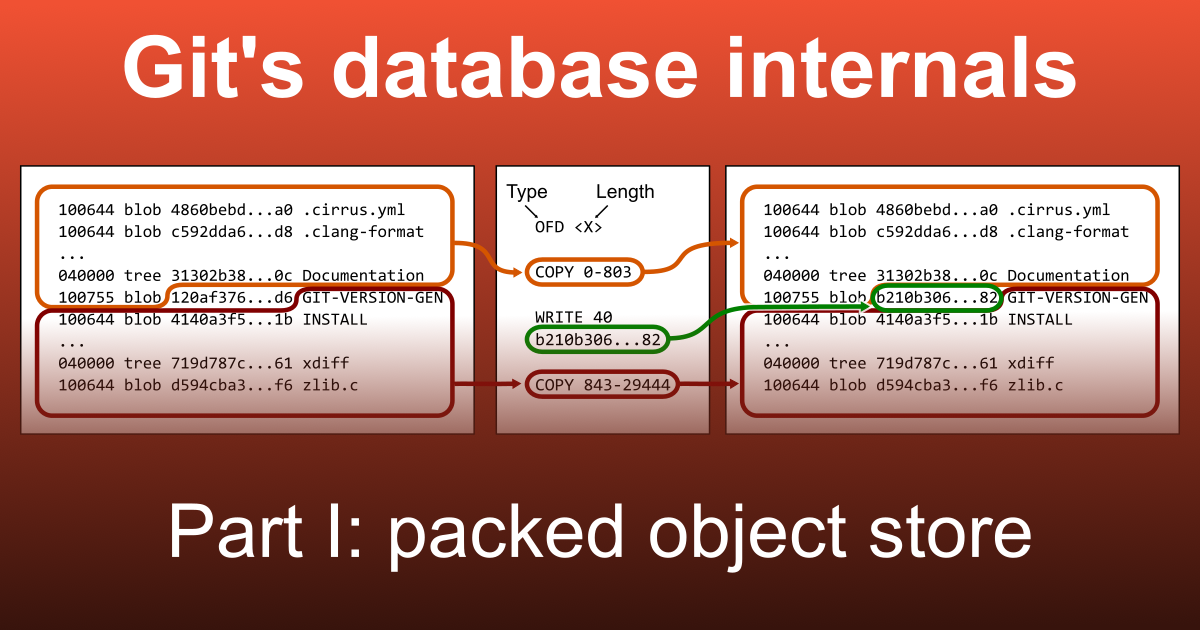
FWIW it's closer to lossless compression e.g. LZ77's behaviour: git's delta compression has two commands which are LITERAL and COPY, and technically it doesn't need to copy linearly from the base object, it would be unlikely[0] but a delta could start by COPY-ing the end of the base object, then add literal data, then COPY the start of the base object (or COPY the end again, or whatever, you get the point).
[0] outside of handcrafting, as the packing process would need to find such a situation which it would estimate useful
I was too lazy to implement the diffing algorithm, so I used the suffixarray from the go standard library and greedily grabbed the longest match at each point in the input. It's been a while, but I think I got a 12% improvement on my test case. (Probably wouldn't do that well in general.)
I'm assumed the git code just runs off of a diff (longest common substring), but I never checked.
The actual model of git internals is that every commit always stores full copies (of modified entries, unmodified entries are dedup'd through the magic of content addressing).
Then as an optimisation of the packing process git will perform delta compression between objects based on a bunch of heuristics. Until you pack you get full copies, and depending how "hard" you pack you may or may not gets huge savings.
Furthermore, Git's pack files are ordered, so depending on the selection it makes it can diff later files from earlier ones (your model) or the reverse, or even both at the same time.
You can see some of the early packing heuristics at https://github.com/git/git/blob/master/Documentation/technic...
[0] https://github.com/CocoaPods/CocoaPods/issues/4989#issuecomm...
The packing process explained in the article is why: rather than make compression an intrinsic part of the system's model (which most VCS do / have done), git moves it to a later "optimisation" phase. This is an additional and somewhat odd costs, but on the other hand it can be extremely efficient (at $DAYJOB we've got files whose compression ratio is 99%).
An other interesting bit (which makes it very annoying to inspect the raw contents of a git repo) is that git DEFLATEs object contents when it stores them on-disk. But while that's clearly documented for packfiles (although the lack of end-of-data marker is implicit and extremely annoying), it's not really spelled out for loose object, you get to find out when you can't make heads or tails of loose objects, and git barfs at your hand-crafted loose objects.
git does store diffs. People are confusing the logical representation with the on-disk layout.
That's not true; otherwise each git branch folder would be huge, but it's not. It stores the snapshot of changes in branch folders
No, gp is right. There is no snapshot of changes. Each unique version of a file is an object in the object store. That does mean each commit would only introduce new objects for files that have changed (these are already added to the object store when you use `git add`) .
But the pack files like the article explains (which are created regularly during gc/maintenance runs) is why the repo size can often be smaller then the working tree.
> Not only is each object compressed individually, they can also be compressed against each other to take advantage of common data.
1: https://github.com/vaibhavsagar/duffer/blob/bad9c6c6cf09f717...
2: https://vaibhavsagar.com/blog/2017/08/13/i-haskell-a-git/
I guess that would be performance-wise the same as switching from running the compiler in a one-off mode to a LSP analyzer.