22 points · by 2noame · 4y ago · 59 comments
What? This makes zero sense to me. I work for money. I do not work because I like working, and the money is just "unleashing potential". Similarly, Colgate makes toothpaste because they know the supermarket will buy it. There is risk they won't, which they accept in return for a profit margin.
>the money doesn't matter. Money you can print. We have experienced that in this financial crisis. You can arbitrarily increase it. The question is, whether the corresponding goods are present. The poverty in our society isn't a precariat problem. It is an elite problem.
This is insane.
When you get that paycheck, only then can you actually pay your bills, to whomever holds your debt at the time. To put it another way - you can't pay someone if you don't have any money in hand.
€ A different way of putting it is to imagine you had 0$ and a job that pays you in two weeks. Now you cannot take any credit since that means the bank pays for you (so the money comes first then the work). What do you do now to survive two weeks? The answer is that you need money to be able to work, not the other way around.
I think there is a cognitive bias in play here that the author has not realized: a bias towards believing people will think and act like they will.
I like to use the analogy of a moving walkway or escalator. Some people get on it and use it as an opportunity to go faster- I walk and it moves, so together I move really fast and get where I'm going sooner. Other people step onto it and stop. Usually it's moving even slower than they would be walking otherwise, but their goal isn't to get places faster, it's to do the least amount of work possible.
Those two extreme attitudes can apply to how people react to something like UBI. Some people will use it to accomplish more. Others will use it to put in less effort. And most people will be somewhere in the spectrum between those two.
I still think UBI is a good idea. I just also accept that it probably won't increase overall productivity in our society.
It is interesting how people can follow the same path and reach different conclusions. To me, UBI makes sense BECAUSE of decreased production. I do not want people who do not want to work a particular job to have to work at that job. I think we have enough food that nobody in this country has to go hungry, even if they choose to not work. Having these people at work does not help productivity (even though it might help production) where I define productivity as production per worker. In fact, I'd say if you reduce the worker base by a lot and only decrease production by a little, you have raised productivity.
Worse, economically speaking, UBI would get swallowed by the inflation it causes, and we have the worse problem of running out of other people's money to pay for UBI.
I think we have already solved the problem of food distribution in the US - hardly anyone dies of hunger these days. Happy to be corrected on that one, if you have contrary data.
I think we have also have cheap abundant housing as long as one doesn't want to live in highly desirable locations like Manhattan. And introducing UBI is not going to solve homelessness problem in Manhattan anyway.
So why introduce UBI, then?
What's the alternative? Isn't that all anyone has ever done? The only difference seems to be what those ideals being used to set expectations are.
I suspect it will, but only because our current system demands a lot of very unproductive workers. There will no longer be people sitting at desks watching the clock and putting in as little effort as possible until 5pm. There are plenty of people on the moving walkway right now just coasting. With UBI people will choose their work. They'll be doing what they are passionate about it and will be free to move on to something else if they aren't. Cutting all that dead weight, should help productivity considerably.
This betrays a lack of understanding of how the economy works. Goods come from people producing them. If less people are working, fewer goods are being produced, and thus there are fewer goods to go around. This leads to either inflation, or UBI payouts dropping.
As a simplified model, we can treat the purchase of consumable goods as using up a finite resource, which ultimately relates to human labour. The amount of effort put into creating xbox games is determined by the profitability of selling them, which is determined by the number of people who buy them. At the time when you buy the game, this labour has already been expended, but in the long term your action will cause more investment to be made into the development of video games. This investment will redirect effort - of programmers, designers, marketers, etc - from developing other products, towards making video games. You get less (or poorer quality) of the other thing, because you redirected effort into video games.
>The utopian idea is that they'll be inspired to do work to earn beyond UBI because of motivation (maybe it's because they want to help people, maybe it's to buy a fancy car).
Of course, some people will choose to do this. The difficulty comes is how this plays out on a generational level. Western countries broadly have below replacement levels of fertility. Individuals who don't work will have lots of time to raise children, and many of them will be motivated to do so. Their children would be liable to adopt their lifestyle. Thus, the number of people who are not working will grow at an exponential rate.
Anyone thinking about the timing of production should also be thinking about credit and finance. Investment and borrowing are how businesses fix the timing problem. Someone with money needs to believe that the sales will happen, and then the business can buy stuff on credit and pay after the sales happen.
To say that "because we have income, we can work" seems like a garbled version of more conventional economics, which is that savings allows for investment?
But it doesn't seem like a shortage of credit is any real bottleneck for profitable ventures. Interest rates have gone up a bit, but that's because central banks think that there is too much credit in the system. That's the opposite problem.
The bottlenecks seem to be in the physical supply chain nowadays. In a chip shortage, for example, businesses can pay for what they need; the problem is that they can't find a seller.
So how do you connect that back to UBI? Sure, if more people have a reliable income then they will spend more, but this isn't the Depression and lack of demand doesn't seem to be the issue.
(Here's a sketch of a better argument: UBI gives poor people spending power, which will cause businesses to anticipate more sales to them and cater more to their needs.)
This whole article feels like it is written by someone who is elated to think they've figured out that we've been doing economics wrong this whole time, and the solution to scarcity is actually super simple!
There's not 10 people with 1 money each, there's a ton of people, some of who have 1 money, while others have a billion money, and others have a couple hundred money, and some have 0 money and are at risk of starving.
UBI causes inflation, which hurts the lower class the most. How is this a win? If everyone gets UBI, then the prices adjust and no one effectively gets UBI anymore. this is what happened to college tuitions in the US because of government grants and government-guaranteed student loans.
The article argues that income is necessary for trade and therefore work which is kind of correct by accident, you need a medium of exchange to trade and work.
No income means no medium of exchange and hence an inability to trade and work.
So what is the solution? Supply and demand, the very thing that economists appear to have forgotten a long time ago, just think about it what it means to have axiomatic scarcity i.e. infinite demand. It means demand and supply will never be in balance. It doesn't take much to recognize that such an axiom is ridiculous and the fact that it is empirically disproven is just one more sad story we have to tell each other to stay grounded in reality.
If economics is a game then games can be finished until there is an update or expansion.
What does the very simple concept of supply and demand being in balance predict? It obviously predicts that all savings are bounded in time as any eternal savings would violate supply and demand. What do we observe in the economy? Eternal savings, quite literally in the form of cash. To make all savings bounded in time, economists have started inflation rate targeting.
Now imagine, you are a rational business owner and you build factories to mill grain and bake bread. You accidentally build one factory too many, it still costs you money to keep it staffed and ready to produce, yet the redundancy is useful if there is a famine, just in case we do need extra bread. However from the business owners perspective it would be better to close the factory and liquidate it into money and then... do absolutely nothing because it costs him nothing and his savings are eternally guaranteed by artificial interventions like the deposit guarantee and the government bailing the banks out at the cost of tax payers.
Okay let's get to the point, the business owner doesn't like an empty factory because it carries business risk and costs him money, but he likes money because the risk is carried by others and it is free at no cost to him. One person has too much money and doesn't invest it, if the money supply doesn't grow endlessly through more debt, then someone else ends up with too little money. The person with too little money has legitimate interests and a desire to work but no ability to do so. At no point is the bottleneck ever in the productive economy and if it was, it would be reflected through higher wages, there would be a scarcity of workers, not a scarcity of the medium of exchange.
To rephrase, in order for the tube of toothpaste to be on the store shelf, all the resources required to create it must have already been expended. The workers got their paychecks last week, the ingredients were already purchased. No further resources are required to put the tube on the shelf, and your payment cannot influence whether it gets there, because it's already there. Your payment can only influence whether there will be another tube of toothpaste to replace it later.
I catch myself thinking about this when I see a pineapple or some meat at the supermarket about to expire.
Surely it would be a good deed to buy that item - otherwise it would go to waste entirely, even if it is plain overconsumption on my part.
But then the supermarket's metrics will show they sold all their stock and will order the same amount again next time - so in the end the overconsumption feeds itself.
I'm really glad that a lot of supermarkets around here (in Switzerland) put products on the edge of (legally speaking) hitting their expiry date on sale and then on apps like Too Good To Go (where you can pick up an assortment of food that would otherwise get thrown out for a low price).
I do hope that internally, the analytics are accurate enough to capture the actual margin on each product to reduce the amount of stock ordered ahead of time.
And no, AI isn't any better at it than humans, because AI is just trying to predict the behavior of humans, which is fundamentally chaotic and prone to variance.
To be clear I’m working from two assumptions: 1) I have no issue with people being completely dependent on government support. 2) I have no issue nor do I partake in our glorification of work for work’s sake.
Having said that, the most important economic aberration UBI would do away with is the need for government and most public policy in general being run as de-facto job programs for the otherwise unemployable. If UBI were a reality there would be no rationale for bloated agencies, over-staffed infrastructure projects, tax schemes for factories, you name it. In that world, we could potentially turbocharge governance, as well as governmental and policy efficiency and efficacy.
A secondary, yet also important benefit of UBI is that it would unleash a ton of capable people who are otherwise bound to jobs or arrangements far below their capacity, for the simple fact that the fear of starvation or homelessness is too great. Think of all the human potential we could release if capable people felt safe enough to get an education or start a business.
Ultimately a bunch of people would just rely on UBI from birth to death. I don’t think that is a bad outcome. We live in a society advanced enough to be horrified by just letting people die/starve. However we struggle with the idea of some people just doing nothing when in fact the best possible outcome is for them to do just that. Some people are just not capable enough to do stuff at the level required in an advanced society, and saddling some institutions with employing them for charity does more harm than good.
Or they could just work and do all those things that only interest them but can't earn money in their free time like everyone else?
The free loaders that you seem to criticize already exist and nobody seems to have the desire to stop them.
Honestly I am so pissed off by people like you. If it was as easy as just working then we wouldn't have any problems whatsoever in our economies. The fact that there is structural unemployment due to how money works and that full employment reveals that there are rent seeking entities in the form of accelerating inflation should already tell you that the current system isn't working.
Here's a counter-example - the last legal sale of a product about to be banned.
In July 1989, the U.S. Environmental Protection Agency issued the Asbestos Ban and Phase-Out Rule (overturned in 1991 by the Fifth Circuit Court of Appeals in New Orleans).
The rule banned the manufacture, import, and processing of asbestos product in three stages. The stage one ban included asbestos/cement flat sheet, like asbestos shingles, starting on August 27, 1990.
However, sales of existing stock were allowed to continue until August 25, 1992. (See https://www.epa.gov/sites/default/files/documents/nps57f.pdf for full details.)
People bought existing stock because, for example, replacing a few broken shingles is a lot cheaper than replacing all of the siding.
Yet clearly the purchase was not an order for continued production.
And the last legal sale (assuming the ban had stayed in place) would not have been an order for continued sales.
Since that last payment isn't ordering the continued production and sale of asbestos shingles, according to the Toothpaste Argument, what is it doing?
There are other banned products, like the prohibition of "Methylene Chloride in Paint and Coating Removal for Consumer Use" https://www.epa.gov/assessing-and-managing-chemicals-under-t... where the ban went into effect after November 22, 2019.
Someone was the last consumer to buy paint with methylene chloride.
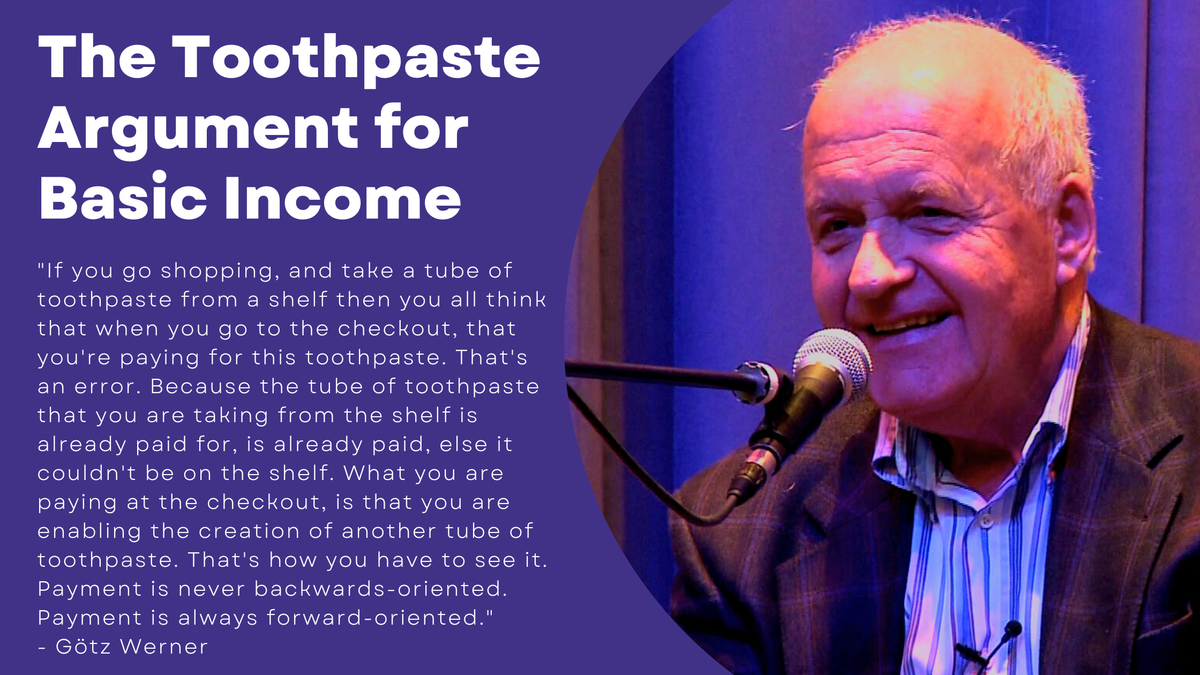
Someone had to pay to put that toothpaste on the shelf.
In capitalist societies, it's the person who provided the capital to the business and what you're doing is repaying that investment when you buy the tube of toothpaste.
In modern socialist societies, you don't have to worry about it because there is no toothpaste on the shelf. Just kidding. You are paying the workers for the labor that went into the production of the toothpaste. In arrears.
I didn't read much past that because I started seeing how we are not working for money or something like that.
"X means Y". "Really? Then explain this example of X without Y."
That toothpaste (or broadly preventative dental care) is a collective benefit (combining thr basic principles of "an ounce of prevention is worth a pound of cure" and Bastiat's broken window parable) and that because we should optimize opportunity costs around creation not repairing destruction we should all happily provide "universal basic toothpaste" to whoever wants it.
And if you extend this accordingly up the first 2 or 3 steps of Maslow's hierarchy of needs you can find some equilibrium of "universal" "basic" income to satisfy those needs.
The article I imagined would certainly make a lot more sense than this one, which is just dorm room economic philosophy.
(I feel like it's sad I have to put this disclaimer, but history has shown I need to say it, so here it is: the above is sarcasm).
I also question how enthusiastic the UBI proponents would be when it actually comes time to dismantle Social Security, Medicare, and other welfare programs. Are they really going to tell someone with disabilities "tough luck" when the normal UBI amount is not sufficient for their medical care? I'm sure they would respond with some kind of adjustment for special needs, but at that point we loop right back around to having a bureaucracy administer payments with different amounts for different levels of need.
The government is already comfortable with doing this, and I am reminded of their authority to do so with every paycheck and sales receipt. However I get what you're saying and I would re-frame it this way, "how will the government collect taxes from someone whose only source of income is the UBI from that government"? Unless the author is likewise proposing the UBI can be bootstrapped and funded in a self-fulfilling manner.
https://mitsloan.mit.edu/ideas-made-to-matter/negative-incom...
I will take the bandaid while fully understanding its flaws and tradeoffs until we become sane and make it redundant.