51 points · by benbreen · 4y ago · 53 comments
In other words, it isn’t a personal trade-off for sustainability; rather, it is a win-win.
There is a reason people started to get cars in the first place.
When its 18:30 in November, when weather is cold, dark and raining I don't see anyone enjoying the fun and convenience of the existing bike lanes, why ?
Similarly, I don't really see bikes being used to carry the weekly groceries for a family of 4, are they reserved for the people who can afford to go shopping every day and just have to carry few items ?
I use my bike almost daily since decades, cold and dark is not an issue (you never really feel cold on a bike as long as you're active/pedaling), rain and wind a bit more, I can carry 20kg of stuff on my bike, bags on my back and front and crate on the handlebar
The culture hasn't caught up with the power and availability of electric cargo bikes. Carrying four bags of groceries two or four miles is trivial in good weather, practical in a lot of poor weather, and you can probably manage six, you can hitch a trailer and go to CostCo if there's a safe path for that.
Anyone can do that if they don't have severe hip immobility, because you pedal when you want to, not when you want to move. It's great for the cold but not deep winter parts of the year: you start moving with the throttle, and pedal to warm up, you can stop before you start sweating into your jacket. In summer, you can work up a sweat, or enjoy 20kmh breeze and just cruise.
They cost a few grand, can come with an eighty mile range, and handle realistic traffic speeds safely. Once the public consciousness notices these things, you'll see a lot more of them.
Edit: I said "a few" grand but there are a couple compelling bikes which come in under 2K.
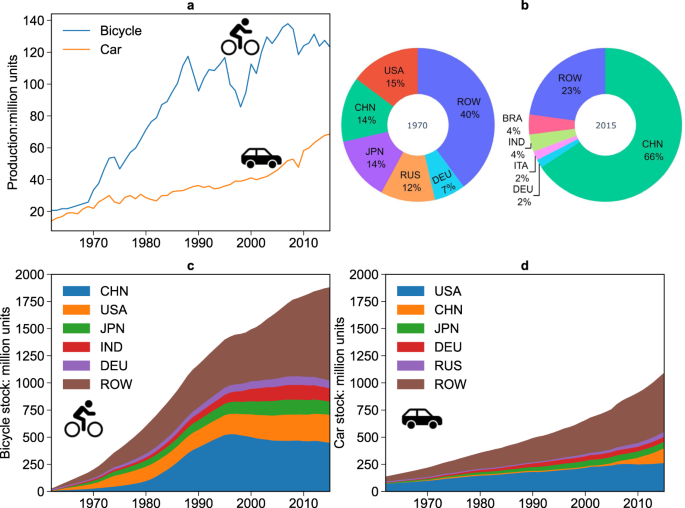
>It’s not as inconvenient as it sounds because there is usually a grocery store within walking and definitely one within biking distance.
I've lived exactly what you are describing and I would not go back to it given the option.
There's a pretty substantial opportunity cost difference between shopping weekly and shopping every couple days. That's time you could spend doing other things you actually want to do. And if the store that's on your way is in a prime location then there is probably a monetary cost too.
Edit: Since I'm apparently wrong would anyone care to point out my error?
We literally live above a grocery store, but my wife still orders grocery delivery on a weekly basis. So maybe cars aren’t necessary if they can be substituted by grocery delivery and smaller loads on bike.
You also raise the reality of cold dark and rainy novembers… well, when my son complains about biking to his guitar lessons on days like that, I hand him his rain pants. Builds character!!
But, biking on snowy days is too dangerous. It is so easy to slip and fall. We have maybe 2 snowy days a year (Amsterdam) and the city pretty much shuts down. However, where I grew up (Cleveland), there were many many snowy days. So, sensitive to the fact that cars are still necessary in many places.
You know that before cars became the de facto mean of private transportation, the streets belonged to the people and kids could freely play outside? That is something we completely forgot, now that we live in post apocalyptic concrete wastelands where simply existing and walking around puts you at danger of being crashed by a vehicle.
We got different experiences, probably live in different cities and countries and now? Both of them are just singular experiences strongly depending on the specific circumstances of our lives and of the concrete available good infrastructure.
There isn't an entrance fee to go to the shops. It doesn't cost more the more you go there.
Nationwide density is very misleading for countries where the population is concentrated in only a handful of urban areas. I wonder whether density data has sufficient quality to provide percentiles of density, say, 10km around each citizen.
Some city designers chose to make areas that are businesses only and living only - about the worst you can do for bike- and walkability
That is simply not true. The car isn't some inherently superior mode of transportation. People will use whatever infrastructure a city invests into most. If you build a city where all the infrastructure budget is spent on cars, then is it any surprise people will use their car to get everywhere?
Once you force people to use cars to get anywhere, then of course that kills local shops, but that didn't happen simply because of the availability of cars. It happened because the city stopped investing into any infrastructure that's not designed for the car.
> Since the bicycle and car trip shares from travel surveys are mainly for cities, we used the mean of city-level values as the corresponding national trip share, because the derived values appear in line with national values from other sources
I didn’t know that bicycle registration is a thing in some countries, though it does make sense why it’s required when I think about it.
Where I live, if your bike is stolen, you’ll just have to pray that your bicycle is unique enough, because like most cyclists, you probably didn’t bother to remember any of their bike’s identifying id.
And considering how much of a mess the government is right now, setting up a bicycle registry let alone any other bicycle-promoting initiatives are probably never considered. It’s a shame because cycling is fun, but if you’re a risk-averse, you’re limited to only a few safe cycling spots.
Tons of people bicycle here just to get around, including mothers with small children. They have bicycles which have 2 child seats. In newer areas, there's bicycle parking lots everywhere: in apartment towers, at the mall, at the grocery store, etc. Bike parking lots don't take up much space unlike car parking lots. In older areas, people just park wherever: on the sidewalk in front of the convenience store, on the side of the street, etc.
It's a very awkward conversation.
But it mystifies me that people insist on still promoting bicycles and public transportation without addressing the real reason many places rely on private passenger cars.
What's the point of incessantly henpecking people who clearly and obviously can't turn to bicycling and public transportation on account of obvious logistical and safety issues?
Right number of bikes = n+1
where n is the number you currently own. Limited by: n = S-1
where S is the number of bikes that would cause a separation from your spouse.I own 6 bikes right now and want another. My best friend used to keep one bike in the boot of his car so his wife wouldn’t see it[1]. He’d then switch it with another every winter and spring[2].
We both own cars and drive most days, so these two things don’t seem that related. I would like to cycle commute more.
1. What really makes me laugh about this is, he chose the same paint scheme because that’s the only thing she notices; 1 is a winter road bike and the other a TT bike.
2. Until it all came out in the pub; she thought it was funny too. :D
There really is no need to seek offence where none is given. It cheapens any further discussion.
Since you ask, I'm in a bike club because I like to ride, race and tour bikes with friends in my spare time. I've just finished a bike tour where about half the group where women. They also collect bikes just like me. Just like my friend, not all their partners ride or have any interest in cycling either.
I have 6 bikes because: a) I've been riding a very long time and I tend not to throw things away. b) different bikes serve very different purposes.
i.e. I don't commute on my TT bike and I don't ride my Brompton folding bike on single track.
As for sustainability, I suggest you look at the actual impact of owning a few old bikes vs say, having even one pet dog, cat or child. These are several orders of magnitude worse.
https://en.wikipedia.org/wiki/Giant_Bicycles
Instead, it names "China" as the #1 producer by far. Taiwan is a separate nation.
https://cyclingindustry.news/taiwan-export-figures-analysis/
The e-bike market, unlike carbon sports bikes, is rather huge, and growing fast.
I'm not saying that Taiwan is not a big bike producing country. But comparison to the total world market of all categories of bikes, their output is not world leading. Just because you are personally into Taiwan bike production doesn't make it fair to call researchers politically biased (especially with your bias so openly on display).