An environmentalist gets lunch
Why being an effective environmentalist can often feel like being a bad one
worksinprogress.substack.com
78 points · by aSig · 4y ago · 159 comments
> Environmental impact is measured over a full life-cycle analysis (LCA) across the following metrics: greenhouse gas emissions, ozone depletion, human toxicity (cancer effects), human toxicity (non-cancer effects), photochemical ozone formation, ionizing radiation, particulate matter, terrestrial acidification, terrestrial eutrophication, marine eutrophication, ecosystem toxicity, resource depletion (fossil), resource depletion (abiotic), and water resource depletion.
[1] https://ourworldindata.org/grapher/grocery-bag-environmental...
What you described is a non-issue if the bag is disposed of properly. Presumably you, as a environmentalist can be relied upon to do that.
[1] https://www.ecfr.gov/current/title-40/chapter-I/subchapter-I...
I'm glad you brought it up, because upon looking at the study the chart is based on, it seems hopelessly optimistic - it accounts for several end-of-life scenarios but they are all 'good' disposals performed after plastic collection, like recycling or incineration. Zero accounting for accidental or incompetent sending to landfills, which indeed seems the main issue with plastic bags.
(The study is also specific to Denmark, where perhaps disposal programs are more reliable than they are in the US.)
https://www2.mst.dk/Udgiv/publications/2018/02/978-87-93614-...
That means I've used them maybe 100 times. Now they're starting to fall apart, and soon I'll need new ones.
I wonder, since they're much heavier and clearly use a lot more plastic, whether I would have used less plastic with the disposable ones.
https://iopscience.iop.org/article/10.1088/1748-9326/aa6cd5
Which only looks at greenhouse gas emissions (and only then compares grass feeding to grain feeding), and does NOT consider the effects to local groundwater, surface water, or air quality from CAFOs.
Here's a CDC resource that goes into depth about the swathe of negative effects on local resources CAFOs create: https://www.cdc.gov/nceh/ehs/docs/understanding_cafos_nalboh...
Besides things like frequent manure spills that pollute surface and groundwater, children living near these CAFOs have elevated rates of asthma.
The piece is very focused on greenhouse gases and the benefits of "economies of scale" but doesn't say a peep about the meltdown of our consolidated food supply when the pandemic subjected it to supply shocks.
And the end result won't be what you want it to be. It doesn't do us any good to stop climate change if the ecosystem still collapses out from under us.
Creating a sustainable environment is a systems problem and carbon is just one of many variables in that system. Yes, it's a really important one and in many ways it is the most pressing. But biodiversity and maintaining ecosystem services are close seconds, and if you optimize your eating for carbon in the way the author is describing you inevitably end up doing more net harm by undercutting those other two.
Further, a lot of the "data" she's linking is completely with out method or context. And method and context can make a huge difference in these sorts of lifecycle analyses. They are fraught with pitfalls. It's one of the reasons it's been so fucking hard to pin down exactly what the most environmental behavior is.
And this whole mess is one of the prime motivators behind my current effort to write an open academic publishing platform [1] that would allow review to be crowdsourced so that we can open and centralize the whole literature. Because then we actually could get a complete picture of what the best current answer to these questions is with out having to go through secondary sources like this which inevitably cherry pick studies, data, and lack context.
[1] https://blog.peer-review.io/we-might-have-a-way-to-fix-scien...
You might be interested in what we're doing at LabDAO, including our publishing lab and the community governance we're developing. Note: we're a DAO but it's not about crypto.
Contact in my profile if you'd like to chat.
I could imagine using natural language processing as part of looking at generating an automated Q&A algorithm or attempting to automate literature reviews in some way, but in the review process?
Someone I was talking to the other day was suggesting using sentiment analysis during the review process as a kind of tone grammarly aid to help people write constructive reviews, which is interesting. But I think that's different from GPT3.
Judging from your bio, I would guess you have much strong ideas about that answer to that question than I do. What are your thoughts?
I rather like the frontiers review process as a gatekeeping process. Papers get much better through their interactive review. But I don’t think peer review should stop with publication. I think there is a need to rate and rank and otherwise gather sentiments from researchers on papers in their field —ideally in a manner that allows for new important work to surface more easily. Whether the goal is to make science human and machine readable, for the further advancement of science. There is going to be a lot of science.
* check this out: https://www.nature.com/articles/d41586-022-02787-5
The truth is reducing CO2 emissions is an emergency, and any other environmental considerations other than doing that is just arguing about deck chairs on the Titanic.
At this point, we would have been in a much better position if the Greens had no been so rabidly anti-nuclear. Germany is restarting coal plants now.
At some point, as the article argues, following “environmental intuitions” is self-defeating.
I don't think that latter sentence follows from the first at all - it's very much a slow emergency that will play out over decades and indeed centuries, and furthermore with a global population of 8+ billion, clearly it's not feasible for all of us to drop everything just to focus on any one single environmental issue. There are inevitably going to some actions that need to be taken to ensure long term ecological health that aren't related to mitigating against climate change, but are just as important, esp. wrt release of toxins/agricultural runoff into the environment, or drawing down water tables or monitoring invasive species (a problem already, but often exacerbated by warming temperatures). Thankfully we can walk and chew gum at the same time. (FWIW I agree re the anti- nuclear stance of environment groups - and would do so regardless of the need for low-emission power: nuclear energy production generally has a much lower environmental footprint than fossil fuel generation)
Climate is an emergency, but if we go chasing the wrong "solutions" based on bad data or incomplete data, or take the base of the ecosystem out from under us in the process, then we won't resolve the emergency or we'll end up in a worse place.
There are some things we know - transportation, housing, urban design, energy, many aspects of industrial manufuaction and waste disposal. These are still complex, but have much clearer cost benefit analysis. We know what the answers are there. Some of them involve individual action (like I laid out below) others are going to require collective action.
Agriculture is a mess with a pitched propaganda war taking place around it. I've spent a decade trying to sort out what is true, and I'm still no closer to feeling like I can say with certainty what the most ecological diet is. But I know that anyone who can say it with certainty has not done complete research.
We're making significant progress on cleaning up energy production, as wind and solar are now the most economic ways to produce new energy by a very long shot. The trajectory of the temperature curve is bending in the right direction, and should bend further. At some point we also need to pay attention to the rest of the quality of life on earth.
Almost nobody among claiming that treats it seriously.
Prominent celebrities claiming that travel by plane.
Greenpeace continues to oppose nuclear power.
Solar power gets blocked because some endemic species or pretty views are threatened.
Noone supports killing air travel.
---------------------------
Almost nobody among "CO2 is emergency" is actually willing to sacrifice own benefits or other priorities. At most they demand sacrifice from others.
I am not going to treat plane-travelling celebrities declaring climate emergency that threatens survival of humanity. The same goes for eco-organizations not willing to support deregulation of nuclear power.
This statement is wrong. Climate and collapsing ecosystems/biodiversity are connected, and one is not more urgent than the other.
honestly I never understood this. Always seemed a more Luddite response than a environmentally principled one.
Environment is not all about carbon footprint. Reducing...or rather not increasing as much global warming doesn't help reducing the 7th continent or the micro plastics/graphene/whatever life threatening microscopic waste we are sending in the environment.
Still support plastic bag and straw 'bans' though.
One small factor to add to the mix is giving less money and power to fossil fuel producers, which I think has an outsize effect.
So I'd like to see most plastics move towards non-fossil feedstocks and better recycling.
Luckily, Extended Producer Responsibility laws lead to both less packaging, less harmful packaging and more recycling of packaging by putting the cost of disposal onto the people with the ability to make systematic change.
The people pushing the "all regulations backfire" line are just anti-regulation because they know they can foist the costs onto other people. If they'd lie about climate change then they've kind of blown their trust with me.
I agree environmentalalsim should be data driven, in both identifying problems and potential solutions. I believe that the meme that it's not is an obvious political fabrication by genuinely bad people.
Only when the minimal amount is used. Clamshell packaging is almost always incredibly wasteful and could be replaced by less weight of cardboard. Plastic jars and similar could often be bags or pouches. etc.
For example, British milk sellers mostly use the same shared milk container, with different labels.
They figured out how to lower the cost, because they were paying for it. They get really in depth in the specific amounts of dye to use in lids etc. to maximise recycling.
https://wrap.org.uk/resources/report/hdpe-milk-bottle-resear...
None of that needed specific regulations, just assigning the costs to the people responsible.
Milk bags have been in use in some places for decades, pack better, are lighter and use less plastic than a bottle lid. Other places do not use them for no particular reason.
My imperfect personal tactic is to consume less of everything.
Refuse -> Reduce -> Reuse -> Recycle
> "Lab-grown meat, dense cities, and nuclear energy need a rebrand. These need to be some of the new emblems of a sustainable path forward."
1) Lab-grown meat is nowhere near commercialization. At best we have plant-based meat substitutes that have similar nutritional profiles (high protein) to meat that can be produced at scale.
2) Dense cities don't really matter that much, as each human requires a similar amount of arable land to grow the food they need each year. That per-human land area might be a bit less for vegetarians, but I doubt it's that big of a factor.
3) Nuclear energy is still quite expensive relative to wind/solar/storage, and that won't change because nuclear's catastrophic failure potential requires over-engineering and high-security, plus the uranium ore and cooling water requirements can be problematic.
Are you sure? My understanding is that people who live in dense cities rely less on automobiles, have their waste treated more efficiently, and consume less energy per capita in order to enjoy clean air and water. Those factors are more important than the land mass required to feed someone.
You can pack a lot of people into a 3km^2 circle at fairly moderate density when you're not wasting 500m^2 (8 parking spaces @ 40m^2 then roads, misc infrastructure and setbacks) per person forcing them to own cars.
A well connected walkable rural town full of 3 story fourplexes and 2 story cottages all clustered within 1km around a main street and train station is completely fine.
A walkable city which is almost all under 8 stories and where large portions of the population live in row houses or five over ones is fine.
Houston or Phoenix is not fine.
People use much less resources per unit of quality of life when they live in dense cities. Density provides massively more productivity with a given amount of natural resource consumption.
Now, if you really care about moving towards a more environmentally friendly world, you'll not stop there. You'll first want to change your diet to be plant-based, but then also want to make sure that those plant-based foods you buy are best-in-class (environmentally speaking), i.e. lead to healthier soil and less microplastics.
Beyond the environmental aspect, I'd also suggest looking at what impact your choices have along social and economical axes.
People are angry their neighbours don’t properly sort their trash while recycling is a shame. Meanwhile planned obsolescence is prevalent.
Making people feel guilty about their very small impact prevent them looking at the real culprits: electricity production, oil companies, global manufacturing and shipping and construction.
Is this seriously an issue compared to trash in general? Sure, people bitch about how it's impossible to repair their iphones or macbooks, but even if you had to replace them every other year, the amount of trash they generate in relation to everything else is absolutely minuscule.
>It’s a conscientious strategy. Making people feel guilty about their very small impact prevent them looking at the real culprits: electricity production
But every kilowatt that you don't consume is a kilowatt that's not being generated by the electric grid. In that sense your actions have a direct impact on greenhouse emissions. Sure, you unplugging your electronics isn't going to single-handedly stop global warming, but that's because no one is single-handedly causing global warming either.
Also, you can literally buy a PV system for your house which would cut your emissions to zero.
>oil companies
see above, also electric cars.
>global manufacturing and shipping and construction
Well the goods you buy has to be manufactured somewhere, so presumably you're against the shipping rather than the manufacturing aspect. However, this source[1] says that shipping is responsible for 2.5% of global emissions, which isn't very significant.
[1] https://www.ukri.org/news/shipping-industry-reduces-carbon-e...
No it’s not an issue that’s my point. What people sort is rarely recycled anyway. That’s why it’s a shame.
> But every kilowatt that you don't consume is a kilowatt that's not being generated by the electric grid.
Yes but what individual consumes is far less relevant than how this electricity is produced especially when you compare domestic consumption to industrial consumption. It’s far more impactful to lobby for the end of coal power plants than switch off your electronic.
> see above, also electric cars.
Yes, it’s finally coming quite slowly but for decades oil was heavily subsidised.
> Well the goods you buy has to be manufactured somewhere, so presumably you're against the shipping rather than the manufacturing aspect.
I’m not against anything. There are huge gain to be made in both shipping and manufacturing. Investments are far too low because they are not mandated.
That’s my point. The most significant gains are at an institutional or corporate level. Most of the debate surrounding individual behaviour is a distraction.
Same thing goes for rooftop solar power: it's fine, but protecting it is not important.
OK. But how it makes
> rooftop solar and urban gardening (or "farming" if you must). Both are ecological catastrophe
claim true?
If you limit the neighbor to n stories at the boundary and n+1 at a setback of the winter noon sun angle where n is the current building then you can get your solar cake and eat it too.
Agree on the urban farming front (delicious lead). Although when done right, high mass yield, refrigerated, low calorie produce can be a net neutral or minor win there and should he considered as reasonable as any other hobby. There is also something to be said for the follow on effects of praxis, even if the immediate effects are minor.
1. stop buying meat
2. stop eating meat
3. stop buying dairy-based products
4. stop eating dairy-based products
5. stop eating eggs, honey, fish
6. use public transport, if possible
7. don‘t fly, if possible
Congrats, you now are an environmentalist.
1. Walk or bike.
1a. If you can't do the above, use public transport.
1b. If you can't do that, consider moving to a city where you can do all of the above (if you can afford it). If you're rural, seek a land trust or farmer to buy your land when you do.
2. Insulate your house.
3. Get solar if you can afford it.
3a. Replace all gas appliances with electric (Heat pump, electric water heater, ec)
4. Don't fly.
5. Dietary changes, but remember to include ecosystem services and impact in your analysis. A little carbon is worth it if it means more land stays free of pesticides and continues to provide for the ecosystem.
At least, this is the best I've been able to make of it after a decade of study using open sources. Agriculture is important, but whenever I've actually dug into the referenced data I always find they're optimizing for the wrong things, leaving out important variables, or just all around cherry picking data with an end goal in mind.
There's currently a propaganda war between multiple powerful lobbies - the animal rights lobby, the meat producers, conventional ag producers, and more - which means there is a ton of misinformation flying around about the actual environmental impacts of eating meat. Really, of all things dietary.
Meanwhile there are a bunch of people exploring alternate agriculture systems through agroecological approaches that show a lot of promise, but haven't been studied enough to really make claims about either way.
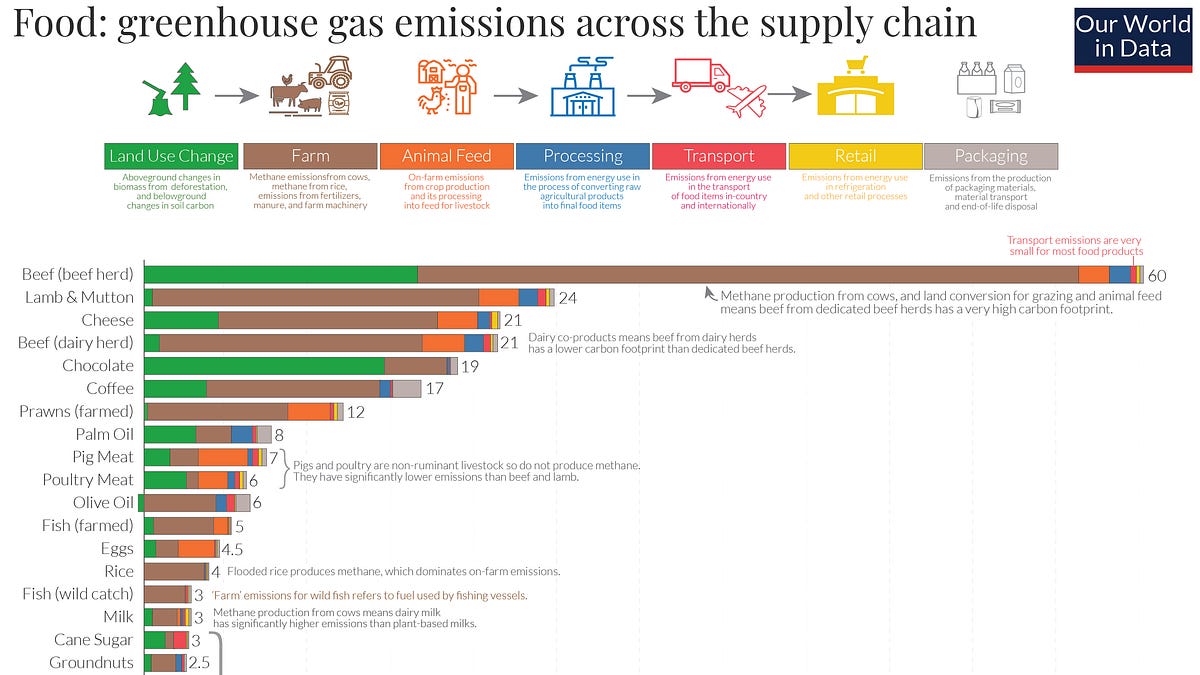
Further, you cannot just say "x amount of finished beef produces y emissions" because there are so many factors that go into it. Feedlot vs traditional range vs intensive rotational vs silvopasture are all different with completely different environmental impacts - of which carbon is only one.
There is also evidence that this sort of grazing can substantially reduce carbon emissions. Meanwhile monocultured grain, beans, and veggies - especially conventional with heavy pesticide* (edit: originally wrote fertilizer, meant pesticide) use - are devastating to ecosystems. They're essentially turning large swaths of land into killing fields, taking the bottom right out of ecosystem and contributing to the massive drop in insect populations (which form the foundation of the food web) we've seen across the developed world.
In short - the agricultural analysis is really fucking complex, multivariate, and grey.
She links a literature analysis that claims to contradict much of this, but I've read literature analyses making these sorts of claims before that just ignore most of the alternative systems, gloss over a lot of nuance, or downplay the harm of convention systems in major ways. I need to read the one she linked, but experience has taught me to treat it skeptically.
I see your point, but this isn't viable. Too many people live too far away from their workplaces, shopping centers, etc (not to mention unpleasant weather) for walking/cycling and we don't have adequate public transit networks (nor can we build them in time to meet our public transit goals). Moreover, EVs are coming in very quickly and will largely wipe out our personal transportation carbon footprint (especially as the grid transitions to clean energy) such that there's very little to be gained (environmentally speaking) from a transition to walking, cycling, and public transit (I say this as someone who wants America to be more walkable, but not at the expense of the environment). Not only is it technically unviable to build out the transit networks and otherwise reorganize our society away from cars, but it's politically unviable--apart from urban progressives, there's very little political will for public transit (many of the people who say they support increased public transit networks aren't actually going to avail themselves of them until they really become more convenient than cars for their specific transit needs).
If a crop needs pollination but you want to reduce dependence on honeybees, it's likely you would need to break up the land the crop is on in order to plant flowering species that attract native pollinators at the edges, and that comes with its own downsides for maintenance and harvest.
The proper way to frame it provided someone has no desire to be vegetarian would be limit your consumption of meat - only eat red meat as an exceptional treat and favour poultry a few times a week - and switch to plant based milk.
Eggs and honey are very much fine as is cheese given the average per individual amount eaten per year.
What we can still control is how bad it is. (An increase 1.5 degrees C looks a hell of a lot different than 4 degrees C). That's still very much a fight worth fighting.
When people ask if we should do this or that, the answer should be "yes". These rules are fine - we should eat less meat, we should drive and fly less, etc. We should also do more systemic things, like investing heavily in battery tech and solar and wind and even fusion longshots. We should regulate the hell out of emissions, and use the proceeds from taxes and fines to help mitigate the effects on the poor. Getting to net zero carbon is going to be hard but it has to happen.
"The rules are fine", and net zero "has" to happen". So in your mind there's no room for argument and the objective is sacred. So how many guns are you willing to put to peoples' heads to get them to change their diets? To get them to stop flying? Driving in particular is required for many peoples' livelihoods, particularly those on the lower end of the socioeconomic spectrum.
IMO, the truly "hard" part of getting to net zero is getting people like you to realize you're not going to force your proposed solutions onto the rest of the world. You're going to have to team up with people you don't like. You know why Texas, the oil/petrochemical capital of the US, has so much wind power? It isn't because an army of environmentalists descended on the state house shouting slogans and waving signs, it isn't to save the environment, it isn't to stop climate change. It's because wind energy is cheap in Texas, something that appeals to even the most coal-rolling, roundup-spraying, green-lawn-in-the-desert Texan.
If you want to save the environment, drop the moralizing and meet people where they are. Until that happens environmentalism is just going to produce backlash, that allow the environmental movements feel even more superior and do things to produce even more backlash, until the price of meat, power, transportation and housing goes up so much that you get a backlash that undoes any short-term progress that was made.
You don't start eating 50kg a day if you become vegetarian, and you don't spend 30 hours a day travelling if you do it by train. Yes, universally switching from cars to any other form of transport would save people 1-3 hours a day to do other things, but if they spend that time doing anything other than sitting in a car it's a win.
You also don't get to use "what if noone did that" as a counter argument for something helping if everybody did it.
If everyone insulated their home properly, got rid of their cars, stopped eating beef, and cut the remaining animal proteins by half we'd be pretty close to net zero right now.
That's an extreme example, but it's not impossible to imagine that there are low-income occasional meat-eaters out there who might start consuming more meat if the price went down. Maybe the increase wouldn't completely reverse the initial reduction, but if the net result was equivalent to only 5% of people changing their lifestyle, then we're talking about a very small change in CO2 emissions.
Get your house insulated. Helps with both heating and cooling.
Use a fan rather than AC if you can.
Do not buy unneeded stuff, buy durable, sell or repair rather than junk.
Stop pretending like climate change is created by consumers and can be controlled by "turning your lights off."
An example might help: Elon Musk is not, AFAIK, vegan. But he's done a lot to popularize electric cars, having far more impact than he could by changing his diet. Likewise, the Beyond meat people have probably done a lot more to reduce meat consumption than they could ever outweigh by eating steak every meal for the rest of their lives. (I am actually not clear on the net environmental benefit of using gas vs. making more batteries, but let's say for the sake of argument that electric cars are an environmental benefit, since it's just an example.)
But it is actually created by consumers. By human beings consuming resources and emitting greenhouse gases in return. Simply because there's nothing else even close in scale as a source of global warming. What else could there be, wild herbivores?
It follows almost tautologically that it is human beings that is causing the warming.
You blame "industrial production processes". But those are completely funded by human consumption in a mostly on-demand action.
So what else is there to blame? The transportation industry? Again, completely funded by, and a direct response of consumers buying stuff. Consumption is at the beginning of the chain. It's the cause.
So your argument sounds wrong to me. It sounds like you want to shift blame to wealthy industrialists. Guess what, a fat bank balance or stock ownership like that of Elon Musk or Bezos does not emit greenhouse gases by simply existing.
- Highly processed food, including fake meat, could be extremely bad for you. The point is we just don't know yet as there isn't good data.
- Dense cities have the potential to be inhumane and not worth living in for various health (e.g. particulates, aerosols, nitrogen, disease) and social (digital-gov tight controls over movement, work, and access to resources) reasons. Just look at covid era China. Large groups of people displaced into under resourced cities ends badly.
-Nuclear is great until you get something like Ukraine where its used as a stick against the rest of Europe. Thyroid cancer rates in western europe would spike as a result of a critical incident. Or ofc Fukashima and Chernobyl. I'm totally pro nuclear but not mentioning its failures is a bad take and I don't believe the figures about nuclear related deaths.
Sure they have the potential for this, but only if we don’t take these problems into account and mitigate them. Take particulates for example (and noise, which you didn’t mention but is also an issue); a lot is from cars. If we assume that every city resident will have and frequently use a car, then sure that becomes an issue. But if we provide viable alternatives to driving and make them as or more convenient than driving, much less of an issue.
Another point: fertility drops massively in cities and this is an environmental concern as you need labour to transition industries at scale (e.g. nuclear plants, solar, wind, biomanufacture). Low birth rate dense cities are a recipe for disaster in terms of sufficient labour for a green transition.
The list of issues with the authors "I'm a misunderstood future hero" viewpoint goes on and on imo.