118 points · by Tozen · 4y ago · 184 comments
We already have the majority of one party believing the last election as stolen despite a comprehensive lack of evidence. It won't take too many more people until a clear majority simply stop believing any election results are valid.
This is the part that gets me. I don't know how anyone with two brain cells to rub together can see this behavior and then still support the people perpetrating it.
Nope, coming in loud and clear, not a bubble problem.
https://www.newyorker.com/news/our-columnists/why-is-trump-o...
Now that I've heard this what greater understanding do I have?
But what you really mean is listen to their grievances and anger at being left behind economically. I'm aware of this but it doesn't justify destroying democracy with false accusations of election fraud.
The big question is, would the outcomes even change with more access? Districts are highly manipulated to guarantee political outcomes no matter who votes, even in blue states this is true, at all levels of representative government. My extremely blue city council even gerrymanders their council districts to entrench political dynasties. Plus you have Prop 22 which has proved that an informed vote is not easy to come by among the public, and money buys policy.
“Because it puts us at a competitive disadvantage relative to Democrats,” said Michael Carvin, the lawyer defending the state's restrictions"
In Supreme Court, GOP attorney defends voting restrictions by saying they help Republicans win
https://www.nbcnews.com/politics/elections/supreme-court-gop...
In some places, state governments are preparing to ignore the results of popular votes entirely, but that only applies to the presidential election.
I'd suggest the efforts to reduce access - limiting early voting, dropboxes, etc. - imply the Republicans believe this to be the case.
https://www.aclu.org/news/voting-rights/why-ohios-congressio...
On the other hand, I'm old enough to remember the election in 2000 and still to this day there are people convinced that election was stolen despite evidence. In fact, were it not for 9/11 I'm sure the protests over that presidency never would have stopped.
I guess I shudder to think what would be required to unite this country again then..
You can't keep counting forever or you end up with nobody as president since Clinton was term-limited, and ultimately the decision turned out to be correct. So the people saying that election was stolen are just as much election deniers as the J6 crowd.
Would that restore faith in democracy? Or would that demonstrate that if you yell loudly enough about the election being stolen, then it will be given to you no matter what.
Omitted from your statement is that he first did this in 2016. He was prepping a "the election was stolen from me" claim at that time when it looked like he might lose, but when he ended up winning, he still claimed voter fraud had occurred. He said he would have won by more if NH hadn't been stolen by illegal immigrants who were sent via bus to cast fraudulent votes. He started a commission to find evidence of that, and it dissolved after it couldn't make any progress (because no such fraud existed). This was a footnote in 2017 many people have forgotten, but it presaged 2020.
https://news.yahoo.com/hillary-clinton-maintains-2016-electi...
The big question is the scale of the operation and whether it impacted the results. It appears to me that the opinion people have is very related to how much they like the result.
https://en.wikipedia.org/wiki/Russian_interference_in_the_20...
Please identify specific people and times for any claims - I’m sure you can find some nut on truthout.org claiming that the GRU hacked voting machines but that’s not the same as a lie becoming the most important GOP litmus test leading to a violent assault on the U.S. Congress trying to prevent the election process from being accurately completed.
But that phrase specifically, I'm not sure exactly what you mean.
In 2016, Russian hackers hacked both the DNC and GOP, and selectively released information collected from the DNC in order to hurt their ongoiong campaign. Russian actors also ran interference campaigns on social media. These are all established facts. They are also not allegations of fraud, simply pointing out that these actions quite possibly had an impact on the outcome of the election.
What Republicans have been claiming for almost two years now is that Democrats have committed outright election fraud. They have accused Democrats of everything from tampering with voting machines to ballot stuffing to throwing out Republican votes, and they make all of these accusations without a shred of evidence. Many Republicans in office today have taken the hard stance that Joe Biden was not elected President.
By who? A handful of internet nutjobs, surely. No one in a position of power or influence ever claimed that the election results were fraudulent in the sense that today's elected republicans are straight up claiming.
(What was claimed, and largely substantiated, was that one campaign appeared to be coordinating closely with Russian interests during the campaign. And indeed people were upset by that. But again, that's not a claim about the election.)
This is 100% revisionist history, and a typical ploy to try to excuse bad behavior.
'Hillary Clinton dismissed President Trump as an “illegitimate president” and suggested that “he knows” that he stole the 2016 presidential election'
https://www.washingtonpost.com/politics/hillary-clinton-trum...
Most importantly, Hillary Clinton conceded the election the next day, as did Al Gore in 2000 once it was clear he didn't have a path to victory. Both pledged to support the victor. Trump hasn't done that, two years on.
Assuming these machines that were handled are decommissioned, is there a risk to future elections that use the same model of machine? I imagine there's significant security through obscurity. Do all models of this machine need to be decommissioned? We're taught that physical access to a machine should deem it compromised. But voters handle machines behind curtains every election. Does 4 hours unfettered access make things worse for the whole model?
I think that's a good low-tech way to have security, since random people never directly interact with the machine. The only outside input is the paper ballot, and it shouldn't be hard to write scanning software that's perfectly secure from malicious ballots.
The only remaining issue then is making sure the machine isn't tampered with before/after the events. You don't even need to trust the poll worker that feeds the ballot into the machine, since they're standing in plain view of everyone at all times, and under surveillance (I assume).
Nobody had to worry about the boxes being tampered with, or about "unauthorized" people gaining access to them before or after the election, because they're just boxes.
If your election can be trusted only if only "authorized" people interact with voting equipment, then it can't be trusted at all. Obscurity has no place in elections.
Former Travis county clerk Dana DeBeauvoir teamed up w UT profs [1] to make voting more secure. let's roll out some standards across the country.
[1] https://www.wired.com/story/dana-debeauvoir-texas-county-cle...
What you are proposing legitimizes traitors and liars
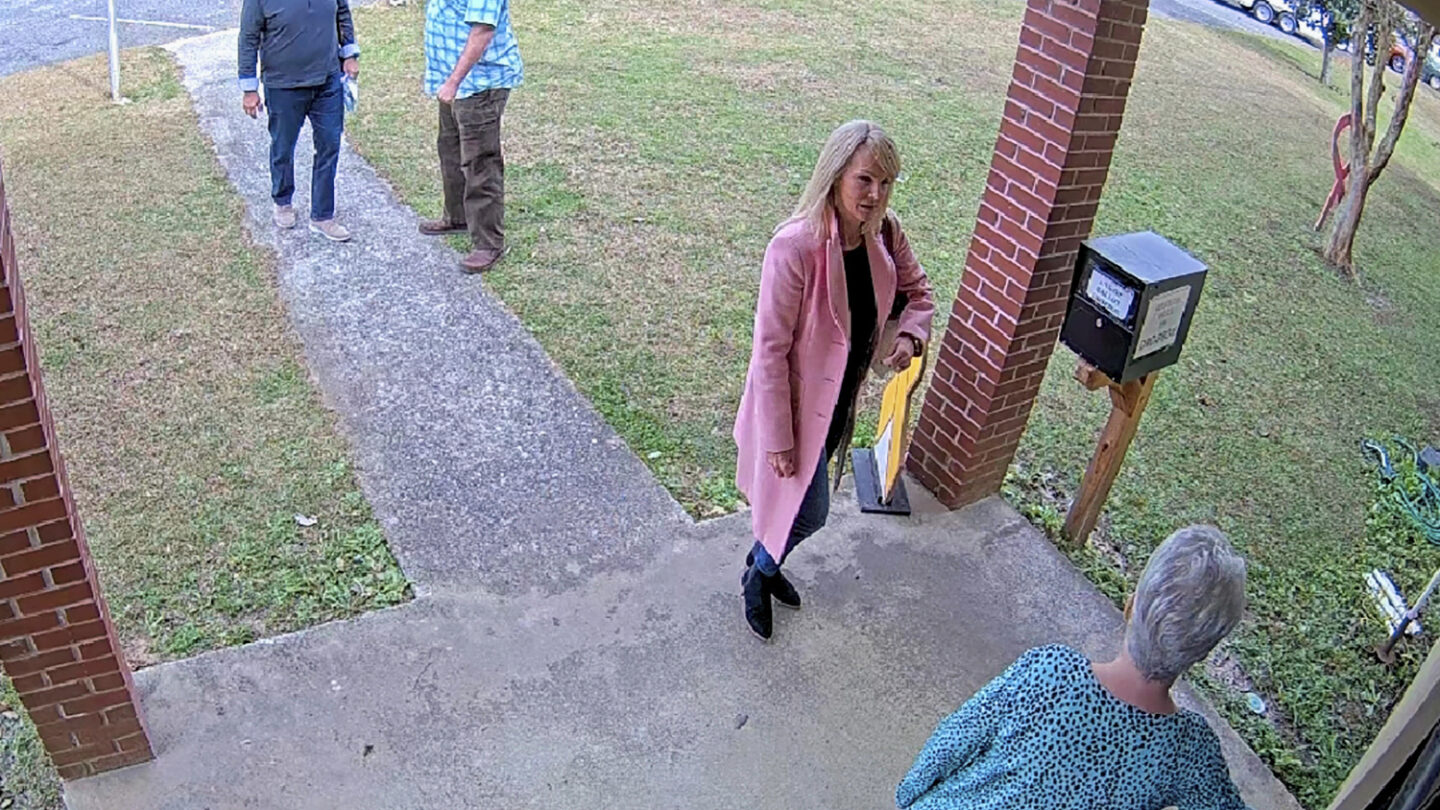
"Latham said that she went to her job as a high school teacher and stopped by the election office briefly that afternoon. But the video image shows her arriving at 11:37 a.m. while time stamps on other images show her there throughout much of the day. She also said she didn’t see specific people and saw others only briefly, but the video images show otherwise."
There are efforts in Georgia to establish paper ballots to make electronic tampering impossible. They could still stuff ballot boxes, but that takes physical work.
The first step in election fraud is always to accuse the other side of it. But real paper ballots are a thing anybody honest and competent supports.
Simple folk physics gives everyone an understanding of the security of ballot boxes. There's thousands of ballot boxes, each in a different physically-secured location, with various personnel keeping track of them, many of them citizen volunteers and workers, as well as partisan observers. Everyone intuitively understands the security, as well as security flaws, of this system.
All of that is lost with electronic voting. Even with complete confidence/faith in the system, it simply becomes a black box. Press button and the vote total is spit out. Only a few experts understand the system in a way that they could explain how that total was arrived at and why you should have confidence in it. And even fewer would be able to actually verify that the black box does what it says it does and that you should by confident in it. Otherwise it's just a box that spits out a number. And computers make up numbers all the time.
Ostensibly it was done to support disabled (blind) folks to vote without anyone else seeing their ballot, but has introduced a massive potential for fraud (lack of paper ballots originally) and distrust (can you verify your vote?) in the process. MAGA just took that distrust and weaponized it.
[1] https://www.eac.gov/about_the_eac/help_america_vote_act.aspx
If you're blind or otherwise need assistance marking your form, you can bring along a person of your choosing or you can ask for two officials to help you out.
If you need accessibility and online voting, you're hosed: there's a system and it sucks.
Overall, there's room for improvement but it's better than all of the electronic-first systems.
Very handy, ballots are tied to each machine for random validation and etc.
I like that system, best of both worlds.
As long as they aren't stuffing more ballots or modifying existing ones it should be easy to do a recount at any time.
There is no reason for an American citizen today to trust the security of pen and paper elections. There never was, but now we have digital tooling.
When one side is determined to scrutinize a large-scale process until it falls apart the process will inevitably breakdown.
- They can provide different accessibility assistance than pen and paper, allowing people to vote on their own. Multi-language support should be easy.
- They can provide UI improvements over paper. Consider situations where the voter needs to select up to 3 candidates out of a list of 12. Or a long ballot with lots of distinct questions.
- Hopefully less lead time for updates to the ballot if someone drops out of the race, is replaced, etc.
The past few times I've voted (Canada) it's been pencil on paper, stuck into a machine that confirmed it could read the ballot, then I left. When it's been a longer ballot for municipal election it's actually felt like a bit of a test. We are voting for: city councillor, mayor, regional representatives, multiple school board trustees from one of two different school boards (but not both).
[0] https://www.ncsl.org/research/elections-and-campaigns/electi...
IMO, for the same reason people are concerned about them...
France handles elections via paper and pen and has everything counted within 24 hrs. Somehow the U.S. had trouble even doing it in a week last election.
Have vote tallies ever been intentionally run adversarially, as in you have partisans count votes and then they have to agree on the final tally?
> In May, The Atlanta-Journal Constitution reported that a man challenged the voter eligibility of 13,000 voters in Forsyth County, Georgia. To reiterate: a single individual questioned the right to vote for around 8% of the registered voters in the county.
I find some of the "ideas" that the GOP might push somewhat appealing, but more often than not I find them distasteful as people and more often than not in reality betraying the ideas they claim to want to uphold.
Free markets, any sense of libertarianism ... all of it seems to actually be the opposite and a guise for "get mine", or "impose my religion", pick winners, and so on.