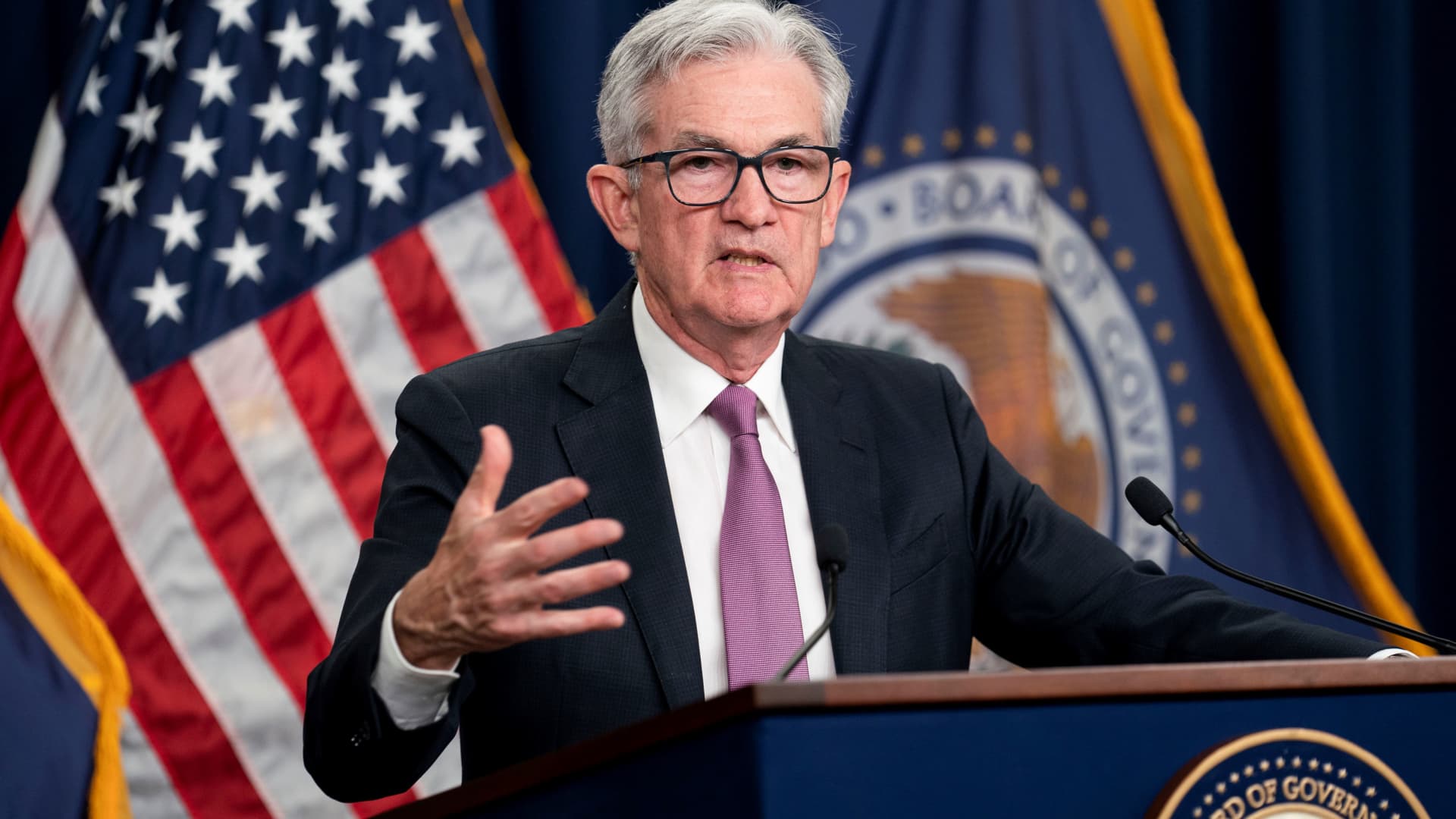
Fed raises rates by another three-quarters of a percentage point, pledges more hikes to fight inflation
The Federal Reserve concluded its two-day meeting Wednesday, with markets widely expecting a 0.75 percentage point interest rate increase.
CNBC
119 points · by donsupreme · 4y ago · 185 comments
That earlier speech was far more direct and succinct than usual. Market participants should have gotten the same message then as they are now. The Fed intents to break inflation, with all the likely consequences that brings.
Whether the Fed actually has the technical tools to do this is another question. Most of what it does is mass psychology - trying to convince the markets of its resolve one way or another. Bank reserves haven't mattered for years as money, but that's pretty much the only lever the Fed holds. It holds another - margin stock trading requirements, but that path has all but been forsaken. Treasuries are the fuel for the financial system. But to the US Treasury, they're just a mechanism to fund the deficit. The contrast has led to some things that are hard to explain otherwise, and more things like this will no doubt arise in the future.
its unlikely the fed is reactive enough in the short term to have any real effect on inflation presuming its tooling is effective. the interest rate hike took six months to implement, and began with a quarter of one percent increase. this was before earnings reports for the prior christmas holiday but november itself was a sobering enough red flag that Powell should have immediately pushed for 1% or more. its taken us nearly a year to arrive at the 3% we're at now, but in my opinion this inflation wont stop for another year, and it wont stop even at clinton-era interest rates of almost 6%. Quantitative easing --and the feds decade long addiction to it-- make this thoroughly uncharted territory. the interest rate push will likely be the straw that breaks corporate real estate, no matter how hard Bloomberg pounds his fists and demands a return to cubicles in his newspaper. this will likely tumble back into another residential housing or auto lending crisis. The student loan forgiveness push and reforms on wage garnishment also send a clear signal that our nations 1.73 trillion dollar nickelodeon of perpetual youth debt is becoming a serious threat as well.
Against this backdrop California plans on distributing $9.5B to any family who makes under a certain amount of money($1k each), I expect this huge infusion of cash to make inflation even worse and I do not know where this will go except that it will not be pretty.
The evidence for supply chain issues - as you mention - and price gouging being contributory causes is much more convincing. If you are not convinced that price gouging is going on, consider profit levels in energy companies in recent months.
Please don't blame this on workers who if anything need to be paid more, and paying them more will not impact inflation, only make it easier to cope with. It may even bring inflation down if jobs in supply chains become more attractive and force profiteers to become more competitive.
When poor people get even the smallest bit ahead, “they are getting scattershot handouts”.
You are talking about families earning less than 2k/month. In California. I honestly doubt that can cover transportation expenses alone in SF.
9.5bn was what Wework was “worth”. Some poor people getting slightly ahead is not the problem.
If a bank trusts a company that they can repay a loan, they'll extend the loan. But if there's a credibility problem, they won't. At the margin, when interest rates go up some companies will cease to be profitable. Banks know intimately how profitable their borrowers are. Even if they have doubts, the income statements will show. So, when the times comes to refinance the loan, the rate may be increased, or the credit line decreased, or new covenants may be put in place, or some collateral required, or various combinations of these.
Corporations (and especially those rated "high yield", or non-investment grade) will see a double-whammy: not only interest rates will have gone up significantly (by 4% early next year), but also their credit spread will go up (see [1], on average it has gone from 3% at the beginning of 2022 to 5% now, and it will keep going up).
That creates the start of a feedback loop: with the increased burden of servicing debt, companies will become less profitable, some will start cutting headcount (just look at the HN posts lately and see how often layoffs are mentioned).
Of course, there's the other feedback loop: higher interest rates means higher discounting of future corporate dividends, dividends which will be smaller anyway, so that means lower stock prices. People will see their savings taking a hit.
And then, a combination of lower savings and higher job uncertainty will lead to lower consumer spending. Or demand destruction.
Which is what the Fed wants.
Make no mistake: the Fed is still the most powerful actor in the financial markets. By far. It has all the tools needed to fight the inflation, and then some.
Who else can buy up trillions of t-bills and mortgages at a moments notice? When they do this, it drops rates. The Fed offered up historically cheap money to borrowers to keep the economy rolling during the pandemic and housing crisis.
> But to the US Treasury, they're just a mechanism to fund the deficit.
The deficit doesn't get funded as well when the Fed is not buying. It's not merely a technicality. Someone else will have to fill the hole left behind by the Fed leaving the market, and that usually means higher rates to draw in money from elsewhere to feed the t-bill and mortgage market.
And this is why they aren't raising it more. If they do, and that doesn't work, people will act like the train conductor broke off the handle.
Short term interest rates being higher means that loans which roll over and refi on a scheduled basis (ARMs being one example) will have their interest payments move much higher. That will create delinquencies and stress in the financial markets eventually, but it will take some time for those loans to wind up getting refinanced at higher rates and for the loans to go delinquent. Watch for CMBS delinquencies to start climbing.
When the Fed says that they need to hold rates through 2023 and not cut people should also believe them. That's how they force the weak hands to capitulate and be liquidated. Everyone will naturally try to kick their cans down the road as long as they can, so it won't happen overnight.
The used auto market has been hot the last couple years, so it’s hard to predict what happens. But since most consumers buy based on the monthly payment, higher rates mean smaller, less luxurious car, which has implications for the profitability of auto manufacturers.
Also, some consumers have been using their homes as piggy banks, refinancing each time the value increases. When happens to consumer spending when they can’t do that?
I didn’t know this, could you explain when it’s last been used, if ever? Could they theoretically drastically raise margin requirements for some stocks and lower it for others to encourage sectors to be rebalanced?
>The recent rise in margin credit has focused attention on the Federal Reserve’s margin requirements for purchasing equities with borrowed funds, which has been at 50% since 1974. In November and December of 1999, margin credit grew very rapidly, outpacing the sizable appreciation in the overall stock market. And in January 2000, it grew further while the stock market’s valuation dropped, leaving the ratio of margin credit to market capitalization at its highest level in the past 29 years. This Economic Letter discusses the recent trend in margin credit and the merits of using margin requirements as a policy tool.
> ...
> The Securities Exchange Act of 1934 mandated federal regulation of purchasing securities on margin. The margin requirement was motivated by the concern that credit-financed securities speculation helped fuel the run-up in stock prices prior to the stock market crash of 1929. The act viewed the Federal Reserve as responsible for managing the availability of credit in the economy, so the Fed was charged with setting margin requirements for securities purchases. The Securities Exchange Commission was directed to enforce those regulations.
https://www.frbsf.org/economic-research/publications/economi...
According to Wikipedia, the rate hasn't been changed since the 1970s:
> Regulation T governs the extension of credit by securities brokers and dealers in the United States.[1] Its best-known function is the control of margin requirements for stocks bought on margin. The initial margin requirement for such margin stock purchases has been 50%[2] since 1974,[3] but Regulation T gives the Federal Reserve the authority to change this percentage. Raising the margin requirement ostensibly reduces risk in the financial system by reducing the potential leverage and total buying power of investors. Conversely, lowering the margin requirement increases systemic risk by expanding the buying power and leverage available to investors. Since 1974, the Federal Reserve has not deemed it necessary to adjust the margin requirement despite periodic extremes of price volatility in the equities markets.[4]
https://en.wikipedia.org/wiki/Regulation_T
Given the absolute neglect of the mandate it was given on this, I suspect the Fed views even mere talk of increasing margin rates as the nuclear option. But if the usual roll call of psyops fail to deliver, this thing is there in its back pocket. I imagine the mere threat would cut 20% off the S&P overnight.
The FED can make they matter again with a pen strike. It doesn't matter because they don't want it to matter.
Inflation isn't the result of mass psychology. It's the result of too much money sloshing around in the economy, thanks to trillions in deficit spending.
BTW, you cannot imagine yourself into having more money.
Or it's because of oil suddenly getting expensive:
This will make you less likely to want the new expensive Iphone, especially if you were going to finance the purchase, so as Iphone sales plumit, there will be less of a chip shortage since supply now meets demand.
Why would they start QE? Fed rate is at 4% right now, there's more than enough room to drop rates if an issue occurs.
Given the data however, its unlikely to happen. We're currently at record employment levels. The expectation is for the rate to keep going up to maybe 4.5% next year, and finally that's when inflation is quelled, and we taper off rates sometime next year.
Of course, we need to keep up with economic data and see if these rate hikes have the desired effects.
A recession will occur if they overshoot, however.
When you choose to get a loan you're pumping a few hundred thousand that was leveraged into existence into multiple industries that gets distributed into the economy, that gets distributed to hundreds of people working.
When you choose just to just buy an iphone, that's $1000ish your spending of your own money.
This reminds me a lot of the 2008 crisis when Bernanke told us that everything was just fine until banks started collapsing. Personally I think the Fed has turned into a political institution that keeps inflating bubbles until there is no way out. I can't see much wisdom or foresight in their moves. They seem constantly behind the curve and instead of smoothing out business cycles they make them more extreme.
Please someone tell me why this is incorrect.
Calling "inflation" for 10 years in a row is basically boy-who-cried wolf. No one believes you, and when you're finally "correct" about it, its not because you had any analysis, its because inflation inevitably occurs in a boom/bust cycle.
Broken clock correct twice a day + Boy who cried wolf syndrome. I still won't be listening to the permabears / runaway inflation guys even with today's market conditions.
[1] https://economics.stackexchange.com/questions/15558/producti...
I am not actually disagreeing with your point. I am just saying 10 out of your 10 most recent comments lack any external links or analysis, and 5 out of 10 comments are low value (IMHO) one-liners...
Disclaimer: I admit I am completely ignorant of macro-economics (even though I helped create and develop a sizeable business that mostly depended on macro-economics!)
[1] https://harrison.totty.dev/p/a-lang-design-analysis-of-holyc — I wished he had called it VitaminC - and some of his comments: https://news.ycombinator.com/threads?id=TerryADavis
For example, the inflation in the US gold currency during the California and Yukon gold rushes.
"Because precious metals were at the base of the monetary system, rushes increased the money supply which resulted in inflation. Soaring gold output from the California and Australia gold rushes is linked with a thirty percent increase in wholesale prices between 1850 and 1855."
https://eh.net/encyclopedia/california-gold-rush/
How about the inflation in Spain due to the influx of gold from the New World:
"These immediate consequences include the price inflation caused by more gold and silver"
https://theclassicjournal.uga.edu/index.php/2020/05/07/spain...
None of this stuff is hard to find. There's no difference in inflation from a flood of gold entering circulation from a flood of fiat money helicoptered into the economy.
https://www.amazon.com/Monetary-History-United-States-1867-1...
Unfortunately, it's a bit of a tough slog, it's not written for the popular press. But it's worth it if you're really interested in understanding what's really going on.
The USA is in recession: https://tradingeconomics.com/united-states/gdp-growth
Inflation is getting better? Relatively speaking? https://tradingeconomics.com/united-states/inflation-cpi
Probably about 1.5-2 years before inflation is controlled again.
Debt to GDP is getting worse and is beyond the limit: https://tradingeconomics.com/united-states/government-debt-t...
They did stop the unfunded deficit spending, obviously still deficit spending: https://tradingeconomics.com/united-states/money-supply-m2
Incidentally it looks like they have decided not to reduce and simply flatten. So it'll likely push closer to 4 years of inflation? Well no, an election will arrive before that.
Private debt climbing: https://tradingeconomics.com/united-states/private-debt-to-g...
So yes, pretty much we know what will happen for the next few years.
Why do they have to care about the consequences? Corporations have the market. Persons have their families, lives etc... Why do elected government officials need to care; especially in this polarized, 2 party, ~~world~~ country.
I'm pretty sure the closest thing we have to accountability in government are blue checkmarks twitter dunking on politicians from the opposite party and then being ignored by all the followers of that party.
You know after consideration I'll only borrow $50,000.00.
Off to tell the wife I've saved us $50,000.00.
Someday, maybe we, as a society, will realize that debt, credit, and lending is the way bankers scam money out of everyone else, and we collectively won't put up with it anymore. Banks often have some of the biggest and shiniest towers in downtowns all around the world. How did they get them? Interest, fees, and charges. I can't count how many times people (even on this very site!) have said something like "don't buy things with cash, invest it and get a loan for it instead because interest." It's no mystery as to why you don't have a tower, because you're paying for someone else's.
Normal people figured this out such a long time ago, that a verse in the Bible says that the borrower is slave to the lender. I'm no slave.
And don't be fooled by the cash and airline miles that your credit card throws at you. You're paying for those "rewards" by fees that the banks and networks charge merchants, and they're ultimately built into increased prices that everyone pays. No one got rich from those crumbs, except the bankers.
Without debt, economic growth nearly zero sum. Waiting for the money to exist and then spending it is just slow and inefficient most of the time. Show me a country that is under-banked and has little access to loans and I will show you a poor country.
If, and when the system collapses, who cares? Advancements gained through technology will be with us.
All economies are run on debt [0]
[0] https://en.wikipedia.org/wiki/Debt:_The_First_5000_Years
It's no utopia, but it works well enough.
Taking on debt to pay your daily living expenses is a recipe for disaster - and that is what the US govt. has been doing (and many individuals as well)
I don't like debt, and it has truly gotten crazy, but I don't know a way around debt.
Its much worse than that. Without a 'gold standard' or really any standard. Money = debt.
For anyone to have any money, others have to have debt. For 50 million retirees to have millions of $ means there is more than that of people in debt.
For a politician to 'forgive debt' means the value must come from someone else, primarily retirees.
>Someday, maybe we, as a society, will realize that debt, credit, and lending is the way bankers scam money out of everyone else, and we collectively won't put up with it anymore.
That's kind of the problem. Lets say we won't put up with it anymore. It ends. No more debt akin to many other empires in antiquity. How do we go about it? Mainly you want to adjust the fractional bank ratio and reserves. Currently 13% or so depending on lots of factors.
So has anyone tried this? Moldova post-USSR has been trying this. It basically destroyed their economy. They never got there, they were close to 2:1 which is crazy good but it ended up just stagnating and wrecking them. Yes lots of confounders here but imagine you can't take on debt. You never have a mortgage. You must buy cash. Guess you're starting to work very early to save enough money to move out of your parents home? homes wont be a good bet neither, without mortgages. Safe investments in retirement funds have to be attracted elsewhere. House prices will be constantly pressured downward but suppliers and construction people want to get paid.
>How did they get them? Interest, fees, and charges. I can't count how many times people (even on this very site!) have said something like "don't buy things with cash, invest it and get a loan for it instead because interest." It's no mystery as to why you don't have a tower, because you're paying for someone else's.
They take their cut of the transaction and take no risks or liabilities on. Smart business.
>Normal people figured this out such a long time ago, that a verse in the Bible says that the borrower is slave to the lender. I'm no slave.
Without debt though, how do you live in a house? You rent? Rent is about the same price as the mortgage. You're paying someone else tower as it were. You should virtually never rent.
It's interesting how the whole system is designed around debt and yet there's only 1 proposed system that might fix this.
Social credit. https://en.wikipedia.org/wiki/Social_credit
Islamic finance is the solution to a balanced and fair economy.
1. It prohibit interest to outlaw debt based exploitation and instead replaces it with loans of generosity (pay back exact amount, no interest ) or fund raising through investment. Whereby the risk of the person receiving investment is shared with the lender. This is in contrast with a conventional loan where if your property or business burns down, you still have to pay off the loan to the bank.
2. Zakat - a wealth tax on every Muslim. The value of 2.5% of cash, stocks, investment each year is given to the most needy of society.
Implement these systems and you will have a just economy that prevents hoarding and exploitation. Literally money is forced to move down societal class and acquiring more wealth is with increased risk. Islamic finance is the solution.
Is this not already the case?
> This is in contrast with a conventional loan where if your property or business burns down, you still have to pay off the loan to the bank.
Isn’t this what insurance is for?
Interest seems like it can be both good and bad. Condemning it completely seems a bit harsh
Inflation is considered bad because it affects everyone, though the poorer you are the more it affects you.
Job losses affect those who lose their jobs and indirectly the economy due to less spending. Inflation affects everyone and run away inflation is one of the worst thing a country can experience.
Job losses affect the entire economy: the rich don't care since they do not rely employment and wages.
In contrast the wealthy are hit enormously by inflation as they start losing in real terms.
The fed prioritizing inflation over unemployment is a massive hit to the working classes. Doesn't matter if eggs only increased by 2% if you lost your home because there are no more jobs.
We only saw high inflation after a year of worldwide Covid insanity, driven by cheap and abundant liquidity coupled with peak globalism (that is now in decline on an absolute basis, exacerbated by the Russia sanctions) coupled with global supply chain & labor shortages (some of which is generational demographics catching up to us)
Source, I lived through high/hyper inflation and was educated on this topic by rich people there.
I’ll link when I do but basically for the past 8 months he’s been explicitly saying he wants to get unemployment up, that he doesn’t mind risking the labor market in his efforts of “demand destruction”, never seen an appointed official say this before so he’s going hard
Here is him being a little tame to Congress https://www.cnn.com/2022/06/23/economy/fed-jerome-powell-hou...
but he has some speeches where he’s basically like “we’re going to raise unemployment” not “could”, not a “maybe a soft landing is possible but here are the risks”, just pain
https://www.bloomberg.com/news/articles/2022-08-26/read-fed-...
"Restoring price stability will take some time and requires using our tools forcefully to bring demand and supply into better balance. Reducing inflation is likely to require a sustained period of below-trend growth. Moreover, there will very likely be some softening of labor market conditions. While higher interest rates, slower growth, and softer labor market conditions will bring down inflation, they will also bring some pain to households and businesses."
"The labor market is particularly strong, but it is clearly out of balance, with demand for workers substantially exceeding the supply of available workers."
He is deliberately engineering a recession to reduce aggregate demand. With luck, the recession will be soft. The goals are reducing labour cost inflation via reduced hiring and increased layoffs, which then leads to reduced consumer price inflation via reduced consumer spending due to budget constraints and negative sentiment. Standard macro 102.
I'm sure if he could increase labour supply via monetary policy, he would. But he can't, so reducing labour demand is the plan.
In a way it kind of looks to me like we have reached peak population, at least in the US. Every generation hereafter will have a workforce equal or less than the current in size. That is, unless birth rates change or immigration is allowed on a larger scale.
People have been increasingly concerned about the impacts of quantitate easing long before 2020. The only people that thought things looked okay in 2021 are people who didn't want to pay attention to the Everything bubble [0] we were (and still very much are) in because they were too busy making money.
Things were "mostly" priced in yesterday, or really last Tuesday when CPI / inflation numbers came out. They basically confirmed .75% because if core-inflation was still a problem, then rates have to go up to fix that.
Then lets look further at how people that have mortgages and build home equity make money: they need 5-30 years of zero disruption in their income, whatever employs the majority of them needs to feel cash strapped and unoptomistic so then the people with mortgages get blown tf out too, within a year
We’re inching up
Overleveraged investments go bye bye
Here's the thing though - none of those ways works. The way that works isn't politically tricky it's politically toxic. Raising interest rates works. It will ultimately piss off just about everyone but if you really want to cut inflation it's the only way to do it everything else is just politicians doing politics.
People aren't really "employed" (in a gainful sense) if the money printer keeps printing. Achieving the lowest possible unemployment results in rising inflation because the necessary availability of surplus capital to allow such a thing to happen.
At any rate, 0.75% won't work. The rate changes need to be more aggressive if the goal is to actually avoid a 2023/2024 catastrophe. It takes upwards of 10 years for inflation to cool off after the process of reducing it begins. We're in for a long ride.