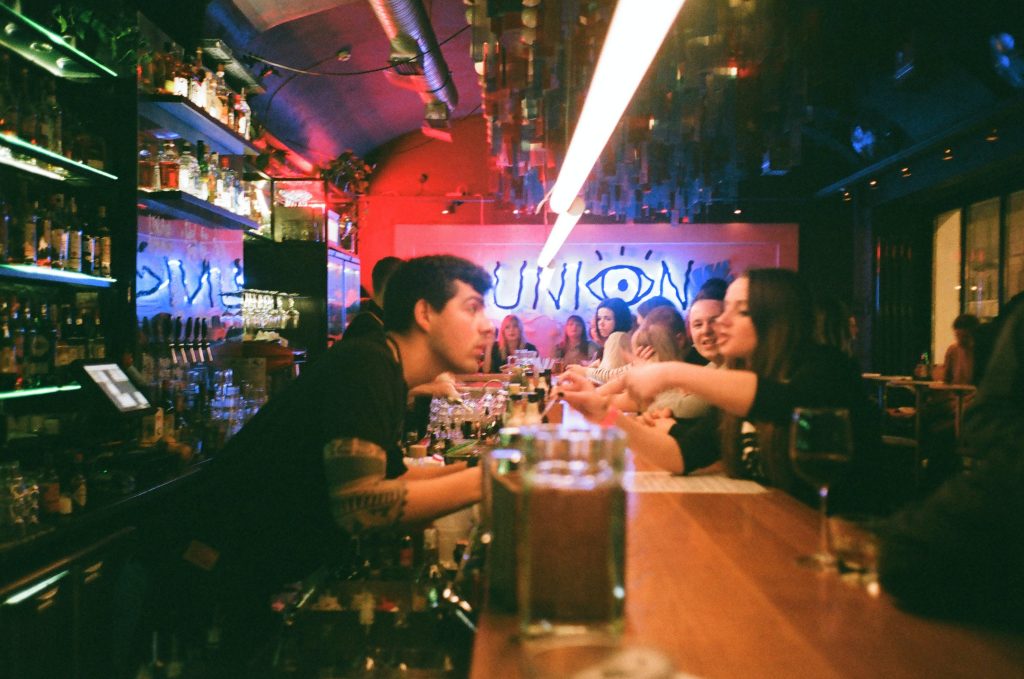
Bartending Tips For Beginners
Being new at bartending can be a scary time. But here are some bartending tips for beginners to help you get started on your way to a profitable career
Bartending License Help
136 points · by mmh0000 · 4y ago · 54 comments
Is that true? I thought it was mead, and a brief search suggests mead does still have a greater claim to that title.
Some references call mead 'honey wine', but to me that feels like like calling vodka 'potato whiskey'.
I accept the same yeasts can be used for wine and mead, but a) we don't know what yeasts they were using millenia ago, and anyway, b) yeasts will certainly influence the flavours, but generally don't determine the name of, the end product.
For example, some historically champagne-only yeasts are a relatively recent favourite for beer makers.
Deliberate - and particularly large scale - production by humans is a more interesting question, of course.
I'd suggest that from a purely evolutionary perspective, honey bees predate grapes, and wild yeasts would certainly have turned an abandoned bee nest into an ad hoc mini-bar on more than one occasion during pre-modern history, but I feel I'm now veering way off from my challenge to that original claim.
If there is no one there to drink it, then it is not drinkable. A beverage requires both a liquid and a drinker to make it drink-able.
My takeaway is drink whatever you enjoy and ignore the price, the label, and the snobs.
1. https://www.theguardian.com/lifeandstyle/2013/jun/23/wine-ta...
My suggestion is go and participate in a blind tasting with an actual expert (a MW or Master Somm), and draw your own conclusions about whether it is a parlor trick or not.
Everyone sits at communal tables, so you get to chat to everyone around you. There was a guy at our table who worked in the Spanish wine industry - I can't recall if he was a sommelier or waiter, but his knowledge of wine was clearly much better than anyone else at the table. When they served the wines with the different courses they didn't tell us anything about them. No-one at the table, including him, did better than chance at even just guessing whether the wines were red or white. It's possible they deliberately chose ambiguous wines to make it more difficult, but it was really amazing how hard it was to tell what you were eating or drinking when you couldn't see it.
I didn't draw conclusions about whether anything was a parlour trick, but it was an illuminating illustration of how much we kid ourselves if we think our senses are really communicating accurately with us.
I suspect your acquaintance may have been in the former camp.
1) "I can identify from the wines you have previously liked that you are likely to like this particular wine that I have personally tasted."
If you find someone good, this is generally not bullshit. They are incredibly useful. And they will probably like you very much if you just be very honest about what you like.
Sadly, only two wine buyers I have ever known who were this good.
This is like having a friend who has a house full of CDs or records that he listens to all the time. If you tell him "I like X, Y and Z" he can tell you "You will almost certainly like Q, and you should take a flyer and give V a try even though you might not like them."
2) "If you give me a food, I can pair wines with it that will complement the flavors".
Really good sommeliers can do this and it is not bullshit. This is the first category with a lot of experience tasting foods and wines together.
And, like all humans, sometimes they get it wrong.
My most fascinating conversations with sommeliers have been when I didn't like a pairing, and I made polite comments about it (for example: "I liked the pairings of the first and third courses, but the second course wine, which was fine by itself, really wasn't to my taste with the food. My wife liked the second and third pairings, but wasn't a fan of the first."). Be forewarned: if the sommelier has the time and latitude, you are likely to get interrogated if you show some interest. CAUTION: You may also wind up drinking far more wine than you expect.
3) "I can identify a Chateau Lafite Rothschild 2010 Pauillac Premier Grand Cru Classe from a glass."
This is where the giant heaping mounds of bullshit enter. Unless a wine has a very unique flavor profile that makes it stick out from wines in general, they're not going to be very distinguishable from other similar wines of similar class.
And, you know what, it doesn't matter. Your palate may not even like that very expensive bottle of wine. So be it.
At the end of it all: drink some wine you are likely to enjoy. Most of the time it will be pleasant. Sometimes it will be a miss. Now and then it will be superb. Relish the moment.
On the other hand, they will be able to taste a wine blind and list out its objective qualities such as acidity, tannins, alcohol level, aromatic markers, etc. These will generally be quite accurate. From these one can deduce varietal, approximate age, quality level, region, etc. Naming the specific vintage or appellation is doable, but requires a lot of knowledge of vintages worldwide and a lot of guesswork. Anything beyond that is probably bullshit as you say.
*all prices US and may vary by your specific location and wine shop.
Of course the vast majority of wine drinkers just guzzle the bottle as soon as they come home from the store, so I can see why one might come to the conclusion that wine $40+ isn’t worth the price.
Body = thickness, aka mouthfeel, aka strength of flavor and texture. (I’m simplifying here.)
Mature = complex. Simple wines that can be opened while young are usually straightforward in the same way that soda is sweet.
We are trying to describe a wine but we don't have words that really fit these particular senses. So we develop a jargon that is at least largely consistent across the ecosystem so when somebody describes a wine as "high minerality" you understand if you've tasted other wines also described this way. The fact that a wine isn't actually "dry" in a literal sense (it is almost entirely water, after all) doesn't matter once you've got a bit of experience matching the jargon to prior experiences.
Next time somebody tells you a wine is "high tannin" or "fruit-forward" or "thin", ask what dimension they are talking about here and try to remember it. Next time somebody says this you'll be able to predict what the wine will be like or you'll know to ask a professional for wines that match the particular things you like.
But there are totally resources. If you want to go in deep, I suggest https://www.thegreatcourses.com/courses/the-everyday-guide-t...
I always thought it was all pretentious claptrap, until a bar owner gave me a glass of 'wine from where I'm from". Wow! My description? "Dry, full-bodied, heavy", then, there where the _several aftertastes is how I'd describe it, and i later bought several bottles. As a dark-beer drinker i was knocked out by this stuff, and did (finally) understand how some descriptions can be applied. I've tried a few different wines in a few different bars since, and the vast majority have been a very easy "light, fruity....and shite".
1. If you see it in your local liquor or grocery store, it's mass-produced so it's probably crap
2. If it's <$20, it's probably crap
3. If it's less than 2 years old, it's probably crap (or needs time to mature)
4. If the label looks flashy, comical, amusing, or otherwise overly graphic, it's probably crap
5. Try lots of wine. Make a spreadsheet. Narrow down what kinds of wine you like over time.
6. Pick the grape you like.
Reds: Merlot has a lot of body and alcohol. Cabernet Saugivnion is similar but more tannins. Both of them are mass-produced and often cheap and crappy, but can also be great. Zinfandel has a lot of body, is jammy with black fruit flavors. Pinot Noir is a lighter red with fewer tannins, but flavor and body can vary greatly. Syrah/Shiraz are full-bodied tannic reds. Grenache are a little sweeter and less acidic, when younger is more fruity, when older is richer-flavored. Gamay is medium-body, low-tannin, fruity. Tempranillo is medium-bodied high-alcohol. Nebbiolo is full-bodied, high-tannin, fruity/flowery & sometimes savory. Sangiovese is full-bodied, high-tannin, acidic, ages well. Pinotage is like a Pinot Noir left in a locker room. Carmenere is high-alcohol, high-tannin, spicy. Malbec is spicy & savory, and a majority of women tend to like it in my experience.
Whites: Chardonnay is middle-of-the-road, and can either be super oaky or have no oak. Sauvignon Blanc is lighter and more fragrant, high-acid; Loire Valley and Napa Valley make good examples. Riesling and Gewurztraminer make dessert wines. Pinot Grigio has medium body and acidity, can sometimes taste like slightly acidic water. Verdicchio has high acid and citric flavors, can taste cheap. Chenin Blanc can be medium-body and slightly sweet and sometimes makes up cheap wines. Viognier are floral, high-acid, high-alcohol. Albarino is medium-body with fruit flavors but can be very bitter. Torrontes makes medium-body, high-alcohol, floral wines.
7. Sign up for a wine delivery thing with whatever coupons you can. Select wines based on flavors you like. Cancel it, then take their generous offers of discounts to order again. And again. And again.
8. If a wine nerd is excited about it, it might not be crap, but you'll probably hate it
9. If you try a wine and really like it, ignore everything above, buy lots of it.
100% disagree. The world is full of sub $20 wines that are fantastic and can easily stand up to wines costing twice as much. Exploring the 'unpopular' corners of the wine world is wonderful way of unearthing real bargains.
4. If the label looks flashy, comical, amusing, or otherwise overly graphic, it's probably crap
While this used to be true, younger wine makers are much more playful and creative when it comes to their wine labels and lots of their top wines often have fun labels
Riesling and Gewurztraminer make dessert wines.
This is a very US-centric view of these grapes. A dry Alsace or Mosel Riesling is in no way a desert wine.
You don't have to be a wine snob to realize this is false. If the world's so full of fantastic cheap wine, it should be easy to find it. But try most of the bottles sub-$20 in most of the USA and they will be crap.
Moreover, if you are a winemaker and you know you have a flavor bomb on your hands, why would you only charge $15 for it when you can charge $25? These are businesspeople, not idiots or philanthropists.
Wine is sold on so much more than just 'flavor'. 'Brand' identity is a huge part of pricing. A pinot noir from Burgundy will cost more than an equally good pinot noir from, for example, Austria, simply because "Burgundy" is a much stronger brand that you have to pay a premium for. An importer trying to introduce Slovenian wines into a new market will have to offer the wines at a discount as it where, because it's a new brand that people are sceptical about.
Another factor is that there is no universal taste. A wine can be well made and taste really great to you, but have taste profile that is 'unpopular' in your market.
All wine is mass produced. The only non mass produced wine you’ll ever find is hobbyists doing fermentations at home in the tens of liters, and while that’s a romantic concept those are surely all actual crap, or at best reach the level of “you know this doesn’t competely such, I can’t believe you made this yourself”
Every step from pruning, fertilizing, harvesting to vinification and bottling is manual labour. This winemaker is doing this full time for an actual living, not as a hobby, mind you, and you very much can buy this wine from her. You won't these bottles in your supermarket of course, as it is mostly sold directly to customers who visit or via mail order. I wouldn't exactly call these wines mass produced. Still these small batch Chasselas, Pinot Gris and Pinot Noirs won't break the bank, as they are going between 15 and 22 Swiss francs (1CHF = 1USD at the moment) a bottle.
If you let must macerate without removing the pomace the red color and a lot of tannins will transfer over and you get red wine.
As you usually don’t want a lot of tannins in white wine you separate the pomace from the must as well, even if you use white grapes (but of course you could let it macerate on the skins, but then you end up with orange wine).
White wine made from white grapes without maceration on the skins is called blanc de blancs.
Do remember that it's a spectrum; winemakers can still have some degree of skin contact in a white wine, so it could also fall outside either of the two categories.
Apparently it's traditional in Georgia (the country, not the US state) and that's also cool because I otherwise never get to interact with anything from that part of the world.
I don't know why the article would say it never happens, but it's not usual.