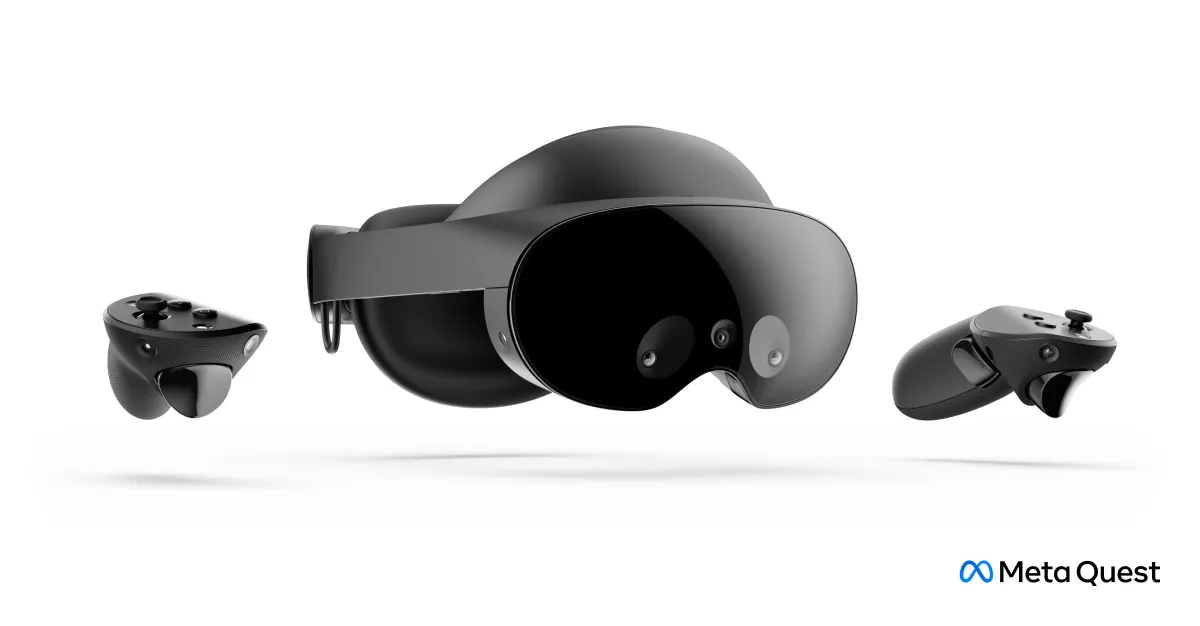
Meta Quest Pro: Premium Mixed Reality Headset
Shop the Meta Quest Pro - our most advanced VR headset. Connect and collaborate in mixed reality like never before with our reimagined VR headset made for long lasting comfort.
Meta
639 points · by mfiguiere · 4y ago · 1068 comments
Also what I really don't understand is how anyone can have anything against them spending $$$ on R&D? Worst case scenario: their whole productivity angle doesn't work out, they lose billions upon billions in the coming decade and eventually scrap the whole thing. Then they've still invented a lot of super interesting tech along the way. High resolution displays, low latency rendering pipelines, novel human interface technologies, high fidelity hand tracking, lightweight and sharp lenses, the list goes on and on. There's lots of applications for each of those things and almost nobody else is willing to spend this much cash for such an uncertain roi. I, for one, am super excited about what the future iterations of this will look like.
Look at the history of it’s core product to see where VR will go if it takes off:
Facebook was the cool place for college students to connect with friends. No ID requirements to sign up and no ads for years. Your feed was just your friends post. Things were great. Now there’s ads in your feed and you need to definitively prove your identity. Not to mention the history of scandals and privacy violations.
They’ll do whatever it takes to get those first 100 million users. Once they get them though all bets are off. Privacy will only get worse, they’ll give up on the initial power users because who cares about a couple million hard core gamers?
Only nobody cared because that was the time prior to the latest privacy awakening, and apparently we still have a hard time putting it in the right context. If the best thing you can say about a company is that it was not big and nobody cared about their (what are now considered) atrocities back when, then you should probably reconsider your evaluation.
How in the world did you come to that conclusion? Any Meta app you have on your smartphone is doing what they can to collect heuristics in order to identify you and serve you Ads. How is that any different? It's just not as obvious.
> Only nobody cared because that was the time prior to the latest privacy awakening [...]
You make it sound like it's a fad or the user simply didn't care in the 2000s. Just because you can doesn't mean you should. If a private company would park a van in front of your door to observe you 24/7 in order to sell mundane details about your daily life to advertisers you'd be up in arms. Yet in the digital space it's no big deal.
Apple is building its own VR headset and making money off VR hardware seems like a stretch.
Dont both Android and iOS devices do this?
So if someone wants to hate Facebook, if they have principled position, I respect that. But that's hardly ever the case in my experience online and offline.
I am not a fan of most social media companies, but I love the tech scene, and the progress Meta is making in this field. Should be universally applauded even by the harshest critics of Facebook.
No company sliding down so much has received much love. Not sure what is there to not understand. Oh yes and owner is clearly an amoral person with strong sociopathic traits hellbent on making humanity worse off long term, not unique but the same applies and compounds.
No amount of self-serving VR progression or some open source libs can anyhow annulate that. Morals is something a lot of people value, and lack of it gets appropriate reactions.
Now that the tech is actually nice enough that it is usable and sometimes even actually better for certain things folks are just jumping on the hate fb bandwagon.
You’re absolutely right that most people here haven’t even tried some of this stuff. Personally I never gave VR a thought myself but my brother wanted a quest so I bought one, now I have my own and am looking forward to trying what’s next.
On that note, I understand why people dislike meta even if they’re making really cool stuff, but people have to realize that Meta isn’t the only VR company. I have a feeling that only Apple can change the popular perception of VR
But the closed environments are just majorly repellant. I had an older headset (rift s) and suddenly needed to create a facebook account. Should have bought the more expensive Steam version. But I don't see how VR can really reach the masses. You need the extra funds and a decent system and 2D monitor is the more sensible investment.
I will never buy an Occulus device again of course. There were management decisions anyone who really likes technology and wants to dabble with it will very likely and understandably hate with a burning passion. A passion sourced in the love for technology and the ability to share it. And they knew that people would dislike it, just hoped they would comply in switching to their Facebook platform.
This is 100% on Facebook and to 0% on grumpy users. Not being grumpy is pretty naive in my opinion.
But a lot of HN users are old enough to remember Meta's (Facebook) catastrophic privacy issues and know better than to let Meta into a huge portion of our life such as work infrastructure.
Meanwhile FB provides free services to two billion people and get to be the scapegoat for NYT and Apple. Yes, they sell adds--just like the entire media landscape going back hundreds of years.
No, its purely FB, clearly long-term amoral company, that gets all the (well deserved) hate. I stand behind the statement that humankind is worse-off long-term with FB existing and trying to get into all aspects of our existence to sell more ads.
I wouldn't care about it at all if US had good regulators re privacy and other aspects of these sneaky corporations. But it clearly doesn't, cash flow is the king, hence one should be reasonably warry of such behavior, with company wielding so much power.
The above more or less applies also to ie Google and Apple, but based on behavior FB is in its own category.
I'd rather back another horse for $1500. And as a consumer base, none of us are obliged to be fangirls for Meta given their track record.
https://www.youtube.com/watch?v=WO91n5phQQY
It's a pretty good title! It's a better VR game than most actual VR games. The control scheme has some interesting motion sword and gunplay. Plus you can turn and dash without getting motion sick because its on a tv. Look at the fighting gameplay. See how much better it is than Half Life Alyx and Boneworks?
But, the immersive quality of red steel 2 fades pretty quickly. As does Alyx and boneworks. Because... it sucks. VR asks you to believe you're in a world, like in ready player one. But you're not. None of the little things are there. It's just a camera on your face with better wii wands.
Having understood this, it's pretty clear that the best possible resolution headset will not fundamentally change the VR experience. Maybe text will be easily readable. That would be nice. But the experience Meta wants you to believe you'll have won't be coming any time soon.
There was still reason to be excited and hopeful about the future of VR.
I'll wait to get excited if the Index is updated. And until then I'll keep using my low res low FOV first gen Vive. Exclusively to hit boxes.
You make it sound like it is all gated behind an app store now somehow. Which is not the case at all.
On my quest 2 headset, I can play games from oculus store, I can also play any steamvr/pcvr games on quest 2 (connected to the desktop PC by a cable or in wireless mode), as well as any user-built application .apk files dowloaded to my headset directly (either from the headset's web browser or transferred from PC). All on the official firmware, no jailbreaking or any special steps needed to make this work.
Not sure how this is even remotely representative of some app store gating.
1. I've been closely following VR for almost 10 years now
2. I've invested some money for the best VR hardware available (at the time).
My take on Facebook and why I am fully on board with the skepticism here:
- VR hardware, at least on the higher end, is pretty good. It has been "there" for many possible applications at least in terms of fidelity since ~2019. VR being so uninteresting is mostly a software problem in my opinion, not a hardware problem, even if the hardware development is important to make adoption more realistic without the need to invest a ton of money.
- The novelty of VR wears off rather quickly. I barely use my VR hardware nowadays, and right now I can't imagine a scenario in which VR makes anything in my everyday life easier and more efficient, quite the opposite. While I don't doubt that it will happen, I very much doubt that Facebook will be involved in the next important step forward. They are just too out of touch with reality (outside of the investor/silicon valley/zuckerberg bubble) for that.
- The software is just lacking, and everything Facebook is presenting when it comes to software is in many ways a step back compared to VR products from as early as 2014 (e.g. VR Chat)...Acting as if Facebook is pushing anything forward here is just naive following of buzzwords at best, dishonest parroting of marketing talk at worst.
- Anything a company like Facebook might plan with VR is just uninteresting, because it will ultimately have dark patterns, manipulation and monetization baked into its very core, be it directly or indirectly.
Rather than developing VR as a "next step" in personal computing, Facebook is just racing to build an ad infested dystopian walled garden as fast as they can, why would I get excited about that in the slightest?
I'm still generally very interested in VR, but the only thing I'll get excited about is VR device from a manufacturer that doesn't have backstabbing me as his ultimate goal and will base all his decisions on being Facebook.
And yes, I still remember "Oculus won't require a Facebook Sign-In", and while that has been reverted for now, I won't believe for a second that the people working at Facebook aren't eager to get something equivalent back as soon as enough users are on board.
We need more humanity, care for ourselves and others, more love and connection to humans and everything surrounding us, to experience what it means to be alive and being a part of the universe. This tech aims to isolate us even more than we already are, through its fundamental design. When you put human values above the maniacal quest of a boy billionaire for relevance and power, you come to the conclusion that this is the entirely wrong path.
The hardware is inconsequential.
The overall goal is the exact opposite of what you're saying here. Just about every single person I've ever talked to in this industry wants to build devices to bring human beings together across space + time. Allowing folks to see each other eye to eye and form real human connections where otherwise it would be impossible. XR is probably the least isolating technology in history if you consider what it can do in terms of breaking down boundaries of time, distance, ability, and appearance. It is the most humanistic of any technology I've ever used in my life, in the way that it's explicitly designed to bridge human, emotional connections where none could exist before. Just one of many perspectives...
This is admirable, but unless they also have some ideas about how to keep such a service running the funding model is going to default to advertising. And advertising has a corrosive impact on free-expression (can't allow anything untoward to happen next to an ad) and community (is this person being genuine or are they selling something?).
With internet revenue models being what they are, I don't see VR social experiences going in a good direction at the moment. Maybe if we had a good p2p technology for hosting/joining VR worlds so these things could be community-run there would be hope. But every popular VR application I know of is hopelessly centralized and subject to the same market forces that made social media such a mess.
I do see potential applications in fields like 3D-enhanced medical imaging, as highly specialized tools for professionals. But not as a general tool or device.
Long-term, I find it more likely that people who can escape into a convincing, curated reality, will do so with increasing frequency and in turn stop caring about their surroundings. Because we’re human primates and not responsible enough to deal with complex change like this yet.
You are working Ina capitalistic system, the only motive for your company is profit for shareholders. When you are small and inconsequential, other motives might rule. But the trajectory is clear. If you succeed, your company turn into a paper clip machine for which humans are just meat for the grinder. This is how it always plays out.
People have a visceral reaction to the implication that donning a computer on your head and interacting via Corporate Memphis styled cartoon avatars is any sort of future that we should seek. It's that simple.
That video of a woman sitting lifelessly at her table while her avatar engages in hearty expressive conversation puts a lump of discomfort in my throat. It's a repulsively dystopian outcome for social interaction, but Meta wants to sell it as a future we're missing out on.
People do not like that. I've followed VR since it's infancy, owned most of the major headsets, used it in an office environment, and I will say while VR is cool, the promise of the metaverse is deeply offensive to the senses of most people, myself included.
It wasn’t at all clear that he was muted and I was unmuted and his hands were moving disconcertingly near where his body should have been. I started describing him to someone irl and his weird avatar head turns slowly toward me, hands still pulsating.
I said something like “uh shit I think he can hear me…?” and his floating weird head glitchily nodded, fingers creeping across his torso the whole time.
I logged out. That was it. So many things wrong I’m not sure I could find any reason why I’d try that again.
I don't understand how you extrapolate that to the entirety of every possibility it will ever have to offer. Yes Zuckerberg's metaverse vision is weird and creepy. But the underlying tech that is being developed to enable it to exist is transformational. The use cases will develop from what suceeds and people actually like. You could just as easily have painted a dystopian picture of people staring blankly at their iPhones walking down the street instead of talking to the person next to them.
The theory: you could let you explore limitless worlds only bound by your imagination and current compute power.
Current meta vision: Horrible outdated corporate cartoon graphics so you can go to a bland sanitized online store to buy an NFT picture of some shoes, and look at a horrible cartoon representation of the Eiffel tower.
Meta should be classed as an enemy of humanity.
Like, at this price point, and with these features that isn’t it, but I can see it in a non-dystopian way.
It’s just that it’s Facebook providing the hardware that scares me.
This is the key part. VR somehow skipped right into "walled garden" and "platfrom" territory right off the bat. It's not just hardware that is interchangeable and multi-use with pluggable things and apps. I think a lot of the people weary of Facebook's VR headset would be put at ease to a large degree if this was an 100% open ecosystem where just one of Facebook's entities is providing the hardware.
> Putting on my VR headset to get in a meeting with the rest of my team does not sound nearly as unreasonable
... are a minority vastly overrepresented by the website we're on.
The company I worked at during the bulk of the pandemic let us all expense headsets to have meetings.
Getting into VR the first time is not a seamless experience in the slightest, so trying to get serious work done in meetings took weeks because of the mix of experience levels.
Then there was the fact that at the end of the day we live in a flat 2D world of software. Trying to hit touch targets meant for a mouse with a magic wand is maddening.
Then there's just the entire uncanniness of avatars that we're nowhere near solving. VR avatars are consistently forced to take on cartoonish proportions because we can't render convincing customizable human avatars on these headsets and won't be near that any time soon. Same goes with the backdrops, which end up being "infected" with the cartoonishness to avoid clashing.
-
But you know what the death knell was for our VR use? At the end of the day, even at its best, it was the same as starting Zoom.
For non-enthusiasts it needs to be stomping Zoom.
They don't want to strap a screen to their face just to do the stuff that they were doing by sitting in front of a laptop. At the end of the day, it was "ok enough", and that was precisely why it fizzled out. General apathy at the fact that, this was not an improvement of exactly what we had been doing for months before, was enough to get people suggesting zoom the moment an issue cropped up, and eventually we all just dropped the headsets.
A solution would be to give each employee a tiny office with a door and a lock, which wouldn't be a bad outcome of VR to be honest...
One of the big feature improvements on this unit is that those cameras area lot better.
Another feature is that the headset uses some kind of lidar to map out the space around you, so that even if you are in an immersive experience objects and people coming into the real world area you marked out will get overlayed into your virtual world, so you can see bob sneaking up behind you.
These headsets are pretty cool and the consumer one is pretty cheap. Well worth getting one even if you are intending to sell it on after experimenting.
But I'm all out when it comes to Meta and Facebook, who have repeatedly proven they are simply a bad actor. The gross privacy negligence, the disgusting mistreatment of their users and advertisers alike, and being a major factor in today's terrible social issues, Meta is a huge net negative for humanity.
They can hand those out for free, and I will still not take it. I am done feeding them data. I want no part of their ecosystem, even by proxy. It doesn't even matter what the product does - I will not take it from Meta.
I realize some people here work for Meta and it's not personal. But you must encounter this opinion from time to time. I have friends who work at Meta and it's incredible to see how they brace for impact every time they tell someone where they work. I feel bad for them, but Meta earned this notorious reputation with noticeable effort.
This was never true and perpetuating that myth contributes to the worst characteristic of HN.
This is Hacker News' reaction to almost every new thing that isn't already several years past the early adopter end of the curve (crypto, VR, a lot of bio). The community has become a bit stiff and conservative, for a tech community.
A natural reaction to decades of "overpromise, under deliver".
In aggregate, company's are pouring billions of dollars and who know how many person hours into VR meetings. Engineers are a limited resource. Investment is a limited resource. This could be going towards trying to solve many more useful problems.
I see people talking about the immersiveness being the biggest selling point. That's so true for video games but do people really think immersion is what's missing with remote work? I've been a fully remote employee for many years. It's the real time chat, drastically improved document collaboration, and video conferencing that has made the biggest impact. I've never yearned to be taken out of the coffee shop I'm working in or my home office and transported to a virtual conference room where I have to physically move my arms and head just like the real world.
Just because some tech works for one use case doesn't mean it does for another. Our touch screens are great on a phone. Terrible in a car where you need to be able to control things without focusing your eyes on it.
People look at this new tech and are flying to it because it's the new shiny thing. If you're in this group, think about what a marvel a screen, keyboard, and mouse are. You only twitch your eyes and barely move your hands and fingers at all. Yet, you can rapidly type, switch between totally different applications, scroll huge canvases of interfaces, etc all while barely expending any energy at all. That's that I call efficiency.
Err well people who own Meta, which is likely a lot of people here through shares, investment funds, pensions, probably don’t want that do they?
I doubt a wide adoption in the market. Just because something new has been created doesn't mean the market will adopt it. It has to have a tangible advantage. If it is meant to replace something, like existing workflows and methods it needs to have an advantage so massive, that it isn't just better than what exists already, but is worth the cost of any transitions as well.
And I just don't see that.
Why would I wear a device, that is still big even in its newest incarnation, on my head when I have 3 ultra-high-definition monitors? Why would I use controllers when I have a mouse, keyboard and a touch-sensitive screen? I already have video chat, speech recognition, chat, mail etc. at my disposal. I already have all these forms of communication on a device that fits in my pocket for when I'm out of office. I already have all these things, and they work, they are configured, they are integrated in my employers existing infrastructure, workflows, methods, they are compliant with whatever regulations apply, they are tried, tested and budgeted for.
I mean, how would I even make the case for this to my employer? "Hey, Mr. CEO sir, my team needs devices that we have never used before in this company, to do exactly what we do now, except you would be able to watch our avatars sitting in front of virtuals screens while we do it, that is, if you wear one as well. Btw. the thing costs 1799 $ per employee."
What Meta is doing, is creating themselves a platform where they can sell ads, because they've been hurt by recent privacy changes by Apple and fear the market share of Google Chrome.
I didn't see the thread until later but back then I thought the Dropbox was a sucker that I was taking advantage of because I could get extra 50 MB or whatever by just walking up to someone in my dorm and referring them to use Dropbox, even if they had no intention to continue using Dropbox...
I want to be less naive now. Facebook (it doesn't deserve the Meta name) will NEVER, EVER do anything for "good". I believe it simply is not capable of doing any "good". We cannot let Facebook be the gatekeepers of a pay toilet, much less the (purported) future of our communications.
Back to the topic though, I thought xbox kinect was trying to solve all of these problems a long time ago with just a couple of cameras. what happened?
Humans do not own VR anything.
The Three Stigmata of Palmer Luckey: an evil alt-right-wing extremist pulling the wool over people’s eyes with his robotic right hand, artificial eyes, and steel teeth, who returned from an expedition to the Prox system in possession of a new alien hallucinogen Chew-Z to compete with Can-D, to perpetrate an uncanny creepy plot about adults on drugs playing together with physical miniaturized doll houses in order to escape their dystopian existence by retreating into to a mega-corporation controlled virtual reality.
https://en.wikipedia.org/wiki/The_Three_Stigmata_of_Palmer_E...
Silicon Valley Keenan Feldspar's VR (S4E8)
https://www.youtube.com/watch?v=S8MAV9jhf04
Silicon Valley (HBO) - HooliVR Goggles (Phone Exploding) S04E09
Damn it, someone made the joke.
Don't forget the promise Palmer Luc-- I mean Eldritch makes Mayerson: that Chew-Z offers incredible opportunity to allow formative experiences customized to the user, yet Lucke-- I mean Eldritch is so controlling of the shared hallucination that Mayerson surmises death is the correct course of action.
Google has also developed a lot of interesting tech along the way. Most of it is junk you can buy for $5 at the Salvation Army now.
The problem with "Meta" is that it's pushing something without any buy-in from an audience that cares about it.
The actual audience for VR is almost completely at the early adopter, 1974 Altair stage. We're at the stage where the enthusiasts are figuring out what works and what doesn't. That's mostly what social interactions will work at first, and what hardware mods are most important to expand those.
As much crap as people give Ready Player One, there's an analogy in there. Facebook is the mega corp trying to take over. They're the "Innovative Online Industries (IOI)" from the novel, a "multinational corporation bent on a well-funded effort to find the Easter egg in order to take control of the OASIS and monetize it." (Direct quote from Wikipedia.)
As a counter example, let me tell you about an early experience I had in Second Life circa 2005 or so.
I got involved with SL for a few years back then. There was one singular critical moment I experienced that convinced me there was something very special happening back then which I really haven't experienced again yet.
In SL your avatar can fly around. Here I am on my low level 2005 pc and low res 2005 monitor with 2005 headphones. I'm cruising around a bit I fly over this hill into one of the weirdest things I had ever seen at that point in my life of 25 years.
I fly over the crest of this hill and run into an amphitheater with a stage. Same thing we've all seen dozens of times in real life. There are dozens of other avatars all in the crowd sitting in different areas of the amphitheater. Most of the audience was oddly wearing furry costumes.
On the stage is a band of other characters, all doing different animations of playing fake instruments.
So the way I'm describing this seems pretty normal these days and nothing impressive. But this was 2005.
What hit me really hard is that these are all real people experiencing the same event AT THE SAME TIME. That was the aha moment.
The band wasn't just npc characters. There was an actual band of 5 or so people together in the real world streaming their show into SL for a bunch of other people from all over the world to watch in real time. Sure, it's like 50 people dressed as sexy foxes and stuff, but they were all witnessing this musical performance in real time through this weird 3rd party virtual interface that very accurately replicated a real world experience in terms of spatial placement and audio (to some extent).
For me, it was this super weird magical moment that gave me a glimpse of what the future actually could be. Everything was built by the people from their avatars to the band people to the person that designed and built the stage and amphitheater. And it was in a shared virtual/physical space where I was able to randomly encounter it just by flying around and crossing a certain hill.
To this day I've probably had a similar AHA moment a handful of times.
Today you can watch bathtub fun time on Twitch, or people begging for subs on YouTube, or people spamming TikTok to promote their SoundCloud accounts.
But none of that comes close to the experience of discovery in 2005 of finding an impromptu rock show in Second Life with furry foxes watching in real-time.
In modern times, I haven't bought a VR headset yet. I've played with it when available, and I've seen a taste of VRChat and some other awesomely weird modern experiences.
I'm firmly convinced that whatever actually ends up becoming "the metaverse" isn't coming from an out of touch older millennial billionaire who took the wrong message from a particular book/movie or it's actual spiritual predecessor Snowcrash.
There's a last sentence here that I tried to write a few times and failed. Weirdos is wrong, so is "alternate thinkers". Young people? That's wrong too because since 2005 Second Life's population of users has been mostly flat but consistent, and they tend to be older tech savvy folks that have used these platforms for decades before they got "popular".
I don't have a label, and that's probably the point. There eventually may be lots of people who dive into "the metaverse", but those people are so diverse that IOI/Meta isn't going to be able to dictate whatever it becomes.
Super cool tech is not a free pass. The tech doesn't stand on it's own, the Quest Pro is an integral part of a dystopian world ruled by Meta.
It's not hate, I just don't want to support or enable Meta's dystopia.
What it really seems like they are doing is having a serious case of NIH syndrome and re-writing a bunch of stuff that already exists elsewhere.
People hate it because Facebook has not proven itself to be a good steward of technology, and I think people are more broadly questioning whether we should elevate these companies to stewards of our lives in the first place.
But as things stand, the more successful this thing is, the more Facebook thrives.
I really can’t cheer on anything that prolongs the life of Facebook.
So yes a tech forum is alight with negativity. We’re also one of the canaries in the mine that should be listened to in this.
He’s eroded freedoms (misinformation, rampant gaslighting, bullying, etc), invaded peoples privacy, and there’s no remedy but defection.
And neither video calls nor VR is proven to be more productive than emails.
The fact is that in 2022 many parts of bigtech-skeptic narrative are being planted in the mainstream culture and politics: the mature thing would be to lean into that, as a responsible technologist, and not rely on nerdy rituals of thrashing 'ware on forums. As much as it is fun, it serves a different purpose. I mean, if it is dangerous for us as human beings and citizens, just say it aloud, we won't be saved by the tech being buggy.
Myself, I have enough stuff to do in the big screen and audio system world and don't crave VR immersion, though it was fun when I tried. But I can see the potential and know that people are already using it in gaming and virtual workspaces. You can potentially buy one simple thing for your computer, not waste that much space and have the immersive experience. One thing I want is that it is open (software and hardware wise) and not connected to any surveillance machine, like we should be able to expect from a freaking appliance.
I wanted QPro to be a success. I expected at least a reasonable bump in resolution. What was released is just disappointing and I can not justify paying that price point. I would go for Pico4 before of QPro.
Cute. Whenever someone wants to defend their dear little niche/dead end product they always make that reference on HN. Similarly on slashdot with the ipod comment. Yet there is a subtlety that every person who makes this broken analogy are missing (apart from the fact, that, well, if someone made a book that kept a record of all instances this analogy was made on HN, it would be hard to miss the fact that.. no, X pet product defended Y times on hn didn't become the next dropbox)
The criticisms against dropbox and the first ipod were nerds who thought there was already, -within the same product category- good enough things, underestimating the importance of things like UI, accessibility, portability (in the case of the ipod when people compared it to the gigantic creative jukeboxes and mp3 CD-R players).
They were criticism targeted at a single product, not an entire category, because no one sane would think there's no use for tools that remotely sync documents, or gives you the ability to listen to your entire music collection on the go. Dropbox and the ipod were great, refined products, but products that stood on the shoulders of giants and markets that were already plentiful by the time they came out. Keeping backups of documents is a need a great amount of people have. People were already listening to portable music when the ipod came out. They were product that did important things better than anyone else on the market, but products that entered markets that were already quite mature. Meanwhile VR as a whole is still a niche.
VR enthusiasts are more like the nerds of old who made fun of dropbox. They have very little understanding of the wants of the general public. Shut yourself in a closed uncanny valley virtual world wearing an uncomfortable headset for hours? This is more like the people who thought rolling your own was better than dropbox.
Zuckerberg is not the next Steve Jobs. If anything, he's the carbon copy of the typical slashdot reader. His mindset is thoroughly alien to the human mind.
https://qz.com/1331956/mark-zuckerberg-keeps-forgetting-abou...
>In the Recode interview, Zuckerberg falls back on the term “use case” to describe people using Facebook Live to stream their own suicides in real time. He repeats this characterization, going on to call suicide-streaming a “use” of Facebook Live: “There were a small number of uses of this, but people were using it to…show themselves self-harm or there were even a few cases of suicide.”
This is the sort of people who think the future of humanity is to enclose yourself harder in your little virtual bubble. The everyday man finds this sort repellent.
The Quest 2 might be a mainstream console, but it's not mainstream.
¹) https://en.wikipedia.org/wiki/Wii_Balance_Board#Reception
It’s foolhardy and expensive to test hardware in prod, especially in a down economy with logistics/resourcing issues, and it’s absolutely nuts to disregard passionate, on-the-hour-Oculus-is-so-great (Boomer) users who’ve thrown thousands into the platform, telling them to delete their Facebook accounts (Facebook accounts they now are now dependent upon) to resolve unverified firmware borkage.
(Also, a more lightweight headset would help get the rest of us there. ;) Where’d ya go, Google Glass?)
Looking at past historical patterns, though, I truly believe a smaller company will emerge from the recession in the next year or two that gets us closer than Meta or any other large company ever has or will.
This is supposed to capture subtle facial expressions. I’m sure every generation will capture more subtleties and have increasingly realistic avatars. So why not just see real faces then?
I always see mentions of virtual sticky notes on a whiteboard. That sounds awful. Do you need to squint to view them from your virtual seat at the table? Do you need to walk your avatar to the board and avoid bumping into others who might be posting their own? We don’t have those issues today with sites like Miro. If the metaverse will somehow avoid these annoyances then how would it be any different from the non-metaverse experience?
While I agree virtual meeting may not be the answer, BUT it is important step in figuring out the balance. I think it's good that Meta is burning $$$ and advancing in figuring out the optimal solution on our behalf (consider it as RnD cost).
Irrespective of it, in case the headsets can become as easy as wearing glasses, I doubt why anyone wouldn't use it.
This isn’t more than efficient. Emulating real life is worse here.
I want to see innovations that take advantage of not being bounded by fucking office spaces.
It’s like writing an email client that forces you to hand write all of the emails and fill out the to field on a little envelope.
Coming back from the analogy, VR and specially AR should strive to use their advantages to create new intetaction experiences, instead of trying to mimic the onsite presence...
I want a high def AR whiteboard that I can "move" independently to my wall, while other people also move position it any way they want in their local environment.
I hope meta also emulates how choosing a seat around a conference table is important.
Including because of power plugs, blinding or overheating sun from windows, and being closer to the boss makes you louder.
While not great, waaay better. Same as email isn’t great, but way better than mail.
someone's not tried it.
VR meetings are, for a very select type of interaction, awesome. Talking to someone over VC is shite. Its half duplex, emotionally and physically draining. That effect is magnified when you add more than one other person.
VR meetings in a very supirsing way, feel more natural than VC. Its got 3d audio, which means low latency duplex talking can happen. You can have more than one conversation in the same VR "room"
None of that is possible with Video conferencing (yet).
There's no way I'd want to have to strap a VR headset on to appear in a meeting I don't want to be in, and for it to be obvious when I'm ignoring it.
But I don't see any sign of that here. You're saying that, if the headsets were easy to wear, everyone would use them, but I can't imagine why. How's this better than a laptop with a camera? I can read text more easily on the laptop. I can share documents more easily on the camera. I can see people's faces and emotions more clearly with the camera. This gets me nothing, and it does so at significant cost.
This appears to be a solution desperately searching for a problem, and remote meetings certainly have problems, but this doesn't seem to be able to solve any of them.
Sure, I'll be excited about this if I really need to collaboratively design the frame of a car with a team that's all working remotely. It'll work great for that. But you know how often my meetings would be greatly eased with a collaborative 3D space? Not often.
Yep, agreed. I keep seeing glossy promos with people standing around collaborating on a design. But honestly how common is that? In my experience the collaborative moments are much fewer than the one person design marathons between meetings.
There seems to be a misplaced idea that everyone wants collaborative design. The Figma founder guy said something like "multiplayer design is the future". Really? I don't think so. The process of focused expertise in design is often driven by the designer, who then meets with colleagues or stakeholders to review and MAYBE try a few things in real time.
Collaborative real time design of course happens, but not as much as they're trying to express. Too many cooks being the basis of avoiding over-collaborative design!
for making the remote more efficient
Literally the worst of all worlds. Looks like you get the inefficiency of in person meetings... along with all of the tech headaches plus nausea... count me out
Whoa there - you’re speaking only for yourself! There’s a minority of us that abhor Teams and wish daily for another company to come up with something better. Of course, that doesn’t mean (badly) reinventing the wheel like this. Really, I’m just hoping for a snappier and more ergonomic Teams but I welcome any and all innovation in the space.
If your team is getting on a call to present things or to talk things through, you’re very likely on a train to nowhere.
In a remote setting, every ounce of effort spent toward emulating “meat space” distracts from the artifact, the work product, and the result.
I am on a team now who records meetings so they can re-watch them. Let that productivity drain set in.
Can I type faster while wearing a headset and holding controllers? Can I navigate source code better than on my three 4k screens and ergonomic keyboard? Does it somehow improve my deployment workflow?
EDIT: I had the image of a "glasses" like VR form from the parent comment when making this comment. It is not talking about Meta's product.
There is nothing in the world that could convince me to bring a Meta VR headset into my home. May as well just install surveillance cameras and pipe the feed directly to Meta.
I don't personally want to wear a giant computer on my head all day.
The reason they're spending so much time on reinventing meetings is because they see that the killer use case for VR/AR headsets is to replace your laptop with a device that shows you a screen, or multiple screens, wherever you go, whenever you want it there.
If you start from the premise that eventually people won't huddle over their 16" laptop screens to make calls, but will instead be wearing a headset that shows them as many giant monitors as they like, then everything else flows from that. How do you handle calls in a world where every user is essentially wearing a visor? How do you collaborate? These aren't solved problems yet, but I'm a firm believer that the headset will replace the laptop, and if that happens I'll be glad somebody has put the effort in to make everything else around that as seamless as it can be.
Within a few years, very comfortable lightweight goggles or glasses will have capabilities that can replace phone and PC interfaces.
Your comment is the equivalent of someone who bought an early airplane and based on that decides that commercial jets are impractical for long flights. Or someone who saw the early CRTs and decided that since they preferred reading paper teletype output that computer monitors would never be usable.
Already Lenovo and others have pretty lightweight glasses that provide a basic (1080p or similar) screen, the Quest Pro looks like a definite step forward from prior VR headsets, Magic Leap and HoloLens are on their second iterations, micro-OLEDs are coming, Apple is working on something, etc…
If you see the direction travel then I'd think you may at least admit that your Rift S experience (which is long in the tooth even prior to the Quest Pro announcement) is no useful guide to what the VR/AR future people are excited about will actualy be like.
Those meetings that could have been an email? Now they're the worst of both worlds, remote but still forced to have this meeting in VR.
Instead of having a screen (or multiple screens), force people in a shitty virtual reality where you have to walk around still, but this time it's either by teleporting with joysticks or making you puke with smooth movement.
Could you be strawmanning any harder?
I've been now full time remote working for 3 years and I have done exactly zero work from any kind of cafe. I have however done one day of work in a virtual desktop, but currently (as of couple years back) I didn't find it any better than just using normal desk and monitor setup.
>Those meetings that could have been an email?
This is complete a company issue. This VR tech is meant for actual meetings.
>Instead of having a screen (or multiple screens), force people in a shitty virtual reality where you have to walk around still,
You are completely misunderstanding the tech. You can literally have infinite amount of screens in a VR environment if you still want to cling to the notion of screens.
This all being said. I doubt this will catch on, however the facial expression capturing tech will be nice for future gaming and chatting applications.
Then you just pop your displayless laptop down on the café table and start typing away like you would with a normal laptop, except you're the only one who can see your screen.
No need to wave around any controllers, no danger of accidentally smacking someone's grande venti mocha latte.
Yes, the reaction to the iPod was negative, but honestly, at the time, the iPod wasn't dramatically and obviously better than the competition. It took a couple generations to show that it was not only better, but it was getting better considerably faster than the competition.
I've got so much more I want to use my desk space for than a monitor =)
Because Meta needs to find new revenue streams.
Meta wants to be Apple.
Seriously - I play ping-pong (Eleven on Quest 2) with my Dad across the country in VR weekly. It's a fun, decent pingpong sim that is remarkably good, but extremely low fidelity graphics.
Even though there's just a head and the paddle for the avatars, I can tell it's him playing because of subtle head and hands movements he does when he loses a point. It's this slumping thing with the shoulders that he does, hard to describe. But it's wild how much presence that little gesture gives.
Except, they want it to be like a giant MMO.
...where I am happy to pay real money to buy virtual clothing for my elf. Which is a thing people do, when they really care about the game.
(Plus people have way too much control over body language and facial expression for it to be useful in work setting)
So no, you're not the only one, but unfortunately, you, just like me, are a silent minority. Although in some of my previous engagements building efficient highly distributed teams have spent a lot of time teaching people to work asynchronously. Which made the few time limited calls extremely effective.
- oh I'm not smiling!
- what's that on my face?
- my hair is sticking up
- did I just pick my nose?
Even if I turn off my cam view of myself I can't seem to get rid of it. Of course I have some of this awareness in real world meetings but in a virtual meetings it's like 10x. It makes trying to do any coding over a screen share almost impossible for me, my brain feels like it's being split in half doing too much at once. Luckily most peer coding is just the screen and voice, no cam. Except interviews, lol.
I never liked phone calls and always preferred face-to-face communication, maybe that's related.
And yeah, when on a call I almost always walk, helps concentration/blood flow.
I don't know if it's enough better for me to choose it over Zoom in everyday use, but this was on Quest 2. A meeting where everyone is wearing Quest Pro will be significantly better. I expect that the combination of the better screen/lenses, better comfort, much better AR passthrough, and of course the new eye/face tracking will make for a very compelling experience.
It doesn’t have to be better than Zoom. It has to be $1500 better than Zoom. Per employee.
I’m in agreement with you — I like Immersed and I like the idea of VR meetings. But will people/employers opt for this over a hybrid on-site/remote system? How do VR meetings work when half the team is onsite in a conference zoom? I don’t want to put on a VR a headset to talk to the coworker sitting physically next to me in a conference room.
Sadly, I see this as useful only for remote-only teams. As one of a handful of remote people on my team, it doesn’t seem like a workable option, even if I already like/use VR.
Is this sarcasm? That's less than 2/3rds of the entry-level price of a 16" MacBook Pro.
If whatever your (remote) business makes isn't valuable enough to spend $125 / month per employee on (assuming you buy a new system every year!), then the future is bleak...
Besides, haven't tried the Pro but everything else I did try isn't there in terms of comfort. A lot of people wear glasses and it's just a bad experience for them.
The last point that seems to be unaccounted for is the flexibility of current voice meetings. You can connect from almost any device anywhere. You can join a meeting from your car. I somehow sense that's going to be a tad problematic with a VR headset.
Of course the ultimate idea is you'll be doing your regular work on virtual screens in VR, so you won't even need to don/doff the headset. But I think comfort and battery life and screen resolution will need to improve further for that to be realistic for most people.
As for flexibility, Workrooms supports standard video calling just fine. You can join from your laptop or phone and still participate. To the VR participants you appear on a large projection screen, and you see the VR participants using a virtual meeting room camera. So you lose nothing in terms of flexibility.
I can definitely see the use cases, especially as the technology improves. If there were live VR music events that me and my friends in different cities and countries could all attend to feel together I imagine I'd use it quite often.
How does that work? Do you mean the band members are avatars too? Or are you talking about a DJ pressing play, and you're in VR space with your friends basically listening to a playlist?
Or are you in a VR cinema with your friends, watching a live stream of a real band?
Maybe https://wavexr.com/ for example?
Will users be permitted to create accounts only for work?
If not, when your personal account gets banned or disabled, will you be unable to work?
Can you see the micro expressions on your audience faces?
Can you draw on a whiteboard with fidelity similar to that of RL chalkboard?
Can I take notes?
This is true for cars, houses, PC gamers, console gamers, mechanics, chefs, etc etc etc
I haven't had the chance to try it myself, so can you explain how it's better?
I feel like the main problem with remote meetings is the audio latency. You cannot speak as you would naturally, you'd speak in turn instead. I'm guessing VR allows you to give and receive visual cues about this so it might be better, is this what you had in mind?
Even the NYC finance people blowing that weekly on cocaïne will laugh their asses off at the idea.
And I wonder if the pancake lenses are really better there. I think god rays will be significantly reduced but edge sharpness is really hard to do with such close focus. The light path at the edges of the LCD to the eye could be twice as long than in the middle.
People have built billion dollar companies entirely remotely without VR (eg Gitlab), so why will it become a requirement in the future? What change will happen to make it a necessity?
Whatever the opposite of a killer app is called (maybe "app killer"?) this is it.
Even if it afflicts a relatively small number of users, it's a serious problem. Besides terrible PR (people less likely to try it because of the risk of a bad experience) it's the fact that any technology that arbitrarily excludes some non-tiny portion of the population is problematic for broad acceptance.
I've never seen an instance of that. If it does happen to some people I'd be very curious about what causes it since there's no obvious reason why it should occur.
It didn’t do any head (other than rotation) tracking, and it’s extremely disorienting to move your head and have the view be static.
Good luck getting your VR meetings product off the ground when your 50 year old boss can’t use it without getting sick.
I think it's become a major problem in the VR game market. Everyone except the super hard core has been burned away by sim sickness, so now all the remaining fans demand intense but nausea-inducing experiences with no comfort options (or too-easily disabled comfort options)
Yes. This is absolutely true. Whatever you do: DON'T try to 'fight through it'. As soon as you don't feel well, STOP. Then pick it up later. Soon you will be able to go for a longer time and it'll disappear completely. Make sure your IDP is set correctly. Get an optometrist to check it for you to make sure. Looking crosseyed (unknowingly) really does not help things.
If you tried doing it that way you were really doing it wrong. You could indeed develop a negative association to the headset. I had this with the DK1 (Development Kit 1) of the Rift, but this was because it simply had horribly inaccurate 3DOF tracking (not 6DOF as required in the real world), and also a high persistance display.
> I think it's become a major problem in the VR game market. Everyone except the super hard core has been burned away by sim sickness, so now all the remaining fans demand intense but nausea-inducing experiences with no comfort options (or too-easily disabled comfort options)
It's not. First of all, you have to take it easy like I described. You will accomodate to it much better. Yes some people will never manage it but it's a really small percentage. If you can ride in the back of a car without getting sick, you can do this as long as you take it easy.
Also, the experiences Meta is aiming for here don't involve rollercoasters and the like. VR is totally fine if you're moving normally within your free tracked space. The problem starts happening when you move with the stick without actually moving, because the disassociation between the visual and inertial senses. The teleportation option helps a lot.
But in a business meeting really you don't have to move around a lot. As long as your motions within that small space are tracked accurately, there will be no motion sickness.
If I don't stop at the first sign of queasiness, which for me creeps up quite slowly, if I don't notice and it gets reasonably strong, it will keep building for another half hour after I stop and can take up to 2 hours to go away. The only thing I can do is lie down with my eyes closed and think about not throwing up.
With me, the more focused I am on the game, even if the screen takes up a smaller part of my vision, the sicker I get. The more my lizard brain thinks its reality, the worse it is.
I've heard of other people purposely training themselves to not be motion sick by playing fairly extreme games or in one case a developer who built a world that would repeatedly drop him from a height.
I don't doubt that it's possible to have the opposite outcome, it probably depends on the person and the process they're going through. I just don't think it's a general rule.
Do you not wind up sweaty? Every time I wear a VR headset for more than a few minutes it's .....moist.
There are small fans that attach to the headset. I've found that they help quite a bit.
I'm in Spain so this kinda rules out using it in summer for long. But most of the year it's fine.
I have to say the new silicone 'skin' they provided to Quest 2 owners makes the sweatiness a bit worse, but it is easier to clean. And the original Quest 2 material was prone to causing skin irritation so I didn't want to risk it for too long.
Although your boss, today, doesn't get extra information, you are inviting a faceless organisation to collect hugely intrusive data about your home, much as if you install an Alexa or Google home.
How much privacy we sacrifice for convenience and features is a decision we all need to make - and it's a difficult decision because I actually don't care if facebook have photos of my messy desk. But I would care if they got hacked an my credit card got leaked, very practically, or if an employer provided unit fed my HR telemetry about my stress levels or how much of the time I spent pooping. That would not be an acceptable tradeoff and it is possible.
Me too!
Have you written about your setup anywhere? Are you willing to dump some notes and share?
Funny thing about the $1500 price point.
If the Quest Pro could replace my triple monitors, $1500 is a bargain. It's basically a laptop with 3 monitors that appear out of thin air whenever you want. Amazing.
To do this it needs to be comfortable enough to wear all day and it needs to be high enough resolution to stare at text all day. It's at least plausible the Pro is comfortable enough for some based on early impressions. But the displays are not cutting it.
I don't think it needs to equal the DPI of a monitor at human viewing distance, but 2160x2160 is still way to low. Maybe 3k would do it with super sampling. Oh and the Quest Pro would need to run any Android app, or else it would only be useful tethered to my computer and lose a lot of the appeal.
So if the Quest Pro can't handle this use case, $1500 seems crazy expensive. A luxury. They have to hope they have a killer game or app that somehow gets people in.
During the height of the pandemic I would have almost paid $1500 if this had a really good 'virtual couch' experience where you can hang out and watch Netflix with friends, passively socializing in a way that felt comparable to the real thing. People love doing this in but it's always so janky.
Thanks, I hate it.
I have a desk with 3 big monitors on it and the idea of being able to take that workspace with me in my backpack is incredibly appealing. Working on my laptop alone (a 16" MBP) is awful in comparison.
We are far away from actually being able to effectively simulate my full-desk workspace in VR.
But even the Quest 2 was enough to make it easy to imagine how it will be when we get there, and obvious that this is how I want to work in the future. And for me, the future can't come soon enough; I'm ready!
That's why I skipped upgrading my phone this year and ordered the Meta Quest Pro instead. I know it also won't be able to replicate my desk setup (and I really hate giving money to facebook too) but I want to experience for myself how much closer we are.
To me, a VR work environment (with mixed-reality option) is the holy grail, and while its clear we aren't technologically there yet, it is equally clear that we will be within a decade or so (maybe less).
But as a practical matter, adding more than 3-4 monitor arms to a physical desk becomes difficult.
So if your startup happens to sell a-grav monitors that can just float in space above my desk, and be re-arranged by waving my hands at them, hit me up in my DMs!
So where to?
I'm actually quite optimistic: I don't see a reason why Meta will be the only player in VR.
I don't think long term they can maintain a moat on a hardware level - other headset producers will pop up once the tech is better understood and we may end up with a situation similar to what we currently have in the console world (2-3 big players and a few niche ones).
I think Meta sees that and are trying to build a moat on a social-networking level and, honestly, I don't know how well that will work.
It's more the Google approach to the ecosystem than it is the Apple approach, though I don't believe the OS is open-source.
For example people say it's uncomfortable : solved now by Quest Pro. People say resolution isn't high enough. Clear path to being solved as display tech and foveated rendering takes over. Don't like being isolated? Solved by Quest Pro with high quality pass through and open side profile. Can't type without seeing your hands? Solved by Quest Pro. Experienced nausea once upon a time using VR? I will bet 80% chance its solved because the tech has gotten vastly better.
For real, monitors are ugly and take up space and become super expensive quick.
If we actually manage to come up with something better then monitors, then amazing. If we don't, they won't be replaced.
If it's better for businesses mandating what their WFH users use.
And then, even, it's more like "if salespeople convince some managers it's better", which isn't the same thing as is-in-fact-better.
No magic engineering from Meta are going to fix these issues.
I get they are trying to make this a productivity tool, but there's a lot of productive use cases outside of directly editing text.
Also: despite the frequent comments by folks here that did not watch the announcement, this is a business-focused device first. It is not targeted towards consumers or gamers. That is the Quest 2, which will continue to be sold.
It won't. The form factor is still too clunky and you will most likely get eye strain.
Btw, another commenter posted a link to these Nreal Air glasses (see https://www.youtube.com/watch?v=bj8hMtWeTUg ). I'd never heard of them before, but they look like a much better approach to a monitor replacement device. They're lighter and more comfortable because they try to do fewer things (no controllers, no battery, no VR).
The real dream of VR work IMO is app windows floating all around, more windowing system than virtual displays.
Or - a re-imagining of how productivity looks like in 3 dimensions. Imagine a spreadsheet app with more than 2 dimensions worth of cells! Or a code editor which diagrams our your functions in 3d space to see the dependencies.
(/me Makes "Minority Report" style swoosh hand gestures)
However, the Quest 2 could still last a whole work day while wired, the Quest Pro might not.
I get Zuck's philosphy on upping the human-computer paradigm to the natural next step but imo horizontal screens at a comfortable 1-10 feet from your eyes will remain unchallenged until seamless brain controlled holograms become a thing.
If it could drive me to work, it’d replace the subway. $1500 is a steal.
I know it's fun to hate on Meta, but this honestly looks like it resolves most of the gripes I had with the Quest 2, aside from the whole Facebook integration piece... It looks like a solid piece of hardware.
They did make good on this. You can make Meta accounts with arbitrary emails and there's no connection to Facebook or real name stuff.
I have a Quest (1 and 2 actually, though the 1 is in storage) and I basically never use it anymore because I just can *not* be bothered to try and log in through its various apps again and install software updates in broken UIs with no progress indication etc.
The only thing I use it for anymore is if somebody's over and wants to try VR, I let them to the tutorial demo and maybe play some Superhot (which hasn't broken for lack of updates ... yet!). Unfortunately streaming that to the TV via Chromecast from the app doesn't work anymore for Zuck knows what reason.
Consumer tech is so hostile and frustrating, I really just can not deal with it anymore. Sorry for the rant.
Your knowledge and experience does not reflect current reality. Multiple logins haven't been required since the launch of the Quest 2. I didn't have a Quest 1, so I can't comment there.
> You still have to deal with a complicated web of accounts and apps
This is false. Only one account is needed. Sometimes individual apps will require a login, but that's exceedingly rare, or allows you to login with other devices, to the app, outside of the Quest ecosystem. This is not a fault of Meta, it's just the reality of third party credentials. I don't recall the last app I had to
If you buy a headset now, you would make a Meta account that would be used for everything. That's it.
If you had a Facebook account and are ok with continuing with the Facebook account, you're done.
If you had a Facebook account and you want to convert it to a Meta account, you can choose to do this, then you're done.
All three situations above use a single account for all apps, besides those that are meant to be accessible cross platform.
I do have to say that Quest Link over WiFi works amazingly well and lets you break out of the walled garden to get to the more interesting corners of VR. It also lets you run stuff that would be way too heavy for the mobile-phone level processor on the Quest. Only downside is the WiFi eats a lot of battery power, so one of those headbands with an extra battery is almost required, but since they improve the weight distribution of the headset it's not a terrible buy.
They're a bad actor, having demonstrated this beyond a shadow of doubt.
A sensible person would need a strong signal to believe they've switched to cooperating, and no such signal is evident.
Can you also use the Meta headsets without creating any account?
Facebook has shadow profiles for people who don’t use the service.
I personally don't want any unnecessary weight on my face since I sometimes use my headsets for 8 hours at a time, for coding. For comparison, something like the nreal air [1] is only 79g!
Out of curiosity, how does that work? What's the flow, what software do you use, do you still use a keyboard to type?
For desktop streaming, you can use your desktop keyboard/mouse, or a bluetooth keyboard/mouse connected to the headset. For native apps, you use a bluetooth keyboard/mouse connected to the headset. The headset sees/tracks the (supported) keyboard with the passthrough cameras and shows a passthrough window/overlay, where it is.
I have no doubt that virtual displays are the future, but probably not until form factors are like the nreal air [3], which I think is still too limited for resolution. Next gen, I'll probably switch over. People will probably be happy enough once PPD triples.
2. https://www.reddit.com/r/OculusQuest/comments/de7ojk/using_v...
Quest Pro has battery on the back so it looks very well balanced. Let's see how long the battery lasts.
The other thing is, I suspect the Quest 2 price point was heavily subsidised, so maybe we're just seeing the real cost of a VR headset when it's advertised to what's perceived as a less price sensitive audience (i.e. businesses).
This means that for every 3 pixels on the quest 2 you now have 4. Not exactly a huge increase IMO. What's needed to reach the equivalent of a 24" 1080p monitor at say 2-3 feet away, still needs like a 2-4x increase in pixel per degree.
If they tell the regular users (who spend $50 per game) that they can’t purchase new games without a new headset, I bet most would ditch the technology.
I still find it weird they haven't shown any mention of incorporating the Bobo VR solution to battery life problems, where there's a secondary battery pack on a magnetic mount and you can swap it out without taking the headset off.
Meanings it’s all Facebook on the backend.
Your account just doesn’t say Facebook erm Meta on it. You are still subject to all the bad things they do with automated bans, shifting TOS, social bla, etc.
1440x1600 per-eye is valve index, and 1832x1920 per-eye for the Quest 2
No idea where the 4x comes from, but I'm guessing that the mixed reality cameras are just better and it's a semi-misleading statement.
> Its screens offer a respectable 1800 x 1920 pixels per eye with a maximum 90Hz refresh rate, plus new display tech that Meta says offers 75 percent more contrast than the Quest 2’s.
  PREMIUM COMFORT
World class counter balanced ergonomics meets sleek design to create a more comfortable headset.Yeah... Not much of a spec sheet. I don't think there is a registration for a "world class" specification anywhere.
The tech spec sheet should be for actual specs, not sales drivel.
It's strange that the display resolution is not mentioned anywhere on meta's site though. Overall this spec sheet is pretty useless.
During the presentation they mentioned "37% more pixels" than quest 2, and more density in the center due to the new lenses. I assume the 2160x2160 ventured on some sites is pretty much correct and the Quest 2-like 1830x1920 is not. Would be great to get actual confirmation though.
I'm waiting for my next gen headset.
Apple might release next spring. Pico hardware for sale in Europe is interesting. Looking forward to seeing if they ship the the US. Several indie hardware plays out there (lynx-r.com, simulavr.com, etc)
I get it, they're focusing on corporate / professional users, but gosh, I'm not spending $1,650 bucks on such an innovative device to run Adobe Acrobat and freaking spreadsheet-based project management tool!
Where's the "wow" first-party apps for the Pro? Where's the new version of Supernatural? Beat Saber? Minecraft in AR/VR? Or whatever fancy B2B apps they spent this last year working on (they do exist, right? Right?). In my mind you need to appeal to both end users and the professional audience at the same time, in order to move the industry forward. Otherwise you'll end up with a HoloLens-like marketshare.
I'm saying this as an early adopter since Oculus Kickstarter days, and really want to see the whole vr/ar/metaverse succeed. But Meta could take a page from Apple playbook on how to put together keynotes and product launches.
ps: on the positive side, the Carmack Unscripted livestream was great. John continues to be in his best shape, and too bad the conversation was 'cut short' (by his standards).
I agree the segmentation of devices makes sense, but it requires an app ecosystem that sits on top and needs to work for everyone together, and you need developers creating those experiences. Like when Apple launched iOS 2 and supported apps for the first time; you need a strong line up of developers and creators in order to move the industry forward.
Adobe Acrobat is not the thing to get corporate users excited. Nor Smartsheet. Where's Zoom and meetings with 3D spatial audio? Autodesk? Maya? Matlab? Training experiences? And yes, bring in games, fitness apps, movies together. We talk so much about "making remote work fun", that this can be a fantastic team experience to blend experiences.
But ok, it seems I'm overreacting to a lousy product landing page put together at the last minute. I'm now watching the keynote[1][2] (which, weirdly, it's not linked anywhere), and it's waay better.
As I expected, lots of mentions of new games, fitness apps, Marvel movies, and all intermixed with Zoom and Microsoft Teams (ha!), virtual monitors, collaboration tools, etc. And if you pay close attention, you'll notice that Beat Saber came right after Accenture and Satya Nadella (!), and discussions on the future of work. So it seems they are indeed blurring the lines between these segments, no matter what device you're using.
I'm still a believer, both as a professional and end user [3], so looking forward to testing the new hardware.
[1] On YT: https://www.youtube.com/watch?v=hvfV-iGwYX8
[2] On FB: https://www.facebook.com/RealityLabs/videos/1425118524564060
It would be absolutely awful right? Like the worst parts of dystopian fiction with microtransactions and popups and all kinds of other cruft in a 360 field of vision some how mandated for gaming and work. World-wide, probably tying into education and basic information access.
What should we expect from an advertising company?
It's not without its bumps and warts, but I highly recommend it.
Also, gaming isn't perfect, but it's really quite good for the kinds of games I play (mostly indie games on Steam).
Just recently got a System 76 machine and they really nail the whole experience. Last time I tried to do 100% linux desktop was probably around 2016, and while it wasn't bad, gaming was impossible except for a hilariously small number of titles and I still had trouble with drivers for most everyday things, had wifi problems etc. It was not bad, but not really something I could use 100% of the time.
Pop!_OS has been great so far, and most importantly, Linux gaming is now really, really incredible. I don't do much multiplayer gaming these days, but I've played a bunch of new titles including CyberPunk 2077 and Stray, plus nearly my entire back catalog, and they play perfectly without any fiddling to get them started.
Most important:
> My computer is mine, and it's never felt more like mine than it does now.
I hadn't realized how slowly my Mac had become more and more Apple's machine over time. I felt like I was slowly losing control of more and more of the device and more things were also Apple's things (for example files stored on iCloud which is both convenient but also feels like I'm really using Apple's computer).
Linux desktop, and getting back to using mostly OSS again really made me enjoy computing again and realize how much everything else feels like you're working on a big advertising box.
Let me be the first. I would like to note my formal complaint at apple put ads on my expensive iPhone.
Maybe I’m a nobody, but I’m somebody.
Doesn't matter that you can disable it; it's the existence of the advertising alone that tells me enough about the garbage philosophy of the company producing the software that I want nothing to do with it, and I could never rightfully recommend it to anyone.
All this VR stuff seems to be an experimental group combined with a marketing budget to cure FB's brand.
TikTok is killing them in the social media space.
They lost billions because of their reliance on Apple, who rug pulled them with the iOS privacy changes.
This is what they're choosing to pursue in response to existential threats to their business.
There are many companies including Apple and Microsoft who do think that VR has the potential to offer ground-breaking new experiences and as such worth investing in.
    the end users are going to be low-level work from home
    employees who have no choice in the matter.
There would have to be killer apps for those headsets. Things that can't be done as well (or done at all) with traditional interfaces.
I haven't heard many ideas being thrown around for things that would actually benefit from VR.
There are certain niche applications that are easy to imagine. Maybe some CAD/CAM stuff, maybe remote surgery or some shit.
But the vast majority of things people do would have no benefit. You're not going to crunch through help desk tickets faster in VR. I realize people probably said the same things about traditional computers 50 years ago, but there were also a lot of folks that were bullish on them. I just don't see it with VR.
I work from home and do daily standups, design reviews, architecture etc.
All of those could be significantly better with VR.
Based off some scroll positions on Facebook, 80% might be a bit low.
As a side note, it's a quote from a fictional character that's (sadly only slightly) exaggerating a real problem for effect. It's not intended to be taken as a gospel truth.
MSFT is putting ads in windows because charging for windows is not working as a business model anymore for them, so now it's a freemium product. You barely if at all see ads in office and related products, and thats because it's a product you can only pay for. Many enterprises will flat out refuse to use "Meta Enterprise VR" if it comes with a ton of ad tech crap, and are totally willing and wanting to pay the difference for it anyway. Too many juicy contracts will be missed to FB's competitors.
Apple is expanding their ads business a lot too.
So it really can go multiple ways, and I don't think FB is going to be the only real competitor in the VR space once it starts ramping up, especially with all the hints that apple is working on the space. You also have things like sony's playstation VR as a strong third competitor, not to mention the background PC VR stuff that exists already.
The extent of your usage of an iPhone is rarely mandated, and most people I know use the iPhone primarily for photos, iMessage, a browser (usually Chrome? At least in my circle) and an email account.
For those functions, Apple is hardly slamming you with recommended content and ads. Instead, you pay an initial premium for a solid bit of hardware. And if you want more, say if you want to store a lot of photos on their servers ($), you pay for it with more money.
Regardless of platform, the problem is still the same, and the solution is equally plain. Apple and Meta should both be allowed to sell hardware - they're both really good at it! Their software needs an opportunity to compete with the community though, otherwise they'll never have their best interests at heart. The good news is that both companies already hire thousands of software engineers to work on their software. It's economically impossible for them to make inferior software even if we do force them to do the right thing. Win/win!
They understand the downsides of being tied to ad revenue more than anyone else. They want to make money from Oculus Store and headset sales, just like Apple does with App Store and iPhone.
I can't say the same with any confidence about any Meta/Facebook product.
Seems like you are stuck in the consumerism / professional world.
Reconnect to the people around you, nature, the things you love etc and just start to dial down those things that are filling you with dread. It's not going to get any better, but the things that matter are still there underneath all that nonsense that you are being sold.
Because you have a lot of knowledge about world events but you don't have very much wisdom about them.
He faces the worst of what's going on, watches some of the most toxic... er, "media clips", and tells you why they're wrong and dumb and why you should actually be optimistic, based on confirmable facts and, as another comment mentioned, wisdom.
News inherently captures attention through fear. "Everything is fine today" doesn't sell papers.
But if that's the story you're choosing to tell yourself I would dread that future too.
Their interest in being the platform is to own next-level surveillance of you for as much of your waking life as possible. They intend to track every gesture, your gaze, and (soon) your biometrics,
so as to feed their other big build out area, ML and similar tools for making superhuman insights about you and your interests,
which they they marry to their bread and butter, selling you to any and all comers regardless of any ethical concerns or concerns about societal consequence whatsoever. (That's not even hyperbole, it's a simple statement of fact.)
I don't believe they're ahead on this, but we can also expect to be ever more successfully manipulated by AI-powered chat bots increasingly well-tuned to provoke "engagement" and emotional response, through which to steer our beliefs behaviors and limbic system. C.f. Blade Runner 2049 and Ex Machina.
A friend made me try his rig against VR porn once, and picked a scenario which leveraged gaze and similar monkey-mind cues like whispering in one ear up close, to trigger all the "intimacy" responses.
Or: made me try the "walk the plank off the top of a skyscraper" demo. I knew perfectly well I was 1" off the floor on a 2x4. I could not step off.
We are utterly defenseless against what is coming,
and if there is one company in the public consumer sphere which has demonstrated that it utterly untrustworthy as a steward of our individual and collective wellbeing, it's Meta.
I dearly hope they crash and burn before they can foist this hellacious future on those of us unable to get out from under it.
Having the choice for digital worlds would make it a little less dystopian. But I think the bigger thing is having competition with hardware, for the 'next-level surveillance' reason you highlight.
https://www.wired.com/story/metas-vr-headset-quest-pro-perso...
An AR headset you can wear while fixing a car has massive value. For writing code or project managing less so. People don’t really want to be more present in remote work meetings not to mention there’s no added business value. But enterprise is a huge market so you have to try to market to it.
Wouldn't these devices cause anxiety and depression related mental problems?
Humans need humans to feel okay and happy, and if these things remove lots of that (a digital avatar isn't the same thing) ... that could be dangerous?
Whilst if they automatically shut down for the rest of the day, after 3h usage, then maybe more ok.
* * *
For deep focus mode software development though, having no distractions, a 360' wide virtual screen (or 180' would be enough) could be lovely. I could fit ... 9 editors side by side. And different project tree views, and a 30'' web design window and Dev Tools. In just a pair of glasses
But is it bleak? When we go all in on virtuality, and the resolution is high enough and all senses are covered, what would be missed from the physical world?
I don't get what exactly is awful about this. Having to use it? Can't you take it off when you don't want it? How is it any different than glowing rectangles being "mandated for gaming and work ... probably tying into education and basic information access"?
Not being able to use it freely; being constantly monitored for US-centric moral policing for all your personal and private communications.
A lack of privacy for even 1-on-1 communications with friends, family, and colleagues.
Not being able to make a new account when yours gets banned for something stupid.
No API access to your own data without abusive contracts you can’t negotiate.
Having to use the name on your ID at all times, even if you have stalkers or other life safety threats.
Ads. Tons and tons of ads.
AR glasses that are identical to normal glasses but with some useful information overlayed, that I can live with. VR, absolutely not.
One of my buddies is an orthodontist who hates his current life but loves video games...he spends most of his free time plugged into the VR headsets playing first player shooter games. Okay..I kind of get that.
My other buddy who has a post graduate degree in genetics who is also an introvert mentioned how he loves Meta's universe. He loves the fact that he can hang out in a virtual theater with his other buddy who lives half way across the CONUS watching 3D movies together. That I don't get.
After typing all that out...I guess I really don't get it. Move along...nothing to see here :D
I've been using VR since DK1 and I've basically never gotten motion sickness. As long as you are "in control" of your movements then it shouldn't happen (sure for a small minority of people it can, but that is no where near the norm).
The only time I've felt weird is something like a roller coaster experience where I'm stationary but everything is moving around me at a fast pace. But basically nothing is like that excpet for a few random gimmicks.
>but it's not in my character to spend that much time with a VR headset
Not really sure what that even means..
I've played a lot of VR with the HTC Vive and Quest 2 and never had any motion sickness (I also don't get motion sickness in cars/boats fwiw)
Enterprise companies are too cheap to justify $1500 per head for a gimmick, though.
Desktop computing with a VR headset is somewhat possible right now, but I am not quite able to stomach the resolution limitations of the Quest 2. I'm looking forward to devices like SimulaVR [0], which intend to fully replace desktop computing with a self-contained VR headset (plus a mouse and keyboard).
In my mind, there are two and a half problems to solve to make it possible. One is pixel density. It has to at least be equivalent (or very close) to our own eyes. Two is comfort, both physical (ventilation, weight) and health-wise (eye strain). Two and a half is being able to navigate without a mouse and keyboard, and preferably no peripherals, but I think I'm able to wait for that.
> Two and a half is being able to navigate without a mouse and keyboard, and preferably no peripherals, but I think I'm able to wait for that.
I can't imagine that. I think it'll end up being a normal desk, mouse, keyboard painted into the VR world by using the passthrough cameras.
Something else I've noticed when I put on my Quest 2 is the lighting. I don't like the way the lights in my office feel like they glare in my eyes. Putting on the Quest 2 and hitting a virtual environment gives the feel of indirect lighting and I find it much more comfortable. It's like being outside.
That comfort doesn't last very long, but if I could get away with it for 2h at a time, and have high DPI virtual screens, I think I'd at least try a virtual office.
They also need to make it so I can drink a cup of coffee with the headset on or the whole thing is DOA. Lol.
The pixel density is there (and better than quest pro), and we just need to finish the comfort features -- passthrough, mechanical comfort, integrated host.
I expect you're wrong - spatial audio, body language, face tracking, eye contact are all super valuable and possibly in VR
Will headsets replace zoom? I can't say. There are other convenience factors there. But hanging out in a virtual place is empirically compelling.
Expectation: https://i.pinimg.com/originals/d1/a2/65/d1a265d2093c0b952112...
Reality: https://assets1.ignimgs.com/2016/10/06/maxresdefaultjpg-f9a9...
Come to think of it, they're both pretty dorky.
Alternatively, think of how small you can make the cubicles if you can integrate the entire computer and telephone into a headset.
You could like double or triple capacity if cubicles were the size of those WeWork phone booths.
I’m not saying VR/AR is going to turn out the same way, but it seems at least possible that new affordances will create new kinds of applications again.
* Disclaimer: I'm an investor in Immersed.
Now that the quest pro is available, I've already pre-ordered it for this use case. I'd love every project I work on to have different "screens" in different environments to put my mind into each project.
I used Immersed at length for two months and I had to stop from the frequency of eye fatigue and tiredness at shorter intervals than I currently experience with regular monitor work.
Until that happens I don’t see companies sending this out, not to mention things like motion sickness some people get even with low motion VR like immersed.
This looks like a sweet piece of tech, but it feels like these big tech companies have too many priorities that come before the end user: investors, the companies own ambitions, governments/politics. If the product decisions they make happen to benefit us, it's only because those other considerations were met first.
I think the best thing to happen would be for FB to solve all the really hard and expensive tech problems, and then go tits up. Then a smaller company that can actually put the user first can step in and reproduce the tech for cheap.
The price point and subsequent price drops were only made possible by Facebook making some important hires for the production engineering and being able to scale the processes to lower component and manufacturing costs.
For better and worse, the CV1 on day one had a meaningful amount of Facebook software and hardware engineering in it.
I don't mean to disparage any of the folks at fb that contributed or their work. I just don't think that companies like fb are capable of putting the user's needs first, as much as many individuals inside the company probably would like to.
What's really interesting to me is that this headset seems to echo Apple's (purported) interests in a "premium" hardware generation targeted at enthusiasts and developers. The Quest is ultimately a leftover from the Oculus acquisition, so it should be really interesting to see how this hardware evolves under Meta's leadership.
I reckon the Pro has a healthy margin and will targets companies. They will use Accenture and peddle the Microsoft suite VR to sell tens of thousands of these to companies for remote work, and most of them will barely be used .
Meta can stem the losses of the VR division, and a Quest 3 will come in a while.
Edit: I did some digging, and the situation is actually pretty complicated. Facebook bought Oculus in 2014, but they continued operating as an "autonomous subsidiary" for a few years before being absorbed into Meta and rebranded as Reality Labs. I guess it really depends on your frame of thought, but I seem to be wrong here.
Meta doesn't seem to be betting on a future where people overly care about specs or prices though. I think they want this to be the Macbook Pro of VR headsets, the sort of thing that Metaverse-enabled companies buy up without a second thought and distribute to their employees because it's "enterprise ready". It's definitely not the sort of strategy that will succeed in the B2C model, but they've already got a victory there. Now they need to scale the technology up for businesses, and that's the interesting part (for me).
Could you expand on this?
Even the Quest 2 has considerably lower screen door effect [1]. The quest pro has double the valve index PPD (~14 vs ~32). The selling point of the Index is FOV. 90 degrees is plenty for work.
1. Through the lens: https://youtu.be/ny_OPsxHQmU?t=199
> The Oculus Quest 2 VR headset is the second version of the Quest headset range. It's similar to the original Oculus Quest in that it's a battery-powered, standalone headset that allows you to freely roam around your physical and digital play spaces without fear of tripping over a wire.
The Quest 2 and the Quest Pro are both "standalones".
Considering this is a very consumer focused product, I imagine most users have smooth scrolling inputs.
I wonder how long this paradigm will continue for (probably until Apple leads a change away)
> I was told the headset would last between one and two hours on a single charge, then take around two hours to recharge
That's...not great for a device targeted at enterprise? Especially without any sort of fast recharge or swappable battery pack.
Unless they release a proprietary charging cable that is.
They also do not list the battery life anywhere, which is a red flag to me.
Think it's clear who Meta wants to buy this! It will be great if companies buy their employees a $1500 headset that they use to play Beat Saber.
Cubicles (even the virtual ones) are not conductive to facilitating collaboration and inducing spontaneous exchange of ideas in an enterprise setting. We will all be taking 10 hours of calls in noisy virtual openspace!
I want to get off this ride.
this entire VR push reminds me of the days when IE and Netscape were competing with "push" browsers, which were equally pointless.
https://www.zdnet.com/article/netscape-releases-beta-of-push...
In case it is able to demonstrate that virtual is "the thing" a lot of new players and "unlocked"-device competitors will jump the ship.
_flushed into grim reality_
Tech Specs:
"World class counter balanced ergonomics meets sleek design to create a more comfortable headset."
:/
The price, while steep, is not outrageous compared to something like an iPhone. But I still haven't seen a "killer app" for VR so it's not a "daily driver" like a phone would be. The association with Meta is also a huge downside for me personally.
Agreed. Whether you agree with how Meta does things or not (I don't), they have made it very clear that they see the Quest as a locked down, Meta-controlled ecosystem.
I happen to use an iPhone, which arguably pioneered this sort of thing, but I feel like Meta are taking it to the next level. They have much higher rev-shares, (I think it's 40-60%), they have tighter control, require a Facebook account to use it (quite different to an Apple account to access cloud features), and while an iPhone is quite functional without the AppStore and iCloud with the web and built-in functionality, I think the Quest is basically useless without a Facebook account setup.
All that lock-in worries me.
People tend to conflate FAANGs with each other. One bad Apple ruins the bunch.
only if you value your time at $0. the amount of time to keep sidequest working and fight official updates breaking it is not trivial.
> They have much higher rev-shares
The current revshare for App Lab is 70/30 in favor of the developer. Much* lower than Apple.
> they have tighter control
Than the iPhone? The Quest can be used in SteamVR like any other headset. Third-party apps can be sideloaded, and the bootloader is (semi) unlocked. Not sure how they're even comparable.
> require a Facebook account to use it
A Meta account now, disconnected from the social network. How is this different than an Apple account?
> I think the Quest is basically useless without a Facebook account setup
Do you have a Quest? I've used mine entirely as a PCVR setup, I don't think I've used a FB service in years besides the store.
* EDIT: Discussed below, "much" is maybe a bit too far. Seems like the final split is roughly the same, though AppLab doesn't take a cut of IAP.
How is that much lower than Apple? If you do under a million a year on the App Store or in the second year of an iOS subscription it's 85/15, else it's 70/30 (unless you have a better backroom deal).
"We will never sell ads." Then sold ads.
Nope. We already had a generational curb stomping by Microsoft. No more Zuckerberg.
It's actually because of their intense manipulation model and penchant for abusing it's users.
https://www.theguardian.com/technology/2014/jul/02/facebook-...
I usually only use my Quest 2 for about a maximum of 7 or 8 minutes at a time to avoid physical discomfort. I would hope that the Quest Pro can be worn much longer, in comfort.
I used to work on VR about 24+ years ago (SAIC, Angel Studios, Disney). I am thrilled to now see commodity VR hardware and experiences.
I don't think the experience is immersive enough or high enough resolution yet, but it will progress. When we reach the point where the limitations on legibility are the same as those limitations outside of VR then I'm sold. A perfect work environment with all the screen real estate I need, perfectly adaptable, hideable, summonable, etc? All while in whichever environment I can create/purchase? How is that not appealing?
I have friends that live on the other side of the world. Being able to each throw on a headset and work in the same environment with our ideal setups whenever we want to is tremendously exciting to me.
The biggest issue I have and the #1 reason that people aren't getting excited about this is Meta. It's the dystopian, regulated, centralized nightmare of a curated and supervised gateway to the workplace. It's the lack of freedom to own your own space, work, and visage. If I can't host my own place in the "metaverse" or craft my own representation or secure my own data, then I can't see myself entrusting a good percentage of my life to it.
Rambling thoughts, probably reading too much Neal Stephenson.
I feel like VR should be in the stages similar to the early gen iPhones where every new release should have legitimate significant new tech that is unambiguously better and exciting. This instead feels like current iphones when they barely improve only here VR can't get even close to a yearly cadence of upgrades and there are loads of features for next gen upgrades still on the table.
I'd consider the Quest Pro too expensive but as someone who plays a lot of rhythm games where those controllers seem to be the weak point I'm strongly considering upgrading my Quest 2 controllers.
I feel what you're saying though. I loved the first Quest and was heavy into VR for a bit but after an hour of the Quest 2 it ended up in the drawer. It's useless for horror games or movies because black simply does not exist - it's generous to call it grey.
I suppose it's findable on the Internet and I am planning to search that info later, but here seem to be knowledgeable folk, so I'd also like to hear your thoughts
Although for the $1400+ price range, I would love to see some "next-gen" headsets with much higher FOV and pixel densities (even if we'd have to use foveated rendering), as well as 120Hz+ refresh rates. Perhaps the tech specs section on the product page is as spartan as it is because many people have been waiting for the next generation headset for a while?
Do we know if the Quest Pro has done anything to address the screen-door effect of the display seen in Quest 2? I understand that PPI is slightly higher, but has anything else been done?
Would love to try a pair programming session with it.
edit: info here — https://www.meta.com/en-gb/help/quest/articles/headsets-and-...
The product still has some rough edges (e.g. that 1-2hr battery life), and consumers will undoubtedly confused this for an evolution of the Quest 2 (which it is not). This feels like a highly polished developer kit that they tried to pivot into an enterprise device in the last few months.
Perhaps they did so out of fear of the public market's response? Releasing an expensive research project in this economic environment might have been a bad look.
When obvious & actually useful use case would be the ability to scan barcodes (including 2D matrix types like QR codes) hands-free. But again this isn’t possible if they keep the pass-through API closed.
This would also allow reliable, seamless integration of digital and real things. QR codes as fiducials can allow precision measurements, useful for all kinds of trades.
Another is scanning documents or pieces of paper. There’s no reason you couldn’t just draw on an ordinary piece of paper using ordinary pencil or pen or marker or crayon or whathaveyou instead of having to use whatever weird input device is in vogue. The headset could continuously scan the document, filling in places your hand is blocking over time, and updating a shared or presented document in real-time. Collaborator edits could be overlayed on top of your physical copy in real-time as well.
Lots of these things are pretty obvious but don’t work if pass-through API is blocked off like it currently is for Quest 2.
[0] https://www.engadget.com/general-motors-ultium-battery-more-... [1] https://asia.nikkei.com/Spotlight/The-Big-Story/China-s-tech... to-limits-by-surveillance-software [2] https://www.buzzfeednews.com/article/carolineodonovan/upwork...
Another overlooked thing is their future EM based wrist sensor which can sense hand movement accurately even if humans don't see it moving. This can be a killer device on its own. The realistic avatar that one can generate by scanning themselves by phone is also very doable with today's tech (SIGGRAPH is full of these papers now). If they can make that happen as fluidly as enabling FaceID, that would be killer app in itself. That can start whole industry of try-before-you buy clothing stores in VR world on your avatar, for example.
> Meta Quest Pro comes with all the goods and then some so you can start working, creating and collaborating — Meta Quest Touch Pro Controllers, charging dock with rapid USB-C power adapter, 10 advanced VR/MR sensors, 256GB storage, 12GB RAM, and a Snapdragon XR2+ Qualcomm processor.
Is there even any software that can take advantage of this? Nothing in Meta’s Horizons, afaict.
The 4x resolution sounds great, but the Quest 2 resolution was already pretty solid. It’s still a great movie watching experience. I’m sure it’s even better with the Pro, but not $1500-for-a-niche-device better
On the one hand, the Simula One is even more expensive. On the other hand, it can be used as a standalone computer, not tethered to an online Metaverse.
My standard use of OQ2 revolves around that, i find myself browsing google earth with the Wander app as well as real estate listings in some websites that support it, as i find that none of the gaming experiences really stick.
- Movement in VR causes nausea, the entire visual field is just never meant to move like that. So static-position videos and photos will be the most comfortable , pleasant experience
I think everything else in VR including complicated controllers are gimmicks, in the same way that most people don't use the most advanced apps in their phones , but instead use instagram
How long until AI makes the year’s best animated film by optimizing via emotional response?
This is doable for some years now. AWS, Azure & GCP + other smaller companies offer APIs for just such a thing and there are also Python models that do this detection. This is by no means anything extraordinary if I understand what you are suggesting.
It's a less-complicated problem than you might think.
Read more at: https://transcripts.foreverdreaming.org/viewtopic.php?f=431&...
Zuck about to have his own moment. $1499??? They’re going to sell… 3 of these?
Cheap and capable AR glasses would've been the game changer they should be looking for, in my view.
Not saying some corporates won't lap it up. but this won't drive adoption necessarily. somebody else will end up doing that
I only get on like once every couple of weeks however. Mostly just playing through stuff I bought off of Humble Bundles or trying not to suck at Beat Saber.
Until I read this sentence I thought that Meta was chasing something impossible. Now that you put it that way... this will probably succeed. tbh.
What is "the way"? Headsets are a necessary R&D bridge into glasses.
I mean, What? Why? I thought the whole point of VR headsets is to be able to focus on a single task and do it in the best possible way.
Text was always very blurry no matter how much I played with resolution, monitor sizes, or distances. Images and video always looked great but for reading text it was completely unusable.
For $1500 coupled with them marketing it for work, I would hope they've solved this issue.
It has done this with Fitbit > Apple watch, now they will repeat with VR/AR, EVs, and hopefully cloud gaming (once it matures technically) - they are master strategists and innovators.
But yes I'm on Windows 10, Firefox 105.0.3, and even in private mode, no extensions enabled, the page does not load for me.
Also I've checked everywhere for the "screen" resolution though couldn't find a mention of it.
Having said those, I believe there will be killer apps for these headsets and metaverse, but we're just not there yet and won't reach for about 4-5 more years.
One of the reasons I switched from Oculus to a G2 Reverb was the visible artefacts of compressing the video for USB.
Headset looks great, designed well. Will probably make some very rich casuals happy.
I wonder if this pro can do it well? It that's the case, I'd just need a laptop and then the quest to have unlimited sized monitors everywhere I go.
The price makes it hard to justify a test though. Even with refunds, it's sorta annoying to go ship things back.
Unless I'm missing something, charging that much for a proprietary cable just sounds like an attempt to lock in to their ecosystem and app store, and prevent this being used as a dumb VR interface to another system.
I can understand it on the budget consumer device, but here it's a little cheap.
* https://www.usb.org/sites/default/files/USB%20Type-C%20Spec%...
https://news.lenovo.com/pressroom/press-releases/glasses-t1-...
I put up with it but it makes me crosseyed. (I use the buffer thingie to keep it farther from my head, which helps somewhat.)
Nor has anyone ever wanted to spend $1,500 to be able to use.. Adobe Acrobat.
https://www.meta.com/quest/accessories/quest-2-virtuclear-le...
Carmack's avatar during his talk today was mostly expressionless, with weird jittery movements and a mouth that didn't line up with the dialogue. Nothing like what the promo video shows. It seems Facebook has a ways to go before they can live up to their marketing.
https://www.facebook.com/events/reality-labs-facebook-page/c...
To the iphone14 page (similar price point): https://www.apple.com/iphone-14-pro/
You can instantly see what showcasing a pro level product should look like given that Meta is all in on this. There is so much white space and weird scrolling resizing and what not.
It looks like I'm viewing a product page on a Dell website.
Even Facebook / Microsoft don't give out VR headsets to all employees.
This is also a first gen product, so this is not the version most companies may be adopting.
In that respect, telnetting into a EW-too talker back in the 90's will be a superior product offering.
Sorry.
1500 bucks down the drain.
Quest 2 256gb - $499
Quest Pro 256gb - $1499
Also, the niche vr porn market will probably buy a lot of units.
That would have been a killer app right there.
Once I switched from Safari on iOS to Chrome on MacOS it worked.
Just compare how small these goggles are to some other VR headsets. It's amazing. I'm sure they made some tradeoffs to get there, but this is a giant leap forward.
Uh, does anyone else just see a blank white page? (Firefox, uBlock Origin, Javascript enabled)
Edit: looks like the cause for me was because of Facebook Container blocking the cross-origin request to a Facebook domain.
Something Something Embrace, extend, and extinguish
And I don't want to sign in on Facebook on my gaming PC. Meaning my $100-$200 VR game library is gone now.
Step 1. Buy MagicLeap
Step 2. Make it smaller
Step 3. Combine it with Quest and make it not look like it's from 1993
AR + VR + smartphone (camera, etc) + gaming console in 1 device
And here we are, 25 years later, and it’s still just a gimmick looking for a use case.
First/only impression: expensive toy for rich people.
Eye tracking is nice though, it makes it possible to only render high detail what you are looking at. This makes the higher resolutions much more interesting.
Generally this seems interesting but this landing page actively detracts from my interest in the product.
> Full-color mixed reality, with resolution 4X higher compared to Quest 2
> Real-time expression tracking
> slimmed down the optical stack by over 40% compared to Quest 2
> 37% greater pixels-per-inch. And 1.3x larger color gamut
> XR2+ processor that delivers 50% more power
> 37% greater pixels-per-inch. And 1.3x larger color gamut
> Full-color mixed reality, with resolution 4X higher compared to Quest 2
How can the resolution be both 4x higher and have only 1.37x the pixels per inch? Those number seem out of sync.
> slimmed down the optical stack by over 40% compared to Quest 2
What does this mean for me? Is it literally slimmer? Are the screens closer, or are there fewer (but thicker) lenses between me and the screens? I have no idea.
> Real-time expression tracking
Is this...running all of the time? Is it an option that developers can use? Is this running on the main processor? On a co-processor?
> XR2+ processor that delivers 50% more power
I did miss this line!
This processor was announced today, in concert with the Quest. One can make informed guesses about how this differs from the existing XR2[1], but it strikes me as odd to announce a new model with additional capabilities that also is using a new SOC without being specific.
[1] https://www.qualcomm.com/products/application/xr-vr-ar/snapd...
They also have the absolute worst business and product strategy in the world. Any unique product that they did not steal or acquire (and some that they did!) have been colossal failures or run into the ground. The irony of a company that has all their customer's data is that they still have yet to understand their customers.
I have yet to meet a single person, anyone at all, who has expressed any interest in "The Metaverse". Even among my circle of friends who are heavily bought into VR. I struggle to find the appeal in a product vision focusing on letting anti-social people socialize.
This is a similar case where I feel a large disconnect between how innovative the technology itself is, and how myopic the use case is. Who would actually use this? Whose job would this improve? This is a solution in desperate search of a problem. At least Hololens put together some convincing value propositions.
I would argue Valve is the main driver of VR in terms of actual software + hardware + platform building. Facebook is just the biggest spender on VR right now.
> Who would actually use this?
Which is funny to me, because I can instantly think of over a dozen use cases for this stuff -- if Facebook was never involved. Use it for training, especially on-site training, use it for conferencing, use it for 3D visualization (basically half of the Hololens demos cross over)
But with Facebook owning it, the value prop of Oculus Quest is zero. It's no longer a hardware or software platform, it's a console, effectively no different than a Nintendo Switch or a PlayStation. Doesn't matter if the Quest was the best thing ever invented, no one reading Hacker News could deliver any products or solutions on it without Facebook owning/controlling it, so there's no reason for anyone to try.
Similarly, while essentially all smartphones before the iPhone were stylus or keyboard driven, within years of the iPhone being released there was a viable competitive platform in android. In the VR space, I highly doubt the vive or the pico headset would exist if it was not for the investments of Meta.
[0] https://venturebeat.com/business/palmer-luckey-i-left-facebo...
wouldn't this be off-site training? if you were on-site, why would you need the VR unit?
I live abroad from many friends and family. If there was a way to casually hang out and replicating the in-person social experience better than video chat, I would jump on that. I already have regular Quest 2 sessions with close ones where we shoot the shit and also shoot zombies - it feels like having a friend over for playing video games.
I for one am looking forward to being able to hang out in the same room, or discover new places, while feeling like we are sharing the same physical space. I am happy Meta is investing to make this closer to a reality!
Opening up Google Earth and watching the sunset on Mount Rainier with a friend is transcendent. Sitting around a virtual boardroom talking to an avatar is not.
Meta's value proposition should be the a) the quality of the experience they provide (video games with friends included!) and b) the seamlessness to use. But a slightly more interactive video chat is not going to sell units.
Lmao… I hate to gatekeep, but having actually backpacked into the high country with friends and watched truly spectacular sunsets, there are so many aspects of that experience, and especially the ones that make it a truly transcendent experience, that just can’t be captured with a VR headset. For one, the physical aspects, being tired and the sense of accomplishment for getting their with your stuff, breathing thinner air, the humidity and breeze as the air changes from the sun setting. You can literally feel the warm life-givingness of the sun leaving. The actual full spectrum light—not RGB filtered—carries amazing amounts of nuance and illuminates everything in an extremely dynamic way; I have yet to see an HDR screen that does a good sunset justice, and I’m not entirely sure they can. And the sound, you can’t make your house in the city quiet and still like the mountain, at least not by putting on a headset, and that quiet lets you hear the littlest things!
By comparison, more interactive video chat, allowing me to feel like I’m sharing a space with a far flung friend, is much much more compelling to me. Online tabletop board games would be much more compelling if it felt like I was actually with the other person.
Wait what? How does one do that?
How is this any different from playing Xbox/PlayStation with a friend online?
> ...while feeling like we are sharing the same physical space.
Not gonna happen. Sorry to break it to you.
Guess we can file you under "not interested" now
I already feel that way in my Oculus Quest 2!
In my opinion there is something different about being "embodied" in a 3D virtual environment that is all around you, seeing the gestures of people you interact with and moving around. Certain human interaction modes, such as moving closer to hear someone, looking at the person you are talking to, gesturing to highlight conversation points etc are already qualitatively different in VR than video games imo. And it looks like this will further increase in the future with face tracking etc.
Doesn’t that make you somewhat of a bad friend?
I agree with the gp. The quest 2 has helped me connect with friends in different states that felt way closer to inviting them over to hang out at the house than just video chatting or whatever.
There is real value in that. Even my wife who is not techy at all enjoyed it after first laughing in my face at the idea.
For better or worse, meta seems to be the only company currently trying to push this forward. So meta it is for now.
Why are you chewing OP out as though you know for a fact that OP is the sole reason that that group of people uses Meta products? You have absolutely no insight into the decisions of that group of people, and instead of asking questions in an effort to learn more, you have suggested that OP is a bad friend.
Some lesser known headsets brands like the Pimax and Varjo target prosumer-grade and enterprise headsets in the US too.
Am so kicking myself. I'll sell the Q2 at a loss and buy the Pico.
I also would like to have a meeting with my other WFH colleagues where I could tell whether people were making eye contact with me, because the conversation would flow smoother.
Honestly though, the feeling of the headset on the face is the least-salient part of that discomfort (to me). It really is like a heavier pair of over-ear headphones in terms of physical profile.
I'll see myself out now
My WFH space is my private space, and I'd rather not invite my colleagues into it. Voice + screen sharing is more than enough, so no thanks. And if my employer required it I'd let myself out.
Valve recently posted a job opening[1] that hints at ongoing efforts in the field.
However, in the end I doubt this will be on a ~Facebook~ _Meta_ platform, hardware, and or game. It will be funny because Zuck and crew will be the ones who accelerated this. I predict they'll lose in the end.
Workplace, portal, and the glasses? They're still developing as I understand it and they haven't given up on anything. The only failure I can think of is libra, which was killed by regulators
The Marketplace (competing with Craigslist) has more than 800 million customers using it which they have built that themselves?
> At least Hololens put together some convincing value propositions.
Yet Hololens isn't aimed at consumers, Meta Quest Pro is aimed at both and the latter has the same use-cases as the HoloLens for half the price.
> Facebook (sorry, Meta) is the only one continuing to advance the VR industry. I respect them for that.
And also the AR industry, which they have the technology (Oculus) and the research to do both.
The death of Meta Platforms Inc. has been greatly exaggerated.
Meta got here in the first place because Apple filtered them out. So they want to be in control of the new device. Tried Facebook mobile, didn’t pan out, too strong competition, so trying VR. Bought Oculus and here we are.
What is the alternative? That they honestly want to become a VR-end-user-centric company? Have you seen their track record?
Separately, I still have a hard time with my friends Quest controllers compared to the Valve knuckles. Something about how the Valve controls grip your hands, instead of you actively gripping them, it's just so much more natural. I'm really surprised these new controllers don't have the same style of straps built-in.
Straps are detachable, comes in-box.
https://www.meta.com/quest/quest-pro/tech-specs/#tech-specs
Images & videos on other parts of the website show bare or covered ears.