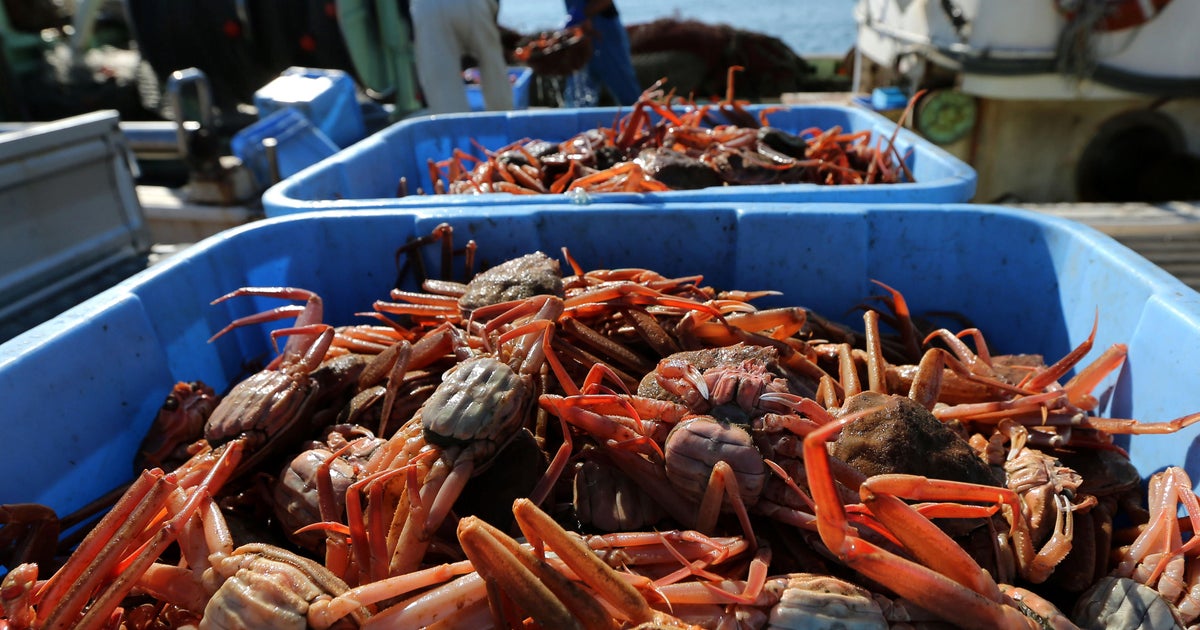
Alaska snow crab season canceled as officials investigate disappearance of an estimated 1 billion crabs
An estimated 1 billion crabs have mysteriously disappeared from Alaskan waters in two years, officials said.
CBS News
542 points · by ijidak · 4y ago · 396 comments
Canada and NAFO continued to overestimate the abundance of cod in the Atlantic Ocean and therefore continued to set dangerously high [Total Allowable Catches]. This was in large part due to the widespread practice of calculating cod populations from catch rates in the commercial fishery – if fishers filled their quotas with ease, then officials believed the stock size was at adequately high levels. However, fishing technology had become so efficient by the 1970s that commercial catch rates remained high even as the cod population dropped to dangerously low levels. Electronic tracking devices could find fish no matter how small their numbers and trawlers could harvest most species with relative ease. ...
Although overfishing in international waters did tremendous damage to northern cod, Canada also failed to maintain a sustainable fishery within its 200-mile limit. The government ignored warnings from inshore fishers and university scientists that cod stocks were in danger and chose to maintain quotas instead of scaling back the fishery, in large part to prevent economic losses and massive unemployment.
By the early 1990s, after decades of sustained intensive fishing from Canadian and international fleets, the northern cod stocks collapsed. The spawning biomass of northern cod had dropped by about 93 per cent in only 30 years – from 1.6 million tonnes in 1962 to between 72,000 and 110,000 tonnes in 1992. In July of that year, Canada imposed a moratorium on the catching of northern cod and ended an international industry that had endured for close to 500 years.
https://www.heritage.nf.ca/articles/economy/moratorium.php
They called off the season in 1992 and it never came back. A pillar of the local economy in the Maritimes was wrecked.
As for climate change and its impact on East Coast fishing, I've read that lobster fishing is no longer a viable industry in Long Island and it's declining in southern New England as waters get warmer and the lobsters permanently migrate north.
Overfishing: It's not this. A billion crabs is north of 5 billion pounds, in other words on the order of 100x the US crabbing fleet's capability. I would hazard to guess there isn't enough crabbing gear on the planet earth to have achieved that catch.
Foreign fleets: If this is the case, the real bad news is that the Rusky's and/or Chinese have developed cloaking device technology.
Trawling: We're talking about the bottom-scrapers. They're new on the scene relative to the crabbers. Alaska allows 4 1/3 million crabs as bycatch (waste), amounting to ~20 million pounds, which would be a decent annual catch. Even though this is thought to interfere specifically with breeding grounds, it isn't enough to have caused this depopulation event. It's more than enough to piss of the crabbers though, since it actually is unfair.
Disease: Is there a precedent in Earth's natural history of a 90% die-off in two years due to disease? We might have to go back to the meteor that killed the dinosaurs. Which brings us to:
Climate change: There was a similar depopulation event in the early 80s. 1980 still holds the annual catch record at 200 million pounds (~40 million animals), a sustained harvest without noticeable impact on the stock. The waters warmed, population (and yield) suddenly tanked on a similar scale, and never recovered to anywhere near those levels. The basic ecological dynamic of a fishery is this: deep, cold, nutrient-rich waters are pushed by a current into a steep continental shelf, forcing them toward the surface where it fertilizes plankton, the foundation of sea life. The volcanic Aleutian archipelago is such a place, another notable one is Peru's fishery. A change in sea temperature can effect this dynamic, in addition to the breeding and general survival of crabs.
However long it takes for the stock to recover (probably a long time, even if the environmental conditions do return to favorable), one outcome is almost a foregone conclusion: independent crabbers will have be forced out, and only the larger companies, with deeper pockets and more diversified across fish species, will survive, leading to another round of conglomeration.
Just want to say that my point about sharing the Canadian cod industry collapse was to illustrate the long-term effects - it still hasn't recovered 30 years later. And maybe that dovetails with what you're saying about indie crabbers being driven out, although from what I understand of the Canadian situation there is basically no industry now, indie or otherwise.
Curious: What is your line of work in Alaska?
I'm in PLC/controls, so no expert on commercial fishing. Just hear/saying from those who are.
Cod reach sexual maturity from 2-7 years, crab in 1 year. But Atlantic cod apparently lay 200k-2m eggs, alaskan crab between 50k-500k. Though I can't quite see if the cod number is lifetime or annual.
I seem to recall a huge drop in the Salmon population on the Fraser river back in the early 2000s. Seems the numbers continue to bounce around. https://www.cbc.ca/news/canada/british-columbia/fraser-socke...
Doesn't mean we don't need to know why. It's good that the crab season is cancelled, but I really feel for the crab fishermen. After the last few years, and with inflation, to lose a whole season must be devistating.
On mobile, so I can't provide a link. Look up sea star wasting disease. It's affected several species of sea star from Alaska to the Gulf of Mexico. One species, the sunflower star went from being everywhere to a red listed endangered species over just a couple of years.
With all due respect, fishing many will take out a huge portion of a potential next generation, so it’s not about affecting the population as is.
https://amp.cnn.com/cnn/2020/10/07/asia/russia-kamchatka-tox...
So sad to see how easily long term catastrophic damage is justified by short term gains.
Either folks aren't RTFA or are being willfully ignorant. Over fishing to the tune 1bn crabs when juvenile populations from 2018 and 2019 looked great? No way.
For example, nobody is predicting a catastrophic decline in the population of pigs, chickens, and cattle.
Fish farming is the future.
Snow crab fishing is relatively strictly regulated since a long time, and while there are always many ways this might be side stepped the amount of missing crabs is way to high in a too short amount of time to just because of over fishing AFIK.
More likely it is a combination of multiple factors putting strain on the population leading to a collapse event. One main driver for many of this factors is probably climate change.
Something similar happened not to far away of where I lived (on a much smaller scale). Tones of fish died. There where many factors which where not grate and in the end too many algae where blamed as main source, but if you look into it it's basically: Low water levels due to multiple years of extremely dry and hot summers strain the ecosystem in various ways and make a explosion algae much more likely. Still that wouldn't have been enough to kill all the fish but throw in the fertilizer from nearby fields even further amplifying the problems and a small contamination with chemicals (which by itself wouldn't have cause it either) and most of the fish died. Or to say it differently with climate change putting strain of water ecosystems we might need much stricter limits about what human causes we allow to put strain on them.
What caused what exactly. Eg, if day warmer waters mean there is less habitat that the crabs can live in, I get that. Or if the deep, cold ocean temperatures have not changed, then that's not it. Or if the crabs have been poisoned by fertiliser, then say that.
I do resent the idea of this catch all term 'climate change' that appears to have answered something while saying nothing. I guess it appeals to us on self masochistic/'original sin' grounds - we want to blame ourselves, and that is a decent, scientific sounding answer that passes muster.
Fwiw, given one of mikedeen's comments, it sounds to me like trawling, and the destruction of habitat, is also a possibility.
“Climate change” is an overly broad term, true, but it’s also very easy to understand what is meant by it in 90% of situations.
If I tell you I got into a car accident “because of bad weather,” you should assume that I don’t mean that it was too hot outside.
If you believe in the rule of law and human rights, then globalism seems like a natural consequence, as does policing the world.
What would happen if you let China have global hegemony and they become the over-fishing police? What type of enforcement do you think they might have (or non enforcement, or selective enforcement).
It seems clear with world scale commons, there must be both a common set of laws (globalization) and an entity capable of enforcing those laws (America is the world police).
Whether anyone is can be debated, but must there be only one sheriff?
We have no right to preach rule of law (which more than anything means consequences for billionaires and politicians), when we don't practice it at home.
I suppose the best the argument can get is that many governments would be much worse police at least for the time being.
I think Europe does have the capacity (but maybe not the will) to check America's power.
You might ask, what problems is globalism going to solve that treaties and national cooperation can't today? More importantly, what will those mechanisms be and will they be just as vulnerable to the problems of corruption and interconnection that plague the meaningful enforcement of treaties and agreements today?
I haven't heard an actual appeal for structural "globalism" that answers these basic challenges.. as such, I mostly see it as a grift designed to remove democratic and republican control from the hands of individuals and cede them entirely to the technocratic machinations of the "new world order."
Recently, we did have a very globally similar response to a world wide event, and I'm not at all surprised that during that time the rich managed to make themselves much richer and the middle class has mostly taken the hit. If that's a hint to what "globalism" has to offer, you can keep it. We'll have to figure out the fishing problem some other way.
You're probably talking about the world wide COVID response, and yes, it was an utter failure. But it was not because of globalism... it was a failure because every country tried to tackle it themselves, incompetently, in their own little vacuum, and the sum total across the world ended up uncoordinated and half-assed. If ever there was an ideal time for "technocracy" and letting the experts take charge worldwide, it was during a global deadly pandemic, but we all blew it.
The difference is, much as the same with a democratic nation.
In a democratic nation, citizens collectively elect representatives, and then laws are passed. Once in place, citizens are bound by those laws, and will be encouraged by various means ; fines, jail, etc, to obey that collective decision.
Now imagine if our democracy was "treaties are made with all citizens of the nation, but you don't have to agree or sign the treaty."
Succinctly put, treaties aren't something you can make another nation sign, and if signed due to force, really force them to comply with in their local area.
A global government however, could punish citizens of any country, should they fail to follow global laws passed.
That said, I am highly uncomfortable with the idea of a global government, because there is such a wide range of belief systems out there, some of them totalitarian, many of them non-democratic, many of them tied deeply to religion, and I don't think the outcome could last, or be pretty.
But there are other systems. E.g. in a council democracy, on every level, every delegate is personally responsible to few enough people from the level below that accountability can be near-instant. You can't add levels indefinitely, either, but I think that the breakdown (of democratic governance) there still happens at scales much larger than with representative democracy.
For one, predatory farmed fish, such as salmon, are often fed from fish meal made from wild fish, which means there's no net benefit.
Fish are farmed intensively, in much denser populations than found in the wild. In this type of environment, water pollution and animal welfare are serious concerns — disease and parasites such as lice are a big problem. It's not hard to find reports of farmed fish in horrifying condition and conditions.
As a side note, intensive farming of pigs, chickens and cattle is a major source of pollution of inland waterways. This is a direct cause of the dramatic decline of freshwater fish populations in many parts of the world.
> For example, nobody is predicting a catastrophic decline in the population of pigs, chickens, and cattle.
That's a great point.
So true...
It's hard to get people to care enough to do anything about it until enough people are affected.
Which is no fun for the sea life and poorer humans waiting for things to get bad enough that sufficient action is taken.
1. Postulate the Commons
2. Also postulate private interests
3. Let private interests have unfettered access to the Commons
4. Problems!
The tragedy is supposedly Commons, but clearly the problem is private interests having unregulated access to the Commons. Tragedy of Private Interests?
In any case this seems like more of a climate change issue (again…)
After all, the tragedy of Romeo and Juliet is what happens to Romeo and Juliet.
From Wikipedia:
> Faced with evidence of historical and existing commons, Hardin later retracted his original thesis, stating that the title should have been "The Tragedy of the Unmanaged Commons".
It is telling that it retains its original name. We teach it speficially as “the problem” with “the commons”.
Why does everyone—including in this thread—think of “the tragedy of the commons” in terms of “the commons” instead of “private property” as we know it? Why is that the knee-jerk response?
Also from Wikipedia:
> Although taken as a hypothetical example by Lloyd, the historical demise of the commons of Britain and Europe resulted not from misuse of long-held rights of usage by the commoners, but from the commons' owners enclosing and appropriating the land, abrogating the commoners' rights.[1]
This theory might be right or wrong. But why is it never even mentioned that enclosure of the Commons happened at some point, and that apparently use of the Commons by commoners might have worked (just might)? Because private property as we know it today is axiomatic. Hence the question is merely about regulating or not regulating the access to the Commons from such private interests; the last part about private interests cannot be questioned.
A third problem/point is that it is just a hypothetical. People just take a thought experiment at face value as something-that-always-happens! But such dynamics do not always come about:
> Elinor Ostrom was awarded the 2009 Nobel Memorial Prize in Economic Sciences for demonstrating this concept in her book Governing the Commons, which included examples of how local communities were able to do this without top-down regulations or privatization.[2]
-
> Romeo and Juliet
Deaths are tragedies in the sense of bad things that happened. How would you prevent a future double-suicide? Not by naming it after some irrelevancy, like the Tragedy of the Efficacy of Oral Poisoning. You learn from the story and don’t poison yourself just because you think someone that you love has died. (I think that’s what it is about?)
The supposed “tragedy” of the Commons is a recurring thing. Not merely a thing that happened but something that can happen again. So how do you prevent that? By focusing on whatever caused the tragedy and fixing that. Not by focusing on the victim.
[1] https://www.newyorker.com/culture/essay/the-theft-of-the-com...
[2] https://www.nobelprize.org/nobel_prizes/economic-sciences/la...
Its particularly tedious as the phrase "tragedy of the commons" has nothing to do with assigning "blame" to the commons (or to the private interests). The phrase itself is not an prescription, merely a diagnosis. Literally no one uses "tragedy of the commons" as capitalism apologia. What an absurd straw man.
No actually, lets not rename all the well established concepts in economics just to give them a certain political lean. That's not actually helpful to understanding anything.
You can go get upset at the more fleshed out comment that I left below. Have fun.
> Literally no one uses "tragedy of the commons" as capitalism apologia. What an absurd straw man.
Go take a look at WalterBright’s (the person who dropped this phrase) comments on economics.
What part of that requires a “commons” to tragically be uncared for? It’s money + markets. We see the same thing in any “natural resource” - wood, mining, oil, wild mushrooms, ivory, you name it.
We have evidence the Hudson Bay was being overfished for oysters in the decades preceding European settlement. Any explanation beginning and ending with capitalism is about as useless as blaming every problem on greed.
https://www.nature.com/articles/s41467-022-29818-z
https://www.pnas.org/doi/10.1073/pnas.1600019113
(Trigger warning for you: the Nature Comms article makes contrasts with "capitalist" fisheries)
Also — I’m saying this as a former vegan — I have developed so many food allergies that I literally cannot be vegan anymore (the vast, vast majority of my food allergies are plants). And yes I carry an epi-pen, they can kill me, etc. If I ate plants only, I would die.
Reality is a whole hell of a lot more complicated than those casually pushing ultimatums on the internet ever seem to realize or acknowledge.
But you know ... plants are already here. We could stop damaging the planet now if we'd manage to switch to plant-based diets.
Define sustainably. If everybody ate like an average american, we would need 4+ earths. Don't forget to count in the wildlife & destruction of oceans. Sustainable economies are mostly plant-based.
https://ourworldindata.org/land-use-diets https://ourworldindata.org/environmental-impacts-of-food
We eat animals because we were taught to and because the system is set up this way. We can change that and lose nothing (not even the pleasure from the food, however alien vegan food seems to you), and gain/solve everything. We just need to open the eyes and learn to cook differently.
Or eat our way to our extinction. What will we say to our children / grandchildren ? That we liked the steak too much?
This is an idiotic comment, but well, here it is.
https://www.seattletimes.com/seattle-news/environment/into-t...
The captain's take on the issue includes climate change, over crabbing areas known to be struggling and trawling. The article also includes an explanation as to how cod could be responsible due to climate change offering less ice protection for the crab.
Heh heh. I imagine fishermen hauling in a net full of potatoes and pasta.
Don't expect your plate of crab or lobster to be cheap these next few years folks.
And if it is cheap somehow, stop eating there. They are probably part of the problem.
But really, is it really the problem? I'm considering the idea from both angles of supply and demand right now. I mean, once upon a time ago, stuff like crab and lobster was considered poor persons food. It was so plentiful that the story goes 'You could just walk down to the local ocean side and scoop some out of the ocean without any trouble'.
The way I see it is this. Pricing is indicative of supply and demand. If demand is high enough, suppliers will attempt to meet that demand. When demand wanes, supply burgeons, thus creating a reason to lower prices so that demand matches supply again. So in a sense, while price would seem to be the culprit, I think it more or less comes down to the fickle nature of the human.
Take red lobster for example. I never eat there, because they always somehow have some 'sale' happening. This means one of two things for me. Either they are selling old product as "fresh" which is not possible in many places they operate, or they are selling under the 'actual' price to increase demand to help meet supply.
Now extend that to the rest of the industry. Where does that land us?
In my mind, it means we are over fishing the species, all because other companies like RL allow for it to happen by continuously artificially spiking demand. Because at the end of the day, even if RL doesn't make profit, the fishermen do. RL and others like them keep buying it. It doesn't matter to the supplier of these restaurants if the food is being eaten or tossed. It's already caught.
Make sense?
There's also water shortages, see the drought that's drying up the Mississippi river. Without water we'll have less and less crop yields.
We slowly had changes happen over 3 decades, then all of a sudden hit a turning point where we're breaking records yearly, maybe even monthly, and starting to get some feedback loops brewing.
The govts of the world though don't seem to think it's a big priority, lucky for them they're all ran by old people who will be dead before it really gets out of hand.
There is another possible outcome... :/
This could be fun ! I mean when it happens it will be awful for those that have homes, good careers, etc. But still will be an interesting part of history to observe.
https://www.montereyherald.com/2020/11/03/the-sardine-war-hi...
Sig and Wild Bill learn how to knit.
[1] https://www.discovery.com/shows/deadliest-catch-the-viking-r...
Source: Family commercial fishes in AK
We don't have supervillains trying to destroy the world, all we need is rational people thinking like this to do it for us.
So are you, and everybody else that has synthetic textiles in their house.
Searching suggests it is done more in SE Asia than in the US (this might be a "what does the cuisine focus on?")
RAS Vertical Farming for Mud Crabs - https://youtu.be/XQJmZz4mdWY (there's a bit of an accent, I'd recommend subtitles)
I'll also suggest a watch of How America's Biggest Indoor Shrimp Farm Sells 2 Million Shrimp Every Year - https://youtu.be/1AK_RQ1uaGs (the American diet tends to have more shrimp than crab). And for crawfish (not indoor) https://youtu.be/_bggaA5AURA
Looked into this more.
"in aquaculture farms, post-nursery crabs reach marketable size and maturity in 6–7 months compared with 18–24 months under natural conditions"
IIRC - Guns, Germs, and Steel had a pretty good point that we didn't so much domesticate animals and plants as there were plants and animals that were pre-disposed to domestication.
If someone can figure out how to keep crabs in large pens without them eating each other, they will make a lot of money. I’m not sure if that’s possible with selective breeding. Maybe we need to wait until crab legs can be “printed” or grown in a lab
If there's a rapid die off of this magnitude there aren't many other problems which would match this level of impact. It could be something else environmental like the water temperature but it doesn't seem like an anthropogenic problem. Similar problems have happened already for other species like oysters.[0]
I was an intern with NOAA in a fisheries lab studying ocean acidification back in college in 2011. There was a large die off in oyster farms the year before which wiped out a good size of their production. The issue then was that the farms were cycling the water in directly from the ocean into the tanks without adjusting the pH. As the pH in the ocean water dropped, it killed off all of the oysters in the farms all at once. They had to do a quick about face to treat the water to regain the catch.
Ocean acidification seemed like a problem that would get worse and worse over time. The estimate back then was that it would take roughly 50 years for the CO2 in the air to equilibrate with the CO2 in the ocean. Since we won't stop emitting any time soon it's going to get a lot more acidic.
I'm a decade behind on the status but back then it seemed like there were a lot of unknowns around the problem too. I'm not sure if more has come to light on the impacts it might have for ecology or the biochemistry of different species. It was a complex problem so predicting the outcome seemed extremely difficult. Hopefully more is known but if not surprises like this would likely crop up. For shellfish, once it goes under a certain pH threshold for a species the young will be unable to form shells which can cause them to die en mass in a short time period.
It doesn't seem like a problem that we can engineer our way out of. The best we can do is probably to monitor and perform science experiments to see some of it coming. Then try to mitigate the damage.
It seems like NOAA would have been able to call out the calcification problem for the snow crab in advance though since there have been issues with other crab species.[1] They probably would have detected the pH change in the waters too so this might not be the cause. Either way it's an interesting subject to learn about.
[0] https://blogs.oregonstate.edu/breakingwaves/2011/06/28/ocean... [1] https://research.noaa.gov/article/ArtMID/587/ArticleID/2581/...
NOAA's ocean acidification program https://oceanacidification.noaa.gov/Home.aspx
This was a good 2011 report from the IPCC if you're interested. https://www.ipcc.ch/publication/ipcc-workshop-on-ocean-acidi...
I'd argue the biggest impact is on... the crab population? Guess nobody really cares for those after all. In which case losing them serves us well.
The biggest impact of a lower crab population is a lower crab population. That's tautological, makes no sense, and why the article doesn't mention it. The decline in population already happened.
We just came along and put some faces on paper so we could stop killing each other over whose fishermen get to catch crab. Then we called it capitalism and pretended that our economic systems transcend natural science.
(Man I was bummed. They had the best hot and sour soup.)
Edite:
Yep, it was Golden Buddha
https://www.sfgate.com/news/article/Smuggler-of-Chinese-arms...
If it was the Big Bad, there would be political uproar. But if it was good ole corruption, it would be business as usual.
That's not just hyperbole, it's flat wrong. Some organizations try to do things about it, even if the methodologies have historically been ineffective. Nobody would be able to completely solve it, while the Oceans are still largely uncontrolled.
https://www.canada.ca/en/fisheries-oceans/news/2022/06/gover...
China’s encroachment on sovereign waters for fishing is one thing when it’s against South American countries with small navies; it’s another thing entirely when it’s the US. I doubt they’re behind this.
1. https://www.washingtonpost.com/business/2022/08/21/alaska-cr...
maybe they considered incorrectly, based on historical data that doesn't reflect recent conditions
also possibly that regulations are being flaunted by bad actors
it could seem improbable that either of those would lead to a sudden catastrophic decline, but many systems do experience a point where what had been a linear decline suddenly craters in a non-linear fashion
Notice that this article is from 2021 for last year's catch.
"The 2021 fall harvest of Bristol Bay red king crab, another important source of revenue for that fleet, was canceled for this year because of too few females."
The collapse has been happening for years. This year it's just another species. Species by species it's going to collapse. Next will be shrimp and krill.
Don't be surprised when the salmon runs collapse too, because for 3 years now every single year has been a 90% decline.
It's still worth investigating, however.
*90% of the are gone - in only 2 years* That's not just overfishing, something much worse has happened.
The cod overfishing was also a very unfortunate tale, but they saw the signs and tracked them catching fire and burning to the ground the entire time, just didn't do anything about it.
Here, AFAIK, they were bewildered at how this occured.
Apparently Cod used to be MUCH larger than it is today. for the same reason, they dont grow very old.
https://www.npr.org/sections/krulwich/2014/02/05/257046530/b...
http://articles.latimes.com/2006/jul/30/local/la-me-ocean30j... (https://web.archive.org/web/20161010003945/http://articles.l...), p3
https://www.fisheries.noaa.gov/feature-story/preliminary-sur...
Also, a lot of people are comparing this to the Canadian DFO's handling of the Cod fishery. Sorry, this is not like that. Both in time line and management style. This fishery was just shut down, it's had its numbers slashed previously as well. In the Cod situation they had their foot in the accelerator until the very end.
Those “alarmist”.
People certainly do blame climate change when they shouldn’t, adding to the denial problem.
But in this case 90% disappearing in 2 years probably isn’t overfishing.
It's shocking, and yet not all that surprising.
Hundreds of Chinese fishing boats set up just outside of international waters in South America and fished everything in the area and brought it back to China. It's like a sick game of Age of Empires but millions of people are affected.
You can blame China for many things but this definitely isn't one of them. Episodic fishery collapses are a thing that occurs naturally aside from fishing activity, and the Alaskan fishery is one of the best managed in the world.
This, in theory, changes every aspect of life by some amount, however minuscule or large it may be. In the case of king crab fishing though we haven't really seen a downward trend. What we've seen is some really good seasons, new techniques, and now very few fish. People like to explain everything away due to climate change but it seems more logical to me this is random deviation or the result of new technology or bad practices by the Alaska Department of Fish and Game. Assuming this follows a normal distribution we would expect a shortage of crab by over 2 standard deviations in 50 year intervals (or after ~25 years of beginning our recording), and below 3 standard deviations if we repeat this 20 times. We could explain this away perfectly fine without invoking climate change