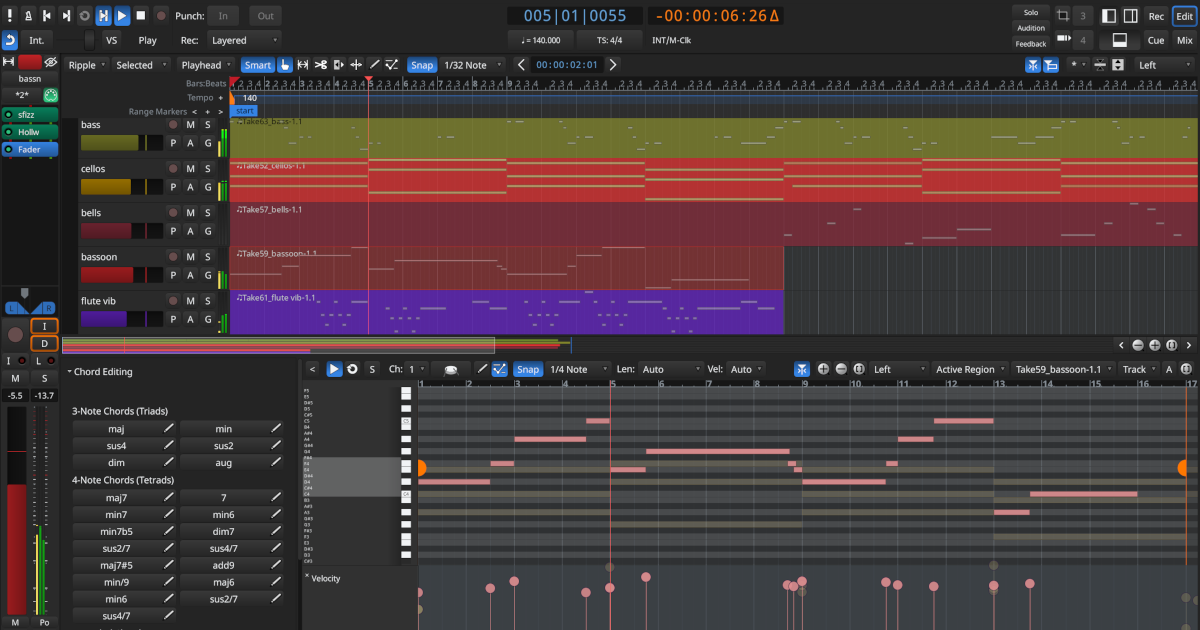
Ardour 9.10 — What
What
Ardour DAW
265 points · by frankzander · 4y ago · 87 comments
You can choose to pay us for the service of building it for you, or if you like, providing a ready-to-run version that we can actually support. That revenue allows myself and other Ardour contributors to work on Ardour as a way of making a living.
There are zero plans to ever move to GTK3 or GTK4 or GTKN.
There are dreams & aspirations to drop our use of GTK and fall back on GDK (just a window & event abstraction), but this is not on any timetable because it means reimplementing text-entry, menus, tree/list views and the file browser.
One major feature that gtk3+ (or SDL2) brings is Wayland compatibility.
CLAP doesn't really much for an Ardour user that isn't already addressed by LV2 or VST3, so although we do want to support it, it's not really on any critical path (other than wanting to support the general move to a not-owned-by-one-company plugin API).
what tips would you give me for making ardour feel a bit more familiar? i understand that’s a very vague question, and a vague response would be justified :)
Running this sort of thing in a browser has become more and more feasible, but I still consider it fundamentally a broken idea. Even if the browser environment started to offer sufficient low level OS interaction (e.g. setting relative real time thread priorities, using SIMD correctly for metering and gain control, and lots more), I can only really see one reason to want to do this: ease of "delivery" of the software to the user.
Porting the 80+ libraries we use to wasm is no laughing matter, and it would be even harder to run plugins, since each of them would have to be ported by their respective developers (in the case of proprietary plugins. A browser based version that could not run Kontakt or Valhalla Shimmer would be a significant step backwards for most serious users.
However, you can already run Cardinal (the FLOSS-ier fork of VCV Rack) in the browser, so at this point it's anyone's guess where this idea might lead us.
[EDIT: if you can work with playback only (e.g. during editing or mixing), we also have a PulseAudio backend on Linux that will (like JACK) also talk to PipeWire. ]
what was your motivation to start this project?
how do you use ardour yourself?
do you have any music to share ?
I don't use Ardour much myself. When I make music, I mostly use the amazing VCV Rack or its slightly-more-FLOSS fork, Cardinal
As for music, not really but last December I did release this: https://pauldavismusic.bandcamp.com/album/suspended-generati...
The other day I bought Bitwig because I was looking for this exact thing on Linux. I don't regret it one bit, but it's amazing to see the beginnings of an open source solution to this! Hats off to the contributors who pulled through and made this happen.
Glad to see they've added a clip based workflow, makes it a lot more useful for the way I do my sequencing and arranging.
Were you caught in the Bitwig drama around the release of their plug-ins last week? ;)
Most recent incident
https://www.reddit.com/r/Bitwig/comments/nvikhf/psa_dont_ope...
https://www.reddit.com/r/Bitwig/comments/nvhy81/bitwig_rever...
The thing with the licensing server has been fixed. I tried that by turning off my router. No session closing and no data loss whatsoever.
What motivated you writing such complicated application?
P.S.: I have the GUI layout and I don't care what people say about GTK!
A longer version is here: https://discourse.ardour.org/t/ardour-20th-birthday/102333
Ardour is awesome and shows that specialized niche software can compete or even out-compete commercial proprietary software (like QGIS in the GIS space).
I hope it will be around for a long time and it's a nice piece of software, thx Paul.
i'd like to hear more about that.
Don't ask me why my fingers typed "have" instead of "love" lol, I have no idea! O.o
Ardour -Audacity Alternative to Record, Edit, and Mix on Linux, OS X and Windows - https://news.ycombinator.com/item?id=27740936 - July 2021 (55 comments)
Paul Davis, lead developer of Ardour on fixing big Linux audio issues - https://news.ycombinator.com/item?id=23739517 - July 2020 (41 comments)
Ardour 5.9 released - https://news.ycombinator.com/item?id=14347758 - May 2017 (46 comments)
Ardour 5 released - https://news.ycombinator.com/item?id=12281137 - Aug 2016 (64 comments)
Ardour 4.0 released - https://news.ycombinator.com/item?id=9403131 - April 2015 (1 comment)
Ardour is a digital audio workstation, which mostly implies that it is a non-destructive, non-linear system. Edits in Ardour do not change any of the media data on disk (everything is done with meta-data). Ardour is designed to handle track counts that Audacity could not dream of (100+), does realtime FX processing (coming to Audacity in the next version) rather than having to process the data and write a new file on disk, and is generally much more capable for handling multi-track audio.
Each one has its place. If you are really just editing an audio file, Audacity is likely to have less of a learning curve. If you involved in music creation or composition or recording, Ardour is much more likely to be the appropriate tool.
I installed Ardour and spent a couple of hours trying to get Jack to work or something like that and gave up.
Not suggesting this is any fault of Ardour's.
But yes, it is true that to some extent, there was a tradition from the late 90s to the 20-teens to create synths as standalone apps for Linux, connected via JACK.
That is really going away now, and you can run U-he synths, Helm, Vitalium, Serge and many others as plugins just like you do on macOS and Windows.
And of course there are bleeding edge lessons learned, applied in things like monome, etc.
Congrats on shipping
I kept my subscription for ardour, though, because I think the project is awesome.
Sadly now I've grown used to another set of quirks (reaper's), so switching back seems quite unlikely. Still gonna keep that subscription running...
sudo dnf install ardour6 lv2-calf-plugins-gui ladspa-autotalent-plugins lsp-plugins-lv2 lv2-zam-plugins lv2-synthv1 lv2-amsynth-plugin
If you'd like, you can listen to myself (lead dev of Ardour) spend 2.5hrs chatting with Justin Frankel (lead dev of Reaper). It won't do much to answer your specific question, but might reveal that the similarities in our development processes and history and goals are much broader than you might expect: http://adc.equalarea.com/2022/02/07/adc1/
If you're a user of Ardour, why would our choice of GUI toolkit have much impact on your use of the program?
Regarding GTK, I could never stomach the specific "feel" that it has, and it's also been incredibly buggy for me on platforms other than Linux, and I use macOS and Windows a lot too. I haven't found a single GTK app that I can tolerate using on Windows or macOS so far. I find QT a lot better in that regard.
I was a heavy user of Inkscape (GTK) back when there were no free alternatives, but when Krita (QT) matured I switched to it and never looked back.
Hard disagree. DAWs like Logic, Ableton, and Bitwig have consistent, straightforward, and (given the amount of data) relatively uncluttered UIs. The open source or cheaper DAWs, like Ardour and Reaper, are a veritable explosion of inconsistent and different sized widgets, fonts, and styles. Reaper also apparently likes massive walls of random text for its menu system too. This is only too typical of open source software: there's no UI designer who can rein in the chaos.
It's fine to say "I don't like (Ardour|Reaper)'s GUI, but I do like Logic, Ableton and Bitwig". There's not much point trying to go beyond that. I get email from about 1 person a week, with about a 50/50 chance of either "I used Logic/other-DAW for years, but Ardour is so much better looking and easier to use" or "Ardour is a piece of shit and ugly as hell, nobody can use this crap". Which is pretty great hint that large swathes of DAW UI/UX design remains extremely subjective and path dependent.